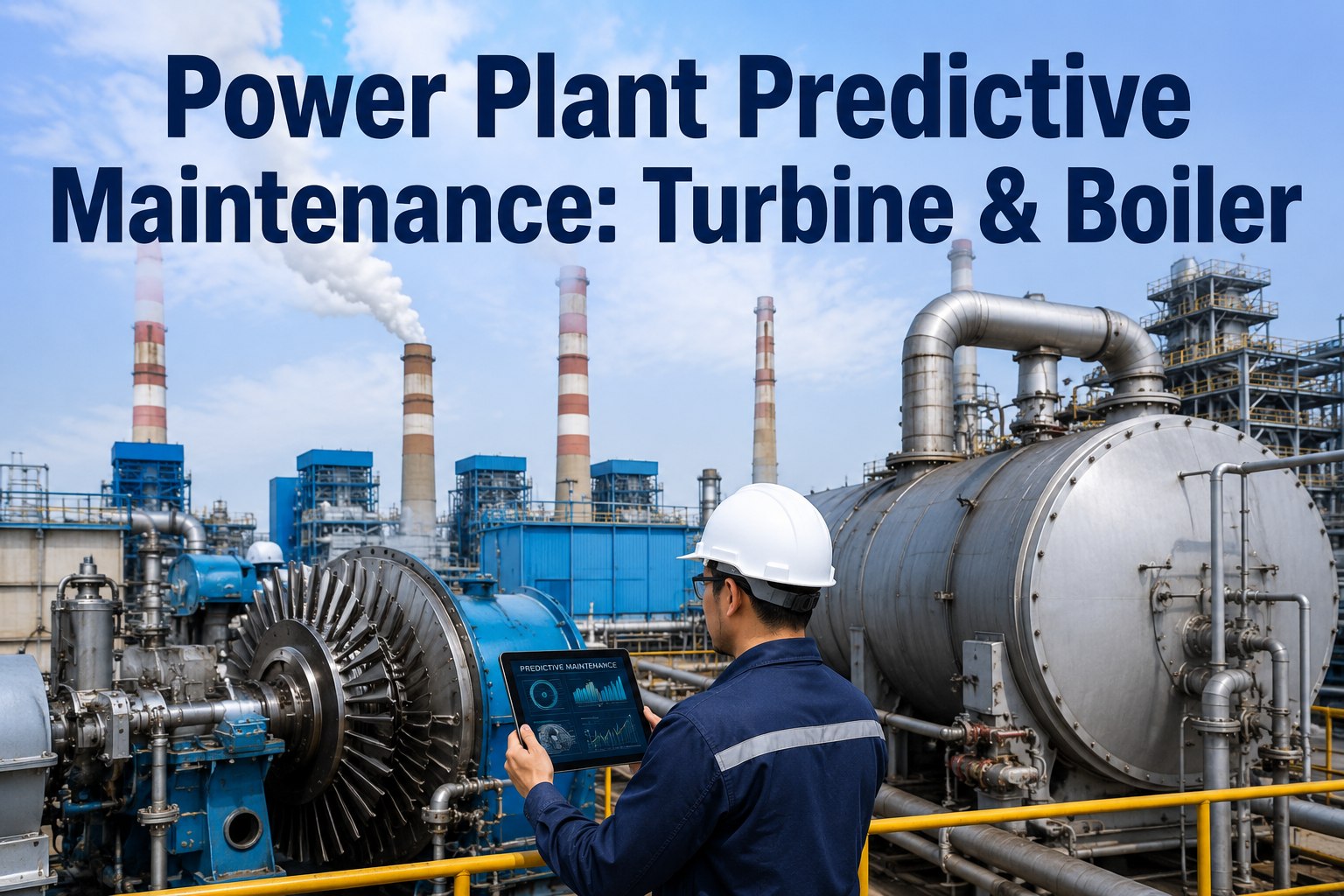
A single forced turbine outage at a 500 MW thermal unit can burn $400K–$1.2M in replacement power and ramp costs per day, yet most of the warning signs — shaft vibration drift, lube-oil degradation, superheat temperature creep — show up in the data 30 to 90 days before failure. Power plant predictive maintenance captures those signals across turbines, boilers, and generators and converts them into condition-based work orders before they cascade. OxMaint pulls vibration, oil, thermal, and process data into one reliability discipline so engineers can trend degradation, auto-trigger work, and stop firefighting. Start Free Trial to deploy PdM at production scale inside your plant.
What if your next turbine overhaul was triggered by data — not by a calendar, and not by a trip?
Vibration, oil chemistry, thermal imaging, and process analytics converge into one reliability discipline. OxMaint turns the signals your instruments already produce into condition-based work orders — before the forced outage decides for you.
Three assets, one reliability discipline
The steam turbine, boiler, and generator account for over 80% of forced-outage MWh lost in a typical thermal plant. Treating them as separate maintenance silos is where most reliability programs bleed money — and where integrated PdM pays back fastest.
Failure-mode-driven PdM for each critical asset
Each asset class has a dominant failure signature. OxMaint maps the right monitoring technique to each mode — then auto-generates a work order when the trend crosses your threshold.
Steam Turbine — vibration & oil monitoring
Shaft orbit analysis, FFT spectra, and journal-bearing wear debris catch imbalance, misalignment, rub, and blade degradation early. ISO 10816 velocity thresholds trigger severity tiers; lube-oil particle counts (ISO 4406) and ferrous density trend bearing wear. A 5% vibration trend shift sustained over 14 days is the classic 30-day pre-failure marker on a 200–600 MW class machine.
Boiler — thermal & process analytics
Tube-wall thermocouples, flue-gas oxygen, feedwater conductivity, and tube-leak acoustic sensors detect fouling, scale buildup, and incipient tube rupture. A 2% drop in heat-rate combined with rising stack temperature signals fouling worth $80K–$250K/yr in lost fuel efficiency on a mid-size unit. OxMaint trends these against load to separate real degradation from normal cycling.
Generator — electrical & insulation diagnostics
Partial discharge (PD), stator winding temperature, hydrogen purity, and excitation current drift flag insulation breakdown, core looseness, and bearing-current erosion. PD trending with a 10 pC sustained increase over 30 days typically precedes a stator ground fault by 60–120 days. Pairing PD with end-winding vibration gives a 90%+ early-warning confidence band on large two-pole machines.
Predictive economics for a mid-size thermal plant
The payback math is blunt. Below is a worked model for a 500 MW two-unit plant running 180 critical assets on OxMaint — representative of a mid-size coal or gas-fired station evaluating PdM against a reactive/calendar baseline.
Outages avoided come from early-warning work orders; efficiency recovered comes from fouling and alignment corrections caught by trend analytics.
| Metric | Reactive baseline | OxMaint PdM | Delta |
|---|---|---|---|
| Forced outage factor | 4.8% | 1.9% | −2.9 pts |
| Mean time between failures (MTBF) | 1,950 hrs | 6,400 hrs | +228% |
| Planned : unplanned work ratio | 55 : 45 | 88 : 12 | +33 pts planned |
| OEE (availability × rate × quality) | 81.2% | 89.6% | +8.4 pts |
| Annual maintenance spend / MW | $31,200 | $19,800 | −36% |
| Payback period | — | 5.8 months | — |
From data silos to condition-based work in four phases
A realistic rollout moves from instrumentation to autonomous work-order triggering in roughly one outage cycle. Each phase has a concrete exit criterion — no "phase two forever."
Instrument & integrate
Connect existing vibration transmitters, DCS tags, oil lab LIMS, and thermal-image stores to OxMaint via OPC UA / MQTT. Exit: all 180 critical assets streaming at least one PdM signal.
Baseline & threshold
Run 60-day baselines per asset; set ISO 10816 / vendor-specific alert and alarm bands. Exit: every asset has a green-amber-red rule with a named owner.
Trigger condition-based work
Auto-generate work orders on amber alarms with pre-built job plans; route to planners. Exit: ≥70% of PdM-triggered jobs completed before red-alarm.
Optimize & scale
Tune thresholds against actual vs. predicted failure modes; expand to BOP assets. Exit: documented availability uplift and an ROI review with the GM.
What changes when PdM actually fires
"OxMaint flagged a 1X vibration harmonic on our HP turbine 23 days before our scheduled 72-hour run. We rebalanced during a planned low-load window instead of tripping at peak demand. One avoided outage paid for three years of the platform."
"We caught a boiler tube-leak acoustic signature at 4 AM, scheduled a controlled shutdown by 9 AM, and patched one panel instead of dealing with a catastrophic rupture. The work order auto-triggered from the alarm — no dispatcher needed."
Stop scheduling failures. Start preventing them.
Deploy OxMaint across your turbine, boiler, and generator fleets and watch forced outages drop inside one operating cycle.
Power plant PdM, answered
Which assets should we prioritize first for predictive maintenance?
Start with the steam turbine, boiler, and main generator — together they drive over 80% of forced-outage MWh losses in a thermal plant. Within those, prioritize by criticality rank and existing instrumentation: assets already wired to a DCS or vibration monitor deliver ROI fastest because there is no sensor capex to justify.
Do we need to buy new sensors to use OxMaint?
Usually not for phase one. OxMaint ingests data from existing vibration transmitters, DCS/SCADA tags, oil-lab LIMS exports, and handheld thermal cameras via OPC UA, MQTT, or CSV. If gaps exist on a high-criticality asset, we recommend a targeted sensor add — typically a $3K–$12K wireless vibration node — which pays back in a single avoided outage.
How does OxMaint generate work orders from condition data?
Each asset has configurable alert and alarm thresholds mapped to failure modes (ISO 10816 velocity bands, particle-count trends, PD magnitude, etc.). When a trend sustains beyond its threshold for the defined dwell time, OxMaint auto-creates a work order with a pre-built job plan and routes it to the assigned planner. You can Book a Demo to see the trigger-to-work-order flow live.
What does a realistic payback period look like?
Most mid-size thermal plants (300–800 MW) see a 5–8 month payback. The savings come from three buckets: avoided forced outages (the largest), heat-rate recovery from early fouling and alignment correction, and reduced reactive labor. The worked model on this page shows a $2.13M net annual saving on a 500 MW, 180-asset plant.
Can OxMaint align with ISO 55000 and our existing CMMS?
Yes. OxMaint functions as the PdM and condition-monitoring layer that can either stand alone or push work orders into an existing CMMS via REST API. Asset hierarchy, criticality, and failure-mode coding follow ISO 14224, supporting your ISO 55000 asset-management objectives and audit trail requirements. Start Free Trial to map your hierarchy in under a day.
Your next outage shouldn't be a surprise.
Join the reliability engineers using OxMaint to predict turbine, boiler, and generator failures weeks before they trip — and prove the savings to their boards.
Free 14-day trial · No credit card