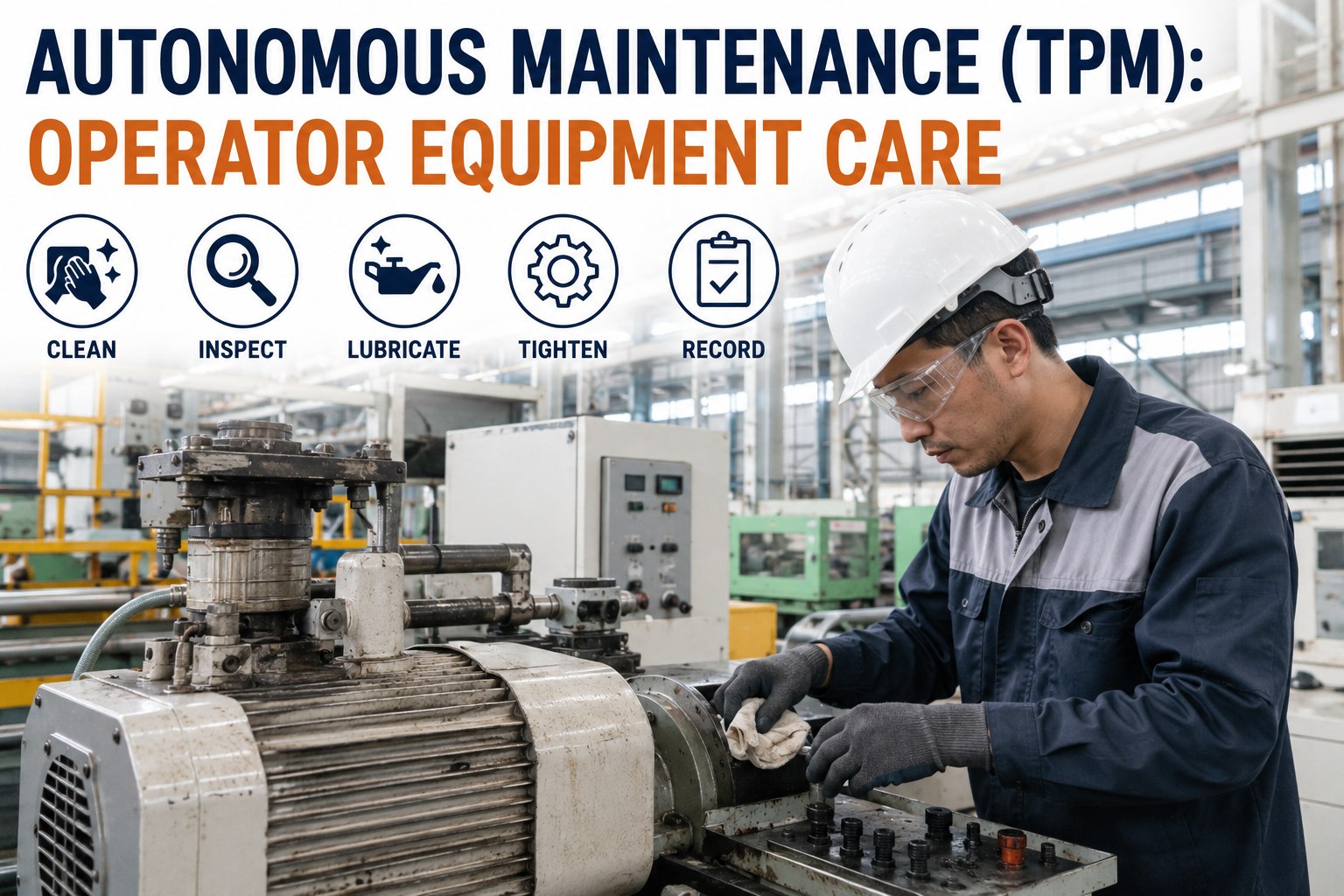
The most powerful idea in autonomous maintenance is also the simplest: cleaning is inspection. When an operator wipes down a machine, they touch every surface — and in doing so they find the oil leak, the hairline crack, the loose fastener, and the belt starting to fray that a maintenance technician visiting once a month would never see. That is the whole premise of Jishu Hozen, the first and foundational pillar of Total Productive Maintenance: the person who runs a machine eight hours a day knows its sounds, vibrations, and quirks better than anyone, so basic care belongs with them. Autonomous maintenance transfers ownership of routine cleaning, inspection, lubrication, and minor adjustment from the maintenance department to operators — and done properly it catches 40 to 60% of equipment breakdowns before they start. The point is not tidiness. It is early detection of deterioration, and the strategic payoff is that skilled technicians stop being consumed by cleaning and small fixes and are freed for the complex, higher-value work only they can do. This guide is a playbook for making that shift: the CIL routine, the seven-step framework, and the division of labor that makes it stick. Start a free Oxmaint trial and give operators mobile CIL checklists with defect tagging, or book a demo to see operator findings flow straight into work orders.
Manufacturing · TPM · Operator-Led Reliability
Autonomous Maintenance (TPM): Operator Equipment Care
A TPM-based playbook for shifting basic cleaning, inspection, and lubrication to operators — catching deterioration early and freeing skilled technicians for the higher-value maintenance work only they can do.
-
40–60%
of breakdowns preventable by operator care
-
7 steps
the JIPM framework for Jishu Hozen
-
10–15 min
daily CIL routine an operator will sustain
-
85%+
world-class OEE that mature TPM targets
The Daily Heartbeat
CIL: Why Cleaning Is Really Inspection
The engine of autonomous maintenance is a short daily routine called CIL — Cleaning, Inspection, Lubrication. It looks like housekeeping and functions like condition monitoring, because each move surfaces a different class of early fault.
- Cleaning is inspection Wiping every surface puts hands and eyes on leaks, cracks, loose fasteners, and abnormal wear. This is the step that converts an operator from a machine user into the equipment's first line of defense — the point is detection, not shine.
- Inspection against a known normal Checking gauges, temperatures, vibration, and noise against what "normal" looks like — bolts, belts, bearings, fluid levels, guards, and safety interlocks. An operator can only inspect what they were trained to recognize as abnormal.
- Lubrication at the right points The right lubricant, in the right amount, at the right points, on the right schedule prevents a large share of mechanical failures — and tightening loose bolts stops vibration-driven damage before it spreads.
Keep the daily routine under 10–15 minutes — an operator asked to spend 45 minutes on CIL every day will not sustain it, and an unsustained routine detects nothing. Book a demo to see CIL as a mobile checklist with photo standards.
The Seven-Step Framework
The JIPM Progression, Step by Step
Autonomous maintenance is deployed through a structured seven-step progression codified by the JIPM. The order matters — plants that skip ahead fail, because operators lack the equipment knowledge to act effectively without building it in sequence.
-
1
Initial cleaning & inspection
Deep-clean the machine to baseline condition. This is not cosmetic — as you clean you find cracked hoses, loose wiring, corroded connectors, and missing bolts. Tag every defect found. -
2
Eliminate contamination sources
Address the root causes of dirt, dust, and leaks, and improve access to hard-to-reach areas. If a machine gets dirty again within hours, the source must be eliminated — not cleaned repeatedly. -
3
Establish CIL standards
Write simple, visual cleaning and lubrication standards with photos of what "good" looks like, frequencies, and acceptance criteria — the daily and weekly tasks an operator can follow consistently. -
4
General inspection training
Train operators to inspect bolts, belts, bearings, fluid levels, gauges, guards, and interlocks — the step that transforms them from cleaners into inspectors who understand what normal looks like. -
5
Autonomous inspection standards
Operators create comprehensive inspection procedures they can execute independently, with measurement criteria and clear decision guidelines for addressing the issues they find. -
6
Workplace organization (5S)
Apply 5S so tools and supplies are organized and ready, reducing time spent searching and standardizing the work area around the autonomous routine. -
7
Full autonomous maintenance
Continuous improvement of the routine and expansion to more equipment — the self-sustaining "we maintain" culture, typically reached 18–36 months after step one.
Autonomous maintenance alone takes 18–36 months, and full TPM three to five years — it is an equipment-ownership transformation, not a quarter-long project. Sign up for Oxmaint to run the seven steps with digital standards and tagging.
Who Does What
The Division of Labor That Frees Technicians
Autonomous maintenance does not replace the maintenance department — it redraws the line between the two roles so each does what it is best placed to do. That redrawing is where the value is released.
-
Operators Take
The Daily Basics
Cleaning, inspection, lubrication, tightening, and abnormality detection on the equipment they run every shift — catching the small faults early and tagging them. Every fault an operator prevents is a work order a technician never has to open.
-
Technicians Get
The Higher-Value Work
Freed from routine cleaning and small fixes, specialists focus their skills on complex repairs, planned maintenance, and reliability improvement — planning and prioritizing rather than reacting to what basic care would have caught.
This is the shift from an "I use, they fix" mindset to a shared "we maintain" one — the cultural change that separates a lasting programme from a cleaning campaign. Book a demo to see operator and technician work in one system.
Why It Fails, and How Not To
Autonomous Maintenance Fails More Often Than It Succeeds
The methodology rewards organizations that commit to the full framework and punishes those that try to extract benefits without the investment. These are the failure modes — each with a direct countermeasure.
| Failure Mode | What Goes Wrong | Countermeasure |
|---|---|---|
| Cleaning campaign | Treated as tidiness, not detection | Measure early-fault finds, not shine |
| Skipping training | Operators can't inspect what they can't recognize | Invest in step-4 inspection training |
| No feedback loop | Findings never become work orders | Route every tag into the CMMS |
| Isolating the pillar | AM runs disconnected from planned PM | Link operator finds to technician PM |
| No OEE measurement | Implementing blind, no proof of gain | Track OEE, MTBF, and defect rates |
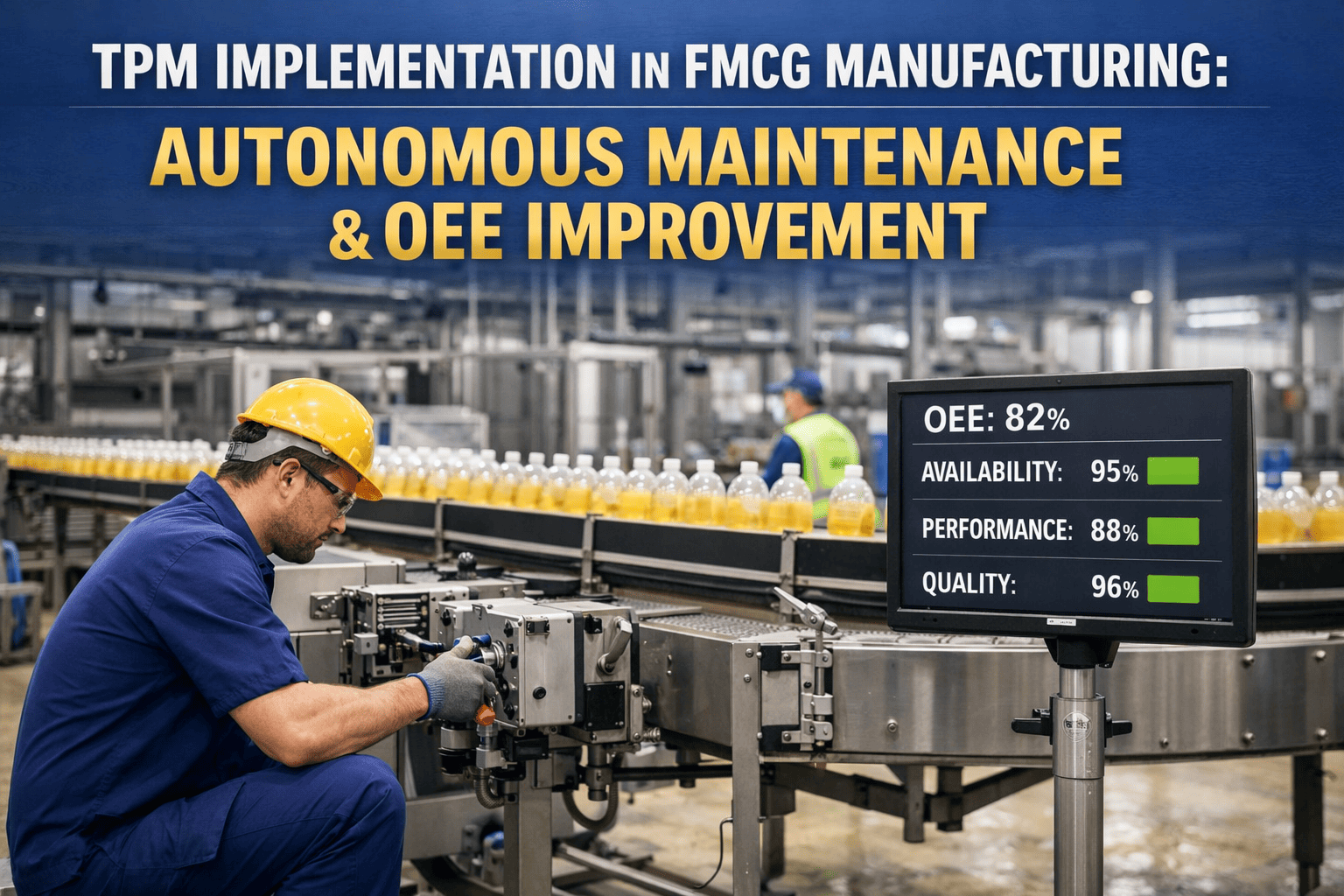
Progress is measured through OEE, MTBF, quality defect rates, maintenance cost, safety incidents, and engagement — implementing TPM without OEE measurement is operating blind. Sign up for Oxmaint to close the loop from operator tag to work order.
Oxmaint for Autonomous Maintenance
How Oxmaint Runs Operator Care
-
Mobile CIL
Checklists With Photo Standards
Give operators mobile-first cleaning, inspection, and lubrication checklists with guided instructions and photos of what "good" looks like — so basic care happens every shift in a sustainable 10–15 minutes.
-
Defect Tagging
Tag It the Moment It's Found
Instant defect tagging during CIL, so a cracked hose or loose bolt an operator spots is captured on the spot with a photo — not remembered, or lost, until the next breakdown.
-
Feedback Loop
Tag Becomes Work Order
Every operator finding flows straight into a work order and back into the standards — closing the loop that keeps momentum alive, the single most common point where autonomous maintenance dies.
-
Standards Library
Visual, Point-Specific
Build and version point-specific CIL standards with frequencies and acceptance criteria, so the routine any operator follows is consistent across shifts and lines as the programme expands.
-
Technician PM
Planned Work, Informed by Finds
Use operator-surfaced breakdown history to build and refine PM schedules for the components that fail most and cost the most — connecting the pillar to planned maintenance instead of isolating it.
-
OEE Visibility
Prove the Gain
Track OEE, MTBF, and defect rates so the availability gains from fewer minor stops and early-caught breakdowns are visible — the evidence that turns a pilot line into a plant-wide rollout.
Frequently Asked
Autonomous Maintenance Questions
What is autonomous maintenance and how is it different from PM?
Autonomous maintenance — Jishu Hozen — is the first pillar of TPM, transferring ownership of basic equipment care (cleaning, inspection, lubrication, tightening, and abnormality detection) from the maintenance department to the operators who run the machines every day. Preventive maintenance is a scheduled tactic performed by technicians; autonomous maintenance is an operator-led strategy that complements it by making operators the first line of defense against the small abnormalities that erode OEE. The two work together — operator finds feed the technician PM programme. Book a demo to see both run together.
What are the seven steps of autonomous maintenance?
The JIPM framework runs: initial cleaning and inspection; eliminate contamination sources and improve access; establish cleaning and lubrication standards; general inspection training; develop autonomous inspection standards; workplace organization with 5S; and full autonomous maintenance with continuous improvement. The order is deliberate — plants that skip ahead fail because operators lack the equipment knowledge to act effectively before they have built it. The full progression typically takes 18 to 36 months.
Why is "cleaning is inspection" the core idea?
Because the act of thoroughly cleaning a machine forces the operator to put hands and eyes on every surface, which is exactly how leaks, cracks, loose fasteners, and abnormal wear get found early. An operator who runs a machine eight hours a day already knows its normal sounds and vibrations; deep cleaning turns that familiarity into systematic detection. The goal is never tidiness for its own sake — it is early detection of deterioration, catching 40–60% of breakdowns before they happen. Sign up for Oxmaint to capture cleaning findings as data.
Why do autonomous maintenance programmes fail?
The most common causes are treating it as a cleaning campaign rather than early detection, skipping the training operators need to recognize abnormalities, having no feedback loop so findings never become work orders, isolating the pillar from planned maintenance, and implementing without OEE measurement so gains can't be proven. It fails more often than it succeeds, and the difference is commitment: organizations that work the full seven-step framework and treat it as a multi-year ownership transformation succeed, while those chasing quick wins get short-term cleaning without lasting change. Book a demo to see the feedback loop built in.
Clean · Inspect · Lubricate · Improve
Put Equipment Care Where the Eyes Already Are
Every leak found at the next breakdown instead of the next shift, every operator who was never taught to inspect, and every defect tag that never became a work order is deterioration going undetected on a machine someone stands beside all day. Oxmaint gives manufacturing teams one platform to run CIL as mobile checklists with photo standards, tag defects on the spot, route every finding into a work order, connect operator finds to technician PM, and prove the gain in OEE — so autonomous maintenance becomes the equipment-ownership transformation it is meant to be, not a cleaning campaign that fades.