Total Productive Maintenance (TPM) represents a revolutionary approach to manufacturing excellence that transforms traditional maintenance practices into strategic operational advantages. Modern manufacturing facilities implementing comprehensive TPM strategies achieve an average of 85% reduction in unplanned downtime, 40% improvement in Overall Equipment Effectiveness (OEE), and $9,000+ annual cost savings per production line. Industry leaders recognize that TPM implementation drives sustainable competitive advantages through equipment reliability, operational efficiency and workforce empowerment while establishing foundations for continuous improvement and manufacturing excellence.
The modern manufacturing landscape demands operational excellence that extends beyond traditional maintenance approaches to encompass holistic equipment management, employee engagement, and continuous improvement methodologies. TPM provides the framework for achieving world-class manufacturing performance through the integration of maintenance, operations and quality management into unified systems that maximize equipment effectiveness and operational profitability.
Manufacturing organizations face increasing pressure to reduce costs, improve quality, and enhance productivity while maintaining stringent safety and environmental standards. Traditional reactive maintenance approaches create operational inefficiencies that compromise competitive positioning and financial performance. Oxmaint recognizes that Total Productive Maintenance addresses these challenges through systematic approaches that transform maintenance from a cost center into a strategic value driver.
Stop losing thousands to equipment breakdowns and inefficient maintenance practices. Join over 500+ manufacturing companies who've already transformed their operations and achieved remarkable cost savings of $50,000+ annually. Don't let your competitors gain the advantage while you struggle with reactive maintenance. The time to act is now.
Start Your TPM Journey Explore TPM SolutionsThe Eight Pillars of Total Productive Maintenance Excellence
Total Productive Maintenance operates through eight fundamental pillars that create comprehensive frameworks for equipment effectiveness, operational efficiency, and organizational excellence. These pillars work synergistically to eliminate losses, improve productivity, and establish sustainable competitive advantages across manufacturing operations.
Autonomous Maintenance (Jishu Hozen)
Empowering operators to perform routine maintenance activities including cleaning, lubrication, and basic inspections that prevent equipment deterioration and enable early problem detection.
Planned Maintenance
Systematic maintenance scheduling based on equipment condition monitoring, failure analysis, and predictive technologies that optimize maintenance timing and resource allocation.
Quality Maintenance
Integration of maintenance activities with quality systems to ensure equipment operates within specifications and produces consistent, high-quality products.
Focused Improvement (Kobetsu Kaizen)
Systematic elimination of equipment losses through focused improvement activities targeting specific performance barriers and operational inefficiencies.
Early Equipment Management
Incorporating maintainability and reliability considerations into equipment design and procurement processes to prevent future maintenance challenges.
Training and Education
Comprehensive skill development programs ensuring all personnel possess necessary competencies for effective TPM implementation and continuous improvement.
Safety, Health, and Environment
Integration of safety management with maintenance activities to create accident-free workplaces and environmental compliance through systematic risk reduction.
Administrative and Office TPM
Extension of TPM principles to administrative and support functions to eliminate waste and improve efficiency across all organizational activities.
The Six Big Losses Framework
TPM implementation focuses on eliminating six major equipment losses that compromise operational effectiveness and financial performance. Understanding and addressing these losses provides the foundation for sustainable improvement and competitive advantage.
Equipment Breakdowns
Unplanned equipment failures that halt production, requiring emergency repairs and causing significant revenue losses averaging $1,800+ per incident in high-volume manufacturing.
Setup and Adjustment Losses
Time losses during equipment changeovers, startup operations, and adjustment periods that reduce available production time and operational efficiency.
Idling and Minor Stoppages
Brief equipment interruptions and micro-stoppages that accumulate significant production losses while often going unnoticed and unaddressed.
Reduced Speed Losses
Equipment operating below designed speeds due to wear, poor maintenance, or operational constraints that reduce throughput and productivity potential.
Startup Rejects
Quality defects produced during equipment startup and stabilization periods that create waste and reduce effective production output.
Production Rejects
Quality defects during normal operation caused by equipment deterioration, improper settings, or maintenance-related issues affecting product quality.
Implementation Methodology and Best Practices
Phased TPM Deployment Strategy
Successful TPM implementation requires systematic deployment approaches that minimize operational disruption while maximizing organizational engagement and sustainable improvement. Oxmaint employs proven methodologies that ensure effective transformation and long-term success across diverse manufacturing environments.
Phase 1: Foundation Building
Organizational readiness assessment, executive commitment establishment, TPM champion identification, and initial training programs that create implementation foundations.
Phase 2: Pilot Implementation
Limited deployment with selected equipment and teams, methodology validation, initial results measurement, and process refinement based on practical experience.
Phase 3: Horizontal Expansion
Systematic rollout across additional production lines, equipment systems, and operational areas using proven methodologies and lessons learned from pilot programs.
Phase 4: Cultural Integration
TPM principle integration into organizational culture, continuous improvement establishment, and performance sustainability through ongoing training and support.
Autonomous Maintenance Development
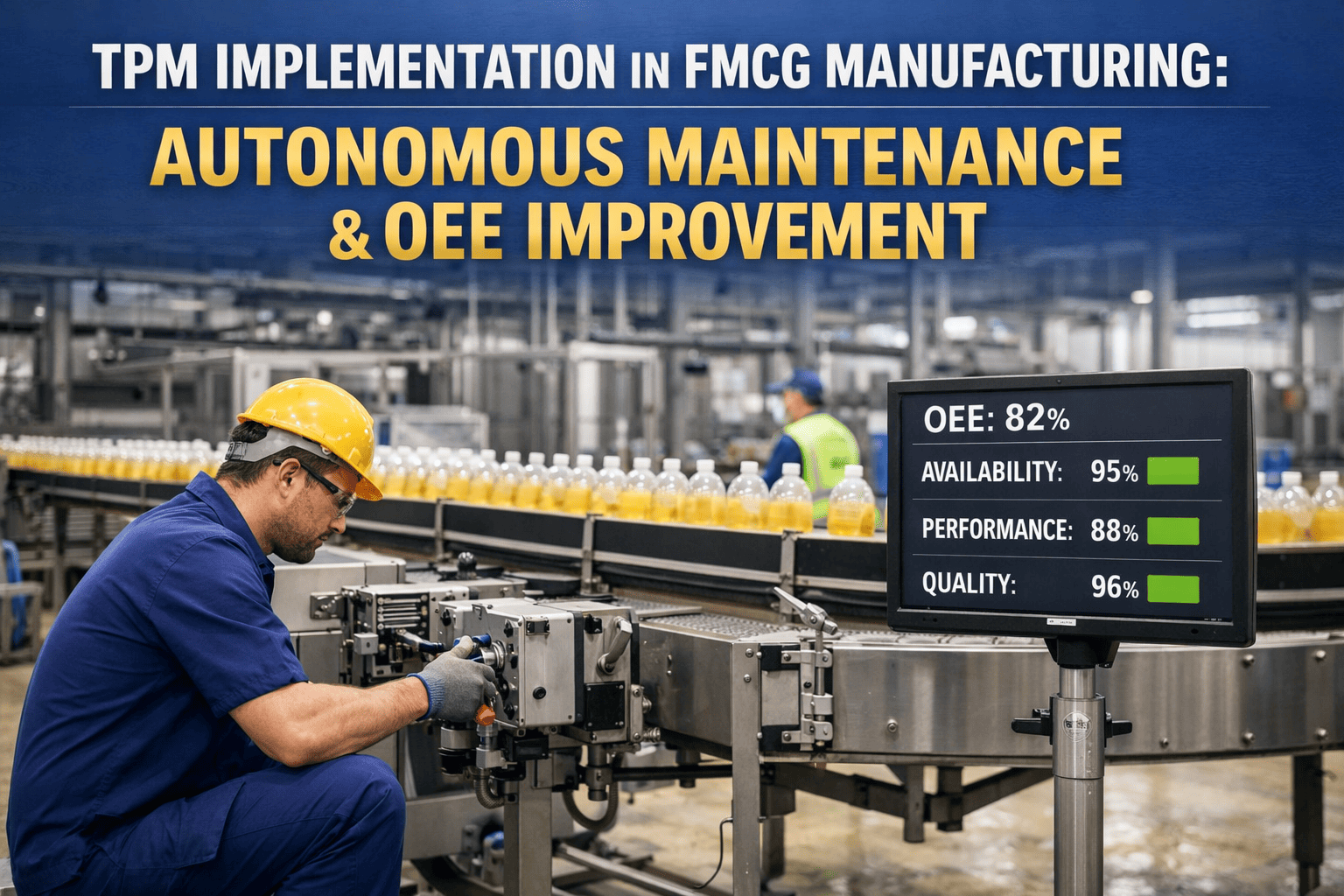
Autonomous maintenance represents the cornerstone of TPM success, empowering production operators to take ownership of basic equipment care while developing deep understanding of equipment behavior and performance characteristics.
Step 1: Initial Cleaning and Inspection
Comprehensive equipment cleaning that reveals hidden defects, wear patterns, and potential failure points while establishing cleanliness standards and inspection procedures.
Step 2: Contamination Source Elimination
Identification and elimination of contamination sources that accelerate equipment wear and deterioration while implementing protective measures and access improvements.
Step 3: Lubrication Standard Development
Creation of detailed lubrication standards, procedures, and schedules that ensure proper equipment lubrication while training operators in lubrication techniques.
Step 4: General Inspection Training
Operator training in inspection techniques, problem identification, and basic troubleshooting that enables early detection of equipment abnormalities and performance degradation.
Step 5: Autonomous Inspection
Implementation of operator-performed inspections using checklists, standards, and procedures that ensure consistent equipment monitoring and problem identification.
Step 6: Workplace Organization
Application of 5S principles to create organized, efficient work environments that support autonomous maintenance activities and continuous improvement.
Step 7: Fully Autonomous Maintenance
Achievement of complete operator ownership for routine maintenance activities with established standards, procedures, and continuous improvement capabilities.
Digital Integration and Industry 4.0 Enhancement
Smart Manufacturing and TPM Integration
Modern TPM implementation leverages digital technologies and Industry 4.0 capabilities to enhance traditional methodologies with real-time monitoring, predictive analytics, and automated decision-making that amplify improvement results and operational effectiveness.
IoT Sensor Integration
Internet of Things technologies providing continuous equipment monitoring, real-time condition assessment, and automated data collection that enhances traditional TPM inspection activities.
Predictive Analytics Platform
Advanced analytics systems that analyze equipment data patterns, predict maintenance needs, and optimize intervention timing for maximum effectiveness and cost efficiency.
Digital Work Instructions
Interactive digital platforms providing step-by-step maintenance procedures, visual guides, and real-time support that enhance operator competency and consistency.
Mobile Maintenance Management
Mobile applications enabling real-time maintenance reporting, work order management, and communication that improve response times and coordination effectiveness.
Performance Analytics and Continuous Improvement
Digital TPM platforms provide comprehensive analytics capabilities that transform maintenance data into actionable insights for continuous improvement, performance optimization, and strategic decision-making across manufacturing operations.
Real-Time OEE Monitoring
Continuous Overall Equipment Effectiveness tracking with automated loss categorization, trend analysis, and improvement opportunity identification for systematic performance enhancement.
Root Cause Analysis Tools
Systematic problem-solving methodologies supported by data analytics, failure pattern recognition, and collaborative investigation tools that address underlying equipment issues.
Benchmark Performance Comparison
Industry benchmarking capabilities that compare equipment performance against best-in-class standards, identifying improvement opportunities and competitive gaps.
Cost-Benefit Analysis
Comprehensive financial analysis tools that quantify improvement investments, track cost savings, and demonstrate TPM value through detailed ROI calculations.
ROI and Financial Impact Assessment
Quantifiable Business Benefits
Total Productive Maintenance implementation delivers measurable financial returns through multiple value streams that extend beyond maintenance cost reduction to encompass productivity improvement, quality enhancement, and competitive advantage creation.
Operational Excellence and Competitive Advantages
Comprehensive TPM implementation creates sustainable competitive advantages through enhanced operational capability, improved product quality, and increased manufacturing flexibility that enable market leadership and profitability growth.
- Enhanced production capacity through improved equipment availability, faster changeovers, and optimized operational efficiency that increases output without capital investment
- Superior product quality through equipment optimization, process stability, and defect prevention that enhances customer satisfaction and market positioning
- Reduced manufacturing costs through lower maintenance expenses, decreased waste, and improved resource utilization that enhance profit margins
- Increased operational flexibility through reliable equipment performance and skilled workforce that enables rapid response to market demands
- Improved safety performance through systematic hazard identification and risk reduction that protects personnel and reduces liability exposure
Industry-Specific Applications and Success Stories
Total Productive Maintenance adapts effectively across diverse manufacturing sectors, with industry-specific applications that address unique operational challenges, regulatory requirements, and competitive dynamics while delivering sector-appropriate benefits and improvements.
Automotive Manufacturing
TPM implementation in automotive plants focusing on just-in-time production support, zero-defect quality achievement, and rapid changeover capability that enables flexible production scheduling.
Pharmaceutical Production
Pharmaceutical TPM emphasizing regulatory compliance, contamination prevention, and validation requirements while maintaining equipment reliability and product quality standards.
Food and Beverage
Food industry TPM addressing sanitation requirements, safety standards, and seasonal production demands while optimizing equipment performance and product consistency.
Chemical Processing
Chemical industry applications focusing on safety-critical equipment, process optimization, and environmental compliance while maximizing production efficiency and reliability.
Change Management and Cultural Transformation
Organizational Development and Employee Engagement
TPM success depends fundamentally on organizational culture transformation that empowers employees, encourages continuous improvement, and creates ownership attitudes toward equipment and operational excellence. Oxmaint specializes in change management strategies that ensure sustainable transformation and long-term success.
Leadership Development
Executive and management training programs that develop TPM leadership competencies, change management skills, and continuous improvement capabilities necessary for successful implementation.
Employee Empowerment
Systematic approaches to employee engagement, skill development, and authority delegation that create ownership attitudes and continuous improvement behaviors.
Communication Systems
Comprehensive communication strategies that ensure TPM awareness, progress visibility, and feedback collection throughout the organization during implementation and operation.
Recognition Programs
Performance recognition systems that acknowledge TPM contributions, celebrate achievements, and reinforce desired behaviors that support continuous improvement culture.
Training and Competency Development
Effective TPM implementation requires comprehensive training programs that develop technical competencies, problem-solving skills, and improvement methodologies across all organizational levels and functional areas.
Operator Skill Development
Hands-on training programs that develop equipment knowledge, maintenance skills, and problem-identification capabilities that enable effective autonomous maintenance implementation.
Maintenance Technician Enhancement
Advanced technical training covering predictive technologies, root cause analysis, and improvement methodologies that enhance maintenance effectiveness and efficiency.
Management Development
Leadership training focused on TPM principles, change management, and continuous improvement leadership that ensures sustained organizational transformation.
Cross-Functional Team Building
Team development programs that enhance collaboration, communication, and problem-solving capabilities across operations, maintenance, and support functions.
Measurement Systems and Performance Tracking
Key Performance Indicators and Metrics
TPM success measurement requires comprehensive KPI systems that track equipment effectiveness, maintenance efficiency, and organizational performance while providing insights for continuous improvement and strategic decision-making.
Equipment Effectiveness Metrics
Comprehensive OEE measurement including availability, performance, and quality components with detailed loss analysis and improvement opportunity identification.
Maintenance Performance Indicators
Maintenance efficiency metrics including planned maintenance percentage, maintenance cost per unit, and maintenance response times that track improvement progress.
Safety and Quality Measurements
Integrated safety and quality metrics that ensure TPM implementation maintains or improves safety performance while enhancing product quality.
Financial Performance Tracking
Economic impact measurement including cost savings, productivity improvements, and ROI calculation that demonstrate TPM business value and investment justification.
Future Trends and Emerging Technologies
Total Productive Maintenance continues evolving with emerging technologies and industry trends that promise enhanced effectiveness, automated capabilities, and intelligent decision-making that will further improve manufacturing performance and competitive advantage.
Artificial Intelligence Integration
AI-powered analytics providing advanced pattern recognition, predictive maintenance optimization, and automated decision-making that enhance TPM effectiveness and efficiency.
Augmented Reality Applications
AR-enabled maintenance procedures, remote expert support, and interactive training systems that improve maintenance quality and reduce skill requirements.
Blockchain Documentation
Immutable maintenance records, compliance documentation, and equipment history tracking that enhance accountability and regulatory compliance capabilities.
Sustainable Manufacturing Integration
Environmental impact optimization, energy efficiency improvement, and waste reduction integration that aligns TPM with sustainability objectives and regulatory requirements.
Don't let equipment failures and inefficient maintenance drain your profits any longer. While you're reading this, your competitors are already implementing TPM strategies and gaining significant advantages. Every day of delay costs you thousands in lost productivity and emergency repairs. Take action now and join the ranks of industry leaders who've transformed their operations. Our proven TPM methodology has helped over 500+ companies achieve breakthrough results within just 6 months.
Begin TPM Transformation Schedule TPM Consultation