bakery-production-equipment-maintenance-checklist

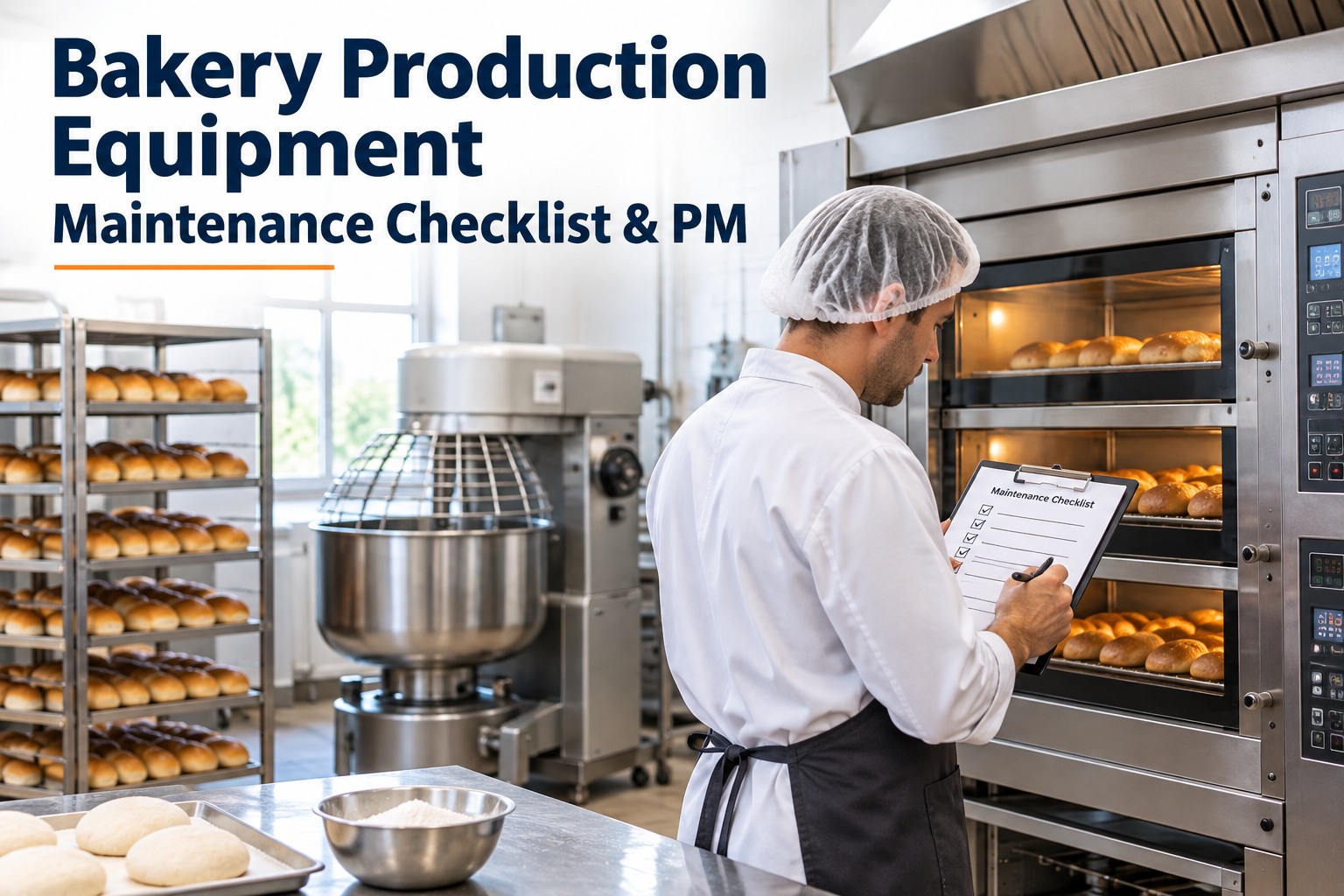
Bakery Production Equipment Maintenance Checklist & PM


A bakery rarely goes down from one big failure. It bleeds out from four small ones in the same week. One real example: a commercial bakery running three 24-hour shifts lost 11 hours of output in a single week — not a catastrophe, but a burner misfire nobody could diagnose without the calibration history, a mixer speed-control fault that waited on a parts run, a proofer humidity sensor that only surfaced when a batch came out flat, and a dough-divider blade misalignment caught by QA on finished product. None were dramatic. All were preventable. Bakery equipment wears faster than almost any food environment — heat cycling degrades oven seals in months, flour and sugar pack motor housings, and fat films harden depositor valves every cycle — so the fix is a per-machine PM checklist run on a schedule, not on a hunch. This guide gives that checklist across every major bakery machine, and how OxMaint's maintenance management software runs it.

Food Manufacturing · Bakery Equipment · PM Checklist · CMMS 2026

Bakery Production Equipment Maintenance Checklist & PM

Deck ovens, proofers, mixers, dividers, depositors, slicers and wrappers — every machine with its own PM tasks at the right frequency, so small failures get caught before they stack into a lost shift.

11 hrs
output lost in one week to four small, preventable failures
40%
fewer unplanned downtime events with a structured PM program
15–25%
energy saved with oven seal, gasket & combustion discipline
3–4%
batch weight recovered by dough-handling & proofer calibration

Every Shift, Before Production: The Non-Negotiables

The cheapest PM in the bakery takes ten minutes at the start of the shift and catches the failures that turn into lost hours. This is the walk that should never be skipped, whatever the order backlog. Sign up free and OxMaint pushes this as a mobile checklist your first-shift operator signs off.

Safety walk
Check every machine for visible damage, loose guards, leaks and unusual odors before power-up.
E-stop test
Verify emergency-stop function on ovens, mixers and all dough-handling systems.
Temp & humidity
Confirm oven bake temp and proofer temp/humidity match setpoint tolerances against a reference probe.
Agitator pin
Inspect mixer attachment pins and bayonet fittings for deformation — a release under load is a safety & contamination event.

The Checklist, Machine by Machine

Each machine fails in its own way and needs its own tasks at its own cadence. Here's the per-equipment PM checklist — the specific items that prevent the specific failures. Book a demo to see these auto-scheduled per asset.

Machine
Watch-For Failure
Key PM Tasks
Cadence
Deck / Tunnel Oven
Burner misfire, steam-tube scaling, seal degradation, hot spots
Burner & flame check, zone-temp calibration vs NIST probe, deck integrity, steam-system descale, door-seal & gasket
Daily→Wk / Annual gas insp.
Proofer
Humidity sensor drift, flat batches, uneven rise
Temp & humidity sensor calibration, spray-nozzle & tray clean, fan & damper check, condensate drain
Daily→Weekly
Spiral / Planetary Mixer
Gearbox wear, bowl-lift failure, attachment release
Gearbox oil sampling (6-mo), bowl-lift chain/screw grease (weekly, food-grade), belt tension, agitator-pin (each shift)
Shift→6-month
Dough Divider
Blade misalignment, weight variance, oil-film buildup
Blade alignment & wear, portion-weight check, knife lubrication, hopper & vane clean-down
Daily→Weekly
Depositor
Valve blockage from hardened fat films, fill-weight drift
Valve & nozzle strip-clean every cycle, seal inspection, fill-weight calibration, piston wear
Every cycle→Weekly
Bread Slicer
Blade dulling, mould-spore transfer, crumb build-up
Blade sharpness & alignment, full sanitation clean-down, guard & guide check, tension
Daily→Weekly
Wrapping Machine
Seal-bar temp drift, film jams, weak seals
Seal-bar temp & pressure, film-path & roller clean, photo-eye alignment, cutter check
Daily→Weekly

In a Bakery, the Maintenance Log Is Also a Food-Safety Record.

Every PM task doubles as a safety and compliance task: a mixer bowl with dried egg residue is an allergen risk for the next egg-free batch, and dough film on a depositor valve is both a blockage and a contamination source. SQF and FSMA audits want an asset register, a documented PM schedule, completed work orders with dates and names, and calibration records. OxMaint produces all four as a by-product of running the checklist.

The Silent One: Steam-Tube Scaling

Some failures announce themselves; this one hides. Progressive scale buildup in deck-oven steam tubes reduces steam output so gradually that crust quality degrades a little each week — and production teams blame the recipe long before anyone suspects the oven. It's the perfect argument for scheduled PM over reaction: nothing breaks, quality just quietly erodes. Sign up free to put steam-system descaling on a fixed cadence.

Weeks 1–4
Scale begins; steam output drops a few percent. Crust barely changes — nobody notices.
Weeks 5–10
Crust color & crispness slip. Team adjusts the recipe, chasing a symptom.
Weeks 11+
Product consistently off-spec; waste climbs. Root cause finally traced to the oven.
Scheduled descale
A calendar PM removes scale before step one ever starts. Quality never drifts.

Parts on the Shelf Turn a 3-Hour Repair Into 30 Minutes

Half of that Texas bakery's lost hours weren't diagnosis — they were waiting for parts. The fastest PM in the world doesn't help if the spare is on a truck. Stock the critical few against the equipment they serve, and a failure becomes a swap, not a shutdown. Book a demo to see auto-reorder tied to each machine.

Oven temp sensors & burner ignition assemblies
Proofer humidity sensors
Mixer mechanical seals & drive belts
Dough divider blades
Conveyor belt sections
Food-grade lubricant stocks

Reactive / Paper Checklist vs. OxMaint Bakery PM

A laminated checklist on the wall is better than nothing — but it doesn't schedule itself, doesn't hold calibration history, and doesn't order the part. Here's what changes when the checklist lives in a CMMS. Start free and put one line on a real PM program this week.

Element
Paper / Reactive
OxMaint Bakery PM
Task scheduling
Wall checklist, skipped when busy
Auto-scheduled per machine & cadence
Calibration history
Nobody can pull it up mid-failure
On the asset record, instantly
Spare parts
Discovered missing during the repair
Min-stock auto-reorder per equipment
Sensor drift
Found when a batch comes out flat
Caught at scheduled calibration
PM completion
Unverifiable — "we usually do it"
Tracked; CMMS programs hit ~94%
Audit records
Assembled in a panic
SQF/FSMA-ready as a by-product

What OxMaint Gives the Bakery Maintenance Team

OxMaint turns the per-machine checklist into a running program — scheduled, documented, parts-backed — so small failures get caught on the walk instead of on the finished product. Here's the concrete mapping. Book a demo to see it on your line.

Per-Machine PM Schedules
Every oven, proofer, mixer, divider, depositor, slicer and wrapper carries its own tasks at shift, daily, weekly, monthly and annual cadence.
Mobile Shift Checklists
The pre-production safety-and-calibration walk pushed to a phone or tablet, signed off by the operator — no skipped steps when it's busy.
Calibration & Sensor Tracking
As-found/as-left readings logged against each oven zone and proofer sensor, so drift is caught on schedule, not in a flat batch.
Spare-Parts Min-Stock
Critical parts linked to the equipment they serve; consumption below minimum auto-generates a reorder before a shortage bites.
Food-Safety Documentation
Asset register, PM schedule, completed work orders and calibration records — the SQF/FSMA evidence set, produced automatically.
Downtime & Waste Reporting
Track the small-failure events, energy trend and batch-weight recovery that prove the program is paying for itself.

Use this checklist plus OxMaint to keep every bakery machine on its own PM rhythm, catch the four-small-failures week before it happens, and turn maintenance records into audit-ready food-safety evidence. Try OxMaint free or book a demo to see it on your bakery.

"

We lost the better part of a week once to four little things — a burner nobody could diagnose without the calibration sheet, a mixer waiting on a belt we didn't stock, a proofer sensor we found only when the bread came out flat, and a divider blade QA caught on finished product. Not one was a real breakdown; together they wrecked our numbers. We built every machine into OxMaint with its own checklist — agitator pins each shift, gearbox oil every six months, steam descale on a calendar, sensor calibration logged against a reference probe — and tied our critical spares to the equipment. The four-small-failures weeks stopped, our SQF audit pulled its own records, and the crust-quality drift we used to blame on flour turned out to be steam scale all along.

Maintenance Manager · Commercial Wholesale Bakery

Frequently Asked Questions

What should a daily bakery equipment PM cover?
A pre-production safety walk for damage, guards, leaks and odors; an emergency-stop test on ovens, mixers and dough handling; oven temp and proofer temp/humidity verified against a reference; and a mixer agitator-pin check. It takes minutes and prevents lost hours.
How often should oven temperature sensors be calibrated?
Oven zone sensors should be calibrated weekly against a NIST-traceable reference thermometer, logging as-found and as-left readings — the record calibration audits and consistent baking both depend on.
Why does crust quality drift even when the recipe hasn't changed?
Often it's steam-tube scaling in the deck oven. Scale reduces steam output so gradually that teams adjust the recipe for weeks before tracing it to the oven — which is exactly why steam-system descaling belongs on a fixed PM schedule.
Which spare parts should a bakery keep on-site?
The critical few: oven temp sensors and burner ignition assemblies, proofer humidity sensors, mixer seals and drive belts, divider blades, conveyor belt sections, and food-grade lubricants — each tied to the equipment it serves so a repair isn't a parts run.
How does the PM checklist help with SQF and FSMA audits?
Audits want an asset register, a documented PM schedule, completed work orders with dates and names, and calibration records. Running the checklist in OxMaint produces all four automatically. Sign up free to start.

Catch the Four Small Failures Before They Cost a Shift.

OxMaint puts every bakery machine on its own PM checklist, logs calibration and sanitation, auto-reorders the critical spares, and produces SQF/FSMA-ready records as a by-product — so downtime, waste and quality drift all move the right way. Start free — no credit card, unlimited users, forever.


Share This Story, Choose Your Platform!