
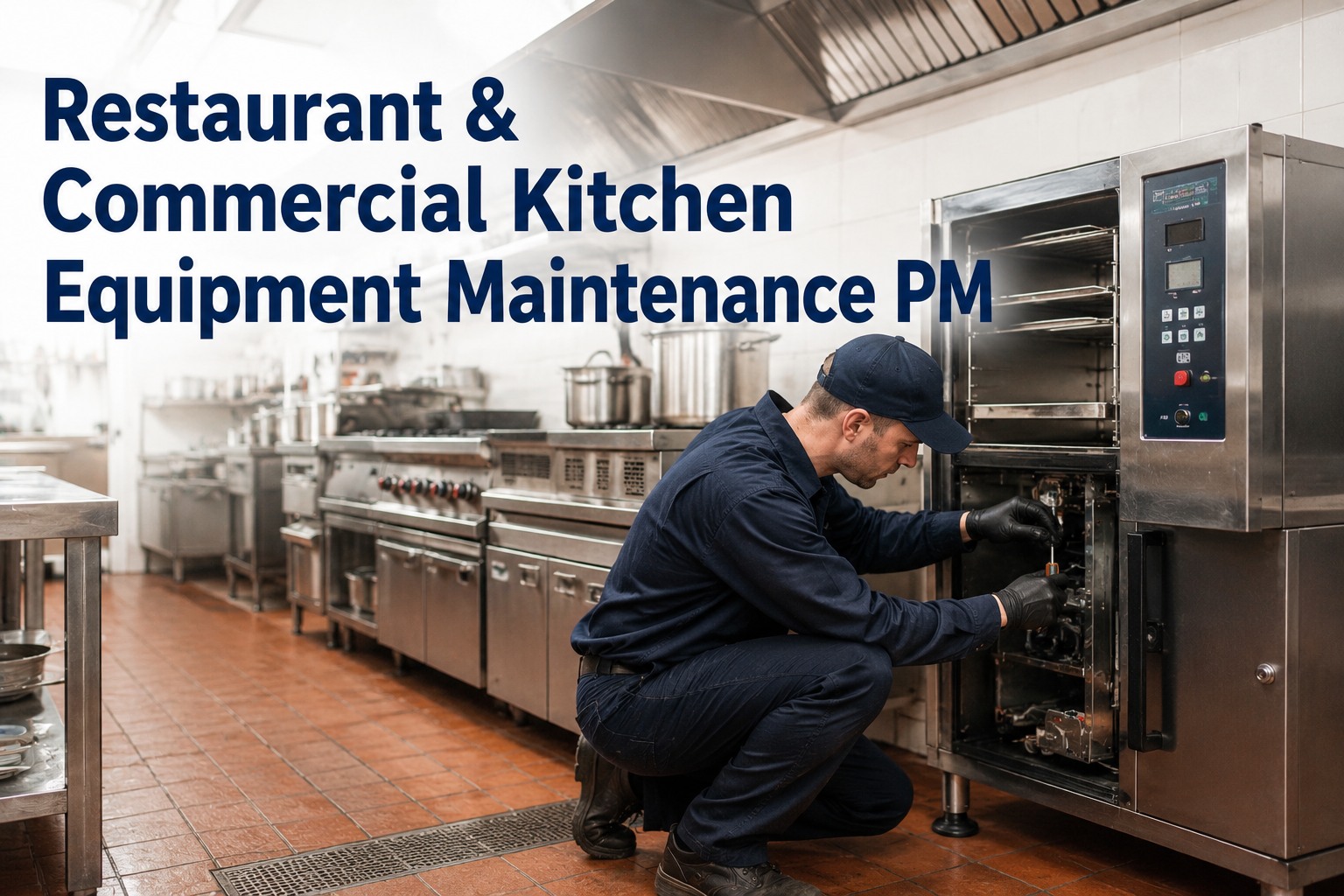
A commercial kitchen is one of the highest-intensity equipment environments in any industry. Fryers, combi ovens, refrigeration units, hood suppression systems, dishwashers, and ice machines operate under continuous production load, in high-temperature and high-humidity conditions, with the additional regulatory pressure of health code compliance that most other industries do not face. When kitchen equipment fails during service, the cost is not just the repair — it is lost covers, emergency contractor call-out rates, and the reputational consequences of a service disruption that customers notice. Structured CMMS for restaurant and food service operations prevents most of these events by ensuring every piece of kitchen equipment receives its required preventive maintenance before performance degradation reaches failure. This guide covers what kitchen equipment CMMS looks like in practice and how Oxmaint.ai manages it across single-site and multi-site food service operations.
Restaurant Equipment Maintenance: Kitchen CMMS & Health Code Compliance Guide
For restaurant operators, facilities managers, and multi-site food service directors — structured equipment maintenance scheduling, health code compliance tracking, and contractor record management for every asset in the commercial kitchen.
Kitchen Equipment Categories & Their Maintenance Requirements
Every equipment category in a commercial kitchen has specific maintenance intervals, cleaning requirements, and compliance obligations. Oxmaint.ai manages all of them from a single platform.
Fryers & Deep Fat Fryers
Commercial fryers require daily oil filtering, regular full oil changes, periodic burner and thermostat calibration, and thorough cleaning of the fry pot, drain valve, and heating elements to prevent carbon build-up that accelerates equipment failure and creates fire risk.
- Daily oil filtering schedule
- Oil change interval tracking by volume and colour
- Burner and thermostat calibration records
- Annual deep clean with engineer sign-off
Refrigeration & Cold Storage
Refrigeration failure is one of the most costly events in a food service operation — both in lost product and in health code implications. Preventive maintenance covering condenser coil cleaning, door gasket inspection, temperature log verification, and refrigerant charge checks protects against failure and demonstrates due diligence under food safety regulations.
- Monthly condenser coil cleaning schedule
- Door gasket and seal condition records
- Temperature log compliance verification
- Refrigerant charge and F-gas certificate tracking
Ovens, Combi-Steamers & Ranges
Combi-ovens and commercial ranges require descaling of steam circuits, burner inspection and calibration, door seal replacement, and regular deliming of water inlets. Missed maintenance on combi-steamer water systems leads to premature heat exchanger failure — a repair that typically costs more than the annual PM programme for the unit.
- Descaling and deliming intervals per water hardness
- Burner calibration and flue gas analysis records
- Door seal and hinge condition inspection
- Annual gas safety check with engineer certificate
Hood & Suppression Systems
Kitchen hood cleaning to NFPA 96 (USA) or TR19 (UK) standards is both a health code requirement and a fire insurance condition. Suppression system inspections must be conducted at six-monthly intervals by a certified engineer. Records of both are mandatory documentation for health inspectors and insurance assessors.
- NFPA 96 / TR19 hood cleaning interval scheduling
- Six-monthly suppression system inspection records
- Grease trap cleaning frequency and contractor records
- Certificate storage and expiry alerts per site
Ice Machines & Dishwashers
Ice machines and commercial dishwashers are the equipment most frequently cited in health code violations — biofilm accumulation, scale build-up, and failed sanitisation cycles are preventable through structured maintenance. Regular descaling, sanitisation records, and water temperature log compliance are the primary inspection points under food safety codes.
- Monthly ice machine cleaning and sanitisation records
- Dishwasher rinse temperature and chemical concentration logs
- Descaling interval based on local water hardness
- Sanitisation cycle compliance records for health inspection
Health Code Compliance: What Inspectors Check & How CMMS Documents It
Health department inspectors in food service operations focus specifically on the maintenance disciplines that prevent contamination, fire, and equipment-related food safety failures. Oxmaint.ai creates the records that demonstrate compliance at each inspection point.
Temperature Logs & Equipment Checks
Refrigeration and cold storage temperature logs are the most commonly requested records during health inspections. Oxmaint.ai structures daily temperature check work orders per unit — with the reading value recorded and flagged if outside the safe range — creating a continuous compliance record without manual log books that can be altered or lost.
Equipment Cleaning Records
Ice machine interiors, dishwasher filters, grease traps, and oven cavities require structured weekly cleaning that is documented rather than assumed. Work orders for each cleaning task capture completion time, the person responsible, and any observations about equipment condition — satisfying the cleaning schedule documentation requirements under most food safety codes. Start a free trial to configure cleaning schedules for your kitchen.
Preventive Maintenance Work Orders
Condenser coil cleaning on refrigeration units, descaling of combi-steamers, and calibration checks on fryer thermostats and range burners all fall into the monthly-to-quarterly PM band. These are the maintenance tasks that prevent equipment failures during service and that demonstrate active equipment management to health and fire inspectors. Oxmaint.ai generates these work orders automatically at the configured interval for every piece of equipment in the kitchen asset register.
Statutory Certificates & Engineer Inspections
Hood cleaning to NFPA 96 / TR19 standards, suppression system inspection by a certified engineer, gas safety checks on all cooking equipment, and refrigeration F-gas certificates all require third-party certification at statutory intervals. These certificates must be current and retrievable for health inspectors, fire marshals, and insurance assessors. Oxmaint.ai stores each certificate per asset with expiry date tracking and pre-renewal alerts. Book a demo to see compliance certificate management for food service.
How Oxmaint.ai Manages Restaurant Equipment Maintenance
Four operational capabilities that define the difference between a structured kitchen maintenance programme and a reactive one.
Automated PM Scheduling Per Equipment
Every piece of kitchen equipment is registered in Oxmaint.ai with its specific maintenance requirements and service intervals. Daily temperature log work orders, weekly cleaning schedules, monthly PM tasks, and annual certification renewals are generated automatically — the kitchen team and maintenance team see their scheduled tasks without any manual work order creation by the manager.
For multi-site food service operations, PM templates configured once are applied across every location — ensuring every site operates to the same maintenance standard regardless of local management attention. Start a free trial to configure kitchen PM templates.
Health Code Compliance Records
Health inspectors require evidence that maintenance schedules were followed — not just that maintenance procedures exist. Every work order completed in Oxmaint.ai creates a timestamped record with the technician or staff member identified, the task description, and any observations recorded. Temperature log readings, cleaning completion confirmations, and calibration results are all captured in a format that is immediately retrievable during an inspection.
Hood cleaning certificates, gas safety records, and suppression system inspection reports are stored per site asset — with pre-expiry alerts ensuring no certificate lapses before renewal. For restaurant groups, the compliance dashboard shows the status of every certificate across every site simultaneously.
Equipment Cost & Lifecycle Tracking
Every work order links its parts and labour cost to the specific piece of equipment. Over time, the per-asset maintenance cost history identifies the equipment that is consuming disproportionate maintenance spend — often older units where the cumulative repair cost exceeds the capital replacement cost. This data is the foundation of evidence-based replacement decisions rather than operating equipment to failure.
For multi-site operators, equipment performance benchmarking across sites identifies whether high maintenance costs on specific equipment types are consistent across locations or concentrated in specific units — a diagnostic insight that drives both purchasing decisions and site-level maintenance standards reviews. Book a demo to see equipment cost analytics.
Stop Managing Kitchen Maintenance From Memory
Oxmaint.ai generates every PM work order, tracks every compliance certificate, and records every equipment service event — across every kitchen in your operation — without manual calendar management or paper log books.
Paper Log Books vs. Oxmaint.ai Kitchen CMMS
The gap between paper-based kitchen maintenance records and a structured CMMS is the gap between hoping compliance is maintained and having evidence that it is.
| Area | Paper / Manual System | Oxmaint.ai |
|---|---|---|
| Temperature Logging | Paper log book — entries missed during busy service, not retrievable in inspection without physical search | Digital daily work orders with recorded values, out-of-range alerts, and instant retrieval by equipment or date |
| Hood Cleaning Certificates | Paper certificate filed — expiry date not tracked, lapse discovered at inspection or incident | Certificate stored per site with pre-expiry alerts and one-click retrieval for inspector |
| Cleaning Schedule Records | Checklist on kitchen wall — completed or not, no timestamped evidence of completion by named person | Work order completion timestamped per task with staff member identification and notes |
| Equipment Repair History | Contractor job sheets filed informally — no searchable history per equipment item | Per-asset service history with contractor records, parts used, and costs linked to each equipment item |
| Multi-Site Compliance View | No cross-site view — compliance status of each site unknown without visiting or calling site managers | Portfolio dashboard showing compliance certificate status and PM completion rate across all sites |
Scroll horizontally on mobile
Our environmental health officer visited three of our sites within six weeks — which was coincidental, not a targeted campaign. At two sites, we passed with zero improvement notices. At the third, which had only been on Oxmaint.ai for two months, we had complete temperature records and hood cleaning certificates immediately available. The officer specifically commented that our record-keeping was unusually thorough. Before the platform, an inspection like that would have required us to pull paper files for 40 minutes while the officer waited. The records were on screen in under two minutes.— Operations Director, Casual Dining Restaurant Group, UK (14 sites)
Frequently Asked Questions
Can Oxmaint.ai manage kitchen maintenance records across multiple restaurant sites from a single account?
Yes. Each restaurant site is configured as a separate location within the same Oxmaint.ai account — with its own equipment register, PM schedule, and compliance certificates. Kitchen staff and site managers only see work orders for their location, while the operations director or group facilities manager sees a dashboard across all sites showing PM compliance rates, open work orders, and certificate status. PM templates configured once at group level can be applied to all sites simultaneously, ensuring consistent maintenance standards regardless of individual site management. Start a free trial to configure your site structure.
How does Oxmaint.ai handle hood cleaning certificate requirements under NFPA 96 and TR19?
Hood cleaning certificates are stored per site as a compliance asset in Oxmaint.ai with the certificate date, the contractor identity, and the next required cleaning due date. The platform calculates the next required cleaning date based on the configured interval for each cooking type — quarterly for solid fuel cooking, semi-annually for high-volume operations, annually for standard use — and generates a pre-due work order to the nominated contractor and the site manager in advance. When the inspection is completed, the new certificate is uploaded against the site record and the next interval begins. The certificate is immediately retrievable during an environmental health inspection without searching filing systems. Book a demo to see the compliance certificate workflow.
Can kitchen staff complete daily temperature log work orders without requiring CMMS training?
Yes. Daily work orders in Oxmaint.ai are designed for completion on mobile in under two minutes. The kitchen team member opens the daily checklist for their area, enters the temperature reading for each refrigeration unit, confirms cleaning tasks as completed, and submits. If any reading is outside the configured safe range, a notification is generated immediately to the site manager. The entire process requires no CMMS training — it is equivalent to filling in a paper log but creates a timestamped, named digital record rather than a paper entry that can be left blank or altered.
How quickly can a restaurant operation get up and running on Oxmaint.ai?
A single-site restaurant can be fully operational on Oxmaint.ai within 2–3 days — equipment registered, PM schedules configured, daily temperature log work orders active, and compliance certificates uploaded. For restaurant groups, site-by-site rollout takes 1–2 weeks depending on the number of sites and the consistency of equipment across locations. The platform's pre-built kitchen equipment maintenance templates (fryers, refrigeration, ovens, dishwashers, hoods) reduce configuration time significantly compared to building schedules from scratch. Start a free trial to begin configuring your kitchen equipment register.
Kitchen Equipment That's Always Ready for Service — Because Maintenance Was Never Missed
Automated PM schedules, health code compliance records, and equipment cost tracking for every asset in your commercial kitchen — accessible by your team on mobile, retrievable in seconds for health inspectors, and scalable across every site in your operation.


.png)
