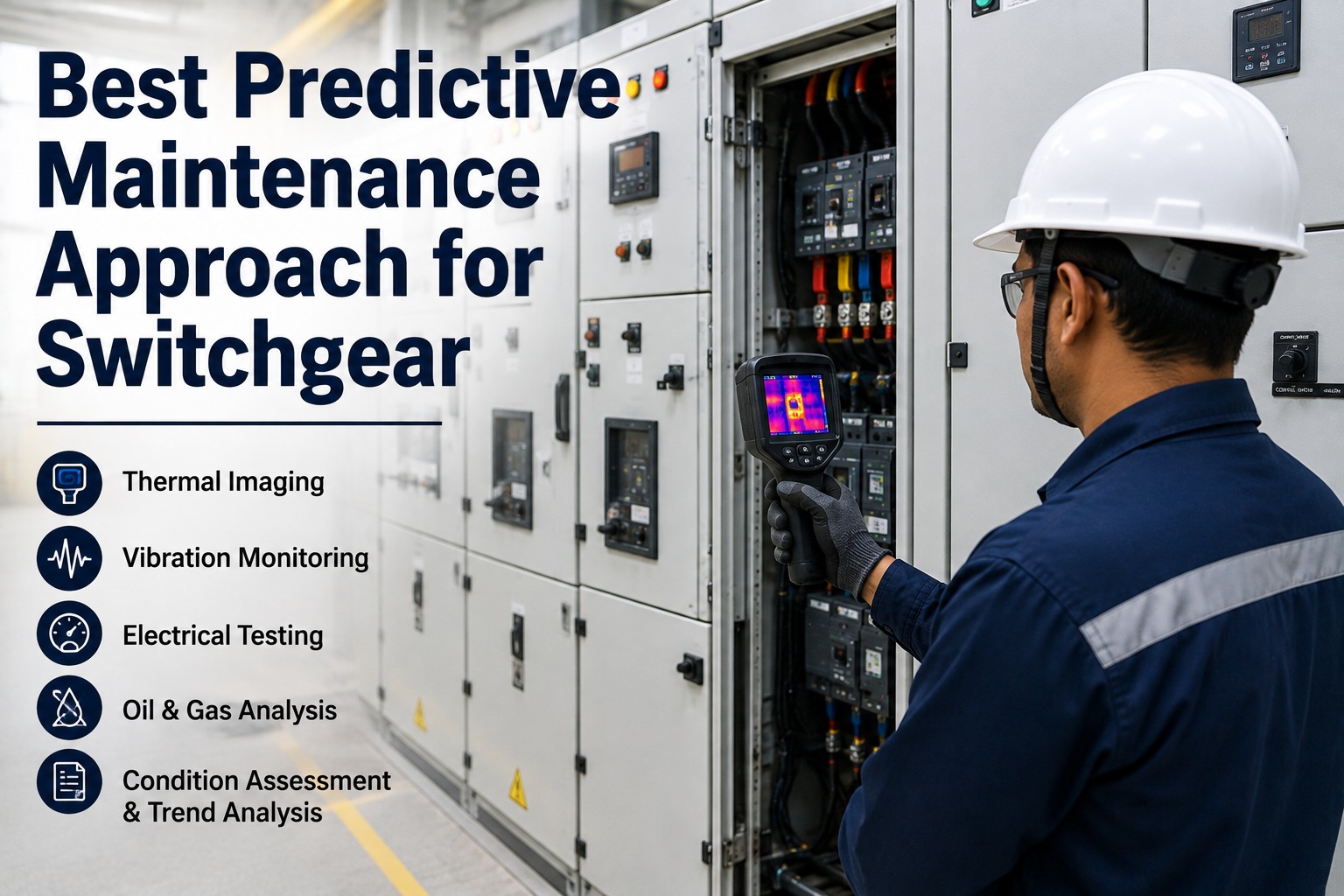
The best predictive maintenance approach for switchgear & breakers is a layered one: combine continuous partial-discharge and temperature monitoring with periodic thermography, contact-resistance and timing tests, then route every anomaly through a CMMS that converts alerts into scheduled work before failure. Most switchgear failures announce themselves weeks or months in advance — through rising contact wear, loosening connections, mechanism degradation and insulation breakdown — yet calendar-based maintenance misses these signals because it inspects on dates, not conditions. This guide walks you through the P-F interval for switchgear, the right sensors for each failure mode, defensible alert thresholds, and how to wire it all into a predictive maintenance program that pays for itself on the first avoided arc-flash incident or unplanned outage. OxMaint's AI-powered CMMS ingests these condition signals, auto-creates work orders when readings cross thresholds, and hands technicians the exact failure mode and repair procedure before they open the cabinet. If you're ready to move from reactive switchgear maintenance to condition-based reliability, Start Free Trial and see how it works on your assets.
What if your switchgear told you it was failing — 6 weeks before it did?
Most breaker and switchgear failures don't happen without warning. Contact wear, mechanism fatigue, partial discharge and thermal hotspots build over weeks or months. The plants that catch them early don't inspect more often — they monitor the right signals and act on them automatically. This guide shows you how.
How far ahead can you detect switchgear & breaker failure?
The P-F interval — the time between when a potential failure becomes detectable and when functional failure occurs — is the foundation of any predictive maintenance strategy. For switchgear & breakers, that window ranges from days to months depending on the failure mode and the monitoring technique you use.
PD activity in medium-voltage switchgear insulation is detectable months before flashover. Continuous online PD monitoring gives the longest lead time of any technique.
Loose or corroded connections heat up gradually. Infrared thermography or continuous temperature sensors catch the rise well before the joint fails or triggers an arc event.
Contact resistance climbs as arcing contacts erode. Trending micro-ohm measurements or monitoring cumulative I²t (current squared × time) reveals wear before the breaker fails to interrupt.
Spring-charge times, coil current signatures and trip/close timing drift as mechanisms wear. Timing tests and motor current analysis catch degradation early.
Which sensors should you install on switchgear & breakers?
Sensor selection isn't about buying the most expensive technology — it's about matching the sensor to the failure mode you're trying to catch. Here's the practical mapping that reliability engineers use for switchgear & breaker predictive maintenance.
| Failure Mode | Primary Sensor / Technique | Monitoring Type | Typical Cost per Asset |
|---|---|---|---|
| Insulation breakdown (PD) | Ultrasonic (airborne), TEV, UHF sensors | Continuous online or periodic | $800–$3,500 |
| Connection hotspots | Infrared thermography, wireless temperature sensors | Continuous (wireless) or quarterly (IR) | $150–$600 |
| Contact wear | Micro-ohm meter, I²t counters, timing analyzer | Periodic (annual or after fault duty) | $200–$800 |
| Mechanism failure | Coil current monitoring, spring-charge motor current, timing tests | Continuous (online) or periodic | $400–$1,200 |
| Environmental stress | Temperature + humidity sensors inside enclosure | Continuous | $50–$200 |
Rule of thumb: start with wireless temperature + humidity on your 10–20 most critical switchgear lineups (fastest ROI), add continuous PD monitoring on medium-voltage gear, and layer in periodic contact-resistance and timing tests on breakers. OxMaint's asset registry lets you tag each switchgear asset with its sensor types, failure modes and test schedules so nothing falls through the cracks.
What alert thresholds should trigger a work order?
Setting thresholds too tight floods your team with false alarms; too loose and you miss the failure window. These are field-tested starting points for switchgear & breaker condition monitoring — adjust based on your equipment class, load profile and operating environment.
A connection running 10°C+ above similar phases under similar load warrants investigation. Above 20°C rise = priority work order. Above 40°C = immediate action.
TEV readings above 20 dB indicate significant PD activity. Trend the rate of increase — a jump of 6 dB in 30 days is more alarming than a steady 22 dB baseline.
When micro-ohm readings climb 50% above commissioning baseline, schedule contact inspection or replacement. A 100% increase = do not reclose without repair.
If trip or close time drifts more than 10% from manufacturer spec or commissioning baseline, the mechanism needs attention. Slow trip = failed clearing = arc-flash risk.
How OxMaint turns switchgear sensor data into scheduled repairs
Predictive maintenance fails when alerts sit in a dashboard nobody checks. OxMaint closes the loop: every anomaly becomes a tracked, assigned, completed work order — and every repair feeds back into the asset's condition history.
Condition-Based Work Order Triggers
Set temperature, PD, contact-resistance or timing thresholds per asset. When a reading crosses the line, OxMaint auto-creates a work order with the failure mode, asset history and priority — cutting response time from days to minutes.
Asset Registry with Failure-Mode Tagging
Tag every switchgear lineup and breaker with its criticality, sensor types, failure modes and test schedules. OxMaint tracks condition trends per asset so you see degradation before it becomes downtime.
Mobile Work Orders with Procedures
Technicians get the work order on their phone with the exact failure mode, test procedure, torque specs and safety checklist — no walking back to the office for paperwork. Close-out captures as-found/as-left readings automatically.
Predictive Analytics & ROI Dashboard
See which assets are trending toward failure, which alerts converted to real repairs, and how much downtime and cost your PdM program avoided. Prove ROI to leadership with hard numbers, not anecdotes.
What does a switchgear predictive maintenance program actually save?
A mid-size manufacturing plant with 24 switchgear lineups and 60 breakers was spending $180K/year on reactive maintenance, emergency callouts and unplanned downtime. Here's what changed when they moved to condition-based maintenance with OxMaint.
Why it worked: they didn't just buy sensors — they wired every alert into OxMaint so anomalies became scheduled work orders within hours, not weeks. The program caught a failing breaker mechanism 5 weeks before it would have faulted, a loose bus connection 3 weeks before thermal runaway, and rising PD activity in one MV lineup 4 months before insulation failure. Each catch paid for the program multiple times over.
See OxMaint running predictive maintenance on your switchgear
Book a 30-minute demo and we'll show you condition-based work orders, threshold triggers and asset health dashboards — configured for switchgear & breaker assets like yours.
How to set up a switchgear PdM program in 90 days
You don't need a year-long pilot or a six-figure budget. Here's the proven 90-day rollout that gets you from reactive to predictive without disrupting operations.
Criticality Ranking & Asset Registry
Rank every switchgear lineup and breaker by failure consequence (safety, downtime cost, redundancy). Load the top 20% into OxMaint with nameplate data, failure modes and test history. This is your PdM target list.
Sensor Installation & Baseline
Install wireless temperature + humidity sensors on critical lineups. Commission continuous PD monitoring on MV gear if budget allows. Capture baseline readings (contact resistance, timing, IR scans) and load them into OxMaint as reference points.
Threshold Configuration & Alert Routing
Set alert thresholds per asset (temperature rise, PD level, contact resistance, timing drift). Configure OxMaint to auto-create work orders when thresholds are crossed, assign to the right technician, and attach the failure-mode procedure.
Go Live & Tune
Run the program live. Track alert-to-work-order conversion, false-alarm rate and caught failures. Tune thresholds based on real data. By day 90 you'll have a working PdM loop — and the ROI data to expand it.
Switchgear & breaker predictive maintenance — your questions answered
What is the best predictive maintenance technique for switchgear?
There's no single "best" — the most effective approach layers continuous partial-discharge and temperature monitoring with periodic thermography, contact-resistance and timing tests. PD monitoring gives the longest lead time (3–12 months) for insulation failures, while temperature sensors catch connection hotspots 2–8 weeks out. Match the technique to the failure mode you're trying to catch.
How much does a switchgear predictive maintenance program cost?
A practical starter program (wireless temperature + humidity sensors on 10–20 critical lineups, plus a CMMS like OxMaint) runs $15K–$40K in year one. Continuous PD monitoring on medium-voltage gear adds $800–$3,500 per asset. Most plants see payback in 4–8 months from the first avoided unplanned outage — a single switchgear failure event typically costs $25K–$50K in downtime and emergency repair.
Can you predict breaker failure before it happens?
Yes — most breaker failures announce themselves weeks or months in advance. Contact wear shows up as rising contact resistance (detectable 4–16 weeks out), mechanism degradation appears in trip/close timing drift and coil current signatures (1–6 months out), and insulation breakdown is preceded by partial discharge activity (3–12 months out). The key is monitoring the right signals and acting on them before the P-F interval closes. Start Free Trial to see how OxMaint automates this.
What sensors do I need for switchgear condition monitoring?
Start with wireless temperature sensors (catches loose connections — the most common failure mode) and humidity sensors inside enclosures. Add continuous partial-discharge monitoring (TEV, ultrasonic or UHF) on medium-voltage switchgear. For breakers, use periodic contact-resistance testing and timing analysis, or continuous coil-current monitoring on critical units. Total sensor cost: $150–$600 per asset for temperature, $800–$3,500 for PD.
How does a CMMS help with switchgear predictive maintenance?
A CMMS like OxMaint turns sensor alerts into action: when a temperature, PD or contact-resistance reading crosses your threshold, the platform auto-creates a prioritized work order with the failure mode, asset history and repair procedure attached. It tracks condition trends per asset, schedules periodic tests, and gives you the ROI dashboard to prove the program's value. Without a CMMS, alerts sit in dashboards and get missed — with one, every warning becomes a scheduled repair. Book a Demo to see it in action.
Stop missing switchgear failures — start predicting them
OxMaint connects your condition-monitoring sensors to automated work orders, so every anomaly becomes a scheduled repair instead of an unplanned outage. Set up your first predictive maintenance workflow in under an hour.
Free 14-day trial · No credit card · Set up in minutes



-optimizing-your-maintenance-strategy.png)