Every unplanned breakdown follows the same pattern in hindsight: the failure was developing for days or weeks before it happened, and the data that would have predicted it was already being generated — bearing temperatures, vibration frequencies, current draw, oil particle counts — but nobody was looking at it systematically enough to act. Predictive maintenance software changes that equation by continuously monitoring equipment condition data and using machine learning models to identify the failure signatures that precede breakdowns before they become breakdowns. The result, in documented industrial deployments, is a 50–70% reduction in unplanned failures on monitored assets within 12–18 months of deployment. Start with Oxmaint free and connect your first sensor-based PM alert in under a day.
AI-Powered Maintenance
From "It broke" to "We knew it would"
Predictive maintenance uses real sensor data — vibration, temperature, current, acoustics — fed into machine learning models that learn your equipment's normal behavior and alert you when patterns shift toward failure. No gut feel. No missed signals. No $40,000 emergency repair at 2 AM.
70%Reduction in unplanned failures on PdM-monitored assets
10×ROI documented on industrial predictive maintenance programs
2–6 wksTypical advance warning window before failure on monitored assets
Reactive vs. Preventive vs. Predictive: What Actually Differs
Most maintenance teams understand the theory. What is less understood is the concrete operational difference between running a preventive maintenance program and a predictive one — and why the difference is worth the investment for high-consequence assets. Book a session to map your asset criticality tiers and identify where predictive monitoring delivers the highest return.
How AI Predictive Maintenance Works in Oxmaint
Predictive maintenance in Oxmaint is not a separate system you integrate later — it is a layer built on top of your existing asset and work order data, activated progressively as sensor data accumulates and machine learning models build baseline understanding of each monitored asset. The following four-step architecture explains how the system moves from raw sensor data to a maintenance work order your technician acts on.
1
Sensor Data Ingestion
Oxmaint connects to vibration sensors, thermal cameras, current transformers, pressure transducers, and acoustic monitors via MQTT, OPC-UA, and REST API. Data streams continuously into the asset condition record — no manual data entry, no periodic downloads. Compatible with major industrial sensor platforms including ABB, Emerson, Fluke, SKF, and generic IoT gateways.
2
Baseline Learning
In the first 30–90 days on a new asset, Oxmaint's ML model establishes the normal operating envelope — what temperature, vibration, current draw, and pressure look like across different load conditions, speed ranges, and ambient temperatures. This baseline is asset-specific, not generic industry data, which is why Oxmaint's failure predictions are more accurate than threshold-based alarm systems.
3
Anomaly Detection and Failure Scoring
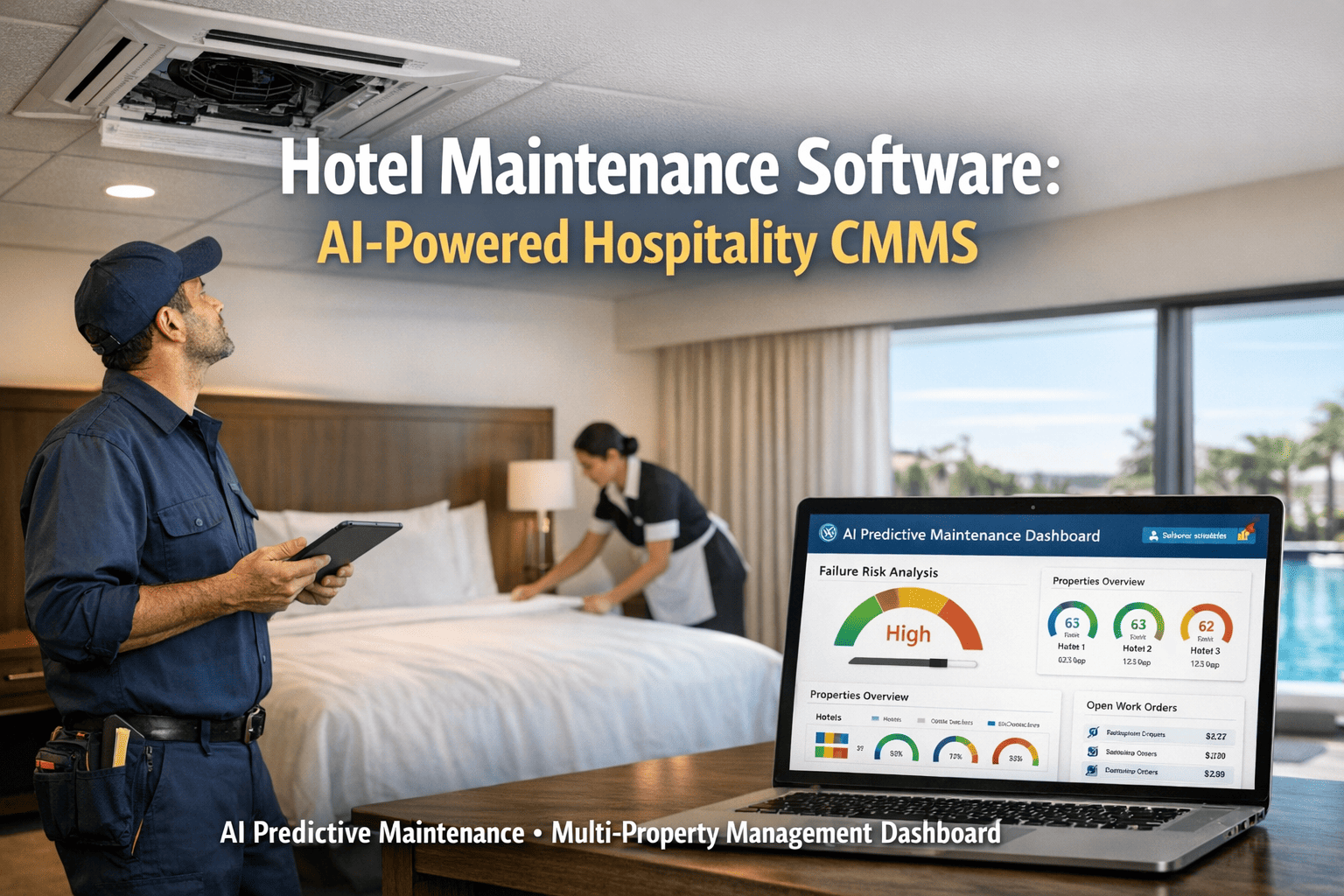
When sensor readings deviate from the learned normal baseline, Oxmaint's model calculates a failure probability score (0–100) and updates it continuously. Score thresholds are configurable per asset criticality: a blast furnace cooling system might alert at score 35, while a utility air compressor might alert at score 60. The score trend — rising, stable, or declining — is displayed on the asset record and drives the maintenance decision.
4
Automated Work Order Generation
When the failure score crosses the configured threshold, Oxmaint automatically creates a condition-based work order — pre-populated with the asset record, the anomaly description, the trending sensor data, and the recommended maintenance action based on the failure mode library. The work order goes to the assigned technician's mobile app immediately, with full offline capability for field execution. No manual detection, no missed alerts, no delay between signal and action.
Which Assets Benefit Most from Predictive Monitoring
Predictive maintenance is not cost-effective for every asset. The economic case depends on failure consequence, sensor installation cost, and the variability of failure patterns. The following asset tiers help prioritize where to deploy first. Sign in to Oxmaint to run your asset criticality scoring and identify your Tier 1 candidates.
Tier 1
Deploy First
High consequence, variable failure patterns
Large rotating equipment — compressors, pumps, fans over 50 kW
Critical conveyor drives and gearboxes on primary process lines
Furnace and kiln drives where failure stops production immediately
Rolling mill main drives and work roll bearing assemblies
Failure cost exceeds sensor + monitoring cost within first prevented breakdown. ROI typically <3 months.
Tier 2
Second Phase
Medium consequence, good sensor ROI
HVAC and utility systems with high replacement cost
Secondary pumping systems where redundancy exists but is limited
Transformer and switchgear thermal monitoring
Cooling tower fans and recirculation pumps
6–18 month payback. Deploy in second wave after Tier 1 model accuracy is validated.
Tier 3
Run-to-Fail or PM
Low consequence or cheap to replace
Small motors under 5 kW with ready spares available
General lighting and low-voltage electrical
Low-criticality pneumatic actuators with manual backup
Sensor cost exceeds failure cost. Managed by run-to-failure designation or simple calendar PM in Oxmaint.
70%
Reduction in unplanned failures on Oxmaint PdM-monitored assets — average across industrial deployments after 12 months
$1.5M
Year-one savings at a steel manufacturer after deploying vibration sensors on critical assets linked to Oxmaint automated work orders
42 days
Average advance warning time before failure on Tier 1 assets monitored by Oxmaint — enough to plan, source parts, and schedule the window
Start predictive maintenance on your first asset today. Oxmaint connects to industrial sensors, builds asset-specific baselines automatically, and generates work orders when the model detects a developing failure — free plan included.
Frequently Asked Questions
QHow much sensor data does the ML model need before it starts generating useful predictions?
Oxmaint's models typically require 30–60 days of baseline data to establish reliable normal-behavior profiles on a new asset. For assets with existing failure history in the work order record, the learning phase is shorter because the model can use historical patterns to inform its baseline. Useful anomaly detection begins within the first week — early alerts may have higher false-positive rates, which the model self-corrects as baseline accuracy improves.
Start Oxmaint free to connect your first sensor and begin the baseline learning process today.
QDo we need dedicated IoT hardware or can we use sensors we already have?
Oxmaint connects to sensors through standard industrial protocols (MQTT, OPC-UA, REST API), which means existing sensors from ABB, Emerson, Fluke, SKF, or any MQTT-compatible device can feed data directly into your Oxmaint asset records without new hardware. For assets not yet monitored, Oxmaint recommends starting with a simple wireless vibration + temperature sensor on Tier 1 rotating equipment — entry-level sensors for this application cost $150–$400 each and typically pay back within the first prevented bearing failure.
Book a demo to discuss sensor compatibility for your specific equipment.
QWhat is the difference between condition-based maintenance and predictive maintenance?
Condition-based maintenance (CBM) triggers maintenance when a measured parameter crosses a fixed threshold — for example, replace the bearing when vibration exceeds 10 mm/s. Predictive maintenance goes further: it uses machine learning to detect patterns in the trend data that precede threshold breaches, generating alerts weeks before the threshold is crossed. Oxmaint supports both: simple condition-based thresholds that work from day one, and ML-based predictive scoring that improves as asset data accumulates. Most teams start with condition-based monitoring and add predictive scoring as their sensor data matures.
QIs predictive maintenance worth the investment for a mid-size facility without a dedicated data science team?
Yes — Oxmaint's predictive maintenance is designed specifically for maintenance teams without data science resources. The ML models are pre-built and self-learning; you do not configure algorithms or write code. Your maintenance team connects sensors, Oxmaint builds the baselines, and the work order arrives on a technician's mobile app when the model detects a developing failure. The data science is inside the platform. The maintenance team uses it the same way they use any other work order.
Start your free account and connect your first sensor in under a day.
Stop Reacting. Start Predicting.
Oxmaint's AI-powered predictive maintenance connects your sensor data to automated work orders — giving your team 2–6 weeks of advance warning on equipment failures that used to cost you emergency repairs, production stops, and reactive overtime.