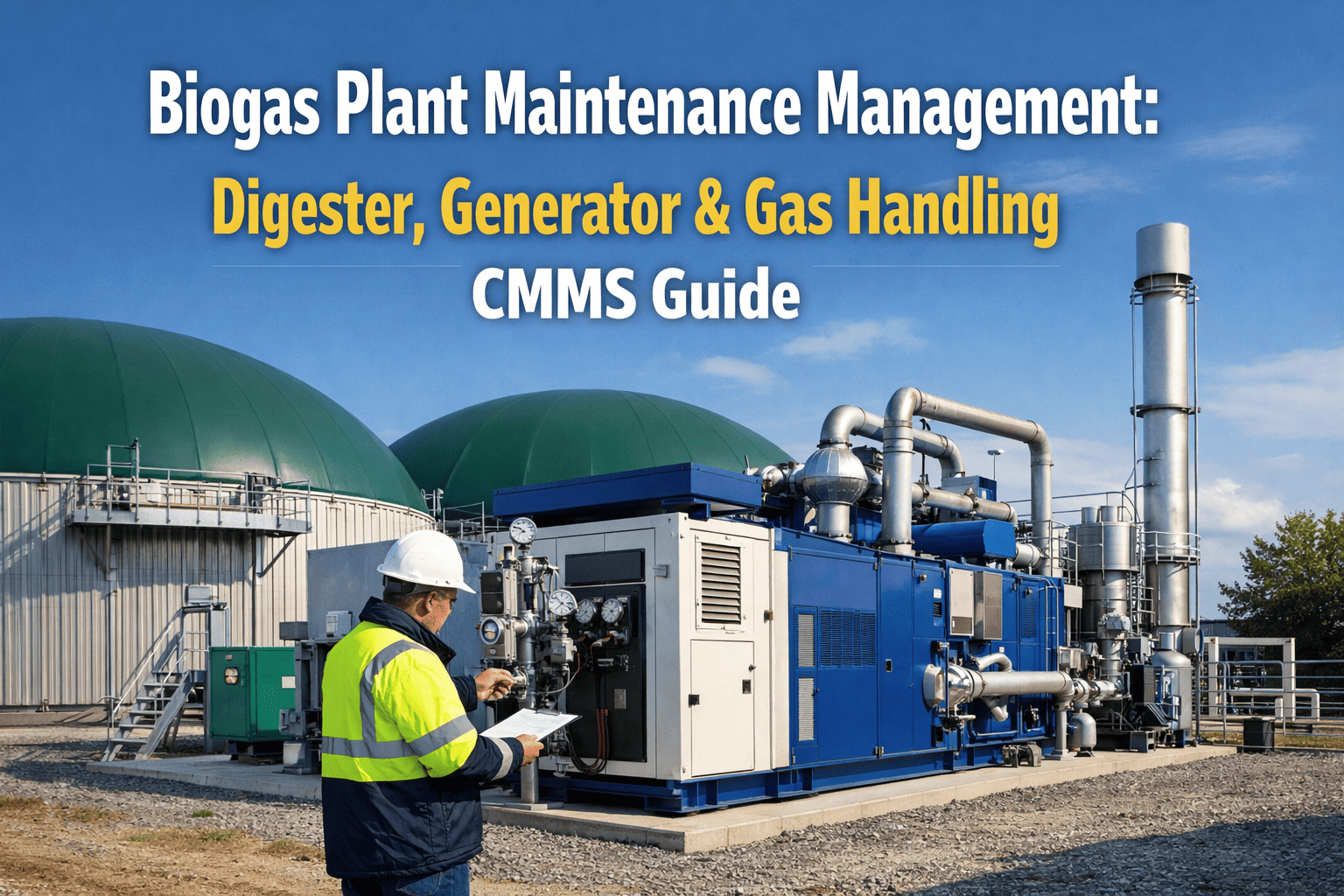
A biogas CHP engine running on 62% methane biogas with elevated H₂S content ages differently from a natural gas engine — oil acidification is faster, spark plug wear is accelerated, and valve seat recession occurs at a fraction of the normal interval. Plant operators who apply natural gas engine service schedules to biogas CHP units typically encounter unplanned shutdowns at 1,800–2,200 hours that should have been prevented at the 1,500-hour service. A 500 kWe CHP unit running unplanned for 72 hours costs between $6,300 and $12,600 in lost electricity revenue before the emergency contractor even arrives. Condition-based maintenance — oil analysis, vibration trending, exhaust gas composition monitoring, and runtime-triggered PM — extends engine life by 25–35% compared to reactive maintenance and reduces major overhaul costs by $18,000–$42,000 per overhaul cycle. OxMaint tracks every biogas engine by runtime hours, triggers PM work orders at the correct intervals for biogas duty, stores oil analysis and vibration records, and plans major overhauls against the capital budget — so your CHP unit runs at design efficiency for its full service life.
Biogas engine service intervals differ from natural gas because H₂S accelerates oil acidification, methane variability affects combustion chemistry, and the duty cycle is typically continuous rather than peaking. OxMaint configures runtime-based PM triggers specific to biogas duty — so every service is done at the right hour, not the wrong one.
Service Item
Interval
Biogas Note
OxMaint Trigger
Engine oil & filter change
250 hrs
H₂S accelerates oil acid number rise — shorten interval vs natural gas
Runtime WO
Spark plug inspection & gap
500 hrs
Biogas CH₄ variability causes plug fouling faster than pipeline gas
Runtime WO
Coolant system check
500 hrs
Verify inhibitor concentration, check for combustion gas ingress
Runtime WO
Valve clearance check
1,000 hrs
Biogas combustion temperature affects valve seat recession rate
Runtime WO
Spark plug replacement
1,000 hrs
Replace fully at 1,000 hrs — gap-adjust at 500 hrs only
Runtime WO
Air & gas filter service
1,000 hrs
Higher H₂S content increases filter loading on gas train
Runtime WO
Oil analysis (lab sample)
Every 250 hrs
Tracks TAN, viscosity, metals — early warning of liner/bearing wear
Sample WO
Vibration & alignment check
Monthly
Detects bearing wear and coupling misalignment before failure
Calendar WO
Major overhaul (top end)
OEM hrs
Typically 15,000–20,000 hrs on biogas — plan 6 months ahead
Forecast WO
Condition Monitoring — Oil Analysis & Vibration
Oil analysis and vibration monitoring are the two most cost-effective condition monitoring tools for biogas CHP engines — each providing early warning of failure modes that visual inspection alone will never detect. OxMaint stores every sample result, every vibration reading, and trends them across the engine service life.
Oil Analysis
Send oil sample to lab every 250 hours. OxMaint stores results and trends six key parameters — flagging deviations that indicate liner wear, bearing failure, or coolant ingress before catastrophic damage occurs.
TAN (Total Acid Number)H₂S-driven oil acidification rate
ViscosityFuel dilution or oxidation indicator
Iron (Fe) ppmCylinder liner or crankshaft wear
Copper (Cu) ppmBearing shell or cooler wear
Coolant glycolHead gasket or liner breach indicator
Soot %Combustion efficiency & ring blow-by
Vibration Monitoring
Monthly vibration measurement at key bearing locations. OxMaint trends amplitude and frequency data — detecting misalignment, imbalance, and bearing defect frequencies months before a failure would occur.
High-frequency envelopeEarly bearing fatigue signal
Trend slope over 6 monthsRate of deterioration — plan overhaul
Smart Technologies for CHP Condition Monitoring
Biogas CHP units benefit from four integrated technology layers that move engine maintenance from calendar-based to condition-based — detecting wear, performance degradation, and exhaust anomalies continuously rather than at each service visit. OxMaint connects all four to your maintenance workflow.
AI Digital Twin
Overhaul forecast
Models engine wear curves from oil analysis, vibration data, and runtime — predicting major overhaul timing 6–12 months ahead so capital is budgeted and OEM parts are ordered before downtime is forced.
IoT Sensors
Continuous
Runtime hour counters, exhaust temperature, coolant temp, oil pressure, and vibration sensors feed OxMaint — generating work orders the moment a reading exceeds its threshold, before the engine shuts down.
SCADA Integration
Auto work orders
Engine SCADA alarms — high exhaust temperature, oil pressure low, knock detection — auto-create prioritised OxMaint work orders with engine tag, reading, and deviation from setpoint pre-populated.
SAP / ERP Integration
Parts ready
OxMaint runtime-based PM forecasts trigger SAP purchase orders for oil, filters, spark plugs, and overhaul kits — all on site before the service date, eliminating downtime from parts unavailability.
CHP Overhaul Cost — Planned vs Emergency
The financial case for planned CHP maintenance is clearest at overhaul time. An emergency top-end overhaul following a valve failure costs 2.4–3.1× more than a planned overhaul at the correct interval — and includes revenue loss while the unit is down. OxMaint eliminates emergency overhauls by tracking every runtime hour and alerting before the threshold is reached.
Overhaul Cost Comparison — Planned vs Emergency ($)
Emergency Overhaul
OEM parts (urgent surcharge)
$28,400
Emergency contractor callout
$17,200
Lost revenue (7-day downtime)
$20,400
Secondary damage repairs
$13,200
$79,200 total
OxMaint planned PM
Planned Overhaul
OEM parts (standard order)
$13,200
Planned contractor schedule
$9,400
Lost revenue (2-day shutdown)
$5,800
Secondary damage (none)
$0
$28,400 total
"We had a valve failure at 19,400 hours on our Jenbacher J320. The emergency overhaul cost us $74,000 including downtime. We joined OxMaint immediately after. Our second engine hit its 20,000-hour mark last month — planned overhaul, parts already on site, 38-hour shutdown, $27,500 total. The difference is extraordinary."
Technical Director · 2 MWe Biogas CHP Plant · Bavaria, Germany
Frequently Asked Questions
Q1Can OxMaint track CHP runtime hours and trigger PM automatically at each threshold?▼
Yes — OxMaint integrates with engine hour meters via IoT or SCADA. Every service threshold — 250-hr oil change, 1,000-hr valve check, major overhaul — generates a work order automatically at the correct runtime.
Q2Can OxMaint store oil analysis results and trend them over the engine service life?▼
Yes — each lab result is stored against the engine asset record. OxMaint trends TAN, viscosity, and metal wear data across samples, flagging deteriorating trends before they indicate imminent failure.
Q3Does OxMaint help plan and budget major CHP overhauls in advance?▼
Yes — OxMaint's digital twin and runtime forecasting shows overhaul approach dates 6–12 months ahead, enabling capital budget planning, OEM parts ordering, and contractor scheduling well in advance.
Q4Can OxMaint manage multiple CHP units at the same or different sites?▼
Yes — each CHP unit has its own asset record with independent runtime counters, PM schedules, and service history. Multi-unit portfolios are managed from one dashboard with site-level and fleet-level views.
Q5Does OxMaint generate the service records required for OEM warranty compliance?▼
OxMaint stores all service records, oil analysis results, parts used, and technician sign-offs in a structured audit trail — exportable as a warranty compliance service history in the format most OEMs require.