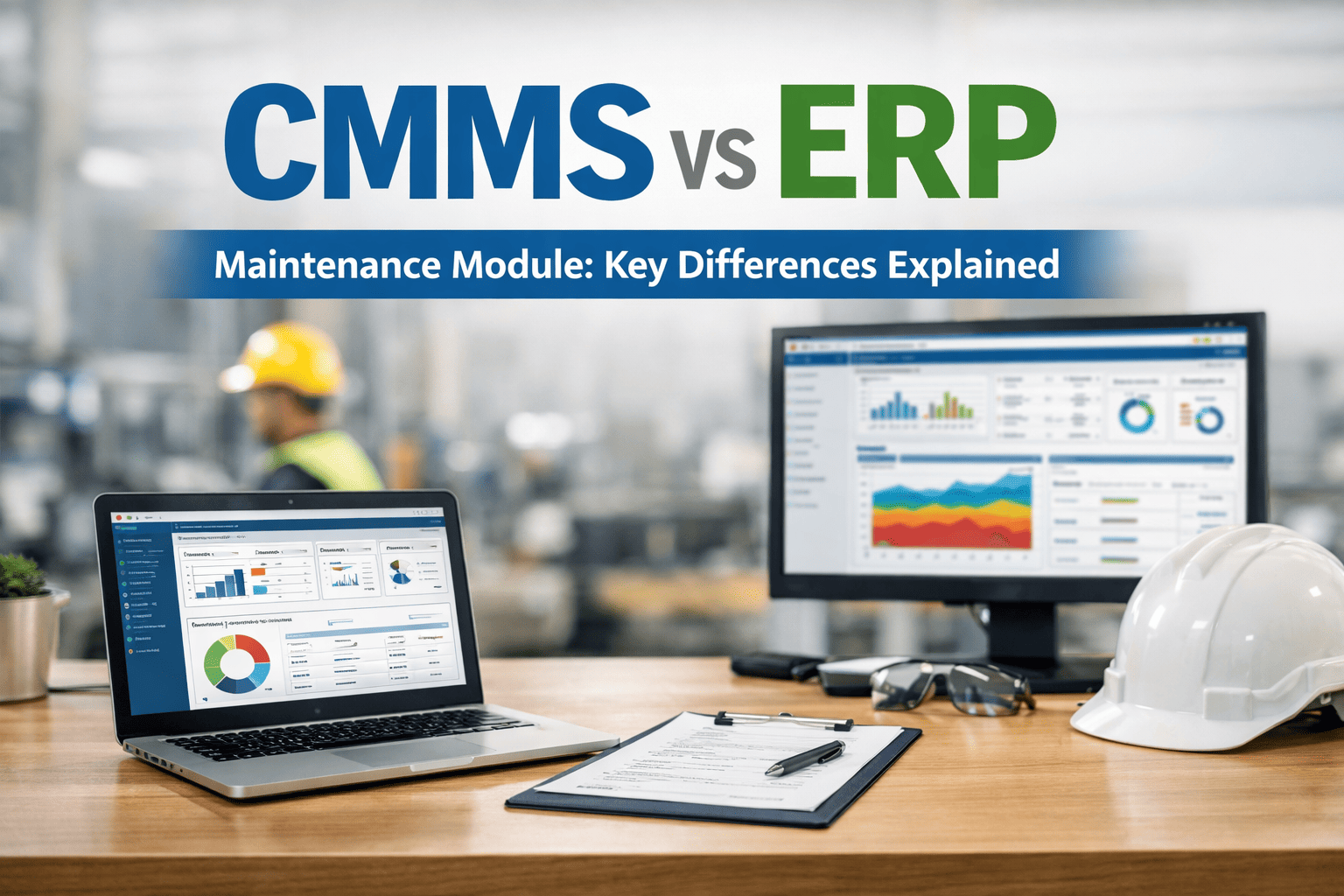
CMMS vs ERP Maintenance Module: Key Differences Explained
Every plant director and maintenance manager running SAP, Oracle, or Microsoft Dynamics has heard the argument from their ERP vendor: "You already have a maintenance module — why do you need a separate CMMS?" It sounds logical on paper. One system, one data model, no integration headaches. But the argument collapses the moment a maintenance technician tries to close a work order from the shop floor on a mobile device, or when a reliability engineer tries to configure a condition-based PM trigger from a PLC sensor signal, or when a compliance officer needs an audit trail that took 3 days to manually assemble from ERP data exports. ERP maintenance modules were built to manage financial data about maintenance — costs, budgets, procurement approvals. CMMS platforms were built to execute maintenance operations — work orders, asset health, PM scheduling, technician dispatch, compliance records. These are different purposes that require different tools, and understanding the distinction is the single most important decision in enterprise maintenance technology strategy in 2026.
COMPARISON · 2026CMMS VS ERPINTEGRATION · ASSET MGMT
CMMS vs ERP Maintenance Module: Key Differences Explained
Why ERP maintenance modules fall short for operational teams — and how dedicated CMMS platforms like OxMaint integrate with ERP to deliver what neither system delivers alone.
The Core Difference: Built for Finance vs Built for the Floor
ERP systems were architected around financial processes — general ledger, procurement, HR, cost accounting. The maintenance module inside SAP or Oracle was added to capture maintenance costs within the same financial data model, not to optimise maintenance execution. The result is a system that answers the CFO's question — "what did maintenance cost last quarter?" — but cannot answer the reliability engineer's question — "which assets are showing early failure indicators right now, and which technician should I dispatch?" CMMS platforms answer the second question. The most effective enterprise maintenance operations in 2026 use both: ERP for financial control and procurement approval, CMMS for operational execution and asset health management, with bidirectional integration keeping both systems synchronised in real time.
ERP Maintenance Module
Maintenance cost tracking and budget management
Procurement and purchase order integration
Financial reporting and depreciation management
HR and labour cost allocation
No mobile-first technician execution
No PLC or sensor connectivity
No AI fault detection or predictive PM
No offline mobile capability for shop floors
OxMaint CMMS
Mobile-first work order execution — offline capable
PLC and SCADA sensor integration
AI fault detection and predictive PM
Automatic compliance audit trail generation
Digital twin asset modelling
Bidirectional SAP / ERP integration
Live in 14–30 days — no 18-month rollout
Multi-site, multi-country unified dashboard
The 5 Operational Gaps in Every ERP Maintenance Module
These are not edge cases or minor inconveniences. They are the five areas where ERP maintenance modules structurally fail to support operational maintenance teams — regardless of whether the ERP is SAP, Oracle, Microsoft Dynamics, or Infor. Every one of these gaps has a measurable cost in downtime, compliance risk, or operational inefficiency.
01
Mobile Execution
ERP interfaces were built for desktop. SAP Fiori improved things but technicians on the shop floor still face interface complexity that drives non-adoption. OxMaint delivers one-tap work order completion from a phone — offline.
02
PLC Connectivity
ERP systems cannot natively receive signals from Siemens, Rockwell, or Schneider PLCs. Machine threshold alerts cannot auto-generate ERP work orders. In OxMaint, a PLC signal creates a work order and dispatches a technician automatically.
03
AI Fault Detection
ERP maintenance modules schedule PM by calendar interval. They cannot analyse sensor patterns, vibration data, or temperature trends to predict failure. AI predictive maintenance is a CMMS capability — not an ERP capability.
04
Compliance Documentation
ERP stores cost data, not operational compliance records. OSHA and ISO audit trails require maintenance execution data — who did what, when, with what parts, and with what outcome. CMMS captures this automatically. ERP requires manual assembly.
05
Deployment Speed
SAP PM implementation takes 6–18 months and $500K+ in professional services. OxMaint enterprise deployments — including SAP integration — go live in 14–30 days at $499/month with no implementation fee. The operational impact is immediate.
OxMaint integrates with your ERP — and fills every gap it leaves.
SAP, Oracle, Dynamics integration included. Live in 14–30 days. No consultant fee.
Head-to-Head: ERP Maintenance Module vs OxMaint CMMS
Capability
SAP PM / ERP Module
OxMaint CMMS
OxMaint + ERP Integration
Mobile work order execution
Poor — desktop-first
Excellent — mobile-first
★ Full mobile + ERP sync
PLC / sensor connectivity
Not available natively
Full PLC integration
★ PLC triggers + ERP cost capture
AI predictive maintenance
Calendar-only PM
AI fault detection live
★ AI PM + ERP procurement trigger
Compliance audit trail
Partial — cost records only
Full automated trail
★ Complete compliance + financial record
Maintenance cost reporting
Excellent — native ERP
Via ERP integration
★ Real-time cost + operational data
Parts procurement approval
Full ERP workflow
Via ERP integration
★ CMMS request + ERP approval
Offline mobile capability
Not available
Full offline mode
★ Offline execution + sync to ERP
Deployment timeline
6–18 months
14–30 days
★ 30 days including integration
Digital twin modelling
Not available
Full digital twin
★ Twin data feeds ERP asset records
▮ CMMS strength▮ ERP strength★ Combined best outcome
How OxMaint Integrates With Your ERP in Real Time
The right answer for most enterprise operations is not CMMS instead of ERP, and not ERP instead of CMMS. It is CMMS and ERP working together — with OxMaint handling maintenance execution on the floor and SAP or Oracle handling financial control in the back office, with data flowing bidirectionally between them in real time. This integration architecture delivers capabilities that neither system provides alone and eliminates the manual data transfer that currently costs enterprise maintenance teams hours every week.
OxMaint CMMS
Work order execution
PLC sensor alerts
AI fault detection
Technician dispatch
Compliance records
Work orders, parts used, labour hours
Cost codes, PO approvals, asset data
SAP / ERP System
Cost management
Parts procurement
Financial reporting
HR & labour costs
Asset depreciation
ⓘ Bidirectional real-time sync — no manual export, no batch uploads, no data lag. OxMaint enterprise plans include SAP integration at no additional professional services fee.
Technologies That Require CMMS — Not ERP
The industrial technology stack that powers predictive maintenance in 2026 — AI camera vision, digital twin modelling, PLC and SCADA integration, OBD telematics — cannot connect to ERP systems. These technologies speak the language of operational technology, not enterprise financial systems. CMMS platforms like OxMaint are built to interface with both worlds: industrial OT systems on one side, ERP financial systems on the other, with AI processing in the middle.
AI Camera Vision
Visual defect detection on production lines. Flags bearing wear, seal leaks, and alignment issues before failure. Feeds directly into OxMaint work order creation — ERP has no pathway for this data.
AI Digital Twin
Virtual asset models that mirror real machine state in real time. Simulate maintenance scenarios and predict remaining useful life. ERP asset records are static — digital twins are dynamic and predictive.
PLC Integration
Siemens, Rockwell, and Schneider PLC threshold alerts automatically create work orders and dispatch technicians in OxMaint. SAP PM has no native PLC connectivity and requires custom middleware to replicate even partial capability.
BMS Integration
Building Management System alerts for HVAC, fire suppression, and electrical systems automatically generate maintenance work orders in OxMaint — not possible natively in any ERP maintenance module.
Predictive PM Engine
AI analyses run-hours, temperature cycles, and vibration trends to schedule PM at the precise optimal interval — not by calendar. ERP PM is purely calendar-based and generates either over-maintenance or under-maintenance.
OBD / Fleet Telematics
Vehicle fault codes and mileage data trigger fleet maintenance work orders automatically in OxMaint. Fleet PM data then syncs to ERP for cost allocation — a workflow no ERP module supports natively.
Total Cost of Ownership: ERP Module vs OxMaint + ERP Integration
Cost Component
SAP PM Only
OxMaint + SAP Integration
Year 1 implementation
$300K – $800K
$0 (included)
Annual licence / subscription
$150K – $400K
$6K – $12K
Ongoing IT / admin support
$80K – $200K/yr
Minimal — self-service
Deployment timeline
6 – 18 months
14 – 30 days
Mobile technician adoption
42% active use
94% active use
3-Year Total Cost of Ownership
$800K – $2M+
$18K – $36K
ⓘ 50-technician, 3-site enterprise operation. SAP PM costs include implementation, licensing, and ongoing support. OxMaint costs include enterprise plan and SAP integration.
"Our SAP PM implementation took 14 months and $420K. Technicians had 38% adoption. We added OxMaint alongside SAP — adoption went to 91% in 60 days and our SAP data became accurate for the first time because the CMMS was actually being used."
— VP of Maintenance, Global Chemical Manufacturer, Germany
Frequently Asked Questions — CMMS vs ERP Maintenance Module
ERP maintenance modules — including SAP PM, Oracle eAM, and Microsoft Dynamics 365 Asset Management — were designed to capture the financial dimensions of maintenance: costs, labour allocation, procurement, and depreciation. They answer "what did maintenance cost?" CMMS platforms were designed to execute maintenance operations: work orders, PM scheduling, asset health monitoring, technician dispatch, and compliance documentation. They answer "what needs to be done, when, and by whom?" The most effective enterprise operations use both tools together — CMMS for execution, ERP for financial control — with bidirectional integration. See how OxMaint integrates with SAP in your environment.
OxMaint integrates bidirectionally with SAP S/4HANA, SAP PM, SAP MM, Oracle eAM, and Microsoft Dynamics 365 via standard REST API. Work orders created in OxMaint sync cost and labour data to SAP automatically. Parts requests from OxMaint trigger procurement workflows in SAP. Asset records and maintenance cost data flow both ways in real time — no manual export, no batch upload, no data lag. This integration is included in OxMaint enterprise plans with no additional professional services fee. Most operations complete the integration in the first 5–10 days of deployment.
ERP interfaces were designed for office-based users completing financial and administrative tasks on desktop computers. The interface complexity — multi-level menu navigation, transaction codes in SAP, data entry forms optimised for keyboard input — creates friction for technicians working in industrial environments with gloves, noise, and poor lighting. The result is low adoption: surveys of enterprise SAP PM deployments consistently show 40–50% active mobile adoption versus OxMaint's 94%. Low adoption means incomplete maintenance records, inaccurate ERP cost data, and compliance gaps — which defeats the purpose of the ERP investment. Adding OxMaint as the field execution layer, with data syncing to SAP automatically, resolves this without replacing the ERP.
Not natively in any major ERP system. SAP has developed IoT connectivity through SAP Asset Intelligence Network and partnerships with IoT middleware vendors, but achieving functional PLC-to-SAP PM work order generation requires significant custom development, middleware licensing, and ongoing IT support that typically costs $100K–$300K beyond the base ERP implementation. OxMaint includes native PLC and SCADA connectivity in enterprise plans — Siemens, Rockwell Allen-Bradley, Schneider Electric, and other major PLC manufacturers — with threshold breach alerts automatically creating work orders and dispatching technicians within seconds. The OxMaint data then syncs to SAP for cost tracking.
For most enterprise operations, the answer is to use them together — OxMaint as the operational execution layer where technicians work, and ERP as the financial control and procurement layer where finance teams work. Replacing the ERP maintenance module entirely means losing financial integration and procurement workflows that the ERP handles well. Adding OxMaint alongside the ERP fills the five operational gaps — mobile execution, PLC connectivity, AI fault detection, compliance documentation, and deployment speed — that the ERP cannot address. The combined architecture delivers better outcomes than either system alone, and costs a fraction of attempting to extend ERP to do what it was not designed for.
CMMS + ERP INTEGRATION · #1 RATED 2026
Fill Every ERP Gap. Keep Your SAP Investment.
OxMaint integrates with SAP, Oracle, and Dynamics — adding mobile execution, PLC connectivity, and AI that ERP cannot deliver, while keeping your ERP financial data accurate and real-time.
SAP, Oracle, Dynamics integration included — no extra fee
PLC and SCADA connectivity — auto work order generation
94% technician adoption — data your ERP has never had

.png)


