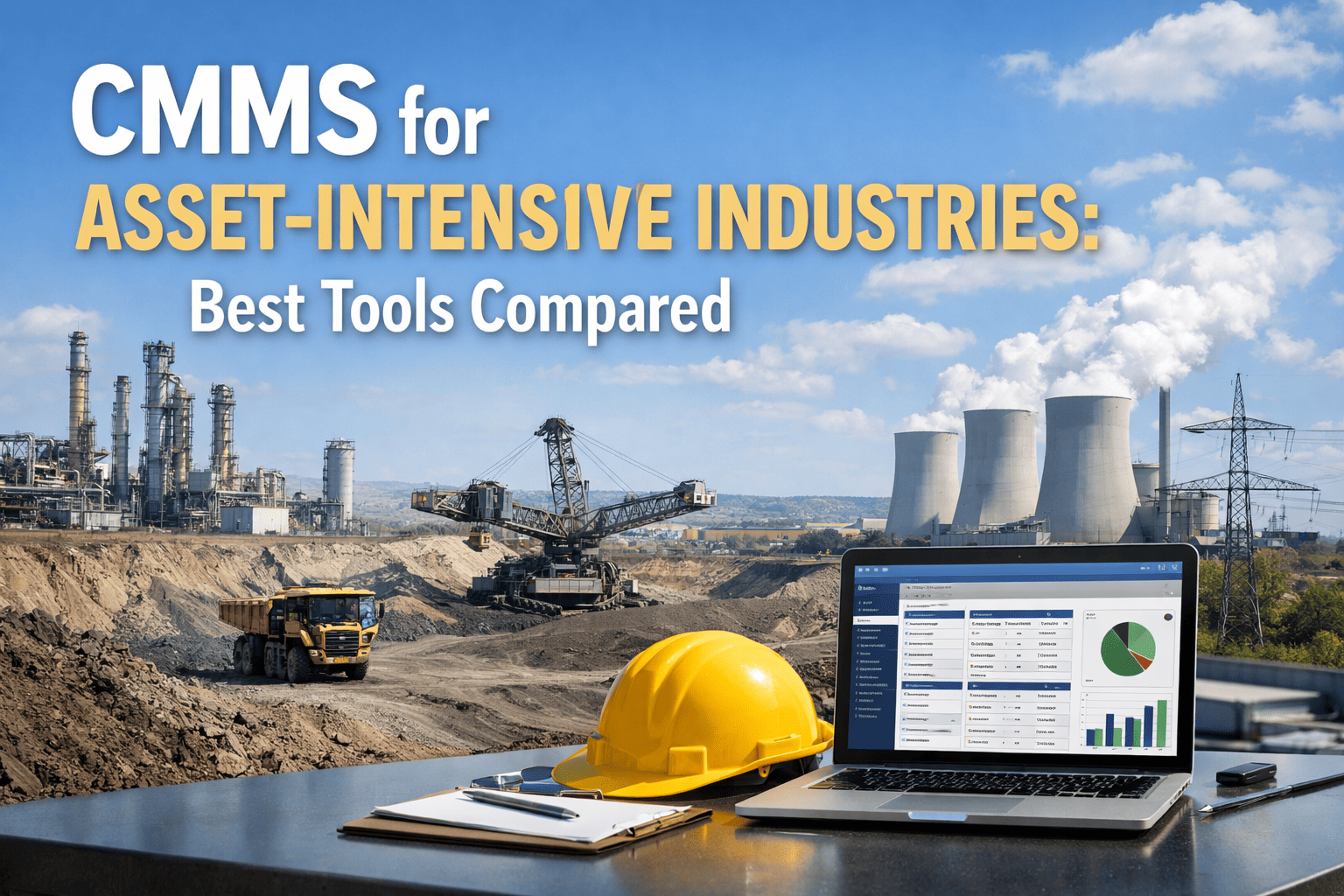
CMMS for Asset-Intensive Industries: Best Tools Compared
Asset-intensive industries don't fail because they lack maintenance staff or budget. They fail because the ratio of assets under management to the quality of the maintenance data governing those assets is chronically imbalanced. A 3,000-asset chemical plant with a CMMS that tracks PM completion but can't link failure history to repair cost, can't surface overdue inspections to the right supervisor, and can't produce a regulatory compliance record on demand is not protected by its size. It is exposed by it. The more assets you operate, the more consequential every gap in your maintenance data becomes. The 3-hour unplanned shutdown on a $400/minute production line. The pressure vessel inspection overdue by 90 days that a OSHA auditor finds. The transformer failure whose repair history shows four previous identical failures — all of which were patched, none of which triggered a root cause investigation. These are the outcomes that define whether a CMMS is working for an asset-intensive operation or just creating the illusion of a maintenance programme. Sign in to OxMaint to deploy a CMMS built for asset-intensive operations, or book a demo to see how OxMaint manages 500–50,000 assets across multi-site industrial operations.
CMMS for Asset-Intensive Industries: The Features That Actually Matter When You're Managing Thousands of Assets Across Multiple Sites
Asset-intensive operations in manufacturing, utilities, logistics, and energy require a CMMS that handles high asset density, complex compliance requirements, and multi-site management at scale — without the $500K+ enterprise implementation that legacy platforms demand.
average hourly production loss from unplanned downtime in process manufacturing — CMMS PM compliance is the primary prevention tool
3,000+
assets typically managed by a single OxMaint deployment in a mid-size chemical or process manufacturing facility
42%
average reduction in reactive maintenance work orders in Year 1 for asset-intensive facilities deploying OxMaint structured PM
90 days
typical OxMaint deployment timeline for a 2,000–5,000 asset multi-site industrial operation — including integration and training
Asset-intensive operations need a different CMMS architecture than facilities management — not because the features are completely different, but because the scale, data complexity, and failure consequence are orders of magnitude higher. A CMMS that handles 50 assets well often breaks at 5,000. OxMaint is built for the 500–50,000 asset range where most industrial CMMS implementations either fail technically or become unaffordably expensive to maintain.
CMMS Platform Comparison — Asset-Intensive Industry Requirements
Feature / Requirement
OxMaint
IBM Maximo
SAP PM
Limble CMMS
Infor EAM
Asset scale (assets managed)
500 – 50,000
10,000+
ERP-scale
Up to ~5,000
10,000+
IoT / PLC / SCADA integration
Native API
Maximo IoT add-on
SAP IoT platform
Limited
Infor add-on
Predictive maintenance (AI digital twin)
Built-in
IBM Watson add-on
SAP Predictive (separate)
Not available
Limited
Multi-site management
Native
Native
Native (SAP)
Partial
Native
Regulatory compliance (OSHA/EPA/PSM)
Built-in templates
Configurable
Configurable
Basic
Configurable
Implementation time
60–90 days
12–24 months
12–36 months
30–60 days
6–18 months
Total Year 1 cost (mid-market)
$18K – $60K
$350K – $1.5M+
SAP license bundle
$12K – $36K
$180K – $600K
OxMaint · Asset-Intensive CMMS · Industrial Scale
500 to 50,000 Assets. Multi-Site. Full Compliance. 60-Day Deployment. No Enterprise Pricing.
OxMaint delivers the asset management capability of IBM Maximo and SAP PM at a fraction of the implementation cost and timeline — built for the industrial mid-market that enterprise platforms ignore.
Critical CMMS Features for Asset-Intensive Operations
Asset Hierarchy Management
Site → System → Equipment → Component hierarchy with full parent-child work order inheritance. A work order on a pump reflects in the system-level and plant-level maintenance records automatically. OxMaint supports unlimited hierarchy depth for assets with complex sub-component structures — rotating machinery, pressure vessels, and control systems.
Regulatory Compliance Documentation
OSHA PSM (29 CFR 1910.119), EPA RMP, API 510/570/653 inspection records, ASME pressure vessel certification, and IEEE electrical equipment maintenance standards — OxMaint stores and tracks compliance documentation with expiry alerts, inspector certification records, and audit-ready export packages.
IoT / PLC / SCADA Integration
Asset condition data from existing PLC and SCADA systems flows directly into OxMaint via OPC-UA, MQTT, and Modbus protocols — generating work orders automatically when process variables exceed defined limits. Eliminates manual alert-to-work-order translation that creates response delays in high-asset-density environments.
AI Digital Twin — Failure Prediction
OxMaint builds a digital twin for each critical asset — modelling degradation from PM history, operating conditions, and sensor data. The twin predicts failure probability 30–90 days ahead, enabling maintenance planning to shift from time-based schedules to condition-driven intervention windows that maximise both uptime and maintenance efficiency.
Spare Parts Inventory Integration
Work orders link directly to spare parts inventory — bill of materials per asset, parts consumption logged at work order close, reorder point alerts when critical spares fall below minimum. OxMaint's parts module tracks parts usage per asset class to identify components with disproportionate consumption rates signalling recurring failure patterns.
Multi-Site Performance Benchmarking
Asset-intensive organisations with multiple sites need cross-site benchmarking — identifying which plant's compressor maintenance programme is outperforming others and why. OxMaint's multi-site analytics surface MTBF, PM compliance, and maintenance cost per asset class across all sites from a single dashboard — the performance visibility that drives continuous improvement at scale.
PSM-covered facilities, pressure vessel programmes, and rotating equipment reliability. OxMaint manages API 510/570 inspection schedules, PSM mechanical integrity documentation, and process safety compliance records for OSHA audit readiness.
PSM
compliance built-in
API 510
inspection tracking
Industry · Power / Utilities
Power Generation & Utilities
Turbine PM, transformer maintenance, substation inspection, and NERC reliability compliance for power generation and T&D assets. OxMaint integrates with SCADA for condition-triggered work orders and manages the compliance calendar for NERC PRC and FAC standards.
NERC
compliance tracking
SCADA
integration native
Industry · Logistics / Distribution
Logistics & Distribution Centres
Conveyor systems, sortation equipment, dock levelers, and material handling at high-throughput distribution centres. OxMaint manages 200–2,000 material handling assets per facility with OEM PM schedule import and parts consumption tracking tied to throughput metrics.
2,000
assets per facility
OEM PM
schedule import
42%
average reduction in reactive maintenance work orders in Year 1 of OxMaint structured PM — asset-intensive facility benchmark
90 days
typical deployment timeline for 2,000–5,000 asset multi-site operation — vs 12–24 months for Maximo and SAP PM implementations
$50K
average hourly production loss from unplanned downtime in process manufacturing — each prevented event represents 1–4x OxMaint annual licence value
"We evaluated IBM Maximo and SAP PM. Both were 14–22 month implementations at $600K–$1.2M for our 2,800-asset chemical plant. OxMaint deployed in 78 days at a fraction of the cost, integrated with our existing SCADA via OPC-UA in the first week, and our PSM mechanical integrity documentation was audit-ready within 90 days. In our first OSHA audit post-deployment, the inspector reviewed our API 510 inspection records on-screen from OxMaint and found zero deficiencies. That was the first clean inspection in six years."
— Director of Maintenance and Reliability, specialty chemical manufacturer, 2,800 assets, Gulf Coast US
Frequently Asked Questions
Can OxMaint handle 5,000+ assets across multiple industrial sites?
Yes — OxMaint is architected for 500 to 50,000 assets across unlimited sites. Multi-site deployments use a hierarchical site structure with shared asset libraries, common PM templates, and cross-site performance dashboards. Each site maintains its own work order queue and compliance calendar while contributing to the consolidated group-level analytics.
How does OxMaint integrate with existing PLC and SCADA systems in industrial environments?
OxMaint integrates via OPC-UA, MQTT, Modbus TCP, and REST API — covering the communication protocols used by Siemens, Rockwell, Honeywell, ABB, and Emerson automation systems. Condition thresholds are configured in OxMaint per asset — when a SCADA variable exceeds the threshold, OxMaint automatically creates and assigns a prioritised work order without human intervention.
Does OxMaint support OSHA PSM mechanical integrity documentation requirements?
Yes — OxMaint's compliance module includes OSHA PSM 29 CFR 1910.119 mechanical integrity documentation templates for pressure vessels, piping, relief devices, emergency shutdown systems, and rotating equipment. Inspection records, inspector certifications, deficiency tracking, and follow-up work orders are all managed within OxMaint and exportable for PHA and compliance audit review.
What is the implementation timeline for OxMaint at a large industrial site?
A 2,000–5,000 asset industrial deployment typically completes in 60–90 days — including asset data import from existing systems, PM schedule configuration, SCADA/PLC integration, technician mobile training, and management dashboard setup. OxMaint's implementation team provides dedicated support for industrial deployments with a fixed-timeline commitment, not an open-ended professional services engagement.
How does OxMaint compare to Maximo for asset-intensive operations?
IBM Maximo is the industry benchmark for large enterprise asset management — it is also a 12–24 month, $500K+ implementation that requires dedicated IT support to operate. OxMaint delivers 85–90% of Maximo's functional capability for asset-intensive industrial operations in 60–90 days at 5–15% of the implementation cost — making it the practical choice for industrial mid-market operations that need enterprise-grade asset management without enterprise-grade IT overhead.
Enterprise Asset Management Without the Enterprise Implementation. Deploy in 90 Days.
OxMaint manages 500–50,000 assets, integrates with PLC/SCADA, and handles PSM compliance — at a fraction of Maximo or SAP PM cost.

.png)


