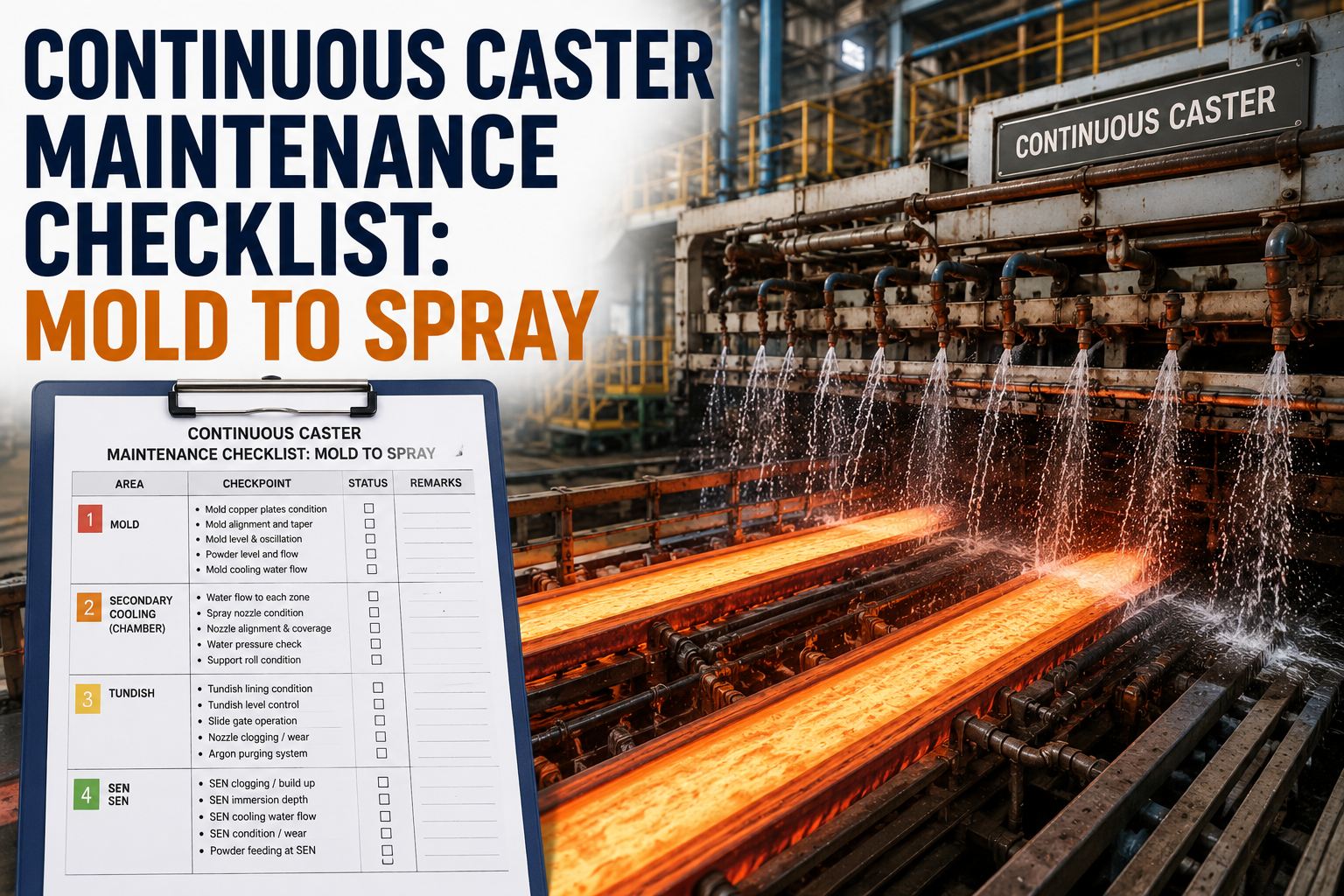
Continuous caster availability is won or lost between the mold and the spray chamber — where copper plate wear, segment roll misalignment, and clogged nozzles quietly convert prime slab into scrap. Steel plants running ISO 55000-aligned preventive maintenance on these assets typically hold caster availability above 92%, while reactive shops drift toward 84–86% and absorb unplanned sequence breaks that cost $18,000–$45,000 per hour of downtime. This checklist distills field-tested PM practices across the three critical caster zones and shows how OxMaint maintenance management software keeps mold campaigns, segment overhauls, and spray nozzle inspections on schedule. Ready to operationalize it? Start Free Trial and deploy the caster reliability program in days, not quarters.
CASTER RELIABILITY · FIELD CHECKLIST
Stop scrap before it leaves the mold.
A disciplined mold-to-spray maintenance program holds caster availability above 92% and extends campaign life by 30–45 heats. Follow the checklist that high-availability steel plants run every shift, every week, every campaign.
THE COST OF DRIFT
Why caster maintenance is a margin lever, not an overhead
A single continuous caster producing 1.2 million tonnes of slab per year generates roughly $720M in revenue at $600/t — and every percentage point of availability lost to unplanned downtime erodes $7.2M from that figure. The mold, segments, and spray chamber are where the loss originates.
Unplanned sequence breaks on a 1.2 Mt/y slab caster — mold sticker, roll failure, or spray loss are the top three root causes.
Reactive shops average 84–86% availability; ISO 55000-aligned PM programs hold 92–94%. That gap is ~70,000 t/y of lost slab.
Longitudinal cracks, oscillation marks, and corner tears — most originate in mold taper drift and uneven secondary cooling.
Disciplined mold PM extends campaign life from a 220-heat baseline to 250–280 heats, deferring $180K copper plate refurbs.
ZONE 1 · MOLD MAINTENANCE
Mold & oscillation checklist
The mold is the single most expensive consumable on the caster and the leading source of surface defects. Inspect taper, oscillation, and lubrication every campaign turnover; log every reading in the CMMS to trend drift.
Mold taper verification
- Measure narrow-face taper at 5 points per side; tolerance ±0.05 mm against spec for the cast section.
- Record copper plate wear; flag >1.5 mm for grinding, >3.0 mm for replacement.
- Verify mold width adjustment screws move freely; lubricate thread and nut assemblies.
Oscillation system
- Check oscillation stroke (±3–6 mm typical) and frequency (100–300 cpm) against casting speed recipe.
- Inspect hydraulic servo-valves for leakage; verify negative strip ratio 60–80%.
- Examine oscillation bearings and linkage for play; max 0.1 mm lateral deflection.
Lubrication & meniscus
- Verify mold flux feed rate uniformity; check for slag rims >5 mm that disrupt heat transfer.
- Inspect meniscus level stability via mold level control; setpoint ±2 mm.
- Log mold cooling water differential temperature; trend to detect partial blockage.
Water & instrumentation
- Calibrate mold thermocouples (28–42 points) — drift >5°C triggers plate cracking blind spots.
- Inspect water box gaskets; pressure-test at 1.25× operating pressure.
- Verify electromagnetic stirrer (EMS) current and phase balance against baseline.
ZONE 2 · SEGMENT ROLLS
Segment roll & bearing inspection matrix
Segment rolls carry 180–250 tonnes of ferrostal weight at 4–6 m/min while bathed in spray water. A single seized bearing raises breakouts risk and can destroy a $40,000 roll in one sequence. Track every segment offline and online.
| Task | Frequency | Tolerance / spec | Failure signal |
|---|---|---|---|
| Roll gap measurement (each segment) | Per campaign | ±0.2 mm of caster map | Centerline segregation, bulging |
| Roll surface profile & diameter | Offline overhaul | Max wear 2.0 mm; no circumferential grooves >0.5 mm | Surface cracks, spalling, pitting |
| Bearing temperature trend | Continuous (online) | <70°C at 2 m/min; alarm at 85°C | Lubrication failure, overload |
| Roll alignment (tape & laser) | Quarterly | ±0.3 mm/misalignment across strand | Edge cracks, rhomboidity |
| Hydraulic cylinder position check | Weekly | LVDT feedback within ±0.1 mm of command | Gap drift, uneven reduction |
| Soft reduction zone calibration | Per campaign | Match metallurgical length model ±0.5 m | Internal cracks, center porosity |
| Bearing grease re-greasing | 2-weekly | Specified NLGI-2 volume per bearing | Grease starvation, water ingress |
| Roll drive motor amperage | Continuous | Within ±10% of baseline for cast speed | Roll drag, bearing seizure onset |
Field example: A 1.8 Mt/y integrated plant detected bearing temperature trending 62→78°C on Segment 4 over 36 hours via OxMaint condition monitoring integration. Maintenance swapped the segment at the next planned sequence break — avoiding an estimated $310K in unplanned downtime and roll damage. The CMMS auto-generated the work order from the threshold breach.
ZONE 3 · SECONDARY COOLING
Spray nozzle & secondary cooling checklist
Uneven secondary cooling is the root cause of 60% of internal crack defects. Nozzle flow deviation beyond ±15% from setpoint distorts the solidification shell. Inspect every zone every campaign and calibrate flow monthly.
Nozzle visual & flow test
- Remove and bench-test 10% of nozzles per zone; check spray angle ±5° of spec.
- Look for clogging, erosion, orifice wear; replace nozzles with >10% flow deviation.
- Verify spray pattern hits strand edge — not roll face — at full pressure.
Flow & pressure calibration
- Calibrate flow meters in each cooling zone; tolerance ±3% of reading.
- Verify header pressure stability; pulsation dampeners charged to spec.
- Audit zone-specific cooling ratios against solidification model setpoints.
Headers, valves & filters
- Clean Y-strainers and backwash filters; delta-P <0.3 bar across filter.
- Exercise control valves full stroke; check positioner feedback.
- Inspect header piping for scale buildup and joint leaks.
Cooling recipe audit
- Validate secondary cooling ratio (L/kg) against steel grade and section recipe.
- Confirm auto-cutback engages on speed reduction to avoid over-cooling.
- Log deviations; trigger metallurgical review if >2 consecutive casts out of band.
CMMS-DRIVEN SCHEDULING
From clipboard chaos to campaign-driven PM
Most caster shops run maintenance on spreadsheets and tribal knowledge. The result: 25–30% of PM tasks are completed late, and 1 in 4 mold campaigns overshoots its safe life. OxMaint ties every check to asset, campaign, and condition — automatically.
Campaign-linked work orders
Trigger mold taper checks, segment gap inspections, and spray audits automatically when a campaign closes — no manual scheduling, no missed turns.
Condition-based triggers
Integrate bearing temperature, vibration, and flow deviation data. When a threshold breaches, OxMaint opens a work order with the right parts and procedure pre-attached.
Spare parts & mold life tracking
Track copper plate refurbishment cycles, roll grinding history, and nozzle inventory. Predict replacement dates from actual wear data, not guesswork.
Audit-ready compliance
Every completed check is timestamped, e-signed, and stored against the asset record. Pass ISO 55000, TPM, and internal quality audits without rebuilding records.
ROI & PAYBACK
What a CMMS-driven caster PM program returns
Model the savings against a 1.2 Mt/y slab caster running 300 days per year, currently at 86% availability with clipboard-based maintenance. Moving to campaign-linked PM in OxMaint typically delivers a 4–7 percentage point availability gain within 9 months.
Annual downtime recovery
Δ Availability × Annual Hours × $/hr
6% × 8,760 × $28,000
= $14.7M / year recovered
Mold campaign life extension
Extra heats × Campaigns/yr × Cu plate $/heat
40 × 52 × $720
= $1.5M / year in deferred mold cost
| Cost / benefit line | Baseline (clipboard) | With OxMaint PM | Annual delta |
|---|---|---|---|
| Caster availability | 86% | 92% | +6 pts |
| Unplanned downtime hours | 1,226 hr/yr | 701 hr/yr | −525 hr |
| Downtime cost @ $28K/hr | $34.3M | $19.6M | −$14.7M |
| Mold campaigns per year | 52 | 45 (longer campaigns) | −7 refurbs |
| Quality scrap rate | 2.8% | 1.4% | −1.4 pts |
| Scrap value recovered @ $600/t | — | $10.1M | +$10.1M |
| OxMaint subscription + implementation | — | $85K | −$85K |
| Net annual benefit | — | — | ~$24.7M |
Model based on industry benchmarks; actual results depend on caster type, steel grade mix, and current maintenance maturity. Typical payback on OxMaint caster PM deployment: 3–6 weeks.
Put every caster PM on autopilot.
Deploy OxMaint in days — campaign-linked work orders, condition triggers, and audit-ready records for mold, segments, and spray. Most plants see measurable availability gains within the first 90 days.
FAQ
Continuous caster maintenance — answered
How often should mold taper be checked on a continuous caster?
Mold taper should be verified at every campaign turnover — typically every 220–280 heats depending on steel grade and section. For high-carbon or crack-sensitive grades, measure taper every 150 heats. Use a precision taper gauge at five points per narrow face and log readings in the CMMS to trend drift between campaigns.
What is the acceptable bearing temperature for caster segment rolls?
Segment roll bearings should run below 70°C at normal casting speed of 2 m/min. Set an alarm at 85°C and a trip at 95°C. A bearing trending above 75°C for more than 30 minutes signals lubrication failure or overload — schedule a segment swap at the next sequence break. You can automate this monitoring in OxMaint — Book a Demo to see condition-triggered work orders in action.
How do I know when spray nozzles need replacement?
Bench-test nozzles every campaign and replace any unit with flow deviation exceeding ±10% of rated capacity, spray angle drift beyond ±5°, or visible erosion of the orifice. A 15% flow deviation in a single zone is enough to cause internal cracks in medium-carbon grades — calibrate flow meters monthly to catch degradation early.
Can OxMaint integrate with our existing caster PLC and SCADA data?
Yes. OxMaint ingests bearing temperature, vibration, flow rate, and mold thermocouple data via OPC-UA, MQTT, or REST connectors. When a parameter breaches a configurable threshold, the system auto-generates a work order with the correct procedure, parts, and priority — turning condition data into maintenance action without manual entry.
What is the typical payback period for a CMMS on a continuous caster?
Most steel plants recover their OxMaint investment within 3–6 weeks of go-live. The dominant driver is unplanned downtime reduction — a single avoided sequence break on a 1.2 Mt/y caster saves $28,000–$45,000 per hour. Additional savings come from extended mold campaign life, lower scrap rates, and eliminated manual record-keeping. A 14-day free trial lets you validate the workflow before committing — Start Free Trial to begin.
CASTER RELIABILITY STARTS HERE
Hold your caster above 92% availability.
Join the steel plants that replaced clipboards with campaign-driven PM. Deploy OxMaint for continuous caster maintenance in days and see availability gains within the first quarter.
Free 14-day trial · No credit card