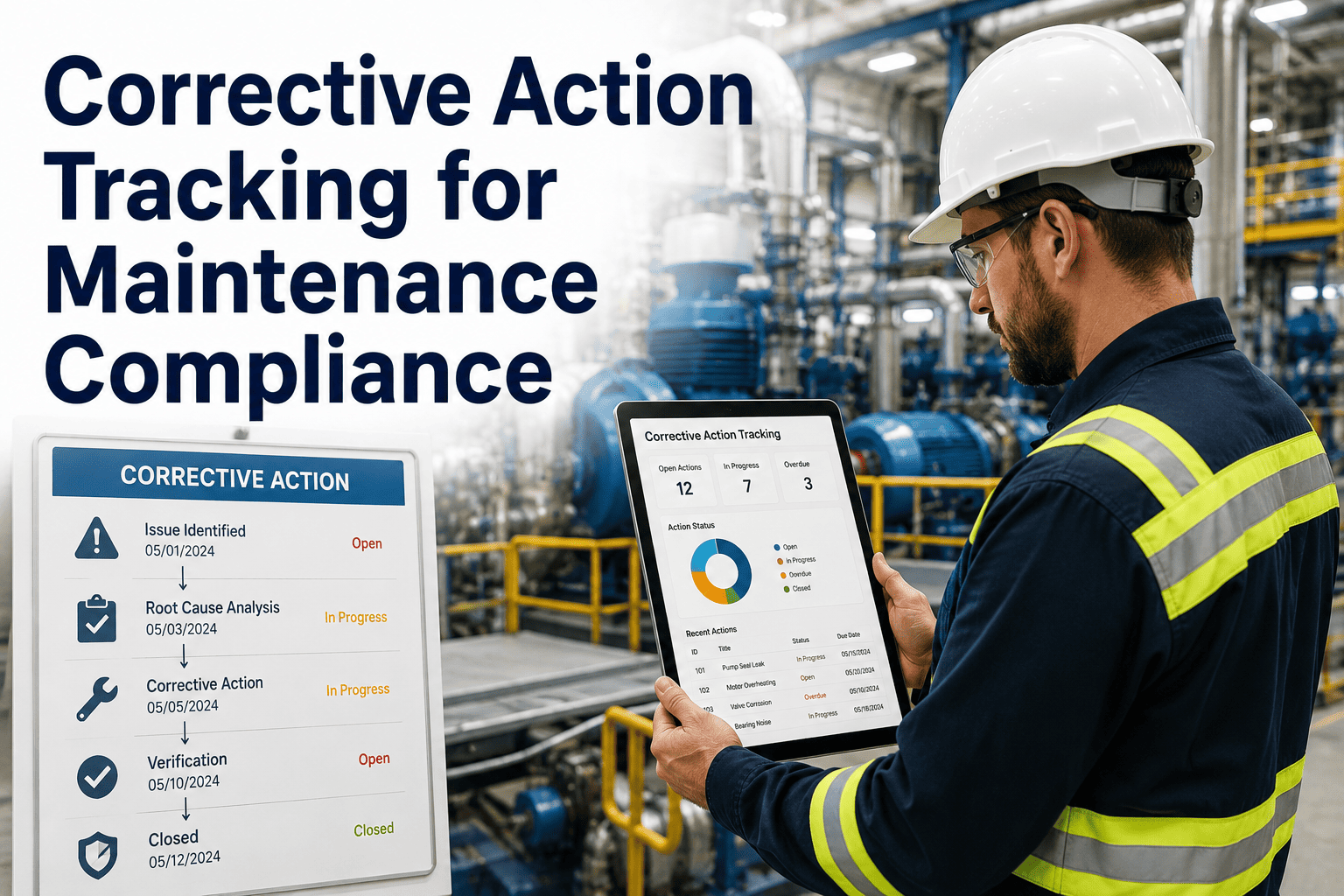
corrective-action-tracking-maintenance-compliance

Corrective Action Tracking for Maintenance Compliance


An inspector flags a missing guard on a conveyor. Someone writes "fixed" in a notebook. Six months later the same guard is missing again, because nobody ever confirmed the fix, logged evidence, or checked whether the underlying cause was addressed at all. The most dangerous phrase in any compliance program is "closed as discussed" — a status with no owner, no due date, and no proof behind it. Sign in to OxMaint to see every open finding across your facility tracked to a named owner and a due date. Book a demo to walk through the full finding-to-closure workflow with real audit evidence attached.

OxMaint · Corrective Action Tracking
Finding the issue is rarely the hard part. Proving it was actually fixed — with evidence an outside auditor will accept — is where most compliance programs quietly fail.

The Five Questions Every Corrective Action Must Answer

A finding is not resolved until every one of these five links back to the original audit line, inspection, or incident report.

1
What was found?

2
Who owns the fix?

3
When is it due?

4
What proof shows it was done?

5
Has the risk actually reduced?
The Warning Sign
"Closed as discussed" is not a closure — it is a note. A defensible corrective action record needs a timestamp, a named owner, and attached evidence such as a photo, a revised procedure, a signed inspection, or a work order reference. Without that, the same finding simply resurfaces at the next audit.
A closure rate above 90% is considered exemplary by most compliance benchmarks. Most spreadsheet-tracked programs never find out their real number until an external auditor asks for it.

What Counts as Acceptable Closure Evidence

Different finding types need different proof. A closure record that mixes these up is the first thing an external auditor will challenge.

Equipment Findings
Before-and-after photos, work order reference, and parts used
Process Findings
Revised SOP, version history, and staff acknowledgement
Training Findings
Completion certificate, attendance log, and competency sign-off
Safety Findings
Field verification note, supervisor signature, and recurrence check

How Escalation Should Work When a Due Date Slips

The point of escalation is not to punish a late fix — it is to make sure leadership sees the risk before it becomes a repeat finding.

Day 0
Finding logged and assigned to a named owner with a due date
Due Date − 3
Automatic reminder sent to the owner ahead of the deadline
Due Date
Status flagged if evidence has not been attached and verified
Overdue
Escalated to the owner's supervisor with the original finding attached

Spreadsheet Tracking vs a Closed-Loop CMMS Workflow

Both can technically "track" a finding. Only one can prove closure to an outside auditor without a scramble.

DimensionSpreadsheet TrackingClosed-Loop CMMS Workflow
Link back to original findingManual copy-paste, easy to breakPermanently linked record, never orphaned
Evidence attachmentStored separately, often lostAttached directly to the action, required before closure
Overdue visibilityFound during the next manual reviewAutomatic escalation the moment a due date passes
Recurrence detectionRarely checked across past findingsAutomatic flag if a similar finding reappears
Audit prep timeDays of manual document assemblyReduced significantly with a standing evidence trail
Scroll right to view full comparison on mobile
Expert Review
This framework was reviewed by OxMaint's compliance operations team against corrective action programs running across regulated manufacturing, healthcare, and facility accounts. The five-question closure standard and the mandatory evidence rule consistently produced the highest closure rates and the shortest audit preparation times among the accounts reviewed.

Frequently Asked Questions — Corrective Action Tracking

A closure rate above 90% within the assigned due dates is generally considered exemplary across compliance benchmarks in safety and quality programs. Sign in to OxMaint to see your current closure rate calculated automatically.
No. The right evidence depends on the finding type — a training gap needs a completion record, while an equipment issue needs a work order and photos. Book a demo to see evidence requirements configured by finding category.
Run a root cause check before closing, not just a symptom fix, and flag any finding that matches a prior closed record so the pattern is visible before the next audit. Sign in to OxMaint to scan for recurring findings across your history.
Escalate to the owner's direct supervisor first, with the original finding and due date attached, rather than routing every overdue item straight to senior leadership. Book a demo to see the escalation chain configured for your organization.
Yes. Safety walkdowns, quality audits, regulatory inspections, and internal reviews can all feed the same closed-loop workflow as long as each finding stays linked to its source. Sign in to OxMaint to consolidate findings from every audit type into one tracker.
OxMaint · Corrective Action Tracking · Compliance Management

An audit finding without a closed, evidenced record is not resolved — it is just waiting to be found again. Close the loop before the next inspection arrives.

Named owners and due dates. Mandatory evidence before closure. Automatic overdue escalation. Recurrence detection across every past finding — one linked record, not a scattered paper trail.
Share This Story, Choose Your Platform!