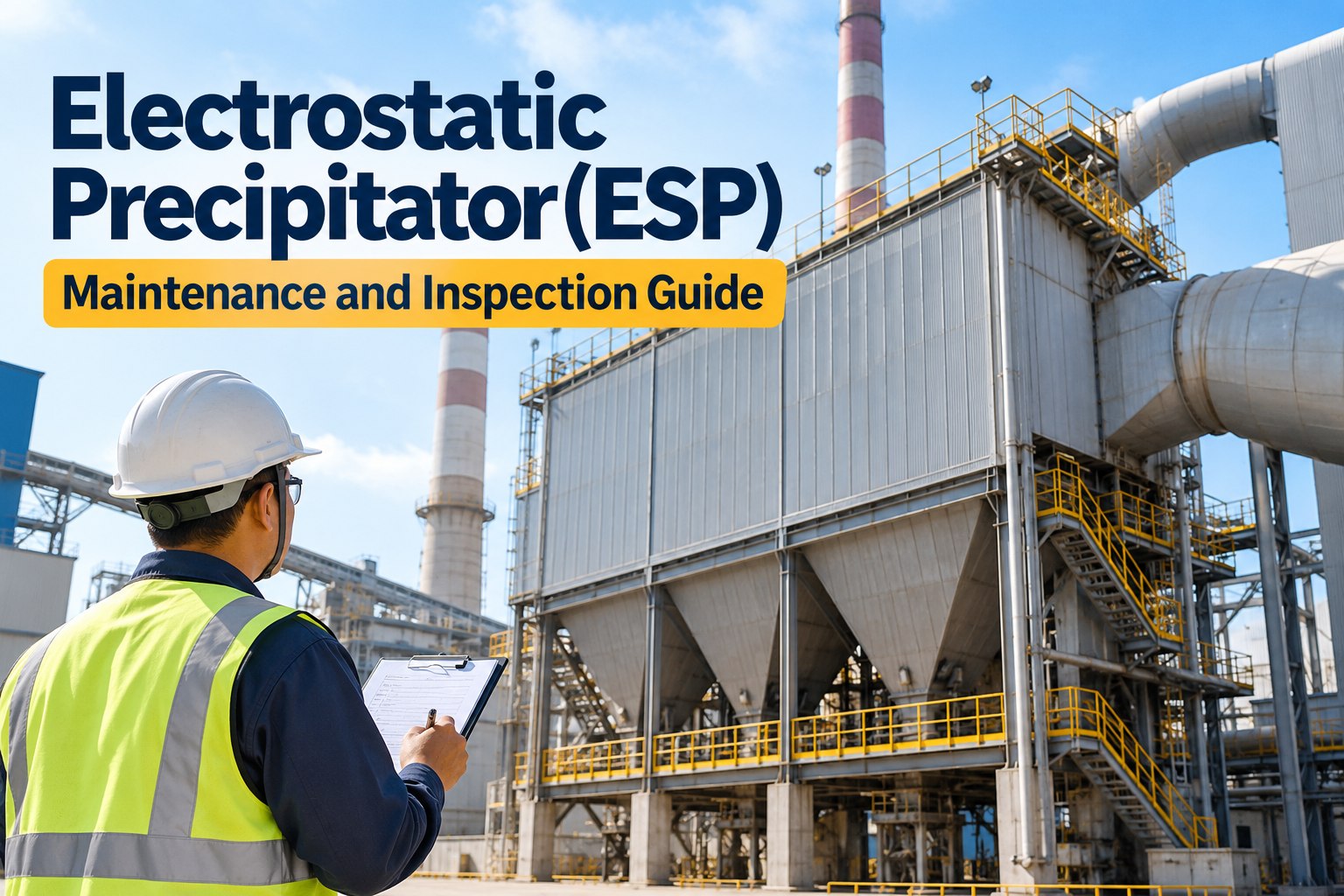
An electrostatic precipitator is the last thing standing between a boiler's fly ash and the stack — and it does its job silently until it doesn't. When electrodes misalign, a rapper stops, or a hopper plugs, collection efficiency slides and opacity climbs, which makes it a compliance problem before anyone treats it as a mechanical one. OXMAINT AI is the AI-powered maintenance management software that keeps every field, rapper, insulator and hopper on schedule, trends T/R health between outages, and turns a falling kV or rising opacity into a work order.
Power & Industrial · Emissions Control · ESP Maintenance · 2026
Electrostatic Precipitator (ESP) Maintenance & Inspection Guide
An ESP only holds its 99%-plus collection efficiency if every component is sound — and most of them can only be reached during an outage. OXMAINT AI, a power-plant maintenance platform, runs the whole program: component PM, rapper and heater schedules, T/R and field-health trending, hopper monitoring and outage inspection planning — so efficiency stays up, opacity stays down, and the record is ready for the regulator.
Charge
→
Collect
→
Rap
→
Clean Gas
ESP STATUS · UNIT 2
Field A45 kV OK
Field B42 kV OK
Field CLow kV / spark
Stack opacity12%
Hopper 3 levelHigh
Safety & scope: ESP internals carry lethal high voltage and hold a residual charge — units must be de-energized, grounded and locked out, and hoppers and casings are confined spaces. This guide is general; follow the manufacturer's procedures, NFPA 70E, confined-space and lockout rules, EPA and Title V requirements, and your AHJ, and use qualified personnel for all work.
99%+
particulate collection efficiency a well-maintained ESP holds
6
component systems to maintain: electrodes, plates, rappers, insulators, hoppers, T/R
Fields
energized in series — one field down pulls efficiency with it
CEMS
opacity and emissions watched continuously between outages
How an ESP Works — and Where It's Vulnerable
Maintenance makes more sense once the process is clear. An ESP charges the dust in the gas stream, pulls it onto grounded plates, knocks it loose into hoppers, and sends clean gas up the stack. Every stage has a component that, when it slips, shows up as lost efficiency.
1
Dirty gas enters
Flue gas laden with fly ash passes through the inlet and gas-distribution screens into the first field.
→
2
Particles charged
High-voltage discharge electrodes form a corona that puts a negative charge on the dust particles.
→
3
Dust collected
The charged particles migrate to the grounded collecting plates and build up as a dust layer.
→
4
Rapped to hoppers
Rappers strike the electrodes and plates, shedding the dust layer so it falls into the hoppers below.
→
5
Clean gas leaves
Cleaned gas exits to the stack; collected ash is removed from the hoppers for disposal or reuse.
Lose the charge, the collection, or the rapping and the dust ends up in the stack instead of the hopper. Start free and map your ESP fields and components in OxMaint.
The Six Components You Maintain
An ESP program is really the sum of six component systems, each with its own failure mode and its own maintenance focus. Here's what each one does and what goes wrong when it's neglected.
Discharge Electrodes
Fails by: breakage, erosion, misalignment
Produce the corona that charges the dust. A broken or shorted electrode kills charging in that lane and drives sparking.
Collecting Plates
Fails by: warping, corrosion, buildup
Grounded plates that hold the charged dust. Warped plates narrow clearances and cause sparking and re-entrainment.
Rappers
Fails by: seized linkage, bad timing
Knock the dust layer loose into the hoppers. A dead rapper lets dust cake, which insulates the plate and cuts efficiency.
Insulators & Heaters
Fails by: cracking, tracking, moisture
Isolate the high-voltage frame. Dirty or cracked insulators flash over and trip the field; heaters keep moisture off.
Hoppers
Fails by: plugging, bridging, fires
Collect and discharge the ash. A plugged hopper backs dust up into the field and can short it out — heaters and level sensors prevent it.
Transformer-Rectifier Sets
Fails by: winding faults, high spark rate
Supply the high-voltage DC to each field. Secondary kV, mA and spark rate are the live health signal of the ESP.
Watch all six and the efficiency takes care of itself; ignore one and it becomes the bottleneck. Book a demo to track every component in OxMaint.
The ESP Inspection Checklist
Work these five sections during the outage, after the unit is de-energized, grounded and locked out. Let qualified personnel sign each item, and keep the record dated for the next survey and the next outage plan.
Twenty checks, one record per ESP — the difference between an outage that fixes the right things and one that guesses. Start free and run this inspection with a dated record in OxMaint.
When Opacity Climbs: Symptom to Cause
Most ESP problems surface the same way — a number moves on the control room screen. Reading that signal back to the component saves hours of hunting.
Trend those signals over time and a developing fault shows itself long before it becomes an exceedance. Book a demo to trend field and opacity data in OxMaint.
A Field That Trips at 2 a.m. Is an Emissions Exceedance by Breakfast.
ESP faults rarely announce themselves until opacity crosses a limit. OxMaint trends each field's kV, the rappers, the hoppers and the opacity signal, and raises a work order the moment one drifts — so the fix happens before the number does.
How OxMaint Runs ESP Maintenance
Your crews do the climbing, cleaning and alignment. OxMaint runs the program around them — the schedules, the health trends, the outage plan and the compliance record.
Component Register & History
Every field, rapper, insulator, hopper and T/R set as its own asset, with its full service and failure history.
Rapper & Heater PM
Scheduled checks on rappers, insulator and hopper heaters, so the parts that fail quietly stay on a cadence.
T/R & Field Trending
Secondary kV, mA and spark rate logged per field and trended, so a weakening field is visible early.
Hopper & Ash Monitoring
Track hopper level, heater status and discharge, so a plugging hopper raises a job before it shorts a field.
Outage Inspection Planning
Build the internal inspection and work scope ahead of the outage, with lockout and confined-space steps attached.
Emissions & Compliance Records
Opacity trends, inspections and repairs timestamped per unit — the documentation a regulator asks for.
The hands-on work stays with your crew; the schedule, the trends and the proof live in one place. Sign up free and build your ESP program in OxMaint.
Reviewed by OxMaint Power & Emissions Operations
Content was checked against standard electrostatic precipitator maintenance and emissions-control practice for power and industrial plants. Component behavior, intervals and regulatory limits vary by design, fuel and jurisdiction — confirm against the manufacturer and your AHJ.
Frequently Asked Questions
What are the main components of an ESP?
Discharge electrodes that charge the dust, grounded collecting plates that capture it, rappers that knock it into hoppers, insulators that isolate the high-voltage frame, hoppers that remove the ash, and transformer-rectifier sets that power each field.
Why does ESP efficiency fall over time?
Usually from dust building up when rappers fail, electrodes breaking or misaligning, hoppers plugging, insulators tracking, or air inleakage. Each sheds a little efficiency until opacity rises.
Book a demo to catch it early.
How is an ESP inspected safely?
Only during an outage, after the unit is de-energized, grounded to bleed off the residual charge, and locked out. Hoppers and casings are confined spaces, so confined-space entry procedures apply throughout.
What do secondary kV and mA tell you?
They're the live health reading of each field. A falling kV with rising spark rate points to a short, misalignment or buildup; tracking them over time flags a weakening field before it trips.
How does a CMMS help with ESP compliance?
It schedules the component PMs, trends field and opacity data, and keeps timestamped inspection and repair records per unit — the evidence of a managed program that an emissions survey expects.
Keep the Ash in the Hopper, Not the Stack.
Put every ESP field and component on one platform with OXMAINT AI — component PM and rapper schedules, T/R and field-health trending, hopper monitoring, outage inspection planning and opacity records. Hold collection efficiency, stay ahead of opacity, and walk into any emissions survey with the proof in hand.