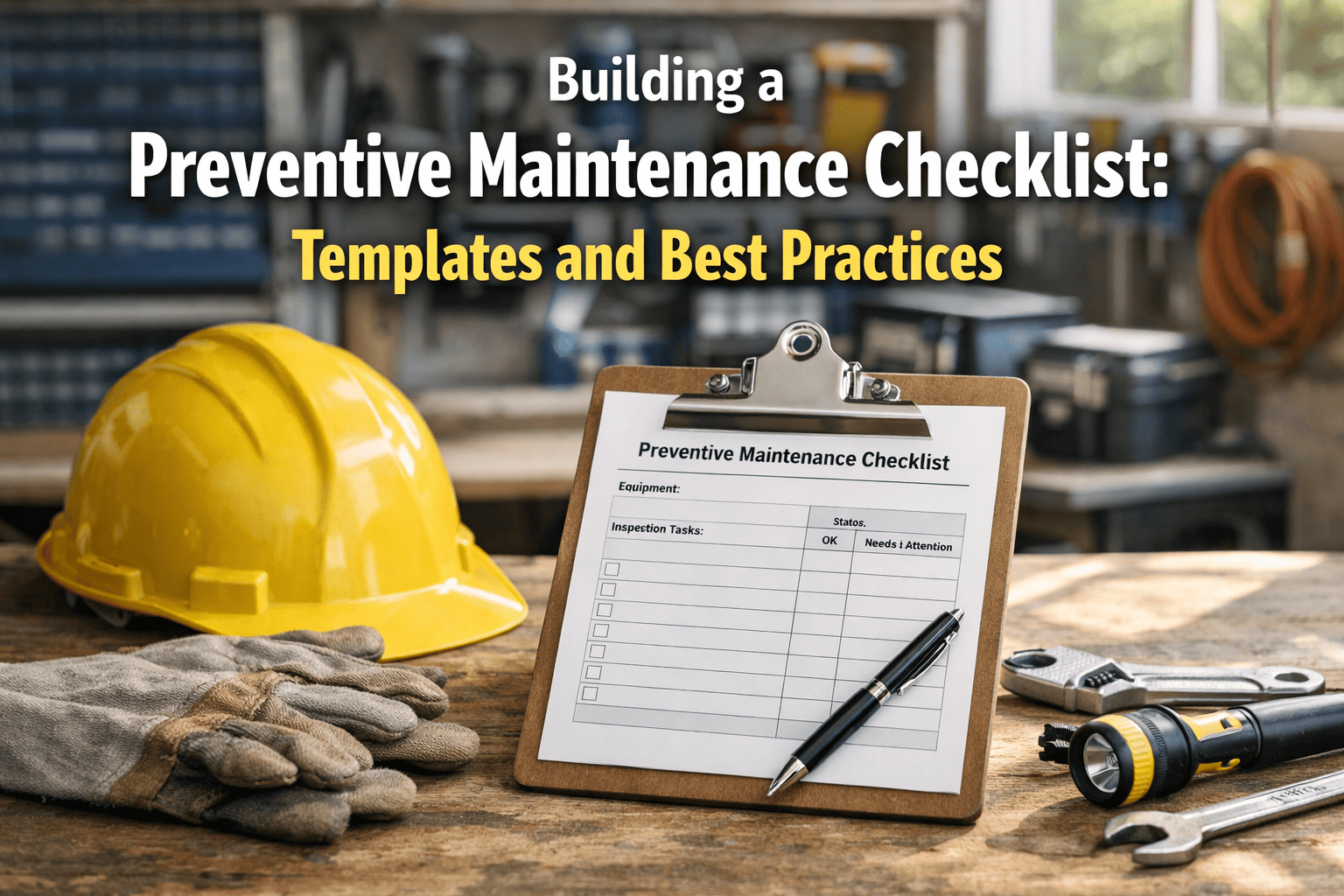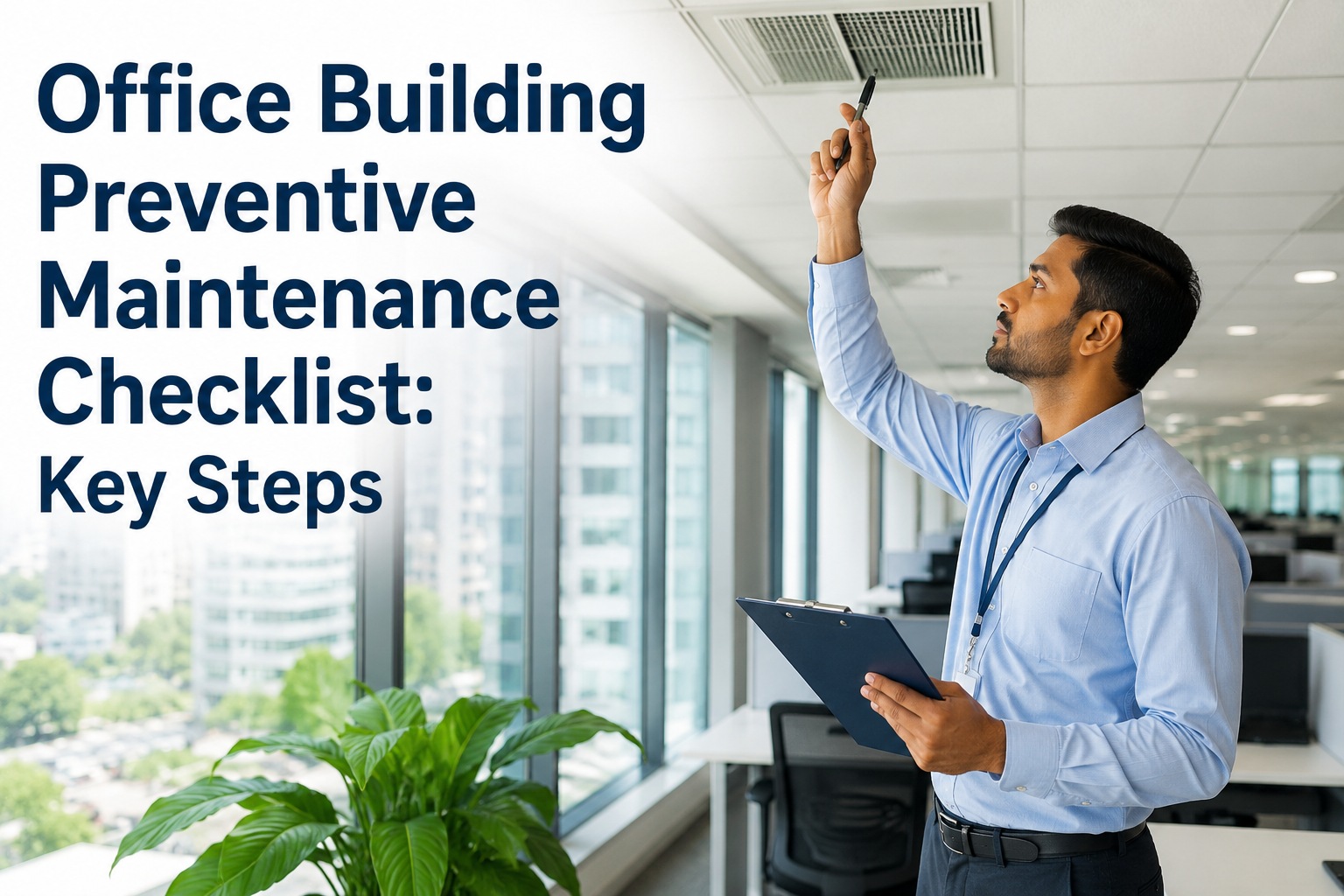
An office building preventive maintenance checklist is the structured set of recurring inspections and service tasks — HVAC, electrical, plumbing, life-safety, elevators, and building envelope — that keeps a commercial property compliant, efficient, and free of costly surprise failures. Done right, a documented preventive maintenance program can cut unplanned downtime by 30–50%, extend asset life by 20–40%, and keep you audit-ready for OSHA 1910 and local fire codes. Done from memory or a photocopied form, it becomes the reason a $400 capacitor turns into a $14,000 compressor replacement in the middle of July. This guide gives you a complete, field-ready office building preventive maintenance checklist with frequencies, thresholds, and OSHA-aligned checkpoints — plus how to digitize the whole program. If you want to skip the spreadsheet phase entirely, Start Free Trial and turn this checklist into auto-scheduled work orders today.
What Does a Complete Office Building Preventive Maintenance Checklist Actually Cover?
Six building systems. Dozens of checkpoints. Zero missed steps. Here is the exact structure high-performing facility teams run on every visit — from rooftop units to the fire panel.
- HVAC & Mechanical — filters, belts, coils, refrigerant, airflow readings
- Electrical & Lighting — panels, thermography, emergency circuits, load checks
- Life-Safety & OSHA 1910 — exits, extinguishers, alarms, egress lighting
- Envelope, Plumbing & Elevators — roof, façade, pumps, code inspections
Why Paper Checklists Fail Office Buildings (and What It Costs)
Industry benchmarking consistently shows reactive maintenance costs 3–5x more per repair than planned work — and buildings running mostly reactive programs spend up to 40% more on energy because degraded HVAC equipment works harder to deliver the same comfort.
A missed quarterly belt inspection does not announce itself. It shows up six months later as a failed air-handling unit on the hottest day of the year, an emergency callout at 2.5x labor rates, and 400 tenants emailing the property manager. Paper forms make this worse: no mandatory fields, no photo proof, no timestamped record when the OSHA 1910 audit or insurance claim arrives. A digital office building preventive maintenance checklist closes those gaps by design — every step required, every reading captured, every completion signed and stored against the asset.
Office Building Preventive Maintenance Checklist by System
A defensible office building preventive maintenance checklist covers six systems on defined intervals. Use these grids as your master template — each card is a checkpoint your technicians should touch, measure, and record.
HVAC & Mechanical
- Inspect/replace air filters (MERV 8–13 per IAQ spec)
- Check belt tension & wear; listen for bearing noise
- Verify thermostat/BAS calibration (±2°F)
- Clear condensate drains & pans; treat for algae
- Record supply/return air temperatures & static pressure
Electrical Systems
- Thermographic scan of panels & switchgear (annual min.)
- Torque-check lugs & connections on main panels
- Test GFCI outlets in wet locations (OSHA 1910.303)
- Exercise backup generator under load; log fuel levels
- Verify UPS battery health & runtime
Life-Safety & OSHA 1910
- Test emergency lighting & exit signs (30-sec monthly, 90-min annual)
- Inspect fire extinguishers — pressure, seal, access (1910.157)
- Verify egress paths clear; doors self-close & latch
- Test fire alarm pull stations & notification devices
- Check eyewash stations & first-aid cabinet stock
Plumbing & Water Systems
- Inspect for leaks at fixtures, valves & mechanical rooms
- Flush water heaters; test T&P relief valves
- Exercise sump & sewage ejector pumps; test floats
- Check backflow preventers (annual certification)
- Log domestic water pressure & temperature
Building Envelope & Roof
- Inspect roof membrane, flashing, drains & scuppers
- Check façade sealant, windows & expansion joints
- Clear gutters & downspouts; verify drainage away from slab
- Inspect parking surfaces, striping & ADA routes
- Document condition with dated photos for capital planning
Elevators & Special Systems
- Monthly: test emergency phone & alarm bell
- Annual: full safety inspection per ASME A17.1 (licensed vendor)
- Test firefighter recall Phase I & II operation
- Inspect machine room: temperature, lighting, housekeeping
- Log all service calls against the unit's asset record
Office Building Preventive Maintenance Schedule: What Happens When
Consistency beats intensity. A 12-story, 180,000 sq ft office tower running the schedule below typically logs 900–1,200 PM tasks per year — impossible to track on a wall calendar, trivial for a CMMS.
| Frequency | System | Key Tasks | Standard / Code |
|---|---|---|---|
| Monthly | HVAC, life-safety, elevators | Filters, belts, exit lights, extinguisher checks, elevator phone test | OSHA 1910.36–38, 1910.157 |
| Quarterly | Electrical, plumbing | Panel inspection, GFCI tests, pump exercise, leak survey | OSHA 1910.303, NFPA 70 |
| Semi-Annual | Roof, envelope, cooling/heating plant | Roof membrane inspection, coil cleaning, sealant survey | Manufacturer specs, ASHRAE 180 |
| Annual | Fire systems, elevators, backflow, thermography | Full alarm test, 90-min battery test, ASME A17.1 inspection, IR scan | NFPA 72, ASME A17.1, local AHJ |
| 3–5 Years | Capital & condition assessment | Property condition assessment, switchgear testing, chiller overhaul | ASTM E2018, ISO 55000 |
Notice how every row maps to a standard. That is the difference between a checklist and a compliance program: when an OSHA 1910 audit, insurance review, or tenant dispute lands, you are producing timestamped records — not reconstructing memory.
OSHA 1910 Requirements Your Building Checklist Must Satisfy
OSHA's General Industry standard (29 CFR 1910) applies directly to office building operations. Five subparts drive most facility citations — build each into your checklist as a mandatory, evidence-captured step.
Egress & Emergency Action Plans
Exit routes must be continuously unobstructed, exit doors unlocked from the inside, and emergency action plans maintained and drilled. Monthly walkthroughs with photo documentation prove ongoing compliance.
Portable Fire Extinguishers
Monthly visual inspections plus annual maintenance checks, with records retained. A digital checklist with e-signature creates the inspection log automatically — no binder to lose.
Electrical Systems
Panels must be accessible, labeled, and free of hazards; GFCI protection required in wet locations. Quarterly torque and thermal checks catch loose connections before they arc.
Walking-Working Surfaces
Floors, stairs, and ladders kept clean, dry, and in repair. Your envelope and grounds inspections feed directly into this subpart — document every repair with before/after photos.
Emergency Eyewash & First Aid
Where corrosives are present (battery rooms, chemical storage), eyewash stations need weekly activation checks and annual inspections. Missed checks are among the most-cited facility violations.
See This Checklist Running on Your Building — Book a 30-Minute Demo
We will load your asset list, map these PM intervals, and show you exactly how auto-generated work orders, mobile checklists, and audit-ready records work on your portfolio.
How OxMaint Turns This Checklist Into a Self-Running PM Program
A checklist on paper is a wish. In OxMaint, it is a scheduled, enforced, measured system — here is what changes on day one.
Auto-Scheduled PM Work Orders
Set each checklist interval once — monthly, quarterly, annual — and OxMaint generates and assigns work orders automatically. No calendar reminders, no missed cycles. Teams typically recover 8–12 admin hours per week.
Mobile Execution with Photo Proof
Technicians complete the digital office building preventive maintenance checklist on any phone: mandatory fields, meter readings, and before/after photo capture. Skipped steps are impossible — the work order cannot close incomplete.
E-Signatures & Audit-Ready Records
Every completion is signed, timestamped, and logged against the asset — exactly what an OSHA 1910 audit, insurer, or buyer's property condition assessment demands. Pull any asset's full PM history in seconds, not days.
PM Compliance Analytics
Dashboards show PM completion rate, overdue tasks, cost per asset, and repeat failures across one building or fifty. Spot the air handler that has eaten $6K in repairs this year and justify replacement with data, not anecdotes.
What Digitized PM Is Worth: A 180,000 Sq Ft Office Tower
Run the numbers on a typical Class-B office building: 240 tracked assets, 4-person engineering team, historically 65% reactive work.
(Emergency repairs avoided + Energy savings + Extended asset life) − Software cost = Net savings
| Value Driver | Before (Reactive) | After (OxMaint PM) | Annual Impact |
|---|---|---|---|
| Emergency callouts & rush parts | $38,000 | $15,000 | +$23,000 |
| HVAC energy waste (degraded equipment) | Baseline | 8–12% reduction | +$11,500 |
| Admin time on paper work orders | 10 hrs/week | 2 hrs/week | +$14,000 |
| Premature asset replacement (deferred PM) | 1 major failure/yr | Life extended 20–40% | +$9,000 |
| Total annual value | — | — | ≈ $57,500 |
Against a CMMS subscription measured in the low thousands per year, payback lands inside the first quarter — before counting the avoided risk of a single OSHA citation or a tenant lease lost to chronic comfort complaints.
Office Building Preventive Maintenance Checklist: Common Questions
What should an office building preventive maintenance checklist include?
Six systems on defined intervals: HVAC (filters, belts, coils monthly), electrical (panels, GFCI quarterly), life-safety (exit lights, extinguishers monthly per OSHA 1910), plumbing (pumps, leaks quarterly), building envelope (roof, façade semi-annually), and elevators (code inspections). Every task needs a frequency, a pass/fail threshold, and a documented record.
How often should office building preventive maintenance be performed?
It varies by system: HVAC filters and life-safety checks monthly, electrical and plumbing quarterly, roof and envelope semi-annually, and fire alarm, elevator, and thermographic inspections annually. Manufacturer specs and local codes always override generic intervals — log whichever is stricter.
Does OSHA 1910 apply to office buildings?
Yes — 29 CFR 1910 General Industry standards cover office facility operations, including egress (1910.36–38), fire extinguishers (1910.157), electrical safety (1910.303), and walking-working surfaces (1910.22). Serious violations carry penalties over $16,000 each, and inspection records are your primary defense.
How do I digitize a paper building maintenance checklist?
Load your asset list into a CMMS, attach each checklist as a PM template with its interval, and let the system auto-generate work orders. With OxMaint, technicians execute on mobile with mandatory fields, photo capture, and e-signatures — Start Free Trial and you can have your first building live in an afternoon.
What is the ROI of preventive maintenance software for office buildings?
Documented programs cut unplanned downtime 30–50%, reduce energy waste 8–12%, and extend asset life 20–40%. A mid-size tower typically realizes $40K–$60K in annual value against a low-four-figure software cost — payback inside one quarter. Book a Demo and we will model it on your actual portfolio.
Stop Running Your Building From a Clipboard
Put this office building preventive maintenance checklist on autopilot — auto-scheduled work orders, mobile execution, photo proof, and audit-ready records for every asset you manage.
Free 14-day trial · No credit card · Live in one afternoon