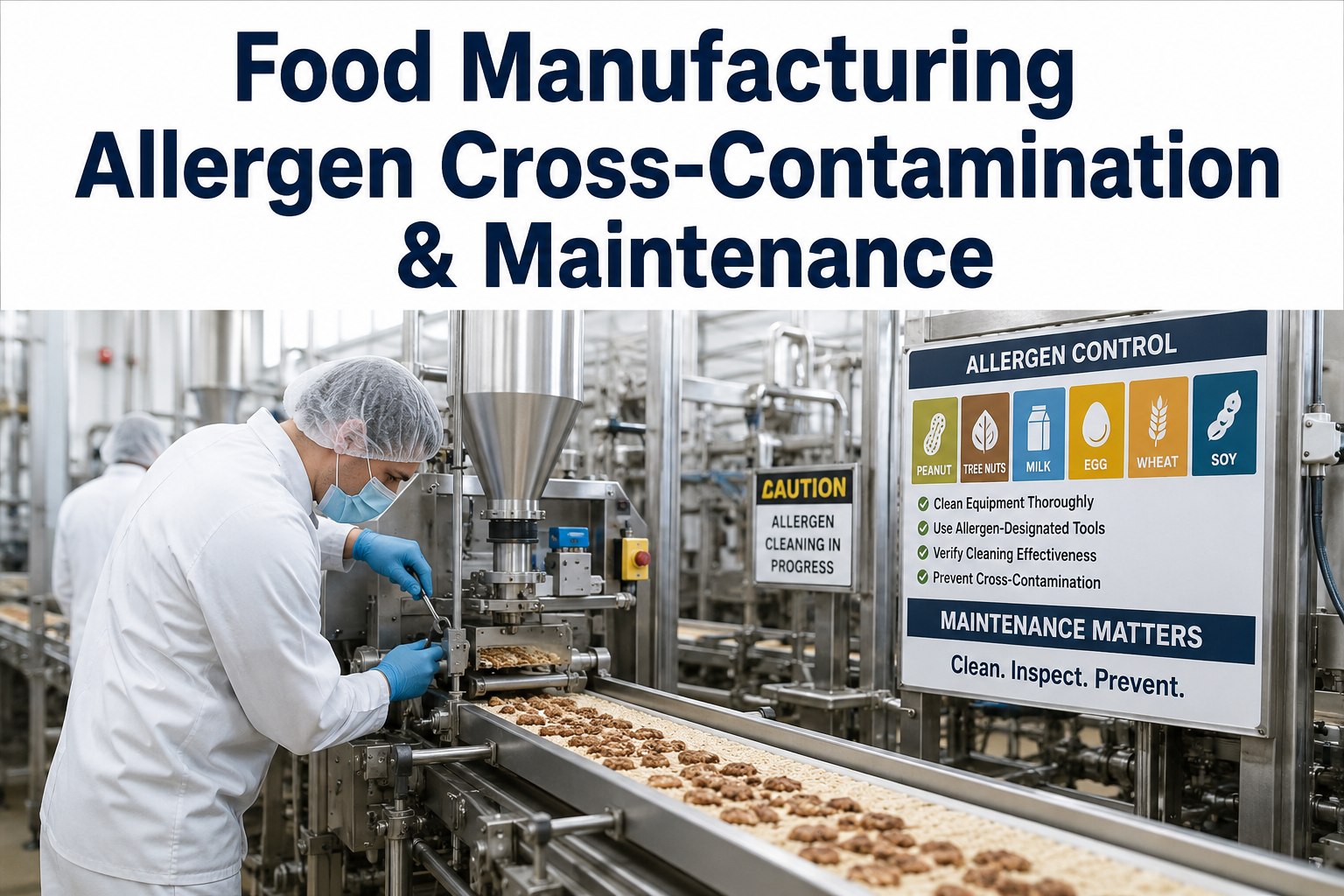
Food allergen cross-contamination is one of the highest-stakes risks in food manufacturing — a single shared surface, missed gasket, or undocumented changeover can trigger a Class I recall costing $10M or more. Effective food allergen maintenance goes beyond sanitation chemistry: it requires rigorous equipment teardown protocols, allergen cleaning verification, and CMMS-backed documentation that proves every maintenance step was completed, signed, and auditable. OxMaint gives sanitation and reliability teams the preventive maintenance structure, digital work orders, and real-time compliance records needed to make HACCP, FSMA, and BRC allergen control fully defensible. Stop relying on paper logs and tribal knowledge — Start Free Trial to see how a connected CMMS transforms your allergen changeover workflow.
One undocumented changeover. One recall. Is your maintenance log audit-ready?
Undeclared allergens drove over 40% of FDA food recalls last year — and most trace back to shared equipment, rework paths, and maintenance gaps you can't see on a clipboard. OxMaint digitizes every teardown, verification check, and sanitation PM so your allergen cross-contamination controls are defensible the moment an auditor walks in.
Why allergen cross-contamination control is a maintenance problem, not just a sanitation problem
Sanitation teams own the cleaning chemistry, but maintenance teams own the physical integrity of the equipment that makes cleaning effective. A worn shaft seal on a filler, a scratched conveyor belt, or a gasket left unseated after a repair can harbor protein residues at levels detectable by swab — long after the CIP cycle reads "clean." When allergen cross-contact prevention fails, root cause analysis almost always points back to a maintenance gap that was never documented.
Under FSMA's preventive controls rule and BRCGS Global Standard for Food Safety Issue 9, food manufacturers must maintain allergen management programs that are verified, documented, and regularly reviewed. That means every allergen changeover maintenance event — gasket swap, filter replacement, conveyor disassembly — needs a traceable work order, a verified reassembly check, and a sign-off tied to a named technician. Paper logs don't survive that scrutiny. Spreadsheets don't either. A purpose-built food safety CMMS like OxMaint does.
The allergen changeover maintenance checklist food plants must verify every time
Every allergen-to-non-allergen changeover — or switch between different allergen profiles — demands a structured teardown, cleaning, and reassembly sequence. These are the maintenance-critical steps that should live as mandatory checklist items inside every OxMaint allergen changeover PM template, not on a laminated sheet taped to the wall.
- Confirm allergen profile of previous run and flag shared-surface risk in the work order
- Lock out / tag out equipment per OSHA 1910.147 before any disassembly begins
- Verify dedicated allergen-tooling kit is staged — no shared wrenches or scrapers across lines
- Photograph equipment baseline state and attach to the digital work order in OxMaint
- Remove all gaskets, O-rings, seals, and screens for individual inspection and cleaning
- Document worn or cracked seals — replace if protein-trap risk is detected
- Verify CIP/COP cycle parameters (time, temp, concentration, flow) match the validated master
- Record any deviation from the validated cleaning recipe as a nonconformance in the CMMS
- Conduct allergen-specific ATP or protein swab at pre-defined high-risk zones (5 ppm threshold)
- Record swab results directly in the OxMaint mobile app — pass/fail tied to the asset ID
- Reassemble with new or verified-clean gaskets; torque values logged per SOP
- QA supervisor e-signs the work order before the line is released for the next product run
- Work order auto-stamps technician name, timestamp, duration, and asset location
- Failed swabs trigger a corrective-action work order with root-cause category
- All records archived in a searchable, FSMA- and BRC-ready audit trail
- 30/60/90-day trend reports surface recurring contamination hotspots by asset
Allergen equipment maintenance records auditors actually want to see
During a BRCGS or SQF audit, the question is never "do you have a procedure?" — it's "prove this specific asset was maintained correctly on this specific date." Auditors want chronological, asset-level proof that teardown, cleaning, verification, and reassembly all happened in the right order, by trained people, with deviations escalated. Here's what that record looks like in a paper system versus a connected CMMS.
| Audit Requirement | Paper Logbook / Spreadsheet | OxMaint CMMS Record |
|---|---|---|
| Asset-specific changeover history | Handwritten entries across multiple binders; difficult to filter by line or allergen | Every work order auto-linked to asset ID, allergen profile, and changeover sequence |
| Technician identity & training status | Initials on paper; training matrix in a separate Excel file rarely cross-referenced | Digital sign-off with name, role, and certification expiry checked at login |
| Cleaning verification results | Swab numbers written on a form; failures flagged verbally, often not escalated | Pass/fail swab data entered in mobile app; auto-triggers corrective work order on fail |
| Deviation & CAPA traceability | Sticky notes, email chains, or a logbook margin annotation | Nonconformance module links deviation to root cause, CAPA, and re-verification |
| Trend analysis across changeovers | Manual data entry into a monthly summary report — if someone has time | Dashboard auto-surfaces repeat-fail assets, mean time between cleanings, and risk scores |
A mid-sized bakery operation running 12 allergen changeovers per shift on shared mixing and depositing lines can generate over 3,000 changeover records per month. On paper, finding a single 3-month-old record for an FDA investigator takes hours. In OxMaint, it takes a 10-second asset-history query — with the swab result, technician name, and any corrective action attached.
What a $42K allergen recall looks like — and how CMMS structure prevents it
Consider a 180-asset snack food plant running shared extrusion and packaging lines across tree-nut and non-nut products. A maintenance technician replaces a worn discharge nozzle on the extruder but doesn't log the gasket inspection. The old gasket, micro-cracked and harboring almond protein, goes back in. The next run is a "nut-free" product. Three weeks later, a consumer complaint triggers testing — the product tests positive at 8 ppm. The plant initiates a voluntary recall of 240,000 units.
The root cause: a maintenance step that existed in the SOP but was never enforced, verified, or documented. With OxMaint, that gasket inspection is a mandatory checklist item inside the extruder's allergen changeover PM. The technician can't close the work order without photographing the gasket, recording its condition, and getting a QA e-signature. If the swab fails, the line stays locked. The recall never happens.
How OxMaint makes food allergen management defensible, traceable, and audit-ready
OxMaint is built for maintenance and reliability teams in regulated food manufacturing environments. Every feature maps directly to the documentation, verification, and trending demands of HACCP allergen maintenance and FSMA preventive controls. Here's how specific capabilities translate into measurable food safety outcomes.
Allergen Changeover PM Templates
Build mandatory teardown, cleaning, and verification checklists per asset and allergen profile. Technicians can't close a work order until every step — including swab results and gasket photos — is completed and signed.
Asset-Level Allergen Risk Profiles
Tag every asset with its allergen exposure, shared-surface connections, and last verification date. OxMaint flags equipment due for allergen-specific PMs and surfaces high-risk assets before changeovers begin.
FSMA & BRC Audit-Ready Records
Every work order auto-captures technician, timestamp, duration, parts used, and verification data. Generate a filtered asset-history report for any date range in under 10 seconds when an investigator asks.
Contamination Trend Analytics
Dashboards track repeat swab failures, mean time between cleanings, and asset-level contamination risk scores. Spot the filler that fails verification 3x more often than its identical twin — before it causes a recall.
See how OxMaint protects your allergen changeovers in 30 minutes
We'll map your shared equipment, build a sample allergen changeover PM, and show you the audit trail your next BRC or FSMA inspector will want to see.
Food allergen maintenance & CMMS compliance: what teams ask most
What is allergen cross-contamination in food manufacturing?
Allergen cross-contamination (also called cross-contact) occurs when an allergen protein transfers from one food product, surface, or piece of equipment to another product that is not intended to contain that allergen. In shared-line manufacturing, the most common vectors are residue left on equipment after inadequate cleaning, worn seals and gaskets that trap protein, and shared utensils or tools. Preventing it requires validated cleaning protocols, physical equipment teardown, and documented verification — all coordinated between sanitation and maintenance teams.
How does a CMMS support allergen cleaning verification?
A food safety CMMS like OxMaint digitizes the entire verification workflow: the allergen changeover PM template requires technicians to enter swab results, photograph cleaned surfaces, and obtain QA e-signature before the work order can close. Failed swabs automatically trigger a corrective-action work order tied to the same asset, ensuring the deviation is documented, investigated, and resolved — not lost in a notebook. You can Start Free Trial today to see the full verification workflow on your own assets.
What records does FSMA require for allergen changeover maintenance?
Under FSMA's preventive controls rule, food facilities must maintain records showing that allergen controls — including cleaning and changeover procedures — were implemented, monitored, verified, and corrected when deviations occurred. For maintenance, that means asset-specific work orders documenting teardown, cleaning verification results, technician identity, reassembly checks, and any corrective actions. Records must be retained for 2 years and available for FDA inspection within 24 hours of request.
How often should allergen equipment be inspected for cross-contact risk?
High-risk shared equipment — fillers, depositors, conveyors, mixers, and packaging lines that run both allergen and non-allergen products — should undergo a documented teardown and gasket/seal inspection at every allergen changeover. For continuously shared lines, a risk-based preventive maintenance schedule should also include quarterly deep-inspection PMs that go beyond routine cleaning to check for micro-cracks, seal wear, and product-zone integrity. OxMaint's asset risk profiles help you prioritize these inspections by allergen exposure and historical swab-fail data.
Can OxMaint integrate with our existing HACCP and food safety plan?
Yes. OxMaint is designed to sit alongside your HACCP plan as the execution and documentation layer for maintenance-related control points. You can map each HACCP allergen control point to a specific PM template, asset, and verification checklist inside OxMaint — so the maintenance actions your HACCP plan requires are the same actions the CMMS enforces, tracks, and reports on. To see a custom mapping for your facility, Book a Demo with our food safety team.
Don't let one undocumented gasket become your next recall
Join the food manufacturers using OxMaint to digitize allergen changeovers, verify every cleaning, and walk into every audit with a complete, searchable, defensible maintenance record.
Free 14-day trial · No credit card