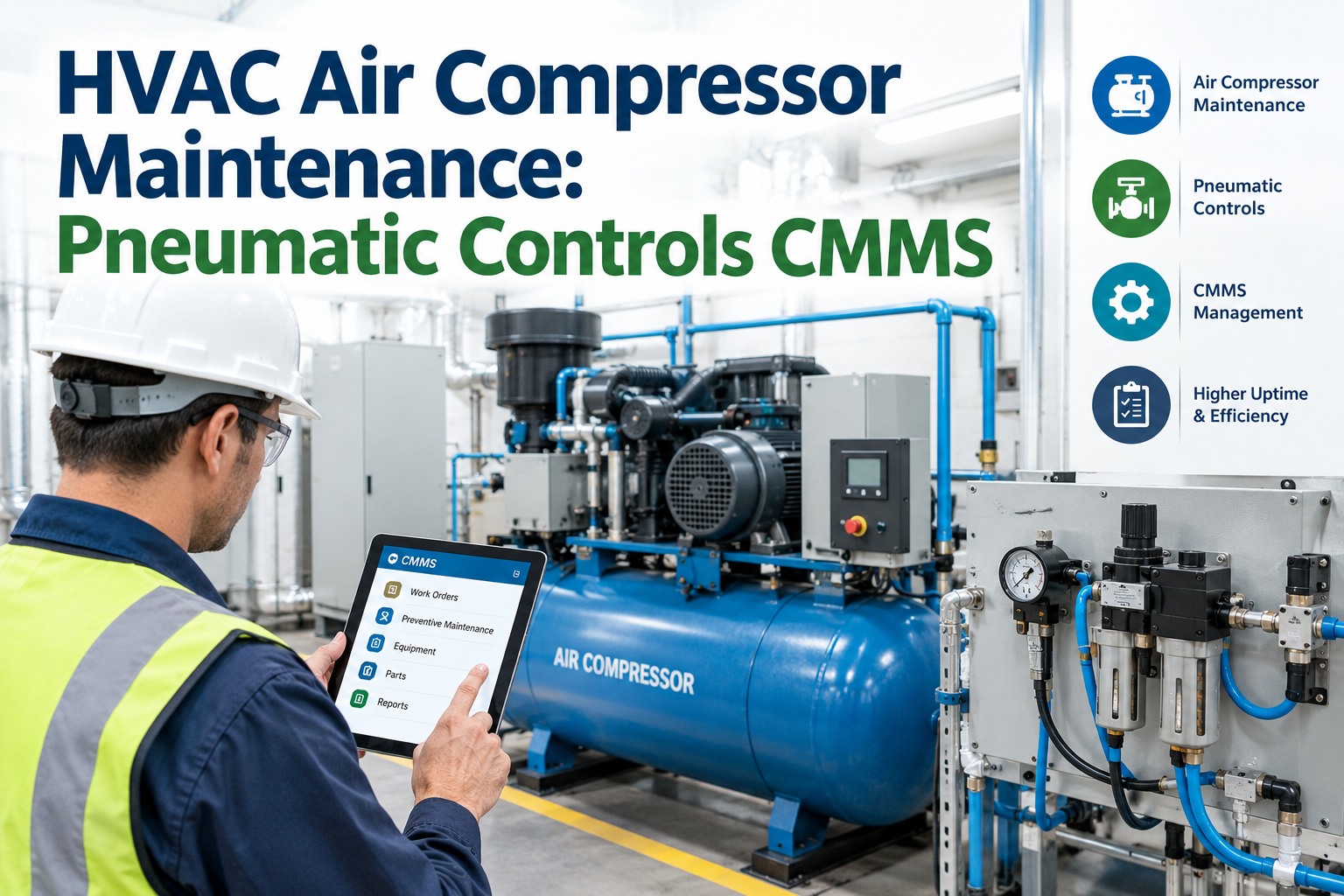
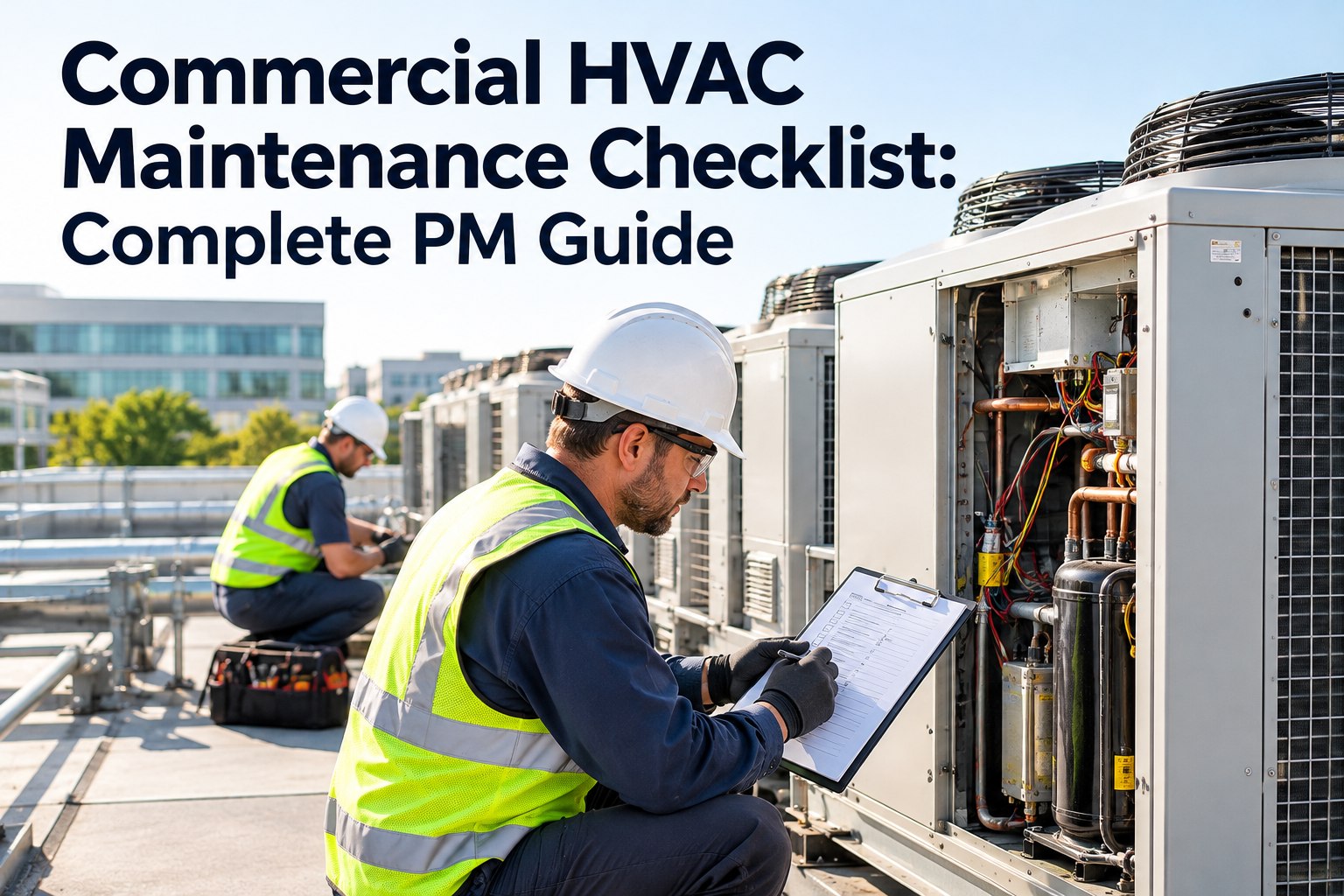
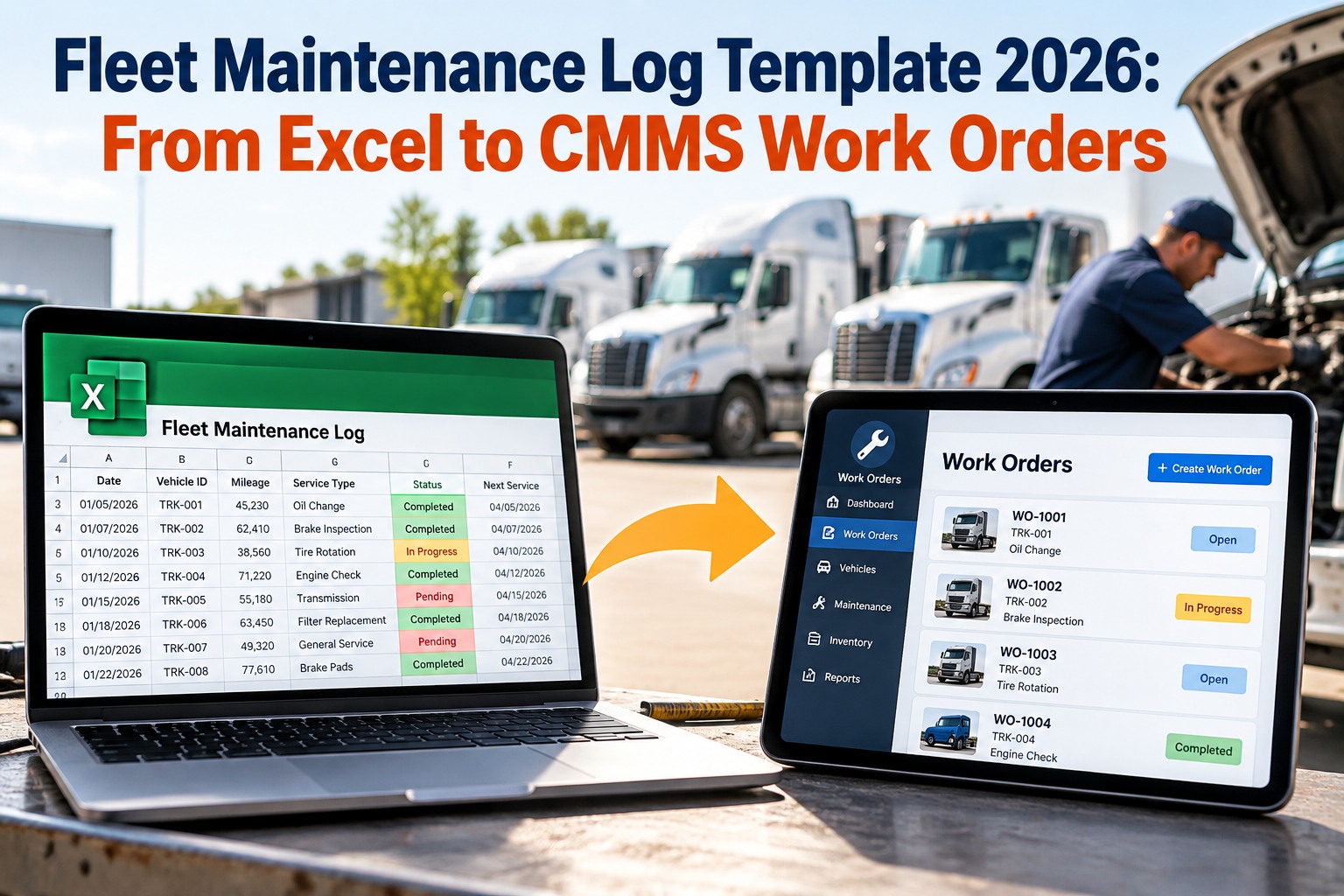
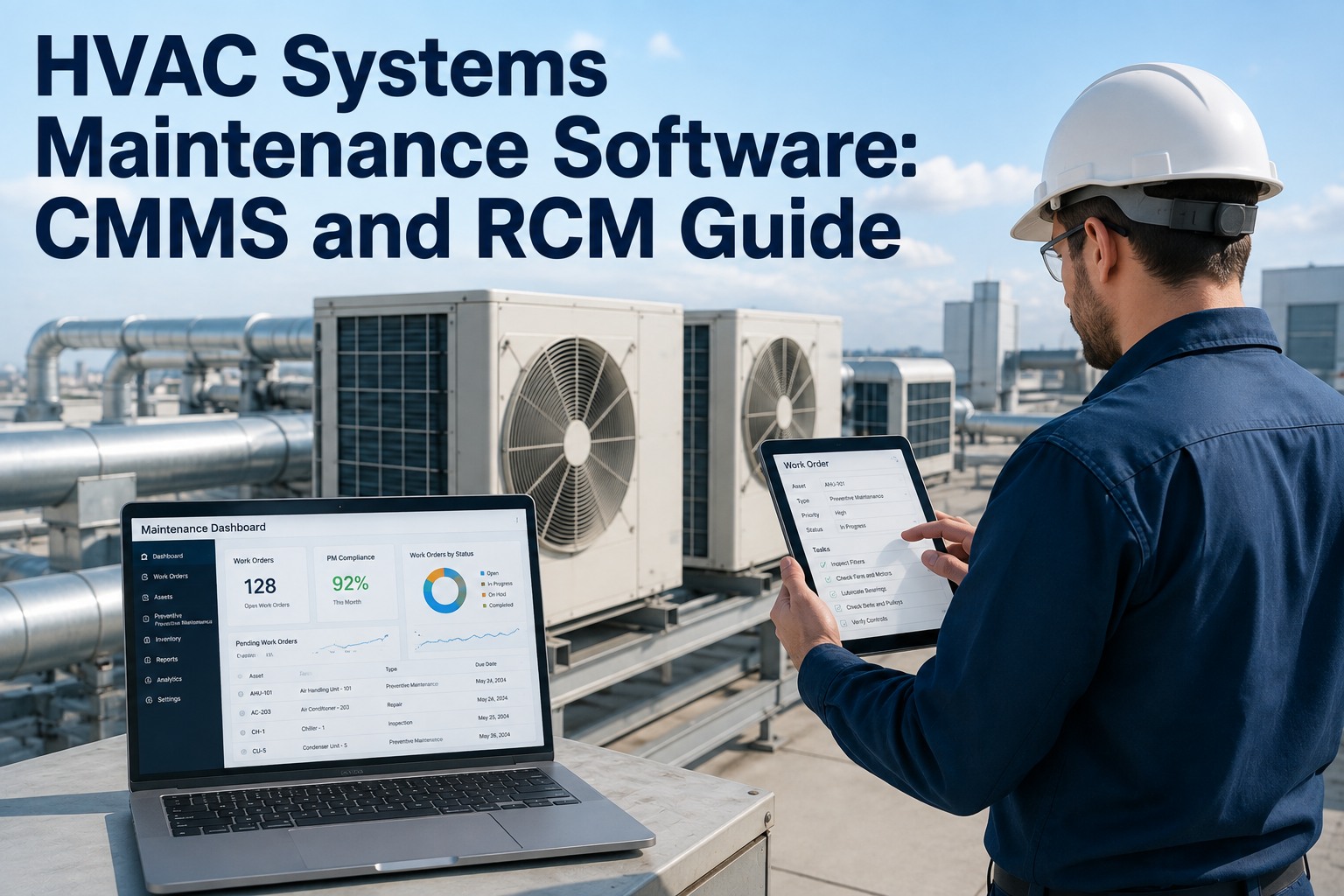
Walk into any commercial building put up before 2000 that hasn't had a controls overhaul, and there's a good chance the thermostats, dampers, and valves are still run by compressed air. Pneumatic HVAC controls are durable and simple — but they live or die on one thing: clean, dry air at a steady pressure. Let moisture, oil, or a pressure drift into the lines and the whole building starts to "hunt" — rooms too hot, rooms too cold, and a maintenance team chasing comfort complaints that all trace back to a compressor and dryer nobody's servicing. This guide covers HVAC air compressor and pneumatic-control maintenance: the compressor and dryer PM, air-quality management, leak surveys, calibration, and how facility teams keep pneumatics reliable while planning a smart transition to DDC. Start free or book a demo.
Facility Management · Commercial HVAC · Pneumatic Controls · Compressed Air · CMMS · 2026
HVAC Air Compressor Maintenance: Clean, Dry Air Is the Whole Job
A pneumatic control system is only as good as the air feeding it. Keep the compressor, dryer, and filters delivering clean, dry, stable-pressure air and the controls run for decades; neglect them and every thermostat in the building drifts. Here's the maintenance discipline — and the transition plan for when it's time.
3–15 psi
the branch-line signal range every pneumatic thermostat and actuator depends on
15–30%
energy savings typically seen after a DDC controls modernization — the transition case
Why Air Quality Is the Entire Game
Pneumatic controls require clean, dry air — that's not a preference, it's the operating principle. The compressor produces air at 15–20 psi, the dryer and filters strip out moisture and oil, and that conditioned air travels through copper or plastic tubing to every control point, where a thermostat modulates it in the 3–15 psi range to stroke a damper or valve. Let moisture through and it corrodes components, freezes in lines, and makes controls sluggish; let pressure drift and setpoints wander. Every comfort complaint in a pneumatic building starts at the air supply. Sign up free — no credit card and put the compressor, dryer, and filter PM on a schedule that actually holds.
The Air Path — Every Stage a Maintenance Point
1Compressor
Produces air at 15–20 psi
→
→
3Filters
Strip oil & particulate
→
4Tubing
Distributes clean air
→
5Controls
Modulate at 3–15 psi
A failure at any upstream stage shows up as a comfort complaint downstream — which is why the compressor room is where troubleshooting should start, not end.
The Compressor & Dryer PM That Protects Everything Downstream
The air source carries the whole system, so its PM is non-negotiable. These are the recurring tasks that keep the air clean, dry, and at pressure — miss them and the failures propagate to every control point in the building. Schedule a 30-minute demo to build these as recurring PM tasks per asset.
Auto-Drain & Moisture Removal
Verify the compressor's auto-drain and dryer are actually purging condensate. Moisture is the number-one enemy of pneumatic reliability — trapped water corrodes and freezes lines.
Filter Replacement
Change coalescing and particulate filters on interval before they load up and pass oil or dust downstream into sensitive thermostats and transducers.
Compressor Oil & Mechanicals
Oil changes, belt and coupling checks, and drain-valve service — the mechanical upkeep a compressor needs to keep running as a 24/7 duty asset.
Pressure Switch & Setpoint
Verify and calibrate the pressure switch so the compressor cycles within spec and holds the 15–20 psi supply the branch lines depend on.
Dryer Performance Check
Confirm the dryer is holding dewpoint under load — a dryer that's failing quietly is the hardest fault to trace from a comfort complaint alone.
Duplex / Lead-Lag Rotation
On duplex compressors, verify lead-lag alternation so both units share runtime — the redundancy that keeps controls alive if one compressor drops.
Forty Comfort Complaints. One Failing Dryer.
The tickets came in from every floor — too hot, too cold, rooms that wouldn't hold setpoint. Techs chased individual thermostats for a week before someone checked the mechanical room: the air dryer had quietly stopped pulling moisture, and damp air was making every control in the building sluggish. OxMaint puts the compressor, dryer, and filters on scheduled PM with the whole air system as linked assets — so the dryer check happens before the moisture reaches the floors, and a comfort complaint has a maintenance history to trace instead of forty separate guesses.
Leak Surveys & Calibration: The Recurring Disciplines
Beyond the source, two recurring jobs keep a pneumatic system honest. Leaks bleed pressure and force the compressor to overwork; drift pulls controls off setpoint. Both are invisible until they've degraded comfort and run up energy cost — which is why they belong on a schedule, not a complaint response. Create your free account and schedule leak surveys and calibration as recurring work.
Leak Surveys
Air leaks at fittings and tubing silently degrade performance and make the compressor run harder and longer. Survey the distribution network with soap solution or an ultrasonic leak detector, tag and repair every leak, and verify supply pressure holds at points throughout the system. All connections must be airtight — a system full of small leaks is a compressor wearing out early.
Sensor & Actuator Calibration
Calibrate pneumatic thermostats and sensors so output stays accurate within the 3–15 psi range, verify proportional band and sensitivity, and confirm damper and valve actuators stroke fully with linkages properly adjusted. Pneumatics need routine calibration to hold setpoint — the recurring task DDC eliminates, and the one most often skipped until comfort suffers.
Maintain Well Today, Plan the DDC Transition Deliberately
Good maintenance keeps a pneumatic system reliable — but it's worth being honest about the trajectory. The technician pool that understands pneumatics is shrinking, the compressor is a standing maintenance load, and DDC delivers 15–30% energy savings with remote monitoring and no air to condition. The smart play isn't rip-and-replace — it's maintain the current system well while planning a phased transition, often via a hybrid path that keeps fast pneumatic actuators driven by DDC through E-to-P transducers. Schedule a live walkthrough to see both the PM program and the transition tracked in one system.
Air-System Assets Linked
Compressor, dryer, filters, and tubing network modeled as linked assets, so a comfort complaint traces upstream to the air source instead of a week of thermostat guesses.
Recurring PM Scheduling
Auto-drain checks, filter changes, oil service, and dryer performance scheduled on interval or runtime — the discipline that keeps clean, dry air flowing.
Leak-Survey & Calibration Routines
Recurring leak surveys and calibration rounds as scheduled work orders with documented results — so drift and leaks are caught before comfort suffers.
Complaint-to-Asset History
Comfort tickets logged against the control point and the air system, building the history that turns recurring complaints into a diagnosed root cause.
Consumables & Spares Tracking
Filters, oil, and dryer media tracked as inventory with reorder points, so a PM never stalls waiting on a part that should have been on the shelf.
Transition Planning Data
Maintenance cost and failure history per zone build the business case for a phased DDC upgrade — and track the retrofit as it rolls out floor by floor.
Keep the compressor and dryer on disciplined PM, survey leaks and calibrate on a schedule, and log every complaint against the air system — and a legacy pneumatic building runs reliably today while the data quietly builds the case for tomorrow's upgrade. Sign up free or schedule a demo to see it on your building.
"
We run three buildings still on pneumatic controls, and for years the compressor room was an afterthought — until a failing dryer turned into a week of chasing phantom thermostat problems across two floors. Putting the whole air system into OxMaint fixed the blind spot: the dryer and filter PMs come up on schedule, leak surveys are logged work orders, and when a comfort complaint lands I can see the air-supply history behind it. It's also quietly building our DDC business case — I can show ownership exactly what each pneumatic zone costs us to maintain, floor by floor.
Director of Facilities · Commercial Office Portfolio
Frequently Asked Questions
Why do pneumatic controls need clean, dry air?
Because the air is the control signal. Moisture corrodes and freezes lines and makes controls sluggish, while oil and particulate foul sensitive thermostats and transducers. The compressor, dryer, and filters exist to keep that signal clean — which is why they're the heart of the maintenance program.
What pressures does a pneumatic HVAC system run at?
The compressor typically supplies main air at 15–20 psi, and control branch lines operate in the 3–15 psi range where thermostats modulate pressure to stroke dampers and valves. Holding both ranges steady is the point of the PM program.
What are the core compressor maintenance tasks?
Verifying the auto-drain and dryer purge moisture, replacing coalescing and particulate filters on interval, changing compressor oil and checking mechanicals, calibrating the pressure switch, and confirming lead-lag rotation on duplex units.
How do you find leaks in a pneumatic system?
Survey fittings and tubing with a soap solution or an ultrasonic leak detector, tag and repair every leak found, and verify supply pressure holds at points throughout the network. Leaks make the compressor overwork and wear out early.
Should we upgrade to DDC or keep the pneumatic system?
Maintain what you have well while planning a deliberate transition. DDC delivers 15–30% energy savings, remote monitoring, and no air to condition — but a phased or hybrid path (DDC driving pneumatic actuators via E-to-P transducers) is usually smarter than rip-and-replace.
How does a CMMS help with pneumatic HVAC?
It schedules compressor, dryer, and filter PM, tracks leak surveys and calibration as recurring work, links comfort complaints to the air system for root-cause tracing, and builds the cost history that supports a DDC business case.
Sign up free to set it up.
Keep the Air Clean, Dry, and On Schedule.
OxMaint schedules compressor, dryer, and filter PM, tracks leak surveys and calibration, links comfort complaints to the air system, and builds the cost data behind your DDC business case. Start free — no credit card. Or book a demo.