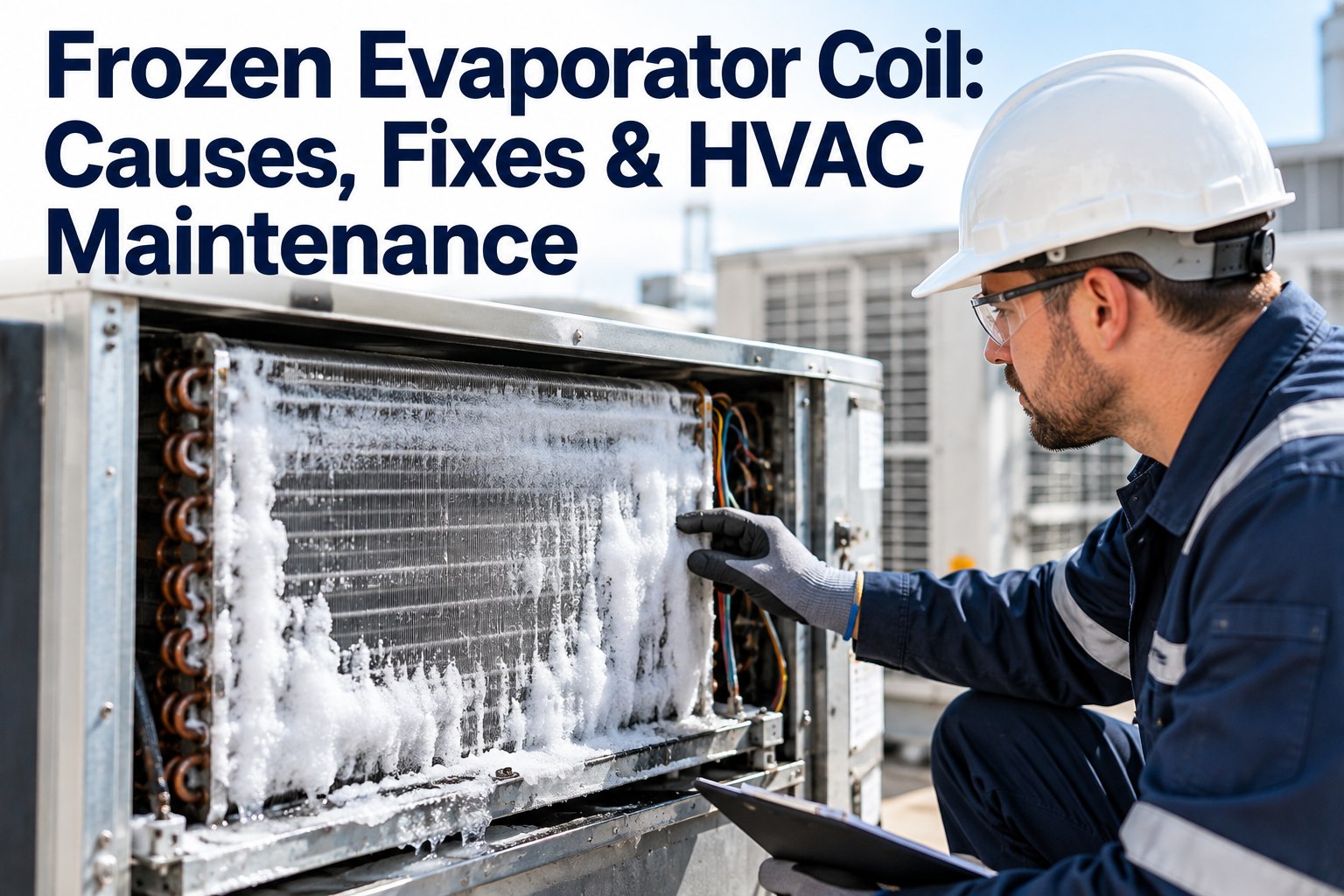
A frozen evaporator coil looks like an ice problem, but it's really a symptom — the coil is telling you that something upstream has broken the balance between airflow and refrigerant. Ignore it and the same block of ice that's starving your cooling is quietly setting up a compressor burnout, the single most expensive failure in the system. The frustrating part: nearly every freeze event announces itself for days through falling airflow, drifting temperatures and rising filter pressure. This guide covers why commercial coils freeze, how to thaw and diagnose them safely, and how OXMAINT AI catches the precursors before ice forms. See it on your units with a live demo.
Commercial HVAC · Evaporator Coils · Troubleshooting & PM · 2026
Frozen Evaporator Coil: Causes, Fixes & HVAC Maintenance
A frozen coil is never the root problem — it's the visible end of an airflow or refrigerant fault that also threatens your compressor. OXMAINT AI is the AI-powered CMMS that trends the early signals — airflow drops, refrigerant anomalies, filter loading — and turns them into work orders before the coil ever ices over.
Sensor & inspection signals
→
Root cause flagged
→
Prioritized work order
→
Predictive PM
One platform, signal to PM
Airflow & refrigerant trends watched
Filters changed on pressure, not calendar
Repeat-freeze root causes surfaced
Compressor protected from ice damage
The Freeze Mechanism: One Broken Balance
Every freeze traces back to a single physics problem. A healthy coil stays above freezing because warm return air keeps feeding it heat as the refrigerant absorbs it. Break either side of that balance — too little warm air, or refrigerant running too cold — and the coil surface drops below 32°F. Moisture in the air freezes onto it, and here's the trap: that ice blocks even more airflow, which drops the temperature further, which grows more ice. It's a runaway loop that ends in a fully blocked coil. Start free and trend the balance before it tips in OXMAINT AI.
1
Airflow drops or refrigerant runs cold
→
2
Coil surface falls below freezing
→
3
Airborne moisture freezes on the coil
→
4
Ice blocks more airflow
↺
5
Runaway freeze → coil fully iced
The 6 Causes — Split by Which Side They Break
Because freezing is a balance problem, every cause sits on one of two sides: it either starves airflow or it makes the refrigerant too cold. Sorting them this way tells you where to look first — and airflow starvation, led by the dirty filter, is by far the most common. Book a demo to see cause diagnosis in OXMAINT AI.
Airflow Side · Most Common
Dirty Air Filter
The #1 cause. A clogged filter starves the coil of warm return air until its surface drops below freezing.
Blocked Vents & Ducts
Obstructed returns, collapsed ducts or furniture over a grille cut airflow below the minimum the coil needs.
Failing Blower Motor
A motor running slow or intermittently moves too little air across the coil even when filters are clean.
Dirty Coil Surface
Dirt insulates the coil so it can't absorb heat — and a fouled coil can cut system efficiency by up to 40%.
Refrigerant Side
Low Refrigerant / Leak
A leak drops coil pressure; the remaining refrigerant expands and runs colder, freezing the coil even with good airflow.
Thermostat / Control Fault
A control that won't cut the unit off as ambient temps fall lets the coil run cold overnight — classic morning-only freeze.
Metering / Charge Issues
A stuck expansion valve or an incorrect charge upsets refrigerant flow, dropping coil temperature below the freeze line.
Refrigerant faults need a qualified technician — low charge means a leak to find, not just a top-up.
Reading the Warning Signs Before the Ice
A coil doesn't freeze without warning — it degrades for days first. These are the symptoms a technician (or a trending system) can catch while there's still time to act, not after the unit has shut itself down. Sign up free and trend these signals per unit in OXMAINT AI.
Weak airflow at the vents
Supply air feels thin or slow — the earliest and most common tell.
Longer run times, less cooling
The unit runs and runs but the space won't reach setpoint.
Ice on coil or refrigerant lines
Visible frost on the suction line or coil face — act now.
Rising energy use
The system works harder for less output, and the bill climbs.
Hissing or bubbling
Often points to a refrigerant leak on the low side.
Repeat freeze-ups
The root cause was never fixed — the strongest signal of all.
Ice Is the Symptom. The Compressor Is What's at Risk.
A frozen coil doesn't just stop cooling — it can send liquid refrigerant back to the compressor and drive it toward burnout, the costliest failure in the system. The precursors — falling airflow, a refrigerant anomaly, a filter loading up — sit in your data for days before ice forms. OXMAINT AI trends them continuously and raises the work order early, so a filter change replaces a compressor replacement.
The Safe Thaw & Diagnose Sequence
When a coil is already iced, how you handle it decides whether you fix the problem or add a second one. Rushing the restart or forcing the thaw damages the compressor or the coil itself. Follow the sequence — and never skip the diagnosis, because thawing without finding the cause just resets the clock to the next freeze. Book a demo to see freeze work orders drive this sequence.
1
Shut the unit down
Stop the cooling call immediately so no more ice forms and no liquid reaches the compressor.
2
Thaw fully — fan on, no heat
Run the fan to melt the ice gently over several hours. Never pour hot water on the coil — thermal shock can crack it.
3
Don't force the restart
Restarting before the coil is fully thawed stresses the compressor. Confirm airflow is strong and the filter is clean first.
4
Diagnose the real cause
Check airflow first (filter, coil, blower, ducts). If airflow is fine, it's likely refrigerant — call a qualified technician.
5
Log it and close the loop
Record the cause and fix against the asset so a repeat freeze shows a pattern instead of starting the guesswork over.
Preventing the Next One: The PM That Actually Works
Most freeze events are preventable, and prevention lives on the airflow side. The trick is to schedule the work against real condition — differential pressure, runtime, coil approach temperature — instead of a generic calendar that ignores how each unit actually runs. OXMAINT AI holds every one of these as a condition-based trigger. Sign up free and build condition-based coil PMs in OXMAINT AI.
Filter Replacement
Trigger: differential pressure, not date
Keeps warm airflow feeding the coil
Coil Cleaning
Trigger: approach temp / inspection
Restores heat absorption, recovers efficiency
Blower & Belt Check
Trigger: airflow trend / runtime
Confirms the unit moves rated air
Refrigerant & Leak Check
Trigger: post-repair / season
Catches low charge before it freezes the coil
Drain & Duct Inspection
Trigger: seasonal / condition
Clears the airflow path end to end
Control & Setpoint Review
Trigger: repeat-freeze flag
Stops overnight cold-cycling at the source
Where OXMAINT AI Fits: From Precursor to Work Order
The difference between a freeze that never happens and a compressor replacement is whether someone acted on the early signal. OXMAINT AI is the CMMS layer that watches for those signals across every unit and turns them into prioritized, assigned work — so the fix lands while it's still cheap. Here's what it puts in your team's hands. Sign up free and connect your first rooftop unit or air handler.
Freeze-Precursor Trending
Continuous tracking of airflow, refrigerant anomalies and filter loading — the drops that precede ice by days, caught early.
Pressure-Based Filter PMs
Filter changes triggered by differential pressure instead of a calendar, so a fast-loading unit never starves its coil.
Prioritized Work Orders
A flagged precursor becomes an assigned, ranked work order with the fault context — no alert lost in an inbox.
Repeat-Freeze Root Cause
Every freeze logged against its asset, so a unit that keeps icing shows its pattern instead of getting thawed again and again.
Multi-Site Asset View
Rooftop units, split systems and air handlers across every site on one calendar, with mobile inspections in the field.
Compressor Protection
Catching the freeze cause early is what protects the compressor — the point of the whole exercise, not just a cleaner coil.
"
We had one rooftop unit that froze up every few weeks all summer. The crew would thaw it, it would cool again, and nobody connected the dots — until we started logging each freeze against the asset in OXMAINT AI and the pattern was obvious: the filter was loading up twice as fast as the calendar assumed. We moved that unit to pressure-based filter changes and the freeze-ups stopped. The bigger win was the compressor we didn't have to replace.
Facilities Maintenance Lead · Multi-Site Retail
Frequently Asked Questions
What's the most common cause of a frozen evaporator coil?
Restricted airflow, most often from a dirty air filter. When too little warm air reaches the coil, its surface drops below freezing and moisture ices onto it — then the ice blocks even more airflow, making it worse. Airflow causes are more common than refrigerant causes.
Can I just scrape or pour hot water on the ice to fix it?
No. Never pour hot water on a frozen coil — the thermal shock can crack or warp the metal. Shut the unit down and let it thaw gently with the fan running over several hours. Scraping risks puncturing the coil and causing a refrigerant leak.
Why does my coil keep freezing after I thaw it?
Because thawing treats the symptom, not the cause. If the underlying airflow restriction or refrigerant fault isn't fixed, the coil freezes again on the next cycle. Repeat freeze-ups are a signal to diagnose the root cause — and to log each event so the pattern is visible.
How does a frozen coil damage the compressor?
A frozen coil can send liquid refrigerant back to the compressor, which is designed to handle vapor, not liquid — driving it toward burnout, the most expensive failure in the system. Catching the freeze cause early is really about protecting the compressor.
How does OXMAINT AI prevent freeze events?
It trends the precursors — airflow drops, refrigerant anomalies and filter loading — continuously per unit, and turns a flagged deviation into a prioritized work order before ice forms. It also schedules filter and coil PMs on real condition rather than a generic calendar.
Fix the Cause, Not Just the Ice — and Save the Compressor.
Every freeze event leaves a trail of falling airflow and drifting temperatures before the ice appears. Route those signals into OXMAINT AI and turn them into work orders while the fix is still a filter change. Start free — no credit card, unlimited users.