Plenty of plants have already bought the sensors. Vibration nodes on the pumps temperature probes on the motors, an oil-analysis feed on the gearbox — the data is streaming. And yet the reactive work orders keep coming, because the alerts pile up in a vendor dashboard nobody watches while the CMMS sits in another tab. The gap in 2026 isn't sensing; it's the last mile — turning a real-time alert into a prioritized, planner-ready work order in the system your team actually works in. This guide covers the sensor-to-work-order pipeline: the sensor types that matter, how alerts become work, and how OXMAINT AI, the AI-powered CMMS, drops the resulting work orders into IBM Maximo, SAP EAM or your own workflow.
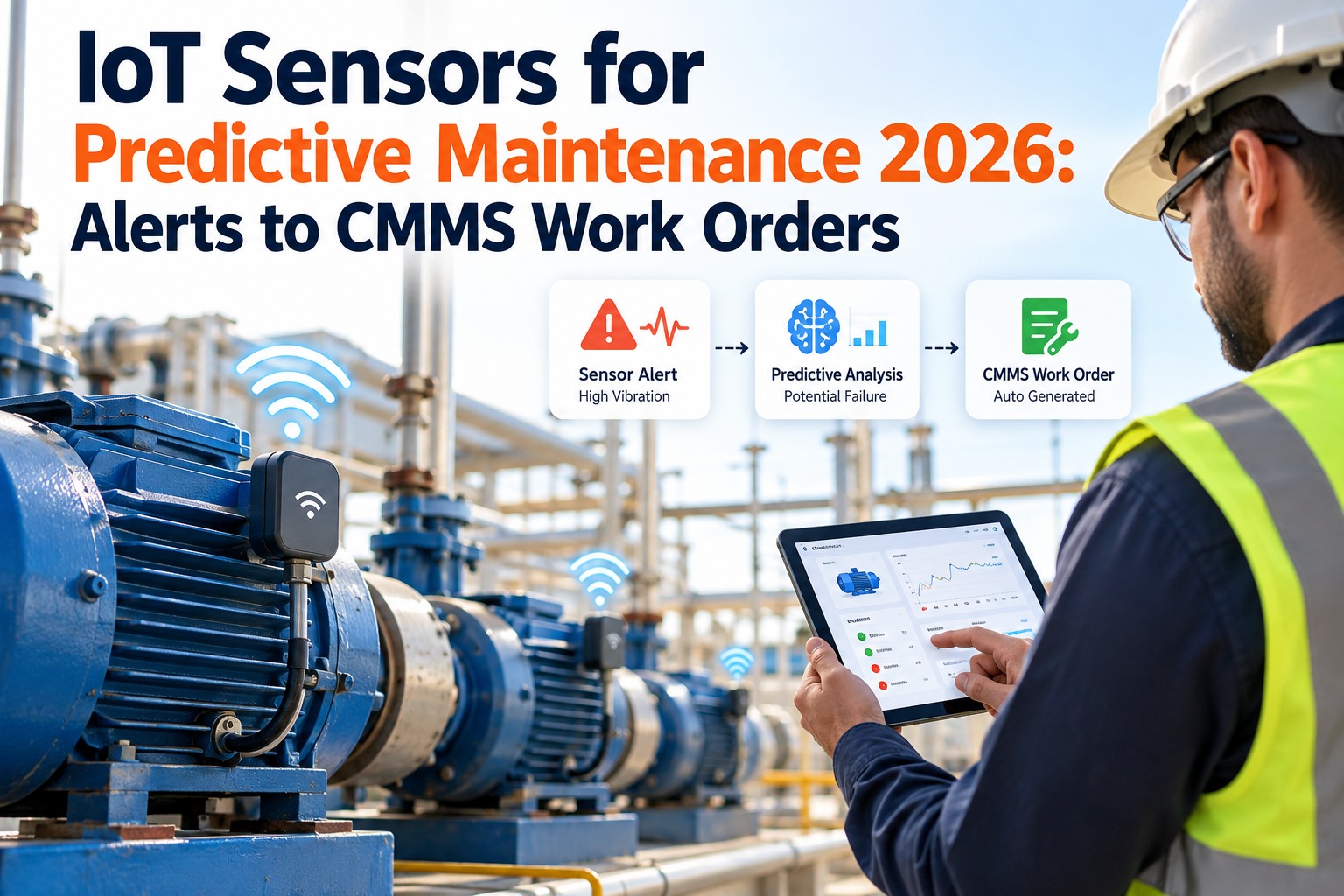
IoT Sensors for Predictive Maintenance 2026: Alerts to CMMS Work Orders
Paying for sensors but still drowning in reactive work because the alerts never reach a planner? OXMAINT AI runs the last mile: sensor alerts become tracked issues, issues become prioritized draft work orders — pushed into IBM Maximo, SAP EAM or your existing workflow — and closed work orders feed the predictive schedule. The vibration spike becomes assignable work, not another notification nobody opens.
The Problem Isn't the Sensor. It's the Last Mile.
Condition data is everywhere now, and most of it goes unused. An alert fires in a vendor portal, a planner never sees it, and the failure it warned about becomes an emergency anyway. The sensor did its job — the workflow didn't. Closing that last mile is where predictive maintenance actually pays off.
Start free and route sensor alerts to work in OXMAINT AI.
- Alerts pile up in a vendor dashboard no planner watches
- Each sensor brand lives in its own separate portal
- An alert carries no asset context, priority or next step
- Alert fatigue — so many false alarms the real ones get ignored
- The failure still becomes a reactive, unplanned work order
- Alerts become tracked issues in the system planners use
- Every sensor feed lands in one place, on the asset
- Each alert carries asset, severity and a suggested action
- Thresholds tuned so real alerts rise above the noise
- The alert becomes a planned work order before failure
The Sensor-to-Work-Order Pipeline
Predictive maintenance is a pipeline, not a sensor. Data has to flow from the signal all the way to a closed work order — and every stage needs to hand off cleanly to the next. Here's the full path.
Book a demo to see this pipeline on your equipment.
Most sensor deployments nail stages 1 and 2 and stop there. The payoff lives in stages 3 to 5 — turning a raw anomaly into ranked, planner-ready work in the system your team already uses.
The Six Signals Worth Sensing
Different failure modes show up in different signals. A robust program combines several, because each is strong where another is blind — and each one should feed the same work-order pipeline.
Sign up free and bring every sensor feed onto the asset in OXMAINT AI.
No single signal catches everything — oil says what is wearing, vibration says where, temperature says how urgent. Read together on one asset record, they cover each other's blind spots and raise higher-confidence alerts.
An Alert in a Portal Is a Failure With a Head Start.
The sensor already told you. Whether that warning becomes a planned repair or an emergency depends entirely on whether it reaches a planner as actionable work. OXMAINT AI is that last mile — alert to draft work order in Maximo or SAP EAM.
Anatomy of an Alert-Driven Work Order
A raw alert says "vibration high." A planner-ready work order says much more — and that difference is what makes it actionable instead of ignorable. Here's what a good sensor-driven work order carries.
Book a demo to see planner-ready work orders from your alerts.
Overlay, Don't Rip and Replace
If your team already runs on IBM Maximo or SAP EAM, the goal isn't to replace it — it's to feed it. A sensor-to-work-order layer should sit over your system of record and route ready-made work into it, so planners keep working where they already work.
Start free and overlay sensor-driven work onto your EAM.
What Good Looks Like
| Dimension | Sensors without a workflow | Sensor-to-WO in OXMAINT AI |
|---|---|---|
| Where alerts land | Scattered vendor portals | One place, on the asset |
| What an alert carries | "Reading high" | Asset, fault, priority, action |
| Who acts on it | Often no one | A planner, via a draft work order |
| System of record | Separate from the alert | Maximo / SAP EAM, fed directly |
| Result | Reactive failure anyway | Planned repair before failure |
Frequently Asked Questions
Make Every Alert Become Work.
Close the last mile of predictive maintenance — turn real-time sensor alerts into prioritized, planner-ready work orders in IBM Maximo, SAP EAM or your own workflow, with OXMAINT AI, so warnings become planned repairs instead of emergencies.