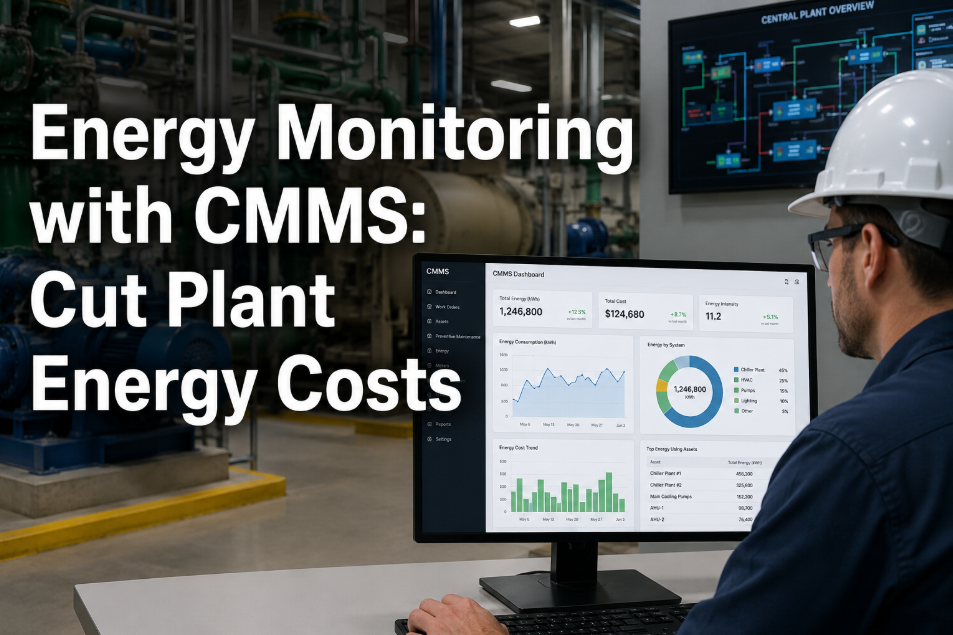
Energy costs represent the second-largest operational expense in most government facility budgets — after personnel — and they are uniquely controllable. A typical government office building consumes 25–50 kBtu per square foot per year when poorly maintained and managed, and as little as 15–25 kBtu/sf when HVAC, lighting, and hot water systems are maintained to performance standards and scheduled against occupancy-driven setpoints. The gap between those two numbers — across a portfolio of 20 municipal buildings — can represent $400,000 to $1.2 million in annual utility spend that is being paid for conditions that planned maintenance and BMS optimisation could eliminate. The challenge for most government facility teams is not the absence of a building management system — most mid-size and large government buildings already have BMS infrastructure — it is the absence of a connection between the BMS energy data and the maintenance work order system that would allow them to act on what the BMS is showing. Sign up for Oxmaint to connect your BMS data to automated maintenance workflows today.
Why Your BMS Alone Cannot Fix Government Building Energy Performance
Most government buildings above 50,000 sq ft already have a Building Management System — but BMS systems are data collection tools, not action systems. The missing link is the connection between what the BMS is showing and the maintenance work order system that can act on it.
The BMS-CMMS Gap Is Where Energy Waste Accumulates
A building management system monitors conditions in real time — AHU discharge temperatures, chiller plant kW draw, lighting zone occupancy, and utility meter pulses. But when the BMS shows that an air handling unit is running at 30% above its design energy intensity, the BMS cannot create a maintenance work order, cannot assign it to a technician, and cannot track whether the corrective action was completed.
That gap — between detection in the BMS and action in the maintenance system — is where energy waste accumulates in government buildings. Oxmaint bridges this gap through BACnet, Modbus, and REST API integrations with major BMS platforms including Siemens Desigo CC, Schneider EcoStruxure, and Johnson Controls Metasys. When the BMS triggers an energy anomaly alarm, Oxmaint automatically generates a maintenance work order for the responsible technician. Book a demo to see BMS-CMMS integration configured for your building system.
- BMS energy anomaly alerts auto-generate Oxmaint work orders — no manual monitoring or data re-entry
- Maintenance completion data feeds back to BMS baseline — energy performance trend tracks improvement
- ENERGY STAR Portfolio Manager submission auto-populated from Oxmaint utility consumption records
- Maintenance-energy correlation reports show which work orders produced measurable kBtu/sf reduction
Where Government Building Energy Waste Comes From — and What CMMS-Driven Maintenance Recovers
Energy waste in government buildings concentrates in three mechanical systems. Each system has distinct maintenance-driven savings levers and a direct connection to BMS monitoring data. Sign up for Oxmaint to configure energy-linked PM schedules for each system.
A clogged AHU filter increases static pressure across the air handling unit, forcing the fan motor to draw proportionally more power to maintain designed airflow. A filter that reaches twice its design pressure drop consumes 15–20% more fan energy than a clean filter. Most government buildings on paper-based PM schedules replace filters by calendar interval regardless of actual loading — replacing clean filters and running dirty ones depending on weather, building use, and season.
Oxmaint links BMS differential pressure sensor readings across AHU filters to condition-based replacement work orders — replacing filters when pressure drop exceeds threshold rather than at arbitrary calendar intervals. This both reduces unnecessary replacements (saving filter cost) and eliminates dirty-filter fan energy penalties. Sign up to configure condition-based filter PM triggers.
Saves 8–12% of AHU fan energyCondenser water scaling on chiller tube bundles reduces heat transfer efficiency, forcing the compressor to work harder to achieve the same cooling effect. A 1mm scale deposit reduces chiller efficiency by 3–5%. The BMS shows this as rising condenser approach temperature and higher compressor kW per ton — but without a CMMS connection, the BMS alarm sits unacted on until the next scheduled service visit. Oxmaint generates a descaling work order automatically when condenser approach temperature exceeds the baseline by 2°C for more than 48 hours.
Saves 3–8% of chiller energyHVAC economisers in temperate climates provide free cooling — using cool outdoor air instead of running mechanical refrigeration — for 800–2,000 hours per year in most US and European government building locations. A stuck-closed damper eliminates this opportunity entirely, costing $2,000–$8,000 per AHU per year in avoidable chiller operation. BMS-monitored outdoor air fraction and damper position feedback linked to Oxmaint PM scheduling catches jammed dampers within days rather than seasonal maintenance cycles.
Saves $2k–8k per AHU annuallyLeaking hot water heating valves that fail to close fully create simultaneous heating and cooling loads in the same zone — the cooling system overcomes the unwanted heat from the stuck heating coil. This condition is invisible to BMS energy monitoring but visible to occupants as zones that are difficult to cool and appear as elevated building cooling loads on hot days. Valve inspection work orders on 12-month cycles with BMS cross-referencing of zone temperature complaints are the systematic detection method.
Eliminates avoidable simultaneous H+C costDaylight-linked dimming controls and occupancy-based scheduling are among the highest-value energy features in government buildings — but they require annual calibration to maintain their designed energy savings. A daylight sensor whose setpoint has drifted by 20% maintains full lighting levels in zones that should be dimmed during peak daylight hours. Oxmaint PM schedules include BMS-monitored zone kWh per square foot trending — zones that consistently run 15% above the building average during low-occupancy periods flag a calibration inspection work order automatically.
Maintains 20–30% lighting energy savingsAfter-hours lighting overrides — temporarily switching on lighting zones for late-working staff — are a legitimate function that frequently becomes a permanent condition when the override reset is not triggered or when zones fail to return to scheduled mode after a software update or power interruption. Government buildings with persistent after-hours lighting loads in unoccupied areas can waste 5–10% of annual lighting energy in zones that never actually need the override. BMS after-hours consumption trending in Oxmaint identifies these patterns within days. Sign up to configure after-hours load monitoring.
Recovers 5–10% of lighting energyLED retrofits in government buildings have typically achieved 30–50% lighting energy reductions versus fluorescent systems. But LED driver failures and sensor faults that return zones to manual-on operation can erode these savings over time. Oxmaint tracks LED system component age and BMS-reported fault codes — generating inspection work orders for zones showing consumption patterns inconsistent with LED operation. Annual LED driver inspection and control system function testing keeps savings at the designed level for the full 15–20-year system life.
Maintains full LED energy savings over system lifeEmergency lighting systems in government buildings are required to operate independently of the normal lighting circuit — but in some older installations, circuit redesigns and panel modifications have created conditions where emergency circuit luminaires remain energised during normal operating hours alongside the normal lighting circuit. Oxmaint PM scheduling includes verification that emergency lighting circuits are isolated from normal lighting operation — eliminating the double-energy condition while also ensuring emergency systems are genuinely tested on their own circuits per NFPA 101.
Eliminates double-circuit wasteDomestic hot water heat exchangers in government buildings serving high-occupancy facilities — courthouses, recreational centres, transit terminals — accumulate scale at a rate proportional to local water hardness and total volume processed. A heat exchanger at 70% efficiency due to scaling requires 30% more boiler or heat pump energy to deliver the same hot water temperature at the tap. Oxmaint tracks water consumption per building and schedules heat exchanger descaling based on volume throughput rather than calendar interval — the same condition-based approach that industrial systems use.
Maintains heat exchanger efficiency above 90%Government building boilers and rooftop unit gas burners drift from optimal combustion settings over operating seasons — air register positions shift, gas supply pressures change, and burner tip wear alters flame geometry. A boiler running at 8% excess oxygen versus the optimal 3% wastes 4–6% of fuel input as sensible heat up the flue. Oxmaint PM schedules include seasonal combustion analysis work orders — O2 measurement, stack temperature logging, and air register calibration — tied to the start of heating season and mid-season for facilities with heavy winter loads. Sign up to schedule combustion PM work orders.
Recovers 4–6% of heating fuel spendDomestic hot water recirculation pumps in government buildings are frequently left running 24 hours per day to maintain hot water availability at every tap — a legacy of pneumatic controls that could not implement time-based schedules. Converting these to occupancy-scheduled operation (running during occupied hours, off overnight and weekends) saves 60–70% of recirculation pump electricity and reduces heat losses from hot water pipes during unoccupied periods. The scheduling change is a work order in Oxmaint linked to the BMS time schedule programming — achievable in one service visit.
Saves 60–70% of recirculation pump energyGovernment buildings that have invested in solar hot water systems — particularly those installed under ARRA or other sustainability programmes — frequently experience declining solar fraction as collector glazing soils, glycol degrades, and pump controllers drift from optimal temperature differential settings. Without annual collector cleaning and glycol testing, a solar system's contribution to hot water energy can decline from 40% to 15% of demand within 3–5 years. Oxmaint PM schedules include annual solar system inspections with glycol specific gravity testing and collector cleaning work orders.
Maintains solar fraction above 35% of hot water demandFive Maintenance-Driven Energy Levers for Government Buildings — What Each One Delivers
The 20–35% energy cost reduction achievable in government buildings comes from five compound levers. No single lever delivers the full saving — the compound effect of all five working together is what creates building-level performance that government teams can report to elected officials and in federal sustainability submissions.
AHU filter replacements triggered by differential pressure readings instead of calendar date, chiller maintenance triggered by condenser approach temperature trending, economiser damper inspections triggered by outdoor air fraction monitoring. Each of these shifts maintenance from arbitrary calendar intervals to evidence-based action — eliminating the energy waste that accumulates between scheduled visits and the unnecessary maintenance spend on systems that are still performing at specification. Sign up for Oxmaint to configure BMS-triggered HVAC PM work orders.
Daylight sensor recalibration, occupancy schedule verification, and after-hours consumption monitoring maintains the designed energy savings from lighting control systems. Without annual calibration work orders in Oxmaint, lighting controls drift — daylight dimming setpoints rise, occupancy sensors lose sensitivity, and after-hours overrides become permanent. Recovering these savings is a PM scheduling problem, not a capital investment problem. Book a demo to see lighting controls PM configured.
Boilers and gas burners across the government building portfolio — rooftop unit heating sections, hot water boilers, and direct-fired AHU heating coils — all drift from optimal combustion settings over heating seasons. A combustion analysis work order at the start of each heating season, combined with O2 monitoring and stack temperature trending, ensures that fuel is burned at maximum efficiency throughout the winter. For a 100,000 sq ft government building spending $120,000 annually on gas, a 5% combustion efficiency improvement recovers $6,000 annually from a $500 service visit. Sign up to schedule your pre-heating-season combustion PM.
Government building BMS setpoints drift over time — system upgrades, space use changes, and manual overrides accumulate until the building's heating and cooling schedules no longer reflect actual occupancy. A courthouse that heats to 72°F from 5am on weekdays but now opens at 8am is wasting 3 hours of heating every weekday. Oxmaint PM schedules include annual BMS setpoint audits — matching heating, cooling, and ventilation schedules against current building occupancy data and generating BMS programming work orders for any mismatch discovered.
None of the first four levers can be measured without a per-building energy intensity baseline. Oxmaint's utility tracking module imports monthly utility bills or connects directly to smart meter APIs, calculates kBtu/sf per building per month, and tracks performance against the ENERGY STAR Portfolio Manager benchmark for that building type. Federal agencies must submit annual ENERGY STAR data as part of sustainability reporting requirements — Oxmaint automates this submission from the same utility data that drives internal performance management. A portfolio dashboard showing all buildings ranked by energy intensity immediately identifies where maintenance-driven energy savings programmes will deliver the highest returns. Book a demo to see the energy intensity portfolio dashboard.
Government Building Energy Intensity Benchmarks by Building Type — Where Your Portfolio Should Be
ENERGY STAR uses building-type-specific benchmarks to assess energy performance. This table shows the target kBtu/sf range for ENERGY STAR certification (typically score 75+) versus typical unoptimised government buildings, alongside the primary maintenance lever for each type. Sign up for Oxmaint to track your portfolio against these benchmarks automatically.
| Building Type | ENERGY STAR Target (kBtu/sf/yr) | Typical Unoptimised (kBtu/sf/yr) | Saving Potential | Primary Maintenance Lever |
|---|---|---|---|---|
| Office / City Hall | 60–80 | 90–130 | 25–38% | HVAC setpoint optimisation, lighting controls PM |
| Courthouse | 70–95 | 110–160 | 28–40% | Extended operating hours HVAC scheduling, chiller efficiency |
| Public Library | 55–75 | 85–120 | 26–37% | Lighting controls calibration, AHU filter PM |
| Fire Station | 85–110 | 130–180 | 24–39% | Apparatus bay heating control, hot water PM |
| Water Treatment Plant | 180–250 | 280–400 | 22–37% | Pump efficiency, aeration system PM, motor condition |
| Recreation Centre | 90–120 | 150–220 | 28–45% | Pool HVAC dehumidification, hot water system PM |
| Police Station | 75–100 | 115–160 | 27–37% | 24/7 HVAC scheduling, generator exhaust heat recovery |
Swipe to view full benchmark table
Your BMS Is Already Showing You Where the Energy Waste Is. Oxmaint Turns Those Signals into Work Orders.
The gap between BMS energy anomaly detection and maintenance corrective action is where government building energy costs accumulate year after year. Oxmaint closes that gap through automated work order generation from BMS triggers — ensuring that what the BMS sees becomes a maintenance action within hours, not weeks.
What Government Energy Managers Are Seeing
Our county had a Schneider EcoStruxure BMS across 12 buildings and a separate work order system that nobody was looking at. The BMS was generating energy anomaly alarms that sat in the control room screen for days before anyone acted on them. After we integrated Oxmaint with EcoStruxure, every BMS energy alarm above our configured threshold automatically becomes a work order assigned to the responsible technician. In the first 12 months, we identified and resolved 47 persistent energy anomalies — stuck economisers, drifted setpoints, and after-hours lighting zones — that had been visible in the BMS data but invisible to our maintenance team. Our annual utility spend across those 12 buildings dropped by $340,000, which our facilities director used as evidence in the budget presentation to move three more buildings onto Oxmaint.
Government Building Energy Management CMMS — Common Questions
Oxmaint integrates with BMS platforms via BACnet/IP, Modbus TCP, and REST API — the three most common data communication protocols in government building automation. Supported platforms include Siemens Desigo CC, Schneider Electric EcoStruxure Building, Johnson Controls Metasys, Honeywell Building Technologies, and Trane Tracer SC. For buildings with legacy BMS systems using older BACnet versions or proprietary protocols, Oxmaint's IoT gateway approach enables data extraction via OPC-UA middleware. Sign up for Oxmaint to discuss your specific BMS integration requirements.
Oxmaint's utility tracking module stores monthly utility consumption data per building — electricity in kWh, natural gas in therms or MCF, district chilled water in ton-hours, and district steam in Mlb. This data is formatted per ENERGY STAR Portfolio Manager's accepted data template and can be exported directly for upload to ENERGY STAR, or transmitted via the ENERGY STAR Portfolio Manager API for fully automated annual submission. The submission includes the building profile data (gross floor area, weekly operating hours, occupancy) that Portfolio Manager requires to generate the building's energy score. Book a demo to see the ENERGY STAR submission workflow.
Yes. Executive Order 14057 (Catalyzing Clean Energy Industries and Jobs through Federal Sustainability) requires federal agencies to reduce building energy intensity, track progress annually, and report to the Office of Management and Budget. Oxmaint generates year-over-year kBtu/sf trend reports per building and portfolio-level intensity reduction percentages — exactly the metrics required for federal sustainability progress reporting. The maintenance-energy correlation reports additionally show which specific maintenance work orders produced measurable energy performance improvements, supporting the agency's ability to demonstrate programme effectiveness to oversight bodies.
Most government facilities see their first measurable energy anomaly work orders generated within the first week of BMS integration — because persistent anomalies that have been unacted on for months become visible immediately. The energy savings from resolving those initial anomalies (stuck economisers, drifted setpoints, after-hours loads) typically materialise within 30–90 days as corrective actions are completed. Portfolio-level energy intensity improvements are typically visible in the 3–6 month utility billing cycle comparison. The full 20–35% reduction builds over 12–18 months as the full PM programme matures and all five levers are operating simultaneously.
Yes — buildings without BMS infrastructure can participate in Oxmaint's energy management programme through manual utility bill import or integration with utility company smart meter APIs. Monthly utility data is entered per building and Oxmaint calculates kBtu/sf intensity, tracks year-over-year trends, and identifies buildings with deteriorating energy performance for investigation. Oxmaint also provides IoT energy sub-metering device integration — affordable wireless electricity and gas sub-meters can be installed on major building systems (HVAC, lighting panels, hot water boilers) to provide building-level monitoring without a full BMS deployment. Sign up to configure energy monitoring for buildings with and without BMS.
Government Building Energy Waste Is a Maintenance Problem. Oxmaint Makes It a Solved One.
The 20–35% energy savings available in most government buildings does not require new HVAC equipment, a new BMS, or a capital budget request. It requires connecting the energy data you already have in your BMS to the maintenance actions that can act on it — and scheduling those actions systematically, on condition rather than on calendar. Oxmaint makes that connection for every building in your portfolio.