Government and public sector maintenance teams face a unique operational paradox: they manage more diverse asset portfolios than most private sector organizations — water treatment plants, vehicle fleets, parks, bridges, public buildings, airports, transit systems — while operating under procurement constraints, budget cycles, and compliance requirements that make adopting modern technology significantly harder. A 2024 Government Accountability Office report found that federal agencies spend $47 billion annually on facilities maintenance, yet 38% of that spending is reactive — responding to failures rather than preventing them. At the state and municipal level, the numbers are worse: 52% of public works departments operate without any structured maintenance management system, relying on spreadsheets, paper work orders, and institutional memory that walks out the door with every retirement. The consequences are measurable and compounding — deferred maintenance backlogs grow 6-8% annually in agencies without structured tracking, infrastructure condition deteriorates below intervention thresholds where repair becomes replacement, and elected officials lose confidence in maintenance budgets they cannot verify with data. The right CMMS platform transforms public sector maintenance from a budget line item that elected officials question into a documented, auditable, mission-supporting operation that demonstrates fiscal responsibility with every work order completed and every asset condition documented. Platforms like Oxmaint are built to work within government procurement frameworks — no heavy implementation fees, no multi-year lock-in contracts, and no FedRAMP complexity barriers that keep smaller agencies stuck on paper. Whether you manage a single municipal fleet or a multi-agency federal portfolio, the platform scales to your mission without the enterprise overhead that most government CMMS implementations drown in. Want to see how it works for public sector operations? Book a demo or start a free trial.
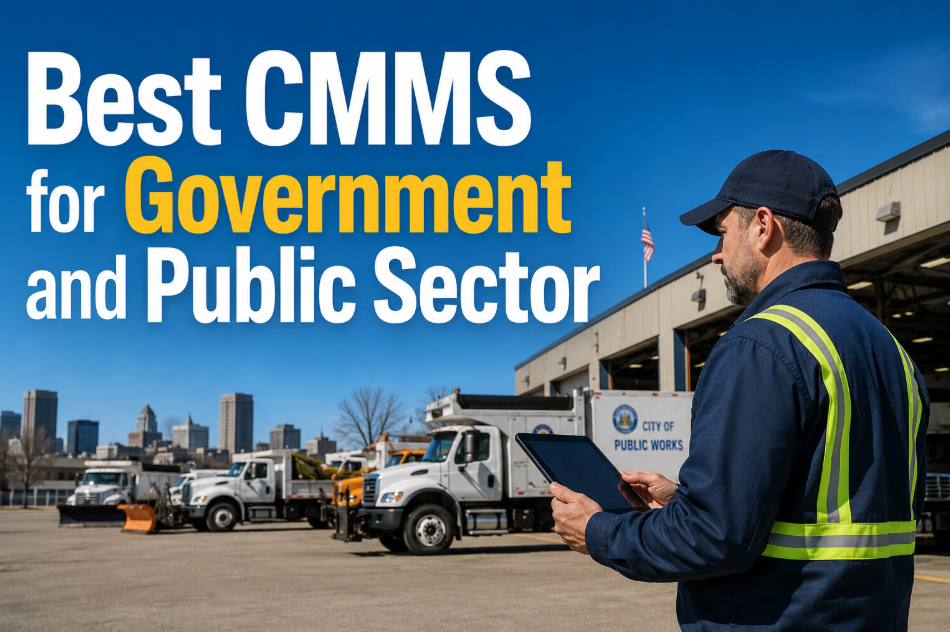
Best CMMS for Government and Public Sector: Federal, State, and Municipal
Comprehensive comparison of CMMS platforms for public works, government fleet, facilities maintenance, and infrastructure management. Procurement compliance, audit readiness, and multi-agency portfolio support evaluated.
Government-Ready CMMS Without Enterprise Overhead
Oxmaint deploys in days, not months. No heavy implementation fees, no consultant armies, no multi-year contracts. Government procurement-friendly pricing with the asset management, work order, and compliance documentation capabilities that public sector teams need — all within most agency purchasing authority thresholds.
Why Government Maintenance Is Fundamentally Different
Public sector maintenance operates under constraints that private sector operations rarely encounter. Understanding these constraints is essential for selecting a CMMS that will actually work in government — not just look good in a procurement evaluation but fail in operational reality because it was designed for manufacturing or commercial real estate.
Government CMMS purchases must navigate competitive bidding requirements, sole-source justification thresholds, GSA Schedule compatibility, fiscal year budget cycles, and approval chains that can take 6-18 months. Platforms with simple subscription pricing and no heavy upfront costs are significantly easier to procure than enterprise solutions requiring six-figure implementations and multi-year contracts that need board approval.
A single municipality may manage water infrastructure, vehicle fleet, parks, public buildings, street lights, transit systems, and stormwater facilities — each with distinct asset types, maintenance requirements, and regulatory standards. The CMMS must handle this diversity without requiring separate instances for each department or forcing artificial standardization that ignores operational realities.
Government maintenance records are subject to FOIA requests, inspector general audits, legislative oversight, citizen transparency portals, and public meeting scrutiny. The CMMS must produce audit-ready documentation with complete work order histories, cost tracking, and asset condition records that withstand the highest levels of public accountability. Every dollar spent must be traceable.
Government maintenance teams face chronic understaffing — 67% of public works directors report being unable to fill technician positions. Average government maintenance technician tenure is 4.2 years before retirement or departure. The CMMS must be simple enough for existing staff to adopt without extensive training, mobile-friendly enough for field crews who spend 80% of their time away from a desk, and robust enough to preserve institutional knowledge when staff turn over.
Government budgets operate on annual or biennial cycles that do not align with asset lifecycles. Maintenance budget requests submitted in March must predict needs 18 months into the future. Without CMMS data showing historical spending patterns, asset condition trends, and predictive failure timelines, budget requests are educated guesses that finance directors rightfully question.
Elected officials respond to constituent complaints — potholes, park conditions, building problems. Without CMMS data showing response times, backlog size, and resource constraints, maintenance directors cannot defend their operations against political criticism. CMMS provides the data that transforms political conversations from complaints to informed resource allocation discussions.
Government CMMS Selection Framework: 8 Critical Requirements
Before comparing platforms, government maintenance teams should evaluate their specific requirements across eight critical categories. This framework ensures the selected CMMS addresses actual operational needs rather than feature lists that look impressive in demos but go unused in practice. Each requirement is weighted by operational impact on government maintenance operations.
Create, assign, track, and close work orders across multiple departments and locations. Must support citizen and constituent service requests, internal work requests, emergency work orders, and seasonal project tracking. Priority classification, technician assignment, and completion tracking are non-negotiable. Average government maintenance team handles 847 work orders per month — the system must handle volume without performance degradation.
Complete asset inventory with condition scoring, age tracking, maintenance history, and replacement cost estimation. Government asset portfolios average $340 million in replacement value for a mid-sized municipality. Without lifecycle tracking, capital planning becomes guesswork and deferred maintenance backlogs grow invisibly until catastrophic failures force emergency spending.
Calendar-based, meter-based, and condition-based PM triggers. Must support seasonal maintenance cycles critical for government operations — winterization, spring infrastructure inspection, summer grounds maintenance, and fall storm preparation. PM compliance tracking by department and asset class provides the evidence that maintenance is being performed as planned.
Track maintenance spending by department, fund code, project, and asset. Government accounting requires fund-level cost allocation that most commercial CMMS platforms do not support natively. Must produce reports compatible with GASB 34 infrastructure reporting requirements and support multi-fund cost allocation for assets serving multiple departments.
Field crews must access work orders, update completion status, and document findings from mobile devices without reliable connectivity. Offline capability is essential — 34% of government work locations have limited or no cellular coverage. Photo documentation and GPS location tagging from the field eliminate return trips to the office for paperwork.
EPA, OSHA, ADA, DOT, and state-specific compliance requirements generate documentation obligations that the CMMS must support. Elevator inspections, fire safety checks, backflow prevention testing, ADA accessibility compliance, fleet DOT inspections, and water quality testing all require timestamped, retrievable records with responsible party identification.
Generate reports for city council, county commission, state legislature, and public transparency portals. Must produce KPI dashboards showing work order completion rates, PM compliance, backlog status, and cost trends. Reports must be understandable by non-technical elected officials who control budget approval.
Single platform serving multiple departments — public works, fleet, parks, water and sewer, facilities, and transit. Department-level permissions, reporting, and budgeting within a unified system. Eliminates data silos between departments that currently prevent portfolio-level visibility and cross-departmental resource optimization.
CMMS Platform Comparison for Government Operations
The government CMMS market includes legacy enterprise platforms designed for large federal agencies, mid-market solutions targeting state and municipal governments, and modern cloud-native platforms built for rapid deployment. Each category has distinct strengths and limitations for public sector operations. Here is how the leading options compare across the requirements that matter most.
| Evaluation Criteria | Legacy Enterprise CMMS | Mid-Market CMMS | Oxmaint (Modern Cloud) |
|---|---|---|---|
| Implementation Timeline | 6-18 months typical | 2-4 months typical | 1-2 weeks typical |
| Implementation Cost | $150K-$500K+ consulting and setup | $25K-$75K implementation | No implementation fees |
| Annual Licensing | $50K-$200K+ per year | $15K-$50K per year | Subscription-based, scales with usage |
| Mobile Field Access | Limited — often requires VPN and training | Mobile app available, varying quality | Mobile-first design with offline capability |
| Multi-Department Support | Strong but complex to configure | Moderate — some limitations on hierarchy | Built-in portfolio hierarchy with department permissions |
| Training Requirements | 40+ hours per user | 8-16 hours per user | 2-4 hours per user |
| Procurement Complexity | Formal RFP, board approval, multi-year contract | Moderate procurement process required | Simple subscription within most purchasing thresholds |
| Capital Planning | Available with additional modules at cost | Limited or basic | Built-in 5-10 year CapEx forecasting |
| Citizen Service Requests | Requires integration with 311 system | Basic request portal | Built-in service request portal with status tracking |
| GASB 34 Reporting | Supported with custom reports | Limited support | Infrastructure condition reporting aligned with GASB 34 |
Government Department Use Cases
Different government departments have distinct maintenance requirements, compliance obligations, and operational patterns. Here is how a modern CMMS platform like Oxmaint addresses the operational realities of each major public sector function. If any of these use cases match your operation, book a demo or start a free trial to see the platform configured for your department.
Manage linear assets (roads, pipes, utilities) alongside point assets (pump stations, lift stations, treatment plants). Track infrastructure condition ratings, schedule seasonal maintenance programs, and document EPA compliance for water and wastewater systems. Average public works department manages $240 million in infrastructure replacement value. Stormwater management, street light maintenance, and traffic signal systems add additional asset complexity that the CMMS must handle within a unified platform.
PM scheduling by mileage and calendar, DOT compliance documentation, DVIR management, fuel tracking, and lifecycle cost analysis. Government fleets average 127 vehicles per municipality across police, fire, EMS, public works, parks, and administrative departments. Emergency vehicles require accelerated PM schedules, priority work order handling, and mission-critical uptime tracking that standard fleet systems do not address.
Building system maintenance (HVAC, electrical, plumbing, elevator), space management, ADA compliance, fire safety inspections, and energy management. Government facilities serve the public directly — HVAC failures, elevator outages, and safety issues affect citizen service delivery and create liability exposure. Facilities range from historic courthouses to modern community centers, each with distinct maintenance challenges.
Seasonal maintenance calendars, playground safety inspections (CPSC compliance), aquatic facility chemical tracking, athletic field maintenance, and trail system management. Parks departments typically manage 40-120 distinct facilities with seasonal workforce fluctuations of 200-400%. The CMMS must accommodate seasonal staff who need simple mobile interfaces during peak periods and year-round staff who manage the full planning cycle.
EPA Clean Water Act and Safe Drinking Water Act compliance documentation, SCADA integration for real-time plant monitoring, pump station PM scheduling, distribution system valve exercising programs, and hydrant maintenance. Water utilities manage assets with 50-100 year lifespans where deferred maintenance creates public health risk. CMMS must support regulatory-specific inspection documentation and produce compliance reports for state environmental agencies.
FTA-mandated State of Good Repair documentation, vehicle maintenance scheduling by mileage and hours, ADA accessibility equipment maintenance, and infrastructure condition assessment. Transit agencies receiving federal funding must demonstrate that assets are maintained in a state of good repair — the CMMS provides the documented evidence that FTA reviewers evaluate during triennial reviews.
Most government CMMS implementations fail because they take too long, cost too much, and require more training than understaffed teams can absorb. Oxmaint deploys in 1-2 weeks with no implementation fees, no consultant requirements, and training that takes hours instead of weeks. Your team is managing work orders, scheduling PM, and tracking assets before most enterprise CMMS vendors have finished their requirements gathering phase. The subscription model fits within most agency purchasing authority — no board approval, no multi-year contract, no capital budget classification complications.
The Real Cost of Operating Without CMMS in Government
Government agencies that operate without structured maintenance management do not save money — they spend more, document less, create liabilities that taxpayers ultimately pay for, and lose the institutional knowledge that retirements take with them. Here are the documented costs of operating without a CMMS compared to the outcomes agencies achieve after deployment.
52% of government maintenance spending goes to reactive repairs costing 4.8x more than planned maintenance. A $500 planned pump repair becomes a $2,400 emergency when the pump fails on a Friday afternoon and requires overtime labor, expedited parts, and contractor callout fees. Across a typical municipal operation, reactive maintenance wastes $340,000-$1.2 million annually.
Agencies with structured PM programs reduce reactive maintenance to 20-25% of total work orders within the first year. Average maintenance cost reduction of 28% through planned work, bulk parts purchasing, reduced emergency overtime, and optimized technician routing. The savings exceed the CMMS cost within the first 90 days for most agencies.
Budget requests to city council or county commission lack data support. Infrastructure replacement decisions are driven by which asset fails most visibly rather than which asset has the highest documented need. 44% of government capital budget requests are rejected due to insufficient documentation — the council cannot approve what they cannot verify.
CMMS generates asset condition reports, deferred maintenance dollar figures, FCI scores, and 5-10 year replacement forecasts. Capital budget requests backed by CMMS data are approved at 73% rate versus 56% for undocumented requests. Council members approve projects supported by condition data because the evidence is objective and verifiable.
When a 30-year maintenance supervisor retires, they take knowledge of every asset location, failure history, workaround, and vendor relationship with them. The replacement spends 12-18 months rediscovering information that was never documented. Critical maintenance procedures live in individual memory instead of retrievable records.
Every work order, inspection, repair, and procedure is documented in the CMMS. When staff retire or transfer, their knowledge remains in the system. New employees access complete asset histories, maintenance procedures, and vendor information from day one. Onboarding time reduces by 60% when institutional knowledge is digital.
Government CMMS Implementation: A Realistic Timeline
Failed government CMMS implementations share common patterns — overambitious scope, inadequate training, and loss of momentum during long deployment cycles. Here is the implementation approach that produces consistent success in government environments, based on agencies that have deployed Oxmaint and achieved operational results within 30 days. Start with one department, prove value, then expand. Do not try to deploy enterprise-wide on day one. Book a demo or start a free trial to begin your implementation today.
Select one department — typically fleet or facilities — as the pilot. Configure the platform with that department's assets, locations, and users. Import existing asset data from spreadsheets. Set up user accounts for supervisors and technicians. Total effort: 4-8 hours of administrator time.
Train pilot department staff — 2-4 hours for technicians, 4 hours for supervisors. Begin routing all maintenance requests and work orders through the CMMS. Focus on work order management and mobile access first. Do not try to implement PM scheduling, inventory, and reporting simultaneously.
With work orders flowing through the system, add preventive maintenance schedules for critical assets. Continue building the asset registry as technicians encounter equipment. After 30 days, the system contains enough data to produce meaningful reports showing work order volume, completion rates, and response times.
Present pilot department results to agency leadership — work order metrics, PM compliance rates, cost tracking data. Use documented success to justify expansion to additional departments. Each subsequent department deploys faster because the platform is already configured and best practices are established.
How Oxmaint Addresses Government-Specific Needs
Government maintenance has operational patterns that differ fundamentally from private sector — seasonal workforces, constituent-facing service, political accountability, multi-fund budgeting, and assets that span a century of construction standards. Here is how Oxmaint specifically addresses these government realities.
Public-facing portal where citizens submit maintenance requests — potholes, park damage, building issues, streetlight outages. Requests auto-create work orders routed to the correct department. Citizens receive status updates without staff manually responding. Replaces phone-and-email tracking that loses 43% of requests in unstructured systems.
Track maintenance spending against multiple fund codes — general fund, water enterprise fund, sewer enterprise fund, capital improvement fund, grant funding. Each work order is tagged to the correct fund, producing reports that match government accounting requirements. Eliminates the manual cost allocation that consumes 6+ hours per month in most agencies.
Pre-built report templates designed for non-technical audiences — city council members, county commissioners, agency directors. Reports show work order completion trends, PM compliance by department, deferred maintenance backlog in dollars, and response time metrics. Exportable in presentation-ready format for budget meetings and public hearings.
Government maintenance workforces expand 200-400% during summer months with temporary and seasonal staff. Oxmaint supports rapid user provisioning, simplified mobile interfaces for temporary staff, and role-based access that limits seasonal workers to assigned tasks while supervisors maintain full system access. Deprovisioning at season end is equally simple.
Built-in condition scoring system compatible with GASB 34 modified approach reporting. Track infrastructure condition by asset class, calculate Facility Condition Index by building, and produce deferred maintenance dollar figures by department. This data directly supports both internal capital planning and external financial reporting requirements.
During weather emergencies, natural disasters, or infrastructure failures, the CMMS captures all response activities with timestamps — essential for FEMA reimbursement applications. Agencies that document emergency response through their CMMS recover 34% more in federal disaster assistance than those using manual documentation methods.
Government CMMS ROI: The Numbers That Justify the Investment
Government procurement requires documented justification for every expenditure. Here are the ROI metrics that agencies deploying structured CMMS consistently achieve — the numbers your finance director and council members need to see.
Frequently Asked Questions
Does Oxmaint meet FedRAMP requirements for federal agencies?
Can we procure Oxmaint through GSA Schedule or cooperative purchasing?
How does Oxmaint handle multi-department access and permissions?
Can citizens submit service requests through Oxmaint?
Give Your Government Maintenance Team Modern Tools
Government maintenance teams deserve the same operational technology that private sector organizations use — without the enterprise overhead, multi-year contracts, and six-figure implementations that consume more budget than the software saves. Oxmaint deploys in days, costs less than a single emergency repair, and produces the documented, auditable maintenance records that government operations require. The taxpayers who fund your operation deserve maintenance managed with data, not memory. Try it free and see why government teams are making the switch.