Reactive repairs eat the budget, PMs slip past due, and audit records live in three binders and a spreadsheet — then a surveyor asks for proof you can't find fast enough. If you lead maintenance in a hospital, the goal for 2027 is simple to say and hard to reach: fewer surprises, defensible records, and equipment your clinical teams can count on. OXMAINT AI is the AI-powered maintenance management software that runs that journey end to end — in one platform, requests and inspections become ranked work orders, every asset stays on an automated PM and predictive schedule, and the KPIs leadership asks for build themselves.
Healthcare Maintenance · Digital Transformation Roadmap · 2027
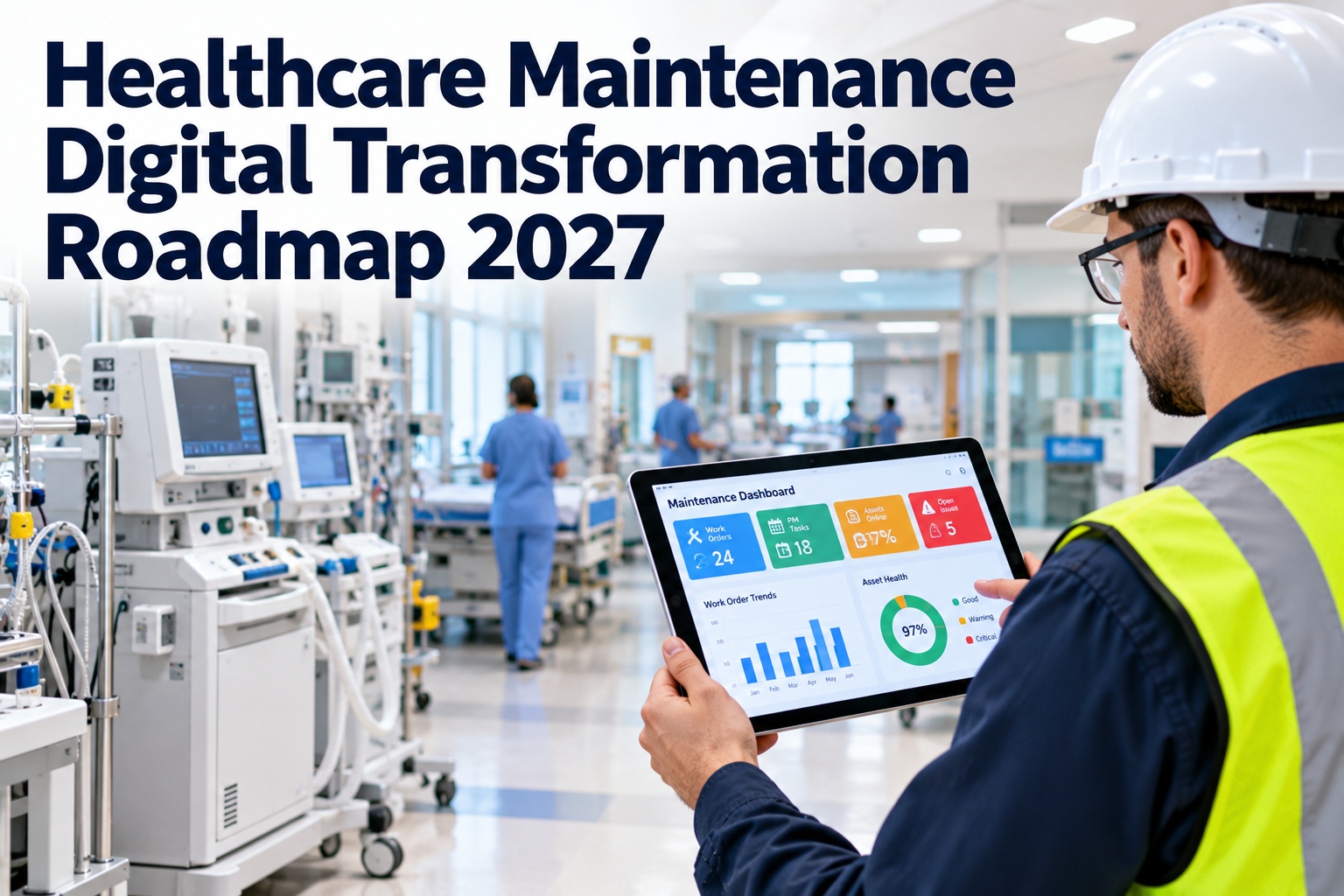
Healthcare Maintenance Digital Transformation Roadmap 2027
Digital transformation in hospital maintenance isn't one purchase — it's a climb through five stages, each one moving more work from unplanned to planned and more records from paper to query. This roadmap shows where each stage takes your KPIs, and how the OXMAINT AI maintenance management software carries the asset register, work orders, PM/PdM scheduling and compliance evidence at every step.
1Reactive
2Digitized
3Preventive
4Predictive
5Autonomous
The Cost of Standing Still
Before the roadmap, the baseline. Most hospitals run maintenance far closer to firefighting than to a plan — and the gap shows up in money, risk and survey days. These are the numbers the OXMAINT AI maintenance management software is built to move, so your first step is knowing which of them describes your facility today. Start free and benchmark your own PM compliance and reactive ratio in OXMAINT AI.
~42%
of hospital maintenance work runs reactively — more than double the under-20% top-quartile target
4.8x
more an emergency repair costs than the same job done as planned maintenance
$8.2B
projected global healthcare CMMS market by 2027
100%
documented PM required on high-risk medical equipment (Joint Commission EC.02.04.01)
The Five Stages of Maintenance Maturity
You can't jump from paper to predictive in one quarter. Transformation is a ladder, and every hospital sits on a rung. Find yours below, then read what the next one asks of you — each stage is a prerequisite for the one above it, and skipping the foundations is why so many "AI maintenance" projects stall. The OXMAINT AI maintenance management software is built to carry a hospital up every rung on one platform. Book a demo to place your facility on the maturity ladder in OXMAINT AI.
01
Reactive — "We fix it when it breaks"
Work orders are phone calls and sticky notes. Nobody knows total asset count. PMs happen when someone remembers. Survey prep means weeks of binder-hunting. Most emergency work orders are failures that a schedule would have caught.
Signal: reactive work > 40% · PM compliance under 65%
02
Digitized — "It's all in one system now"
The foundation stage. In the OXMAINT AI software, every asset lives in a single digital register with its make, model, location and service history. Work requests come in through one channel and become tracked work orders. You can finally see the backlog instead of feeling it.
Signal: one asset register · mobile work orders · no more paper logs
03
Preventive — "Maintenance runs on a schedule"
The software runs automated PM schedules across every asset class — biomedical equipment and facility systems alike. Tasks auto-assign, overdue work escalates instead of disappearing, and compliance records build themselves as techs close jobs. Reactive work starts dropping.
Signal: PM compliance above 85% · reactive ratio falling toward 20%
04
Predictive — "We catch failures before they happen"
Condition data — runtime hours, temperature, battery health, fault codes — flows into the OXMAINT AI software, and a reading that drifts out of range opens a work order on its own. Calendar-based PM gives way to condition-based intervals on your most critical assets.
Signal: condition alerts auto-raise work orders · PdM on critical assets
05
Autonomous — "The system runs the loop"
Priorities set themselves by patient-safety impact, parts and labor are planned against real demand, and executive KPIs flow straight to the board deck. People make the judgment calls; the OXMAINT AI software handles the routing, scheduling and evidence. This is the destination, not the starting line.
Signal: criticality routing · live KPI dashboards · data-driven CapEx
Most Hospitals Are Stuck Between Stage 1 and Stage 2 — and Can't See Why.
The jump that unlocks everything above it is the boring one: getting every asset, work order and PM into a single platform. Do that, and preventive and predictive become settings you turn on — not projects you restart. The OXMAINT AI maintenance management software gives you that foundation live from day one.
Where Your KPIs Land at Each Stage
A roadmap is only real if it moves numbers. Here's what the same five metrics look like as a facility climbs — reactive-dominant at the bottom, best-in-class at the top. Read it as a target map: the column you're in today, and the column the next rung puts within reach, with the OXMAINT AI software computing each number for you as work gets done. Start free and watch these KPIs calculate from your live work-order data in OXMAINT AI.
Ranges reflect widely cited healthcare maintenance benchmarks (ASHE / Joint Commission-aligned reporting) and vary by facility size, asset mix and program maturity — treat them as direction, not a guarantee.
The Four Workstreams Every Roadmap Shares
Stages describe how far you've come; workstreams are what you actually build. Every hospital transformation moves these four forward in parallel — and the OXMAINT AI maintenance management software runs all four on one platform, so the asset register that anchors compliance is the same one that feeds your predictive alerts. Book a demo to see the four workstreams running together in OXMAINT AI.
Asset Intelligence
One register for every medical device and facility system — make, model, location, criticality and full service history. It's the foundation nothing above works without.
Work Order Flow
Requests, inspections and alerts become one ranked, assigned, verified queue. Nurses report from a phone; nothing dead-ends in a voicemail or a passing comment.
PM & PdM Scheduling
Automated preventive schedules on every asset class, shifting to condition-based intervals as sensor data comes online. Overdue tasks escalate — they never quietly vanish.
Compliance Evidence
Every PM, repair and inspection is timestamped and retained, so Joint Commission and CMS documentation becomes a query — not a six-week scramble before survey day.
A 90-Day Start That Doesn't Disrupt Care
You don't close the roadmap in a weekend, but you can be live and climbing inside a quarter. The point of a staged start is that clinical operations never pause — with the OXMAINT AI software you digitize first, schedule second, and layer prediction once the data is flowing. Start free and stand up your asset register in week one with OXMAINT AI.
Weeks 1–4
Digitize the Foundation
Import or build the asset register, set criticality classes, open the single work-request channel. You move from "we think we have about…" to an exact, searchable inventory.
Weeks 5–8
Turn On Preventive
Load PM schedules for biomedical and facility assets, auto-assign by team, switch on overdue escalation. Compliance records begin accumulating automatically from closed work orders.
Weeks 9–12
Layer Prediction & Reporting
Connect condition signals on critical assets, set thresholds that raise work orders on their own, and stand up the live KPI dashboard leadership reviews. The climb to Stage 4 begins.
“
We thought we needed a predictive-maintenance project. What we actually needed was to stop running maintenance out of three spreadsheets and a whiteboard. Once every asset and work order lived in one place, PM compliance climbed on its own — and survey prep went from weeks of binder-hunting to pulling a report in the meeting. The "AI" part came later, and it only worked because the foundation was already there.
Director of Facilities & Clinical Engineering · Regional Health System
How OXMAINT AI Carries the Whole Roadmap
The reason transformation stalls is that each stage usually means a new tool — a tracking system here, a scheduling add-on there, a reporting layer bolted on last. The OXMAINT AI maintenance management software is one platform for all five stages, so climbing a rung is turning on a capability, not restarting a project. Book a demo to see your full roadmap on one platform in OXMAINT AI.
REGISTER
Every medical device and facility asset in one register with criticality, location and full service history — the single source the rest of the roadmap runs on.
INTAKE
Mobile work requests from clinical and facility staff become ranked, assigned work orders — no voicemails, no lost sticky notes, one visible queue.
AUTOMATE PM
Preventive schedules across every asset class with auto-assignment and overdue escalation, so compliance is a by-product of work getting done.
PREDICT
Condition thresholds on critical assets raise work orders automatically — moving you from calendar-based to condition-based maintenance.
PRIORITIZE
Criticality routing puts life-critical assets ahead of cosmetic ones, so the queue reflects patient-safety impact, not just a timestamp.
REPORT
PM compliance, reactive ratio, uptime and MTTR compute live from work-order events, and audit records export on demand for Joint Commission and CMS.
Expert Review
This roadmap is a general maturity framework, not a prescription for any one hospital. The five stages and KPI ranges reflect widely cited healthcare maintenance benchmarks and typical program patterns — real targets depend on your facility's size, asset mix, regulatory environment and current program. Benchmark figures (reactive ratio, PM compliance, uptime, MTTR, cost multipliers, market size) are drawn from industry reporting and vary by source and facility; they are directional, not guarantees. Predictive maintenance requires condition data and validated thresholds before it is dependable, and clinical-equipment maintenance intervals ultimately follow manufacturer requirements and your accreditation program. OXMAINT AI is the CMMS platform that runs the asset register, work orders, PM/PdM scheduling and compliance records — it supports the program your biomedical and facilities teams own; it does not replace clinical engineering judgment or regulatory responsibility.
Frequently Asked Questions
What is a healthcare maintenance digital transformation roadmap?
It's the staged path a hospital follows to move maintenance from reactive, paper-based work to a planned, data-driven program — typically through five maturity stages: reactive, digitized, preventive, predictive and autonomous. Each stage builds on the one below it, and the foundation is always a single digital asset register and work-order system.
Start free and stand up that foundation in OXMAINT AI.
Which stage should we tackle first if we're mostly reactive today?
Digitization — getting every asset, work order and PM into one platform. It's unglamorous, but it's the rung that makes preventive and predictive possible; skipping it is why many "AI maintenance" initiatives stall. Once the data is centralized, automated PM scheduling usually lifts compliance quickly, and that's where the reactive ratio starts to fall.
Book a demo and we'll map your current stage and the next step.
Which maintenance KPIs should leadership track along the roadmap?
The core set is PM compliance rate, reactive-versus-planned work ratio, critical equipment uptime, mean time to repair (MTTR), and survey documentation readiness. These are the metrics accreditation surveyors and CFOs both care about, and they move measurably as a facility climbs the maturity stages. A good platform calculates them automatically from live work-order data rather than monthly spreadsheets.
Book a demo to see these KPIs computed live from your own data.
How does a CMMS help with Joint Commission and CMS compliance?
The OXMAINT AI maintenance management software timestamps and retains every PM, repair and inspection, so the 100% documented-PM expectation on high-risk equipment becomes a query instead of a binder search. Audit-ready records export on demand, and digital trails close the documentation gaps that drive survey findings. The records build themselves as technicians close work orders — no separate compliance project required.
Start free and let the compliance record build itself in OXMAINT AI.
Do we have to replace our sensors or existing systems to go predictive?
No. In the OXMAINT AI software, predictive maintenance layers on top of the foundation you already have — condition signals from existing device sensors, runtime data and fault codes feed thresholds that raise work orders automatically on your most critical assets. You add the action layer without ripping anything out, and you only extend it to the assets where early warning pays off most.
Book a demo to see how prediction fits onto your current setup.
Know Your Stage. Plan the Climb. Start This Quarter.
Put your whole hospital maintenance program on one platform with the OXMAINT AI maintenance management software — a single asset register, ranked work orders, automated PM and predictive scheduling, and the KPIs and audit records leadership asks for, computed live. The 2027 roadmap starts with one step you can take today.