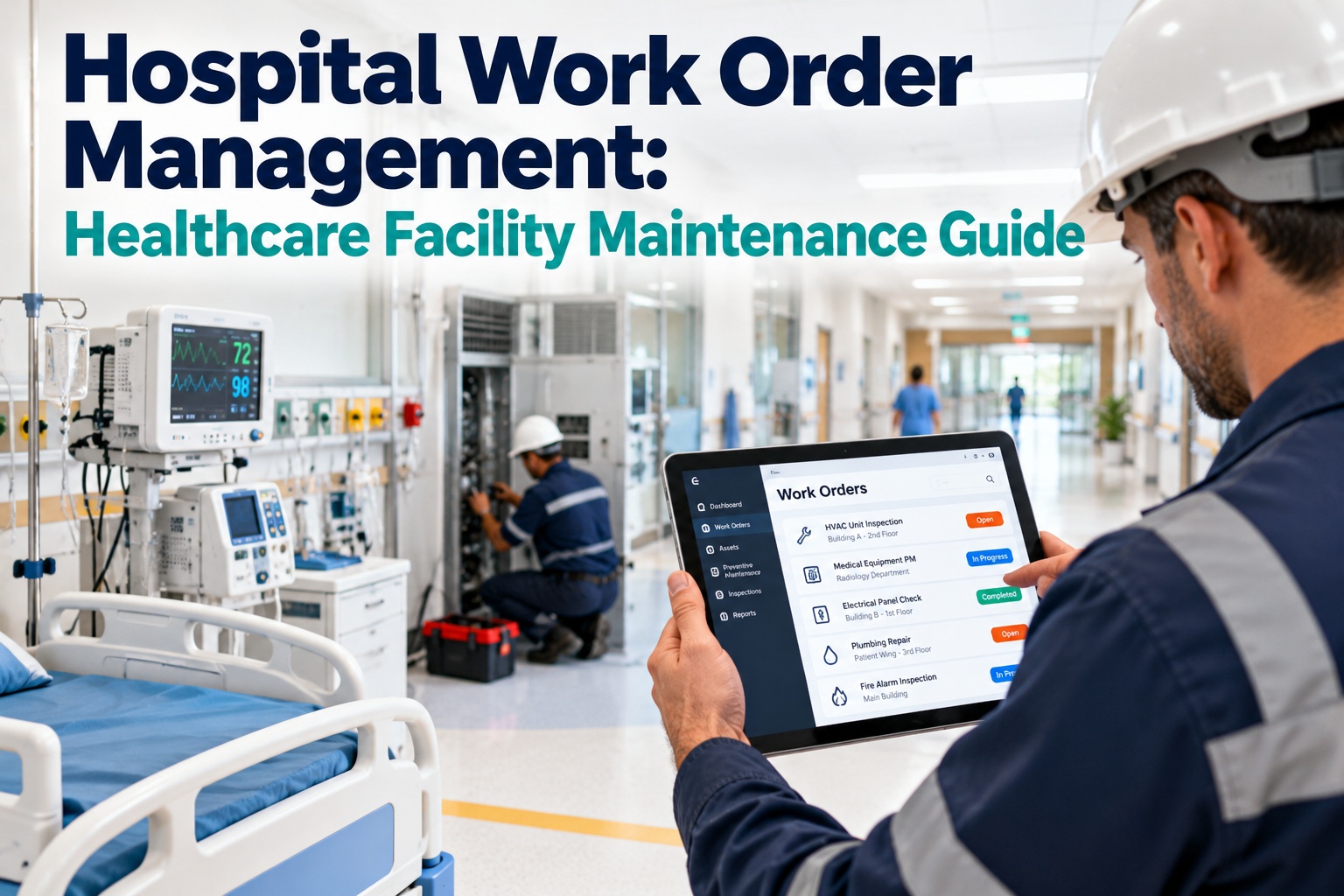
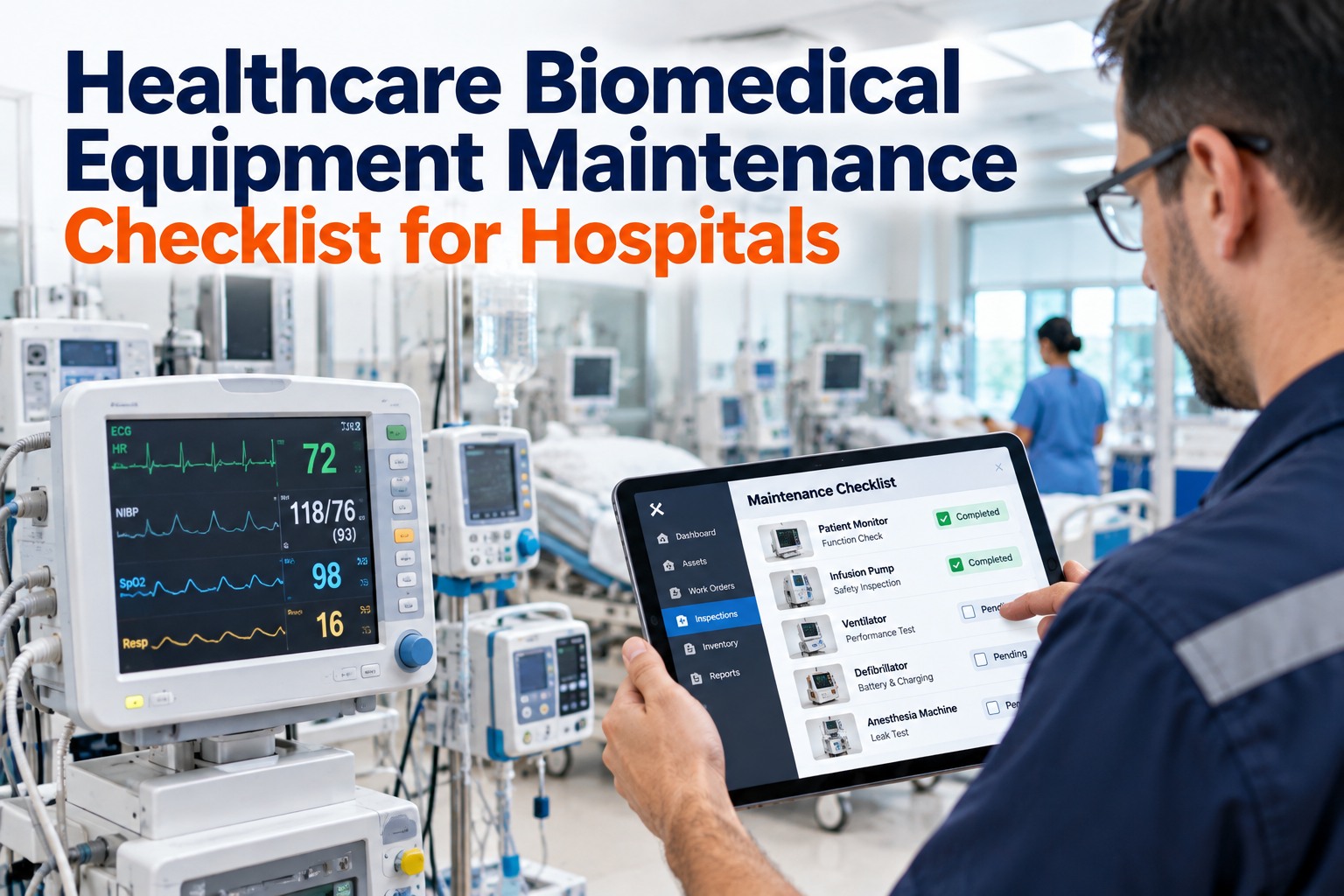
A hospital never closes, so its maintenance never stops. Requests pour in around the clock — a failed OR air handler, a dripping faucet, a flickering corridor light, a generator that failed its test — all into the same queue, from clinical staff who need to get back to patients. When those requests live on phone calls and sticky notes, the emergency competes with the trivial, PMs slip, and there's no record when the surveyor asks. This guide covers how hospital work order management brings order to that queue, and how to run it in OXMAINT AI — or book a demo of healthcare facility maintenance in OXMAINT AI.
HOSPITAL WORK ORDER MANAGEMENT · HEALTHCARE FACILITY MAINTENANCE · 2026
Hospital Work Order Management: Healthcare Facility Maintenance Guide
A life-safety fault and a loose door handle can't share one undifferentiated queue — and a maintenance history that lives in people's heads fails at survey time. OXMAINT AI is the AI-powered CMMS that intakes every request, prioritises it by patient-safety impact, schedules the preventive maintenance, and keeps the audit trail — so the critical work happens first and the record is always ready.
1 · Intake
2 · Prioritise
3 · Execute
4 · Record
24/7
requests never stop — the queue runs every hour of every day
4 tiers
emergency, urgent, routine and preventive — not one flat list
EC
the Environment of Care standards that maintenance records must satisfy
$/bed
maintenance cost per bed — the metric leadership watches
The Hospital Work Order Lifecycle
Every request — from a nurse's call about a warm fridge to a scheduled generator test — moves through the same disciplined path. The difference a CMMS makes is that each step is captured, not remembered. Start free and run the full work order flow in OXMAINT AI.
1Request
Clinical or facilities staff log the issue from anywhere, with location and detail.
2Triage
The request is prioritised by patient-safety and operational impact.
3Assign
Routed to the right trade or technician with the asset and history attached.
4Execute
The work is done and logged from a phone at the point of repair.
5Close
Parts, labor and notes captured; the requester is informed.
6Record
The complete, dated history stays on the asset for survey and analysis.
Not All Work Is Equal: Priority Tiers
The single most important thing hospital work order management does is sort the queue by consequence. A life-safety fault jumps ahead of everything; a cosmetic fix waits. This is the triage that keeps the critical work first.
Emergency
Medical gas, OR/ICU HVAC, emergency power, fire systems
Immediate — patient & life safety
Urgent
Leaks, failed clinical-area equipment, access or security faults
Same-day — before it escalates
Routine
Non-critical repairs, comfort items, minor fixtures
Scheduled into the backlog
Preventive
Planned PMs on utilities, HVAC, generators, life-safety systems
On cadence — never deferred for routine
The priority definitions and response targets are set by each hospital's own policy and its Environment of Care program.
The Systems Facilities Keeps Running
Behind the work order queue sit the building systems a hospital can't operate without. These are where PM and fast response matter most — because their failure reaches the patient. Book a demo of critical-asset PM scheduling in OXMAINT AI.
Medical Gas & Vacuum
Oxygen, medical air and vacuum systems — directly life-critical, tightly regulated.
HVAC & Critical Air
OR and ICU ventilation, pressure and filtration that protect patients and the sterile field.
Emergency Power
Generators and transfer switches that must carry the building through an outage.
Fire & Life Safety
Alarms, sprinklers, fire doors and barriers — inspected and documented to code.
Water & Plumbing
Domestic and process water, including the management of waterborne risk.
Vertical Transport
Elevators and lifts that move patients, staff and supplies through the building.
The Metrics That Run the Program
A work order system is also a measurement system. These are the numbers hospital facilities leadership watches — and the ones that show whether maintenance is in control or firefighting.
PM Completion Rate
The share of preventive maintenance done on time — a core compliance and reliability measure.
Work Order Backlog
Open, aging work — a growing backlog is an early warning of an overloaded program.
Response & Resolution Time
How fast requests are acknowledged and closed, tracked by priority tier.
Planned vs Reactive
The ratio of scheduled to emergency work — more planned means fewer surprises.
Maintenance Cost per Bed
Total maintenance spend normalised per bed — the headline benchmark for leadership and budgeting.
Cost per Square Foot
Spend against floor area — a companion benchmark for comparing facilities.
Benchmark values vary widely by facility age, size, acuity and region — the value is in trending your own numbers and comparing like with like.
How OXMAINT AI Manages Hospital Maintenance
OXMAINT AI is the AI-powered maintenance management software that runs the whole facility program on one platform — the request intake, the priority routing, the PM schedule, the asset history and the metrics. Put your facility on it when you start free and centralise your work orders in OXMAINT AI.
Easy Request Intake
Clinical and facilities staff log issues from a phone or portal, with location and photos.
Priority Routing
Requests triaged and routed by patient-safety impact, so the critical work rises to the top.
PM Scheduling
Preventive maintenance on critical systems generated on cadence and never lost in reactive work.
Asset History
Every repair, part and PM on each asset, so the next technician and the surveyor both have the record.
Audit-Ready Records
Dated, signed maintenance documentation ready to produce for Environment of Care review.
Dashboards & Metrics
PM completion, backlog, response time and cost tracked so the program is run by the numbers.
Order in the Queue Is Safety for the Patient.
When the life-safety fault is always worked first, the PM never slips, and the record is always ready, maintenance stops being a scramble and becomes a system. OXMAINT AI is where the hospital's whole facility program lives and runs.
EXPERT REVIEW
Written for hospital facilities, plant-operations and healthcare maintenance teams. Hospital facility maintenance operates under accreditation and regulation — The Joint Commission's Environment of Care and utilities-management standards, CMS Conditions of Participation, and codes including NFPA 99 (Health Care Facilities Code) and NFPA 101 (Life Safety Code) — and each hospital's own policies set its priority definitions, response targets and documentation requirements. Clinical and biomedical equipment maintenance is often managed by a separate clinical-engineering function and governed by its own rules. The priority tiers, metrics and benchmarks here are a general framework, not fixed standards. OXMAINT AI is a maintenance management platform for facility assets and work orders — it is not a medical-device management system, an accreditation guarantee, or a substitute for your compliance program.
Frequently Asked Questions
What is hospital work order management?
It's the process of intaking maintenance requests, prioritising them by patient-safety and operational impact, assigning and completing the work, and keeping the record — usually run through a CMMS. In a hospital it has to handle a 24/7 flow of requests, keep life-safety work ahead of routine, and produce documentation for accreditation.
Start free and centralise hospital work orders in OXMAINT AI.
How should hospital work orders be prioritised?
By consequence to patients and operations. Emergencies that affect life safety — medical gas, critical HVAC, emergency power, fire systems — come first; urgent issues that will escalate come next; routine repairs are scheduled; and preventive maintenance on critical systems runs on its own cadence and isn't deferred for routine work. Each hospital sets the exact definitions and response targets.
What is maintenance cost per bed?
It's total facility maintenance spend divided by the number of beds — a way to normalise and benchmark maintenance cost across facilities of different sizes. It's a headline metric for hospital leadership, though it varies widely with building age, size, acuity and region, so the real value is trending your own figure over time and comparing like facilities.
How does a CMMS support accreditation?
By keeping complete, dated, retrievable records of every PM and repair on each asset — which is exactly what Environment of Care and utilities-management reviews look for. Scheduled PMs with completion records, prioritised response, and a full asset history turn survey preparation from a scramble into a report, because the evidence already exists.
Is facility maintenance the same as medical equipment maintenance?
No — they're usually separate. Facility maintenance covers the building and its systems: HVAC, power, plumbing, fire safety, elevators. Clinical or biomedical equipment — the devices used directly in patient care — is typically managed by a clinical-engineering or biomed team under its own regulations. A facility CMMS focuses on the building side.
Book a demo of facility asset management in OXMAINT AI.
Give the Facility Program a System, Not a Scramble.
Run hospital facility maintenance on OXMAINT AI: every request intaken and prioritised by patient-safety impact, preventive maintenance scheduled on critical systems, full asset history kept for survey, and the metrics — PM completion, backlog, cost per bed — on a dashboard, so the critical work comes first and the record is always ready.