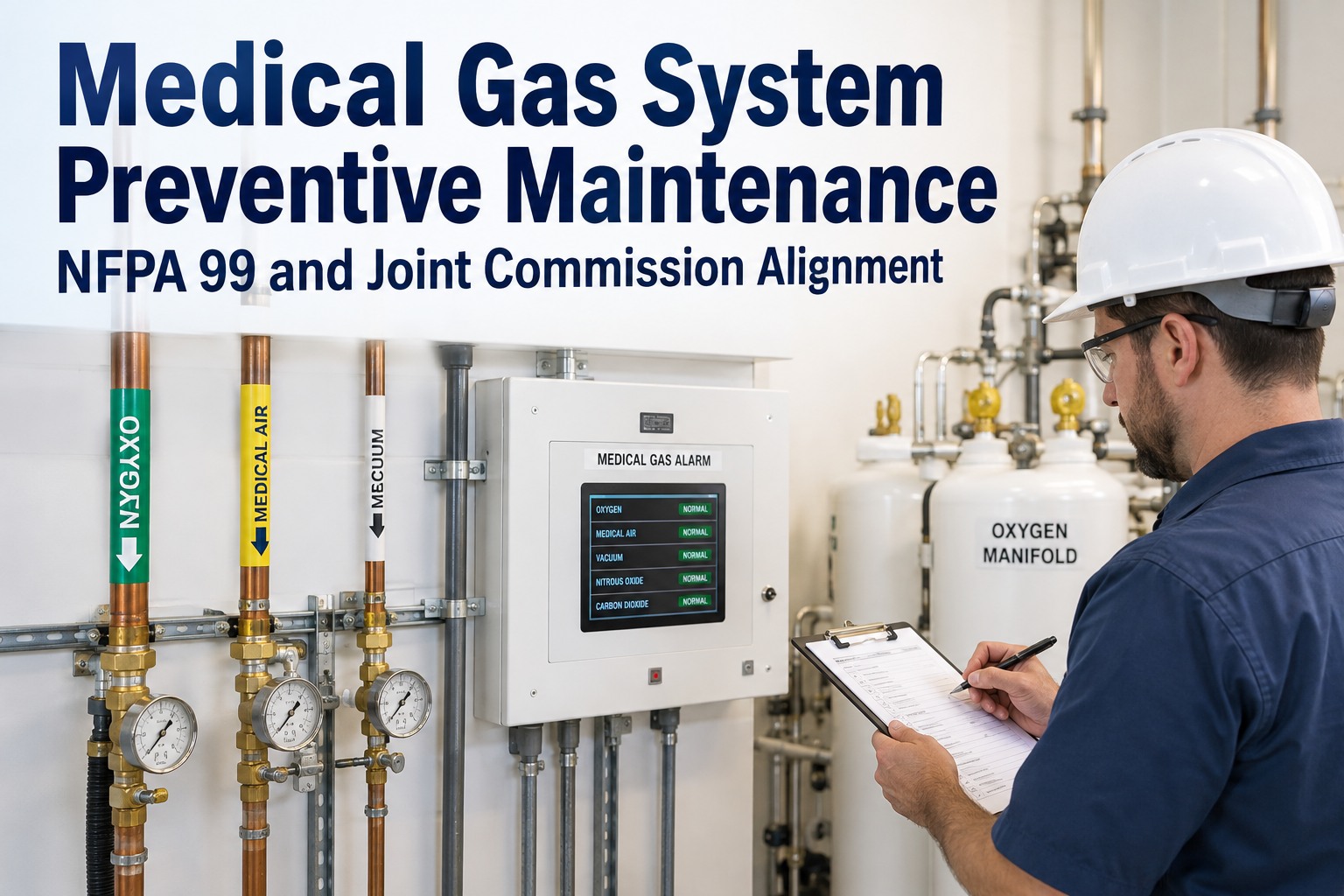
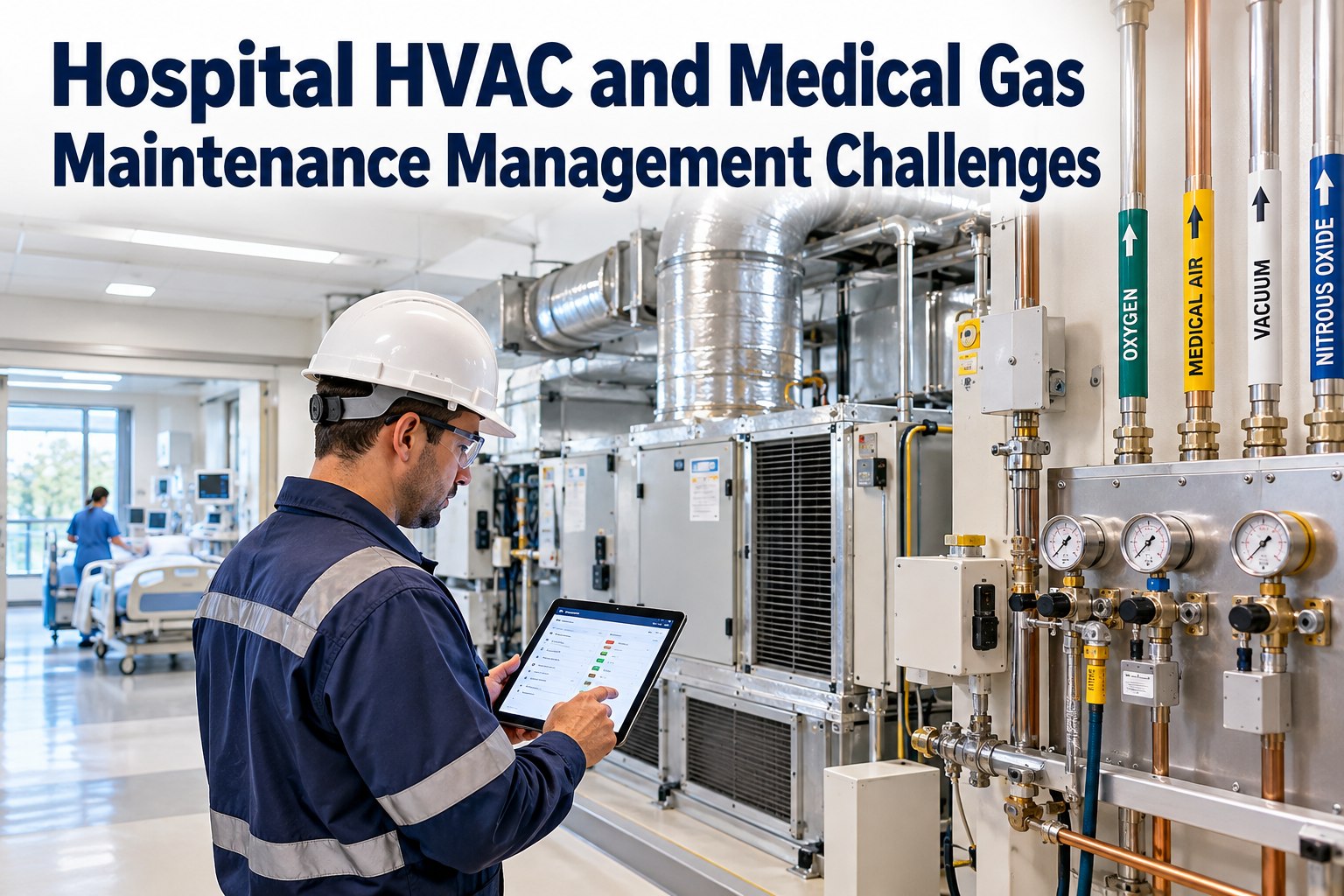
In a hospital, most utility failures are inconvenient. A medical gas failure is a sentinel event — a zone valve that won't isolate during a fire, a master alarm that never sounds, or medical air that drifts past the carbon monoxide limit while a patient is on it. This is why medical gas is governed more tightly than any other building system: NFPA 99 mandates documented inspection, testing, and alarm verification for every zone valve, alarm panel, and source across the oxygen, medical air, vacuum, and nitrous oxide systems — and the Joint Commission cites hospitals not for skipping the work, but for being unable to prove it happened. The gap between the inspection that occurred and the record that proves it is exactly where citations and liability live. This guide lays out the NFPA 99 maintenance program by frequency, the four systems it governs, and how OxMaint turns every check into audit-ready evidence. Book a demo to see NFPA 99 compliance digitized.
The Highest-Consequence Utility in the Building
Four compliance anchors every hospital facilities team is expected to know cold.
NFPA 99
Health Care Facilities Code — Chapter 14 consolidates all inspection, testing & maintenance for piped gas systems
EC.02.05.09
Joint Commission standard — inspect, test & maintain piped medical gas and vacuum with documented results
10 ppm
Max carbon monoxide in Grade D medical air — an exceedance is a patient-safety event, not a note
ASSE 6040
The qualification standard for personnel maintaining piped medical gas systems
Where Citations Actually Come From
Surveyors rarely find a hospital that never inspects its medical gas. What they find is inspection that can't be proven — undocumented, sampled instead of complete, or missing the details that make a record defensible. Three failure patterns account for most findings.
The documentation gap
The valve was tested, but the record doesn't show the valve identity, location, gas type, date, and tester. An undocumented test is, to an auditor, a test that didn't happen.
Sampling instead of 100%
Zone valve isolation is the most-cited deficiency — and NFPA 99 requires every installed zone valve tested annually, not a representative sample.
Unverified alarms
Master and area alarm panels that were assumed working but never function-tested. The alarm that doesn't sound is the failure nobody sees until it's needed.
The NFPA 99 Program Runs on Three Clocks
Medical gas maintenance isn't an annual event — it's a layered program running on three cadences at once. A compliant hospital executes all three consistently across every system, and can produce the record for any of them on demand. This is the backbone your PM schedule has to reproduce.
DAILY / ONGOING
Source pressure & content-level logs (bulk O₂, manifolds)
Master alarm signal monitoring
Medical air compressor & vacuum pump operating status
QUARTERLY / PERIODIC
Area alarm panel function tests
Source equipment inspection & changeover checks
Air-quality sampling (CO, dew point) for medical air
ANNUAL / QUALIFICATION
100% of zone valves tested for isolation & labelling
Full master & area alarm verification
Outlet/inlet performance & cross-connection review
Four Systems, Four Distinct Obligations
NFPA 99 governs four piped systems serving patient care, and each carries its own inspection focus. A single PM program has to cover all four without treating them as interchangeable — the failure modes and the consequences differ.
O₂Medical Oxygen
Bulk liquid storage, pressure regulation, manifolds, zone valves, and area alarms. The highest-consequence gas — loss during a procedure is immediate.
AirMedical Air
Compressor sources held to Grade D — CO under 10 ppm and dew point controlled. Air quality is a monitored patient-safety parameter, not a comfort spec.
VacMedical Vacuum
Pump sources and receivers maintaining continuous suction. Redundancy and changeover verification keep suction available at the bedside without interruption.
N₂ONitrous Oxide / WAGD
Anesthetic supply and waste gas disposal. Tight control over leaks and scavenging protects both patients and staff in the OR environment.
See Your Whole NFPA 99 Program on One Dashboard
Bring your zone valve list and alarm inventory to a 30-minute session. We'll load your four gas systems into OxMaint, set the daily, quarterly, and annual schedules, and show a zone-valve test producing an audit-ready record as it's completed.
The Three Components Auditors Open First
When a surveyor reviews a medical gas program, three component records get pulled before anything else — because they're where deficiencies cluster. Getting these three right and documented carries most of the compliance weight. Start a free trial and build your zone-valve register to close the biggest gap first.
Zone Valves
Every installed valve tested annually for isolation — closing stops flow to the right zone, doesn't affect neighbors, and the box labelling matches. Each record needs valve identity, location, gas type, date, and tester. This is the single most-cited deficiency.
Alarm Panels
Master and area panels function-tested so every signal actually annunciates — pressure high/low, source changeover, and reserve conditions. An alarm assumed working is a failure waiting for the worst moment.
Source & Manifolds
Bulk oxygen, cylinder manifolds, air compressors, and vacuum pumps — with changeover and reserve verified, and medical air quality sampled. The supply end where a single fault can drop an entire gas.
How OxMaint Runs Medical Gas Compliance
OxMaint turns the NFPA 99 program into digital inspection workflows — every zone valve, alarm panel, and source on its correct cadence, every result captured with the fields an auditor demands, and every deficiency routed to a corrective work order. The documentation gap closes because the record is created at the moment the check is done. Book a demo to map your medical gas program.
Schedule
Three Cadences, One Calendar
Daily logs, quarterly tests, and annual qualifications each run on their own schedule with reminders — no clock gets missed.
Register
Every Zone Valve Tracked
All installed valves in one register so annual testing is provably 100% — not a sample — with identity and location on each.
Capture
Mandatory Record Fields
Valve ID, gas type, date, and tester are required fields — the record can't be saved incomplete, so it can't fail review.
Verify
Alarm Test Logging
Master and area alarm function tests logged with pass/fail per signal — verified annunciation, not an assumption.
Correct
Deficiency to Work Order
A failed check auto-opens a corrective work order and tracks it to closure — the closed loop surveyors expect.
Export
Audit-Ready in Seconds
Filter by system, date, or area and export the full inspection history for a Joint Commission or CMS survey on demand.
Close the Gap Between the Inspection and the Proof
Move zone valves, alarms, and gas sources onto one system that schedules every cadence, enforces the record fields, and exports audit-ready history for your next survey. Free forever plan available — no card required.
Frequently Asked Questions
What does NFPA 99 require for medical gas maintenance?
NFPA 99 requires a documented, layered program — daily source and alarm monitoring, periodic functional tests and air-quality sampling, and annual qualification including testing 100% of installed zone valves — across the oxygen, medical air, vacuum, and nitrous oxide systems, with results recorded and retrievable.
Start free to build the program.
How does this align with Joint Commission requirements?
The Joint Commission's Environment of Care standard EC.02.05.09 requires hospitals to inspect, test, and maintain piped medical gas and vacuum systems with a documented program and results. NFPA 99 defines the technical work; the Joint Commission checks that it's done and provable — which is why the record matters as much as the inspection.
Why is zone valve testing the most-cited deficiency?
Because it's the most operationally complex and it's all-or-nothing — every installed valve must be tested annually for correct isolation and labelling, not a sample, and each result must carry the valve identity, location, gas type, date, and tester. Missing valves or thin records are the fastest path to a citation.
Who is qualified to maintain medical gas systems?
ASSE 6040 is the professional qualification standard for personnel maintaining piped medical gas systems. During a survey, staff competency and training records may be reviewed, so hospitals should be prepared to demonstrate that the people doing the work are properly qualified for the equipment installed.
Book a demo to see the compliance trail.
Does OxMaint support NFPA 99 medical gas compliance?
Yes. OxMaint schedules the daily, quarterly, and annual cadences, tracks every zone valve for provable 100% annual testing, enforces mandatory record fields, logs alarm function tests, routes deficiencies to corrective work orders, and exports audit-ready inspection history for Joint Commission and CMS surveys. A free forever plan is available to trial the full workflow.