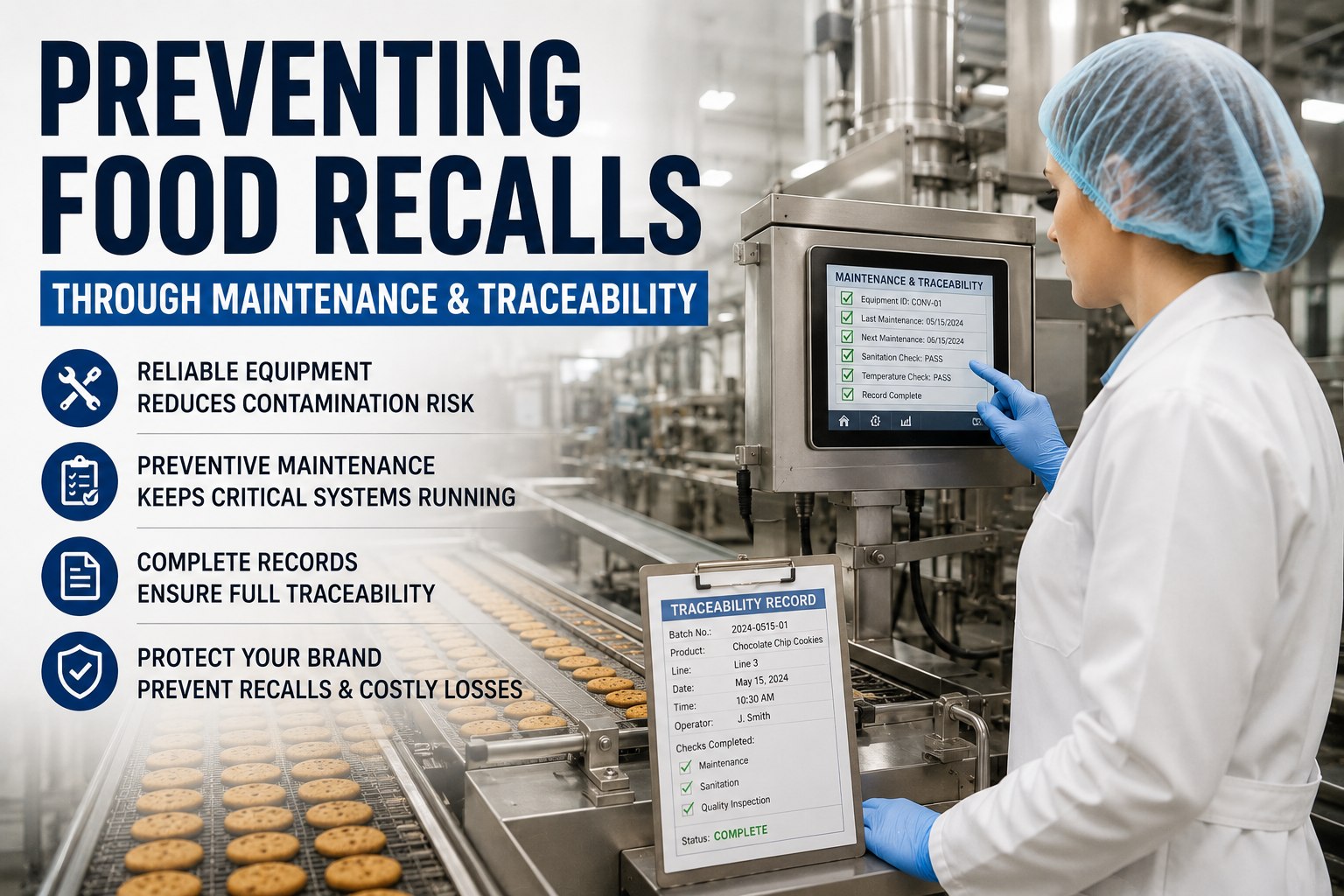
Oxmaint is the food manufacturing maintenance software that links every equipment PM, sanitation cycle, calibration record, and temperature log to the production lot it protected — turning maintenance data into the traceability evidence FSMA Section 204 requires and the due-diligence record that keeps recall scope small. The average food recall costs $10 million in direct costs, 59% of consumers hesitate to buy a brand after one, and 43% of FSMA inspections flag lot-record gaps that a paper-and-spreadsheet operation cannot close in the 24 hours FDA gives you. This guide covers where recalls actually come from on the plant floor, what FSMA 204's five Critical Tracking Events demand as of January 2026, and how Oxmaint's food-focused CMMS builds the maintenance-to-lot record that isolates a bad batch in minutes instead of pulling the whole SKU.
Preventing Food Recalls Through Maintenance & Traceability
A practical 2026 field guide for food and beverage plant managers, quality directors, and maintenance leaders — grounded in the equipment failures that cause recalls and the maintenance records that stop them, powered by Oxmaint's food manufacturing CMMS.
Six equipment failure modes behind most food recalls
A contamination event almost always traces to equipment — a sanitization lapse, a temperature excursion, a worn seal, a metal detector that drifted out of calibration. Without a maintenance record linked to the production lot, food manufacturers cannot demonstrate due diligence and face recall remediation costs of $30,000-$100,000 per day. Oxmaint links every sanitation cycle, calibration certificate, and PM record to the specific lot it protected — so a contamination event stays isolated to one shift instead of pulling three months of production. To see this linkage on your equipment, start a free Oxmaint trial.
Cold chain excursions
Freezer defrost failures, chiller compressor drift, refrigerated warehouse door seals. Oxmaint logs every temperature setpoint deviation against the affected lot.
Salmonella · Listeria riskCIP / sanitation lapses
Clean-in-place cycle deviations, sanitiser concentration drift, spray ball wear. Oxmaint enforces CIP verification and blocks the next batch until sign-off.
Allergen · biofilm riskMetal detection drift
Metal detector and X-ray inspection calibration lapses. Oxmaint schedules shift-start test-piece verification and quarantines lots when checks fail.
Foreign body riskSeals, gaskets & O-rings
Worn hygienic seals on tanks, valves, and pumps let product cross-contaminate. Oxmaint tracks seal age against replacement interval and flags overdue units.
Cross-contaminationThermal processing
Retort, pasteuriser, and oven temperature/time drift. Oxmaint links every batch to its thermal record and flags any deviation from the validated schedule.
Pathogen survival riskAllergen changeover
Missed changeover cleanings on shared lines cause allergen cross-contact — the leading cause of Class I recalls. Oxmaint enforces the changeover checklist per line and per SKU.
Class I recall driverThe five Critical Tracking Events every FTL facility must record
FSMA Section 204, codified as 21 CFR Part 1 Subpart S, requires food manufacturers handling products on the Food Traceability List to capture Key Data Elements at five Critical Tracking Events — with the ability to produce a sortable electronic record within 24 hours of an FDA traceback request. Manual and spreadsheet-based systems routinely fail this timeline in mock recall exercises. Oxmaint captures KDEs at every CTE electronically, links them to the equipment maintenance record that protected the lot, and produces the sortable spreadsheet FDA requires in under 60 minutes. To see the record structure on your production lines, book a food manufacturing demo.
Growing / Harvesting
Farm location, harvest date, commodity, quantity, and Traceability Lot Code assigned. Oxmaint links supplier TLC to the incoming lot at receipt.
Receiving
Supplier TLC, receipt date, quantity, and the specific storage location captured — with the sanitation record for that location attached to the receiving event.
Transformation
Input TLCs, output TLC, transformation date, quantity produced, and every equipment PM plus CIP verification that ran on that line before the batch.
Creation
New TLC assigned for finished product, creation date, quantity, and the metal-detector, thermal, and allergen changeover records that protected the batch.
Shipping
TLC, ship date, quantity, receiver location — closing the chain of custody with the equipment record that verified the lot left in compliant condition.
What a recall actually costs — and what maintenance records save
The financial case for maintenance-linked traceability is not theoretical. Every dollar saved comes from three places: smaller recall scope (isolate the bad lot, keep the good product on shelves), faster FDA audit response (electronic KDE records vs three days of paper compilation), and reduced remediation timeline (due-diligence maintenance records vs open-ended investigation). The table below is the recall economics food manufacturers running Oxmaint use to justify the platform in one avoided event. To baseline these numbers against your plant, sign up for a free Oxmaint trial.
| Recall dimension | Without integrated records | With Oxmaint traceability |
|---|---|---|
| Direct recall cost | $10M+ average | Up to 80% scope reduction |
| Recall scope | Full SKU or product line pulled | Isolated to affected lot / shift |
| FDA 24-hour response | Days of manual record compilation | Sortable electronic record <60 min |
| Daily remediation cost | $30,000-$100,000 / day | Rapid closure with due-diligence evidence |
| Brand impact | 59% of consumers hesitate to buy | Targeted recall preserves shelf presence |
| Compliance labour | Paper logs, spreadsheets, PDF supplier data | 70% labour reduction with automated KDE capture |
| FSMA inspection gaps | 43% flagged for supplier lot data | Supplier TLC linked at receipt CTE |
Six capabilities that turn Oxmaint into your recall prevention system
Oxmaint is the food and beverage maintenance management software that links equipment records to lot records so a contamination event stays small, a traceback request gets answered in an hour, and an FDA inspection finds due-diligence evidence for every batch. The six capabilities below are how food manufacturers, quality directors, and plant maintenance leaders use Oxmaint to protect brand, budget, and shelf presence. To scope Oxmaint against your operation, book a demo with our food manufacturing team.
Lot-to-equipment linkage
Oxmaint links every production lot to the specific equipment, PM record, CIP verification, and calibration certificate that protected it — one query returns full due-diligence evidence.
Cold chain monitoring
Oxmaint integrates temperature sensors on freezers, chillers, and cold-storage to flag excursions against the exact lot in the affected zone at the time of the event.
CIP & allergen enforcement
Oxmaint blocks the next batch until CIP verification and allergen changeover checklists are complete and signed — eliminating the leading cause of Class I recalls.
Metal detector calibration
Oxmaint schedules shift-start test-piece verification for metal detectors and X-ray, logs the result against the shift's lots, and quarantines batches when checks fail.
FSMA 204 KDE capture
Oxmaint captures Key Data Elements at every Critical Tracking Event electronically and produces the sortable spreadsheet FDA requires in under 60 minutes.
Mock recall drills
Oxmaint runs mock recall exercises against live production data — proving lot isolation works before an actual event forces the plant to find out in real time.
Oxmaint for food recall prevention & traceability — FAQ
How does Oxmaint link maintenance records to specific production lots?
Oxmaint tags every PM record, CIP verification, calibration certificate, and temperature log with the equipment ID and timestamp — then cross-references that data against the production schedule to identify which lots ran on that equipment during that window. When an FDA traceback request arrives, one query returns the full maintenance chain protecting every affected lot: the CIP that ran before the batch, the metal detector calibration that verified it, the temperature record that held it, the seal replacement done two weeks earlier. This is the due-diligence evidence that keeps recall scope small and demonstrates preventive controls under 21 CFR Part 117.
What foods are covered under FSMA 204 and does the rule apply to my facility?
FSMA 204 applies to facilities that manufacture, process, pack, or hold foods on the FDA Food Traceability List — leafy greens, tomatoes, cucumbers, melons, herbs, soft cheeses, shell eggs, nut butters, seafood, ready-to-eat deli salads, and any product containing these as ingredients in the same form. The rule requires electronic KDE capture at five Critical Tracking Events and 24-hour FDA response capability. Even facilities exempt from FSMA 204 directly are subject to FSMA Preventive Controls under 21 CFR Part 117, which requires the same underlying maintenance and sanitation record discipline. Oxmaint supports both frameworks in one platform.
What are the five Critical Tracking Events under FSMA 204?
The five CTEs are Growing/Harvesting, Receiving, Transformation, Creation, and Shipping — each requires specific Key Data Elements captured and retained for 24 months. Growing captures farm location and initial TLC assignment. Receiving links supplier TLC to storage location. Transformation records input and output TLCs plus equipment PMs run on the line. Creation assigns a new TLC to the finished product with associated protective records. Shipping closes the chain with TLC, ship date, quantity, and receiver. Oxmaint captures KDEs at every CTE electronically and links them to the equipment records for FDA audit response.
Which equipment failures cause the most food recalls?
Allergen cross-contact from missed changeover cleanings is the single leading cause of Class I recalls in the US. Cold chain excursions from freezer or chiller failures drive Listeria and Salmonella events. CIP cycle deviations create biofilm and pathogen growth on food-contact surfaces. Metal detector and X-ray calibration lapses drive foreign-body recalls. Worn hygienic seals on tanks and valves cause cross-contamination between products. Thermal processing drift on retorts, pasteurisers, and ovens allows pathogen survival. Oxmaint schedules PMs and enforces verification on every one of these equipment classes and links the maintenance record to the lot.
How fast can Oxmaint produce records for a 24-hour FDA traceback request?
Oxmaint produces the full sortable electronic spreadsheet FDA requires under FSMA 204 in under 60 minutes. Every KDE is stored electronically at the point of capture, every CTE record is time-stamped and lot-tagged, and the query engine returns the traceability chain for any lot code across shipping, creation, transformation, receiving, and growing events. Facilities running Oxmaint respond to FDA traceback requests 65% faster than those using manual records — the difference between compliance and a warning letter that escalates to further regulatory action.
What is the realistic ROI when a food manufacturer deploys Oxmaint?
Food manufacturers typically hit full payback inside one avoided recall event, with measurable operational benefits from month one. Oxmaint delivers 65% faster FDA audit response, up to 80% recall scope reduction through rapid lot isolation, and 70% reduction in compliance labour through automated KDE capture. On a mid-size FMCG plant, avoiding a single Class II recall event — average $2-5M in direct costs — covers a multi-year Oxmaint investment. Add the ongoing operational benefits and full FSMA record structure inside 30 days of deployment, and the platform pays back before the first FSMA inspection. To model the case for your plant, start a free Oxmaint trial.
Keep the recall small. Keep the brand intact.
Oxmaint gives food and beverage manufacturers one platform to link every equipment PM, sanitation cycle, calibration record, and temperature log to the production lot it protected — so FSMA 204 traceback requests get answered in an hour, recall scope stays isolated to the affected lot, and every FDA inspection finds due-diligence evidence for every batch.