A Form 483 observation related to maintenance records can halt a product line, trigger a warning letter, and launch a consent decree process that takes years and tens of millions of dollars to resolve. The root cause in most cases is not negligent maintenance — it is undocumented maintenance: work performed without traceable digital records, calibrations done without timestamps, and inspection histories that exist on paper forms that cannot be produced during an FDA walkthrough. OxMaint's compliance tracking system closes every one of those documentation gaps with automatic audit trails, electronic signatures, and calibration records that are inspector-ready the moment an FDA investigator enters the facility.
Compliance Article · Pharma & GMP · FDA Form 483 Defense 2026
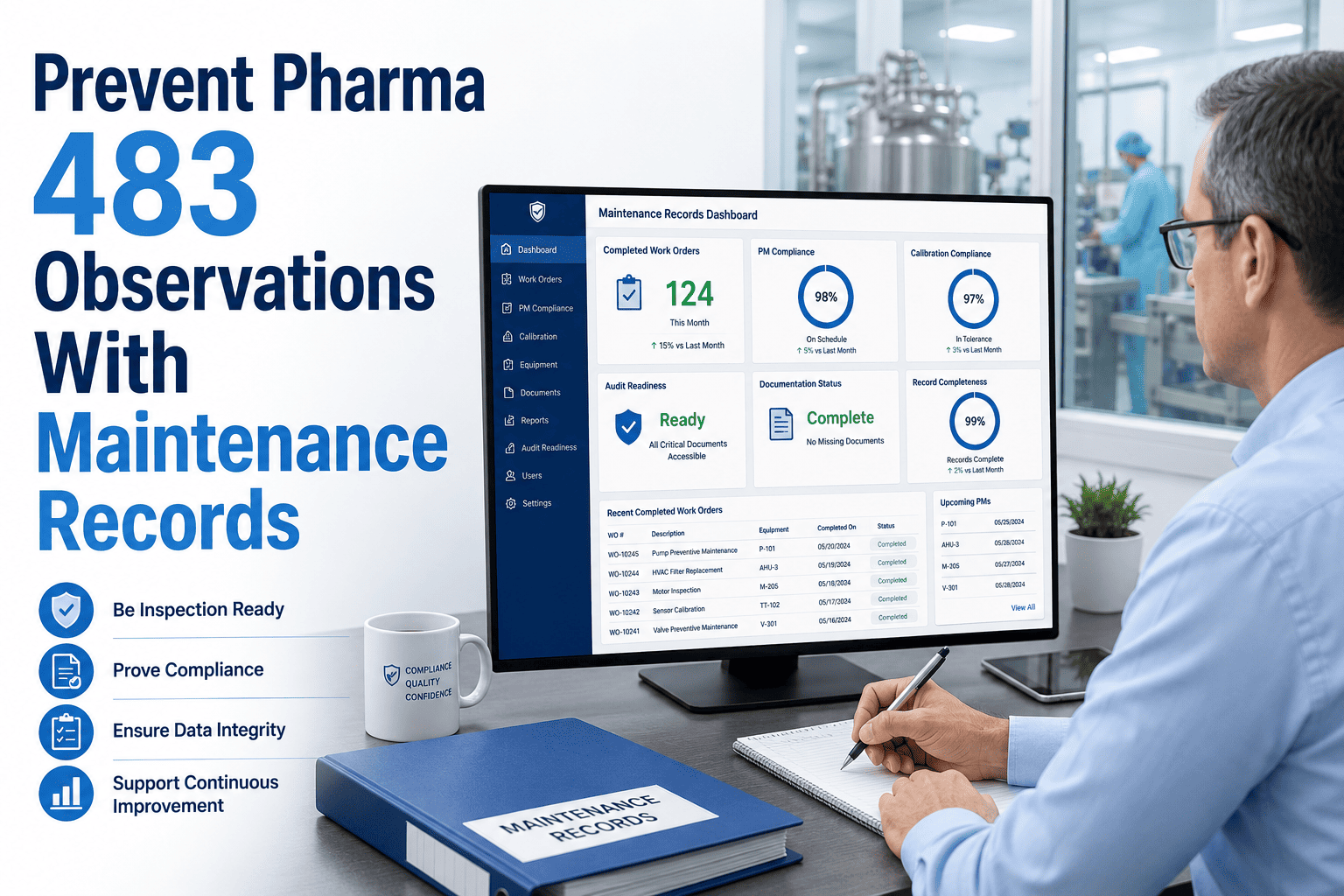
Prevent Pharma 483 Observations With Maintenance Records
How pharmaceutical maintenance teams use digital work orders, calibration logs, and complete audit trails to eliminate the documentation gaps that trigger FDA observations.
483
Most common pharma 483 cite relates to inadequate maintenance/calibration records
62%
Of GMP deviations are linked to preventive maintenance failures
$10M+
Average cost of a consent decree related to recurring maintenance deficiencies
The Problem
What Actually Triggers Form 483 Maintenance Observations
FDA investigators use a standard protocol when reviewing maintenance records: they select a sample of equipment from the asset register and trace every calibration, preventive maintenance, and repair event for the past 12–24 months. Any gap in that chain — a missed PM, a calibration performed but not recorded to the correct instrument ID, a work order closed without a completion signature — becomes a potential 483 observation. The equipment may have been maintained perfectly; if the record cannot prove it, the observation stands.
483
Equipment Not Maintained at Appropriate Intervals
PM scheduled in one system, performed by a different team with no cross-reference. Paper record exists but cannot be linked to the asset's formal maintenance history.
483
Calibration Records Incomplete or Unsigned
Calibration performed but record lacks the technician identity, calibration standard reference, or formal review signature required by 21 CFR Part 211.68.
483
No Evidence of Qualification After Repair
Critical equipment repaired and returned to service without a documented IQ/OQ/PQ re-qualification record attached to the repair event.
483
Audit Trail Gaps or Record Alterations
Paper records show corrections without original data retained, or timestamps are inconsistent — both are data integrity findings under 21 CFR Part 11.
FDA-Inspection-Ready Records
See How OxMaint Closes Every Maintenance Documentation Gap That Triggers 483 Observations
Book a 30-minute demo and we'll walk through a real pharma maintenance audit trail in OxMaint — from scheduled PM to calibration log to electronic sign-off — showing exactly what an FDA investigator would see.
OxMaint Compliance Features
How OxMaint Protects Against Each Observation Type
| 483 Risk Area |
OxMaint Solution |
Regulatory Coverage |
| Missed or overdue PMs |
Automated PM scheduling with escalation alerts and overdue flags visible to managers |
21 CFR 211.67, 211.68 |
| Incomplete calibration records |
Structured calibration log forms with required field enforcement — record cannot be submitted incomplete |
21 CFR 211.68, ISO 9001 |
| Missing electronic signatures |
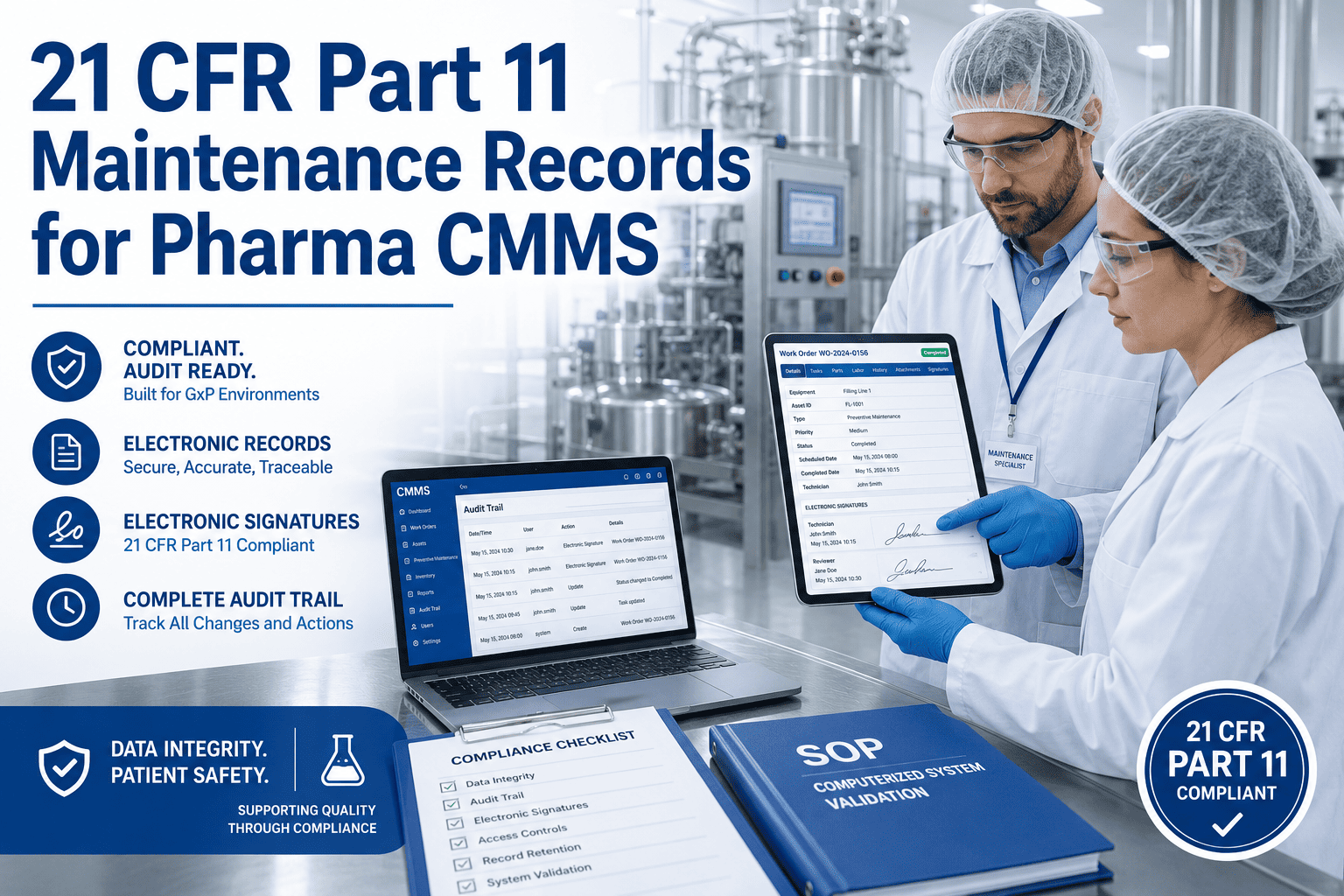
Role-based e-signature workflow with user authentication tied to 21 CFR Part 11 compliant audit trail |
21 CFR Part 11 |
| No post-repair qualification |
Repair-linked qualification checklist template that must be completed before work order closure on qualified equipment |
21 CFR 211.68, GMP Annex 11 |
| Audit trail gaps |
Immutable timestamped record of every create, edit, approve, and close action — every user, every change, permanent log |
21 CFR Part 11.10(e) |
| Paper records not producible |
All records digital, searchable by asset, date, technician, or equipment ID — export-ready for FDA request in minutes |
21 CFR 211.180, Part 11 |
“
In my experience conducting FDA inspection readiness assessments, the maintenance record gaps that generate 483 observations are almost never caused by maintenance teams not doing the work. They are caused by documentation systems that make it impossible to prove the work was done correctly. A technician who performs a calibration on paper, loses the form, and recreates it from memory two weeks later has created a data integrity problem — even if the calibration itself was perfect. Digital CMMS systems with enforced form completion, e-signatures, and immutable audit trails eliminate this class of observation almost entirely.
Dr. Patricia Hernandez
GMP Compliance Consultant, Pharmaceutical Quality Systems Practice — FDA Inspection Readiness Report 2025
FAQ
Frequently Asked Questions
Which specific sections of 21 CFR Part 211 relate to maintenance record requirements?
The primary sections are 21 CFR 211.67 (equipment cleaning and maintenance), which requires written procedures and records for each maintenance operation; 211.68 (automatic, mechanical, and electronic equipment), which requires calibration of equipment and retention of written records; and 211.180, which defines record retention requirements for batch production and control records. OxMaint's GMP maintenance module is configured against all three sections with compliant work order templates and record retention policies.
Book a demo to review the specific regulatory coverage against your equipment types.
Can OxMaint produce a complete maintenance history for a specific piece of equipment on demand during an FDA inspection?
Yes. OxMaint's asset-level history view shows every work order, PM completion, calibration record, repair event, and qualification record linked to a specific asset — filtered by any date range — and can be exported as a PDF or CSV report within seconds. During an FDA walkthrough, the QA team can produce a complete 24-month maintenance history for any equipment immediately from any device without requesting records from IT or searching file cabinets.
Start a free trial to see how the asset history export function works for your equipment register.
How does OxMaint handle the requirement to retain original data and prevent record alteration?
Every record in OxMaint is immutable after submission — the original data is permanently stored and cannot be overwritten, deleted, or altered. If a correction is necessary, the system creates a new record with a link to the original, retaining both versions with timestamps and user IDs. This meets the ALCOA+ principles (Attributable, Legible, Contemporaneous, Original, Accurate) required for pharmaceutical data integrity compliance under both FDA and EMA guidelines.
Book a demo to review OxMaint's data integrity architecture against your current quality system requirements.
Does OxMaint support equipment qualification records (IQ/OQ/PQ) linked to maintenance events?
Yes. OxMaint allows qualification protocols to be attached directly to assets and linked to specific repair and modification events. When a work order for a qualified equipment item is closed, the system can require completion of a re-qualification checklist before the closure is permitted — preventing qualified equipment from being returned to service without documented re-qualification. Qualification records and their linkage to maintenance events are visible in the asset audit trail and searchable during inspection.
Start a free trial to configure qualification templates for your validated equipment classes.
Audit-Ready Before the Investigator Arrives
Close Every Maintenance Documentation Gap That Triggers FDA Form 483 Observations
OxMaint's pharma-grade CMMS enforces GMP-compliant documentation at every maintenance step — automated PM tracking, structured calibration logs, 21 CFR Part 11 audit trails, and electronic signatures — so your records are always ready.