A steam turbine does not fail on a schedule. It fails at a journal bearing that started running 8°F hotter three weeks ago and nobody trended it. At a last-stage blade whose leading-edge erosion crossed the FMEA threshold two outages back. At a governor valve stem whose stiction increased on every hot start. RCM proves that only 15% of failure modes are age-related and actually respond to time-based PM — the remaining 85% require condition-based, predictive, or run-to-failure strategies. Which means a paper PM binder built around calendar dates is prescribing the wrong medicine for 85% of what actually breaks a turbine. Oxmaint is the maintenance management software US power generation teams use to embed RCM methodology directly in the execution layer — SAE JA1011 failure-mode mapping, FMEA-driven work orders, condition monitoring thresholds that auto-generate corrective actions, and a full audit trail against every rotor, bearing, and steam-path component. Start free and stand up an RCM programme on your turbine fleet this week, or book a demo mapped to your HP, IP, and LP rotors, bearings, and control system.
Power Generation · Steam Turbine · SAE JA1011 · FMEA
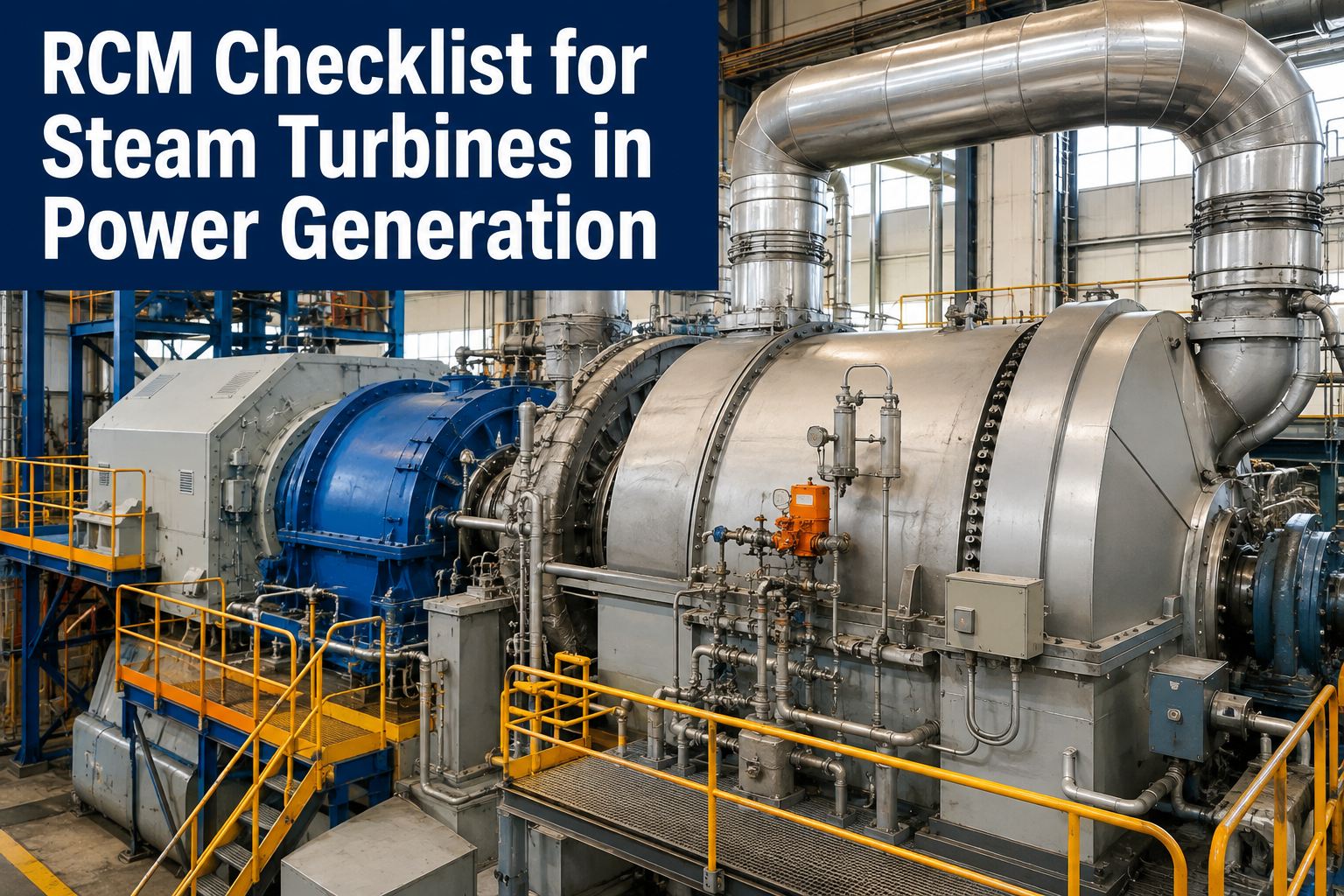
RCM Checklist for Steam Turbines in Power Generation
Every failure mode, every detection technique, every consequence-driven maintenance strategy — organized around the SAE JA1011 seven-question framework, FMEA logic, and the condition-monitoring toolkit (vibration, oil, thermography, performance trending, borescope) that turns a reactive turbine programme into a predictive one.
-
85%
of failure modes are NOT age-related and do not respond to calendar PM
-
15%
only — the share of failures that actually justify time-based restoration
-
7
SAE JA1011 questions defining every RCM decision on every critical asset
-
20 / 80
assets that drive unplanned downtime cost — main turbines lead the list
The 85% Problem
Why Calendar PM Prescribes the Wrong Treatment for Most Failures
Traditional PM assumes all assets benefit from scheduled restoration on a calendar. RCM proves the opposite — only 15% of failure modes follow age-related wear-out curves that respond to time-based intervention. The other 85% follow random, infant-mortality, or condition-degradation patterns that only surface through the right monitoring technique. Applying calendar PM to condition-driven failure modes wastes labour and misses the actual defect.
- The 15%: filter change intervals, coupling grease intervals, seal renewals on wear-out cycles. Time-based restoration is the correct answer.
- The 85%: bearing wear, blade erosion, control valve stiction, generator winding degradation. Only condition monitoring catches these before they trip the unit.
SAE JA1011 Framework
The Seven Questions Every RCM Decision Answers
SAE JA1011 is the international standard that defines what qualifies as an RCM process. Every critical asset — HP rotor, boiler feed pump, generator — is analysed against these seven questions in sequence. Oxmaint stores the answers as structured fields against each asset so the logic is retrievable, not tribal.
-
Q1
Functions
What is the asset expected to do in its operating context? Primary functions (deliver rated MW) and secondary functions (containment, safety, environmental).
-
Q2
Functional Failures
How can it fail to deliver required performance? "Fails to deliver rated output," "delivers output with excessive vibration," "fails to trip on demand."
-
Q3
Failure Modes
What specific physical events cause each functional failure? Bearing wear, blade erosion, seal leak, coupling failure, control valve stiction.
-
Q4
Failure Effects
What happens when each mode occurs? Evidence of failure, safety impact, environmental impact, operational impact — lost MWh, secondary damage, outage extension.
-
Q5
Consequences
Are the consequences hidden, safety/environmental, operational, or non-operational? This drives the risk tolerance for the selected task.
-
Q6
Proactive Tasks
What proactive task will prevent or mitigate the consequence? Condition monitoring, scheduled restoration, scheduled discard — chosen per SAE JA1011 logic.
-
Q7
Default Actions
If no proactive task is applicable, what default action applies? Failure-finding for hidden failures, redesign, or accept run-to-failure.
Steam Turbine FMEA
Failure Modes That Actually Take Turbines Off Line
This is the working FMEA for a typical utility steam turbine — each failure mode, its root cause, downstream effect, the detection technique that catches it early, and the RCM strategy Oxmaint fires against it. Load this into the CMMS once and the platform generates the condition-based work orders automatically instead of the technician remembering which mode to look for.
| Failure Mode | Cause | Effect on Unit | Detection | RCM Strategy |
|---|---|---|---|---|
| Journal / thrust bearing wear | Oil contamination, lube degradation, load imbalance | Rising bearing metal temp, rotor rub, forced trip | Vibration + bearing temp + oil analysis | Condition-based |
| Rotor unbalance / misalignment | Thermal bow, coupling wear, foundation settlement | 1× vibration spike, blade tip clearance loss | Vibration spectrum + phase analysis | Condition-based |
| Oil-film instability (whirl / whip) | Low load, low oil viscosity, bearing clearance drift | Sub-synchronous vibration, bearing damage | Vibration below running speed harmonic | Condition-based |
| Blade erosion (LP last stages) | Wet steam impingement, water carryover from separators | Efficiency loss, blade root stress, potential release | Borescope + performance trending | Predictive + outage insp. |
| Nozzle failure / diaphragm distortion | Creep, dishing, thermal fatigue | Steam path distortion, resonance, vibration | Steam path audit at outage | Scheduled discard |
| Control valve stiction | Deposit build-up, actuator degradation | Slow load response, poor frequency control | Valve stroke time trending | Condition-based |
| Generator winding insulation | Thermal ageing, partial discharge | Insulation failure, forced outage, machine damage | Partial discharge + thermography | Condition-based |
| Emergency trip system fail | Valve stiction, solenoid degradation (hidden failure) | Cannot trip on real demand — safety consequence | Online trip test on schedule | Failure-finding task |
The Turbine Anatomy
Sub-System Failure Focus by Zone
Different zones of a steam turbine fail on different physics. HP is thermal-fatigue driven; LP is erosion driven; the generator is electrical; the controls are actuator wear. An RCM programme scoped per zone applies the right monitoring technique in the right place instead of one blanket vibration route.
-
HP Section
Thermal Fatigue & Creep
Rotor bore cracking, casing distortion, valve chest fatigue. Dominant failure driver: thermal cycling and start-up rate.
Monitor: rotor stress model, start-count log, casing metal temp
-
IP Section
Solid Particle Erosion
Iron oxide exfoliation from reheat piping impinges on leading edges. Efficiency loss precedes structural risk.
Monitor: performance trending, borescope at outage
-
LP Section
Moisture Erosion
Last-stage blade leading-edge erosion from wet-steam impingement. Water carryover from separators accelerates it.
Monitor: borescope, blade tip acoustic, moisture separators
-
Bearings & Lube
Wear, Instability, Contamination
Journal / thrust bearings, lube oil circuit, oil coolers. Oil-film instability and lube contamination are leading trip causes.
Monitor: vibration, bearing metal temp, oil ISO code, TAN
-
Controls & Valves
Stiction & Response
Governor, stop, intercept and control valves. Stiction and slow response degrade frequency control long before a trip.
Monitor: valve stroke time trend, hydraulic pressure
-
Generator
Insulation & Cooling
Stator winding insulation, rotor winding, hydrogen cooling system. Insulation ageing is a hidden risk until failure.
Monitor: partial discharge, IR thermography, H₂ purity
Condition Monitoring Toolkit
The Five Techniques Every Turbine Programme Runs
A useful monitoring programme does not try to collect every possible data point. It focuses on the failure modes that can force lost generation, expand repair scope, or shorten the next run cycle. Below are the five techniques that carry the majority of predictive detection weight on a steam turbine, and the PF interval (potential-failure to functional-failure) each one earns.
Vibration Analysis
Continuous online vibration on every bearing plus periodic spectrum and phase analysis. Detects unbalance, misalignment, bearing wear, and oil-film instability.
PF interval: weeks to months
Oil Analysis
ISO cleanliness code, TAN, water content, wear particle count. Detects lube degradation, cooler leaks, bearing metal ingress before temperature rises.
PF interval: months
Performance Trending
Heat rate, section efficiency, pressure ratio. A drift on a specific stage isolates where blade fouling or erosion is developing.
PF interval: months to outage cycle
Borescope & Steam Path Audit
Visual inspection at every planned outage. The definitive check for blade erosion, nozzle distortion, and steam-path deposit build-up.
PF interval: outage-to-outage
Thermography & Partial Discharge
IR on generator stator, connections, oil coolers. Partial-discharge trending on generator windings catches insulation ageing hidden from other techniques.
PF interval: months
Where to Start
The 20% of Assets That Cause 80% of the Downtime Cost
RCM is resource-intensive and meant to be applied selectively to preserve life-cycle value. Start with the assets that drive the most unplanned downtime cost — main turbines, boiler feed pumps, main transformers, and protection systems. Oxmaint's criticality scoring puts these at the top of the queue automatically and defers the analysis on low-consequence assets to a later phase, so the RCM programme delivers ROI in weeks rather than years.
Strategy Selection
Matching the Task to the Failure Mode
A common RCM anti-pattern is task inflation — every identified risk turns into another PM, even when the task will not detect or prevent the failure. SAE JA1011 requires the selected task to be technically feasible and worth doing. Below is the working match between failure-mode type and the RCM task category that actually addresses it.
-
Condition-Based Task
Monitor a measurable parameter and intervene at a defined threshold.
Best for: bearing wear, blade erosion, valve stiction, winding insulation — the majority of turbine failure modes.
-
Scheduled Restoration
Restore to original condition at fixed intervals — overhaul, rebuild, re-line.
Best for: the minority of modes with consistent wear-out life (major outages, seal renewal on a proven interval).
-
Scheduled Discard
Replace at a fixed interval regardless of condition.
Best for: filters, batteries, some seals — when the part is cheap and the failure consequence is high.
-
Failure-Finding Task
Test hidden protective functions periodically to reveal latent failures.
Best for: emergency trip valve, overspeed trip, protective relaying — anything that only acts when the primary function fails.
-
Run to Failure
Accept the failure — monitor consequence only.
Best for: low-consequence, redundant, or economically-justified. Never for a safety-consequence failure mode.
-
Redesign
Modify the asset when no task is technically feasible or worth doing.
Best for: chronic issues where the underlying design flaw drives the failure (e.g. persistent soft-foot from a weak base).
Built for Power Generation
How Oxmaint Embeds RCM in the Execution Layer
-
Failure-Mode Registry
FMEA Stored Per Asset, Not in a Binder
Every turbine asset carries its own FMEA — modes, causes, effects, detection techniques, and strategies stored as structured fields. New engineers see the RCM logic; it does not leave when a senior technician retires.
-
Condition Triggers
Sensor Thresholds Fire Work Orders Automatically
Vibration overall value crossing threshold, bearing metal temperature rise trending 8°F above baseline, oil ISO code drift — every threshold auto-generates a corrective work order with equipment ID and severity.
-
Feedback Loop
Closed Work Orders Refine the RCM Logic
When technicians close work orders — measured vibration, parts replaced, actual condition observed — findings feed back into asset history. Which inspections consistently find nothing? Which modes occurred earlier than predicted? The CMMS answers both.
-
Criticality Scoring
Focus Analysis on the 20% That Drives 80% of Cost
Every asset is scored on failure consequence, so RCM effort is concentrated on main turbines, feed pumps, transformers, and protection systems — where the analysis actually pays for itself.
-
Hidden-Failure Cadence
Failure-Finding Tasks Scheduled Automatically
Emergency trip tests, overspeed tests, protective relay operational checks — all scheduled on their own failure-finding cadence with e-signed test records that survive an audit.
-
Outage Package
Findings Flow Into the Next Planned Shutdown
Borescope observations, steam-path audit results, condition trends flagged as amber — all packaged into the next outage scope automatically, closing the gap that turns planned work into emergencies.
Measured Outcomes
What Power Plants Gain When RCM Runs in the CMMS
-
85%
Failure Modes Correctly Strategised
The share of failure modes that finally get the condition-based, predictive, or failure-finding task they actually needed — instead of calendar PM that never touches them.
-
20 / 80
Effort Focused on Critical Assets
Criticality-scored RCM concentrates analytical effort on the 20% of assets that drive 80% of unplanned downtime cost — turbines, feed pumps, transformers, protection.
-
Weeks
To First-Value RCM Deployment
Instead of a year-long consulting exercise, RCM-in-CMMS delivers a working failure-mode registry and condition-based triggers on the main turbine in weeks.
-
$0
Free Forever Plan to Start
Reliability teams start on the free forever plan, load a first FMEA against the highest-consequence asset, and scale into the full platform as the programme matures.
Frequently Asked
Steam Turbine RCM Questions
Where should a power plant start its RCM implementation?
Start with the 20% of assets that represent 80% of unplanned downtime cost — main turbines, boiler feed pumps, transformers, and protection systems. Attempting full-fleet RCM upfront is a common failure pattern; criticality-based screening keeps the programme delivering value. Start free and load your first FMEA against the main turbine today.
Is calendar-based PM still valid for any part of a steam turbine programme?
Yes — for the 15% of failure modes that follow age-related wear-out patterns. Coupling grease, some seals, filter changes, and major-overhaul intervals still respond to time-based intervention. The other 85% require condition monitoring, predictive analytics, failure-finding, or accepted run-to-failure.
How does Oxmaint handle hidden failures like emergency trip system integrity?
Hidden functions get failure-finding tasks. Oxmaint schedules trip-valve exercise, overspeed tests, and protective relay operational checks on their own cadence with e-signed test records — the audit trail regulators and insurers expect after any protection-system incident. Book a demo to see failure-finding tasks configured on your protection systems.
How does closed-loop feedback actually refine the RCM logic?
Every closed work order records what was actually found — measured vibration, parts replaced, condition observed. Over cycles, the CMMS reveals which inspections consistently find nothing (candidates to relax) and which modes occurred earlier than predicted (candidates to tighten). RCM stops being a static binder and becomes a living asset strategy.
Is there a free plan to prove out RCM before rolling to a fleet?
Yes. Oxmaint's free forever plan is enough to load an initial FMEA on the highest-consequence asset, configure condition-based triggers, and demonstrate value against a real failure event. Scale into the full platform when the programme expands across the fleet. Sign up for the free plan and stand up your first RCM asset today.
Function · Failure · Consequence
Every Turbine Trip Was Predictable in the Vibration, the Oil, or the Trend Line
The FMEA above is the framework. Oxmaint is the maintenance management software that turns SAE JA1011 into scheduled, mobile-first, condition-triggered work — every bearing, every stage, every hidden protective function. Stop maintaining by calendar and start maintaining by failure mode and consequence.