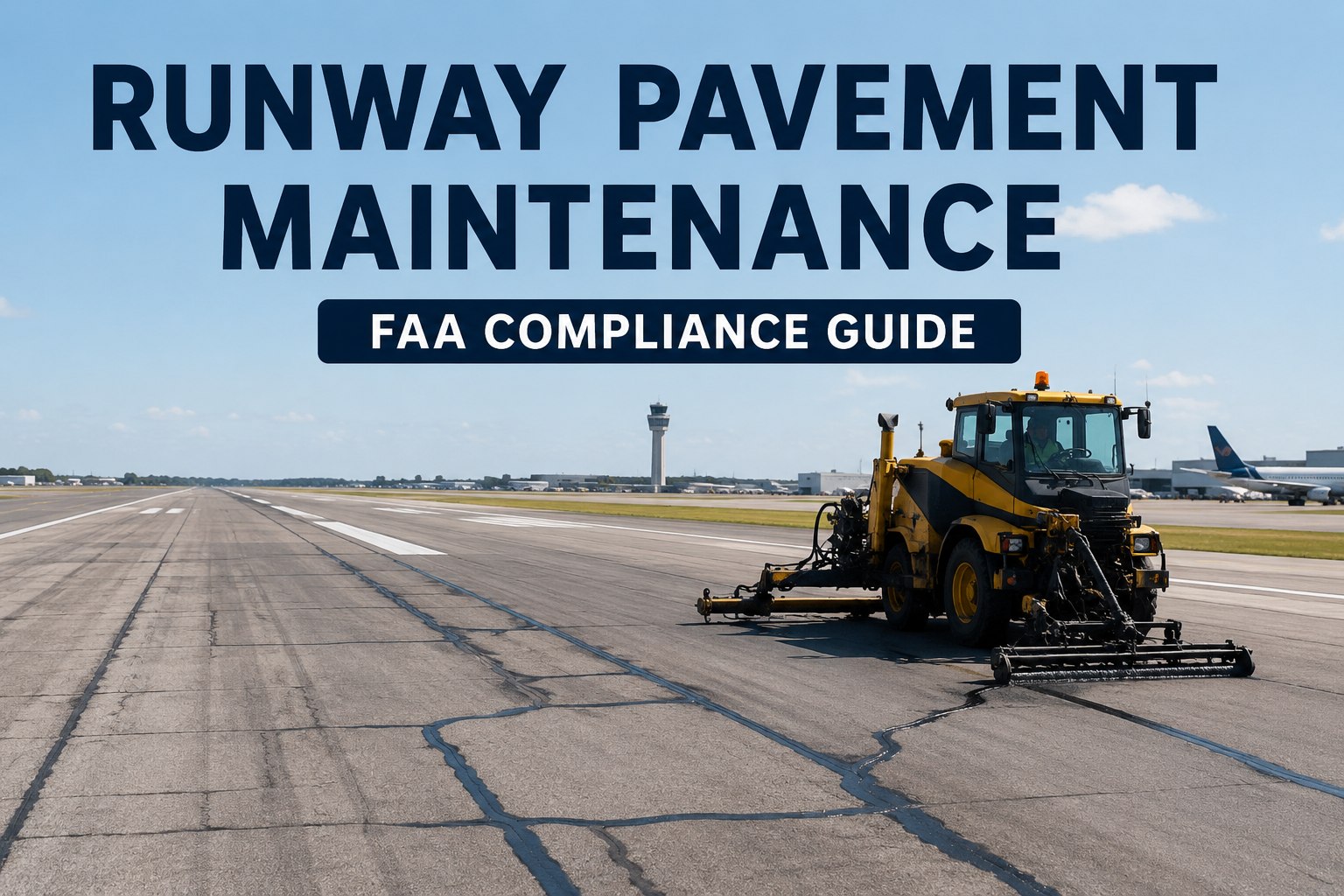
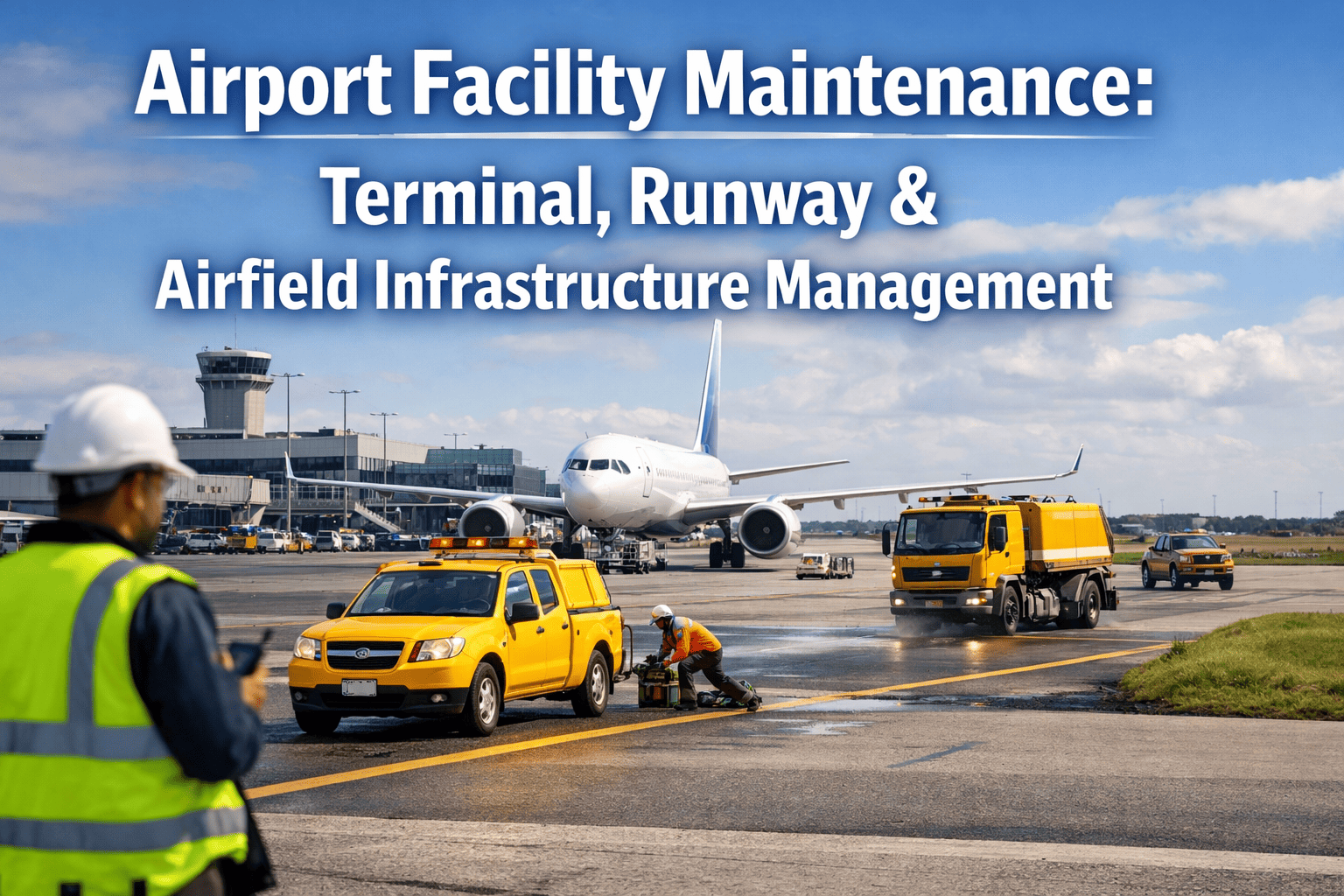
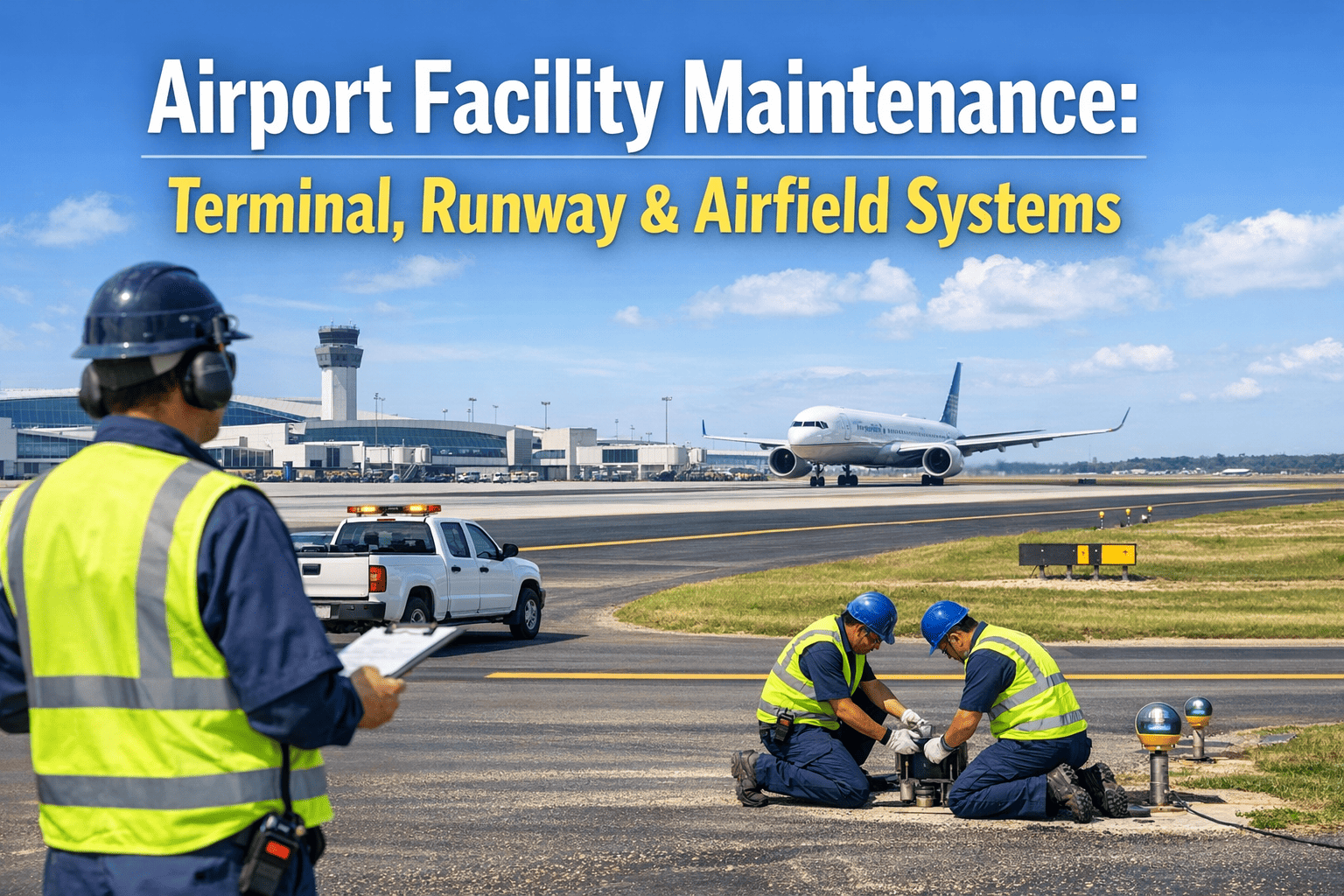
A single 3-inch spall in the touchdown zone of a Category I runway can generate the FOD that shreds a $30 million CFM engine on the next departure. A hairline crack ignored for one wet season becomes a full-depth reconstruction the following year. And a Pavement Condition Index that drifts from 70 to 60 without a documented preventive intervention will cost the airport 6 to 8 times more per square meter to correct than the seal coat that should have been applied at PCI 75. Airport pavement maintenance is one of the very few disciplines where the economics of doing the work at the right moment are so stark that mistiming is more expensive than the work itself. It is also a discipline governed by a specific and demanding regulatory architecture — FAA Advisory Circulars 150/5380-6C for maintenance techniques, 150/5380-7B for the management framework, 150/5370-12 for quality management, and 14 CFR Part 139 for inspection cadence — that every certificated airport operator must satisfy continuously. This guide walks through the PCI diagnostic framework, the pavement deterioration curve that dictates intervention windows, the FAA-mandated inspection cadence, and the distress types every airfield maintenance manager must catalog. And it shows how OxMaint turns the entire pavement management program into a single audit-ready operational system rather than a stack of paper inspection logs. Book a free demo to see runway pavement management inside OxMaint.
86-100
Good
Continue monitoring · no active intervention required · document baseline for trend
71-85
Satisfactory
Preventive maintenance window · crack sealing · seal coat · joint reseal · lowest cost intervention
56-70
Fair
Planned rehabilitation window · surface treatment · thin overlay · patch and reseal
41-55
Poor
Major rehabilitation required · mill and overlay · structural evaluation · below primary runway threshold
26-40
Very Poor
Partial reconstruction · full-depth patching · elevated FOD risk · operational restrictions likely
11-25
Serious
Full reconstruction planning · significant FOD generation · aircraft weight restrictions
0-10
Failed
Immediate reconstruction · pavement not serviceable · closure until rebuild complete
FAA minimum for primary commercial service runways: PCI 70
FAA minimum for other pavement areas: PCI 55
6-8×
cost multiplier for full-depth reclamation at PCI 30 versus preventive surface treatment at PCI 65 — timing is the entire economic story
Daily
minimum movement area inspection required by 14 CFR Part 139 · additional inspection after every significant activity period
3 yr
maximum interval between formal PCI surveys per AC 150/5380-7B · annual recommended for high-traffic operational areas
The Pavement Deterioration Curve — Why Timing Is Everything
Airfield pavement does not degrade linearly. It follows a well-documented S-curve: slow condition loss during the first 60-75% of design life, followed by rapid acceleration once the pavement crosses the "cliff" around PCI 55-60. The intervention window between PCI 70 and PCI 85 is where preventive maintenance delivers 6-8 times the value per dollar spent compared to the same money applied later. Airports that operate an active pavement management program using OxMaint's condition tracking module intervene during the flat portion of the curve — before the acceleration begins — and dramatically extend the life-cycle economics of the entire airfield asset.
Pavement Deterioration Curve · The Cliff at PCI 55-60
Yr 1
Yr 3
Yr 5
Yr 8
Yr 12
Yr 15
Yr 17
Yr 19
Yr 20
Good · No intervention needed
Preventive Window · $1 saves $6-10
The Cliff · rapid deterioration · high-cost repair only
Every year of delay past the preventive window compounds cost · every intervention timing decision belongs in the CMMS, not in an engineering memo
The Cost Multiplier — What Delay Actually Costs
The economic case for preventive pavement maintenance is not marginal. It is one of the sharpest cost differentials in industrial asset management. A dollar spent at PCI 75 replaces roughly $6-10 that would have been required at PCI 60, and roughly $50-100 that will be required at PCI 25. Every airport pavement dollar has a "moment of maximum leverage" — and after that moment passes, the same intervention no longer solves the underlying deterioration.
Treatment Cost per Square Meter · By Timing
PCI 75+ · Preventive
Crack sealing · seal coat · joint reseal
PCI 55-70 · Rehabilitation
Mill and overlay · surface treatment · thin lift
PCI 25-55 · Major Rehab
Full-depth patching · structural overlay · partial reconstruction
PCI <25 · Reconstruction
Full reconstruction · closure required · operational impact
Delaying preventive maintenance by 3 years typically doubles the cost of the required intervention · delaying 5 years quadruples it
The FAA Inspection Cadence — Part 139 & AC 150/5380-6C
Certificated airports operate under a defined inspection cadence that layers continuous, daily, weekly, monthly, and annual requirements against every square meter of movement-area pavement. Each cadence tier has its own scope, its own documentation requirement, and its own citation risk during FAA Part 139 inspections. OxMaint schedules every inspection at the correct interval, captures the observations against the specific pavement section, and produces the audit-ready documentation FAA inspectors and AIP grant applications both require.
FAA-Mandated Pavement Inspection Cadence
Continuous
FOD self-inspection during operations · sweep programs · post-event inspection after each significant activity period
Part 139 · AC 150/5210-24
Daily
All movement areas inspected at least once daily · runway, taxiway, apron surface condition · FOD sweep documented
14 CFR Part 139.327 · AC 150/5200-18
Monthly
Detailed distress mapping · crack progression tracking · joint condition · drainage function · marking condition
AC 150/5380-6C
Annual
Comprehensive condition survey · friction testing per AC 150/5370-10 · rubber removal assessment
AC 150/5380-7B
3-Year Max
Formal PCI survey per ASTM D5340 · full pavement condition evaluation · AIP grant funding baseline data
ASTM D5340 · AC 150/5380-7B
Run Every FAA Inspection From One Platform
OxMaint schedules every continuous, daily, monthly, annual, and PCI-cycle inspection at the correct interval, captures observations against the specific pavement section, and produces the FAA-ready documentation package on demand. See it live against your airfield.
The Distress Field Guide — What Inspectors Are Actually Looking For
The FAA distress catalog is the operational vocabulary of runway inspection. Every distress type has a defined visual signature, a severity classification (low, medium, high), and a density measurement — and the combination of these three drives the PCI deduct value that determines the pavement's overall condition score. The reference below covers the seven most common flexible pavement distresses observed on commercial airfields, each with its inspection focus and typical intervention.
Common Flexible Pavement Distresses
Longitudinal Cracking
Cracks parallel to pavement centerline · often thermal or reflective origin
Route & seal · crack fill
Transverse Cracking
Cracks perpendicular to centerline · typically thermal shrinkage-driven
Route & seal before winter
Alligator (Fatigue) Cracking
Interconnected cracks resembling alligator skin · structural failure indicator · high FOD risk
Full-depth patch · structural evaluation
Block Cracking
Rectangular pattern from age hardening · not typically load-related
Seal coat · surface treatment
Raveling
Loss of surface aggregate · rough texture · progressive FOD generation
Fog seal · surface treatment
Rutting
Longitudinal depressions in wheel path · load-related · water ponding hazard
Mill and overlay
Weathering / Oxidation
Loss of binder · surface hardening · precursor to raveling and cracking
Rejuvenator · seal coat
Every observation logged against the specific pavement section in OxMaint with type, severity, density, and photo evidence — the exact data the PCI calculation requires
Expert Perspective · The Airfield That Never Loses a Runway
Airfield maintenance is the discipline where the difference between a great program and a poor program is invisible until it isn't. The great programs run their preventive interventions at PCI 78 and never have runways in the news. The poor programs run reactive interventions at PCI 45 and end up on the front page after a FOD incident, or an emergency closure, or an AIP grant application that gets pushed back because the condition data is 26 months old and no longer qualifies. What makes the difference is not budget — it is the operational discipline that treats every crack observation, every friction test, every FOD sweep as a documented event linked to a specific pavement section. Once that data layer exists in a CMMS like OxMaint, the pavement management program stops being an annual engineering exercise and becomes a continuous operational function. The runway condition rating trends are visible every morning. The intervention windows are flagged before they close. The FAA documentation is always current. The airport stops reacting to pavement problems and starts operating ahead of them.
Intervene During the Flat Curve
OxMaint's condition tracking flags PCI trending toward the cliff before intervention windows close — protecting 6-8× cost leverage.
Every Distress Is Data
Type, severity, density, and photo evidence captured against the specific pavement section — the exact PCI calculation inputs.
FAA Documentation Is Automatic
Part 139 daily inspections, monthly distress maps, annual friction data, and PCI surveys all produced from routine execution.
Make Your Pavement Program the Cost Center Nobody Notices
If your pavement inspections still live in paper logs and your PCI surveys are three years old, you are carrying preventable FAA compliance risk and leaving 6-8× cost leverage on the table every intervention cycle. See what OxMaint — a maintenance management platform built for airport pavement operations — looks like against your airfield.
Frequently Asked Questions
What is the Pavement Condition Index (PCI)?
PCI is the industry-standard 0-to-100 scale for quantifying airfield pavement condition, defined by ASTM D5340 and referenced in FAA AC 150/5380-7B. It is calculated by cataloging observed distresses by type, severity, and density, then applying deduct value curves. FAA sets minimum PCI at 70 for primary commercial service runways and 55 for other pavement areas. Formal PCI surveys are required at maximum 3-year intervals, with annual assessment recommended for high-traffic operational areas.
What FAA regulations govern runway pavement maintenance?
The core framework consists of AC 150/5380-6C (maintenance techniques and procedures), AC 150/5380-7B (pavement management framework), AC 150/5370-12 (quality management for maintenance), AC 150/5210-24 (FOD management), AC 150/5200-18 (airport self-inspection), and 14 CFR Part 139 (airport certification and inspection requirements). Certificated airports operating under Part 139 must document compliance continuously — OxMaint captures every applicable inspection at the correct cadence.
Why is preventive pavement maintenance so much cheaper than reactive?
Because pavement deterioration follows an S-curve, not a linear decline. During the first 60-75% of design life, condition loss is slow. Past PCI 55-60, deterioration accelerates rapidly — the industry term is "the cliff." A dollar spent at PCI 75 on crack sealing or seal coat replaces roughly $6-10 that would be required at PCI 60 for mill-and-overlay, and roughly $50-100 required at PCI 25 for full reconstruction. Timing the intervention during the flat portion of the curve is the entire economic story.
How often must airports inspect their runways?
14 CFR Part 139.327 requires daily inspection of all movement areas, plus additional inspection after each period of significant activity. Monthly detailed distress mapping is expected under AC 150/5380-6C. Annual friction testing per AC 150/5370-10 assesses surface performance. Formal PCI surveys per ASTM D5340 must occur at maximum 3-year intervals. FOD self-inspection is continuous during operations. OxMaint schedules every cadence tier automatically per pavement section.
What is FOD and how is it managed on runways?
FOD is Foreign Object Debris — loose material on airport pavement that can strike propellers, be ingested into jet engines, or otherwise damage aircraft. AC 150/5210-24 provides FAA guidance on FOD management. Sources include pavement distress (spalling, raveling), construction debris, wildlife, and ground vehicle-generated material. FOD programs require continuous self-inspection, documented sweep programs, post-event inspection after significant activity, and source tracking. OxMaint logs every FOD event with location, source category, and disposition against the specific pavement section.
How does a CMMS support FAA compliance for airport pavement?
A pavement-aware CMMS schedules every required inspection cadence, captures observations against specific pavement sections with photo evidence, calculates PCI trends over time, flags intervention windows before they close, produces AIP grant application-ready condition data, and generates the audit documentation FAA inspectors require during Part 139 reviews. OxMaint's airport pavement module includes pre-built templates for all required FAA cadences and produces the compliance evidence package as a byproduct of routine execution.