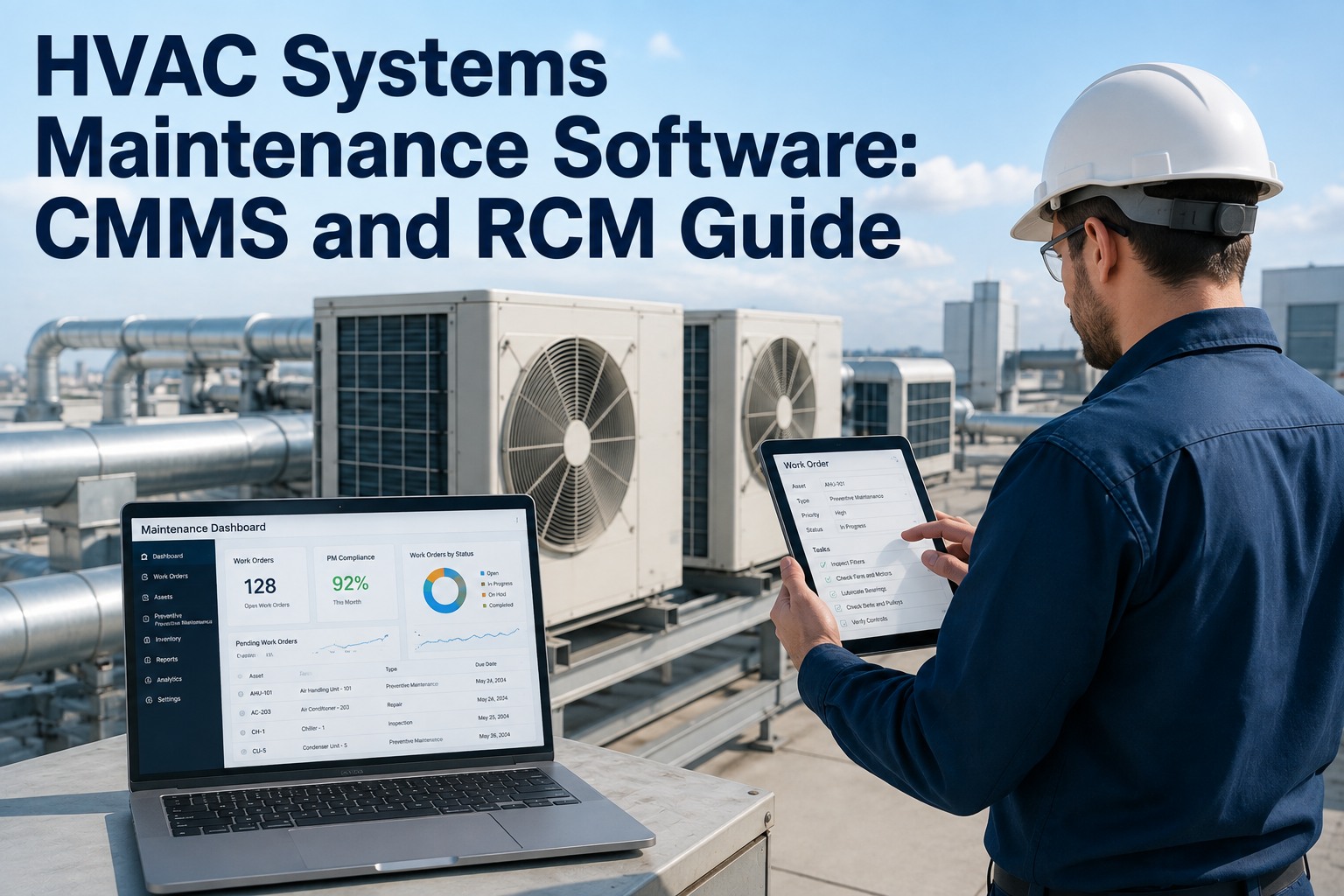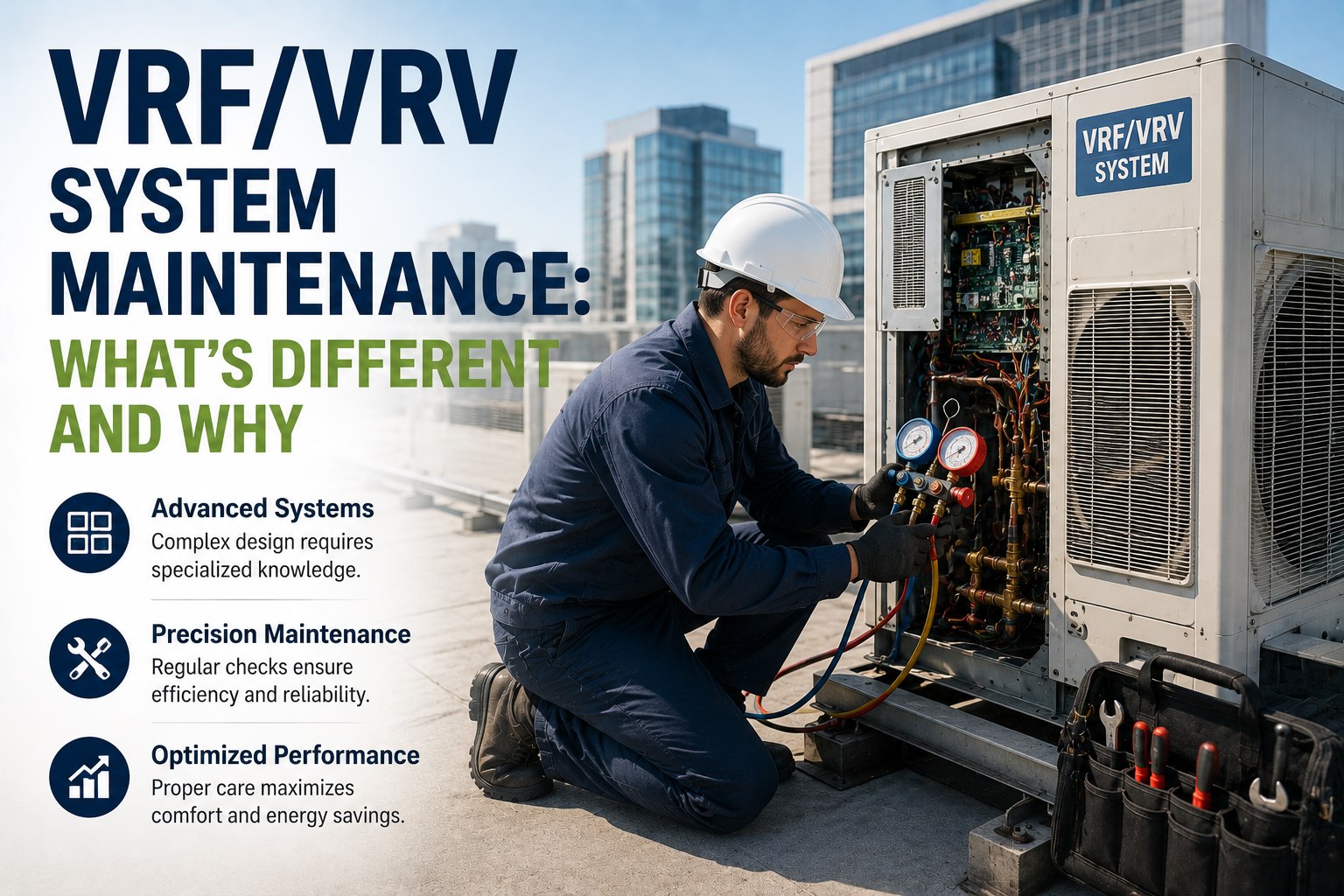
Variable refrigerant flow systems deliver efficient, zoned comfort across large buildings, but their intricate piping networks, embedded controls, and OEM-specific service protocols make VRF and VRV system maintenance fundamentally different from conventional split-system upkeep. A single refrigerant leak, communication fault, or missed firmware update on a VRF system can cascade into multi-zone failures and energy penalties that quietly erode the ROI of the original install. Facility teams need a structured approach to VRF preventive maintenance that tracks refrigerant compliance, schedules manufacturer-defined PM tasks, and documents every intervention defensibly. OxMaint gives maintenance and reliability teams the CMMS infrastructure to manage VRF HVAC maintenance at manufacturer-defensible standards — you can Start Free Trial or book a personalized walkthrough to see it on your assets.
VRF & VRV MAINTENANCE GUIDE
Is your VRF/VRV maintenance program built for manufacturer-defensible compliance — or just reactive repairs?
Variable refrigerant flow systems run 15–20 years when serviced to OEM specs — but a single missed leak inspection, undocumented refrigerant top-up, or unpatched controller can cut that lifespan by 30% and trigger EPA violations. OxMaint structures every PM task, refrigerant log, and controls integration so your VRF reliability is audit-ready.
WHY VRF IS DIFFERENT
What makes VRF/VRV system maintenance different from conventional HVAC
A VRF system with 40+ indoor units, 300 meters of refrigerant piping, and a central controls network is not a bigger split system — it is a precision refrigerant ecosystem where one fault propagates across every zone it serves.
Refrigerant piping complexity
VRF systems use branched-pipe networks operating at high pressures (up to 600 psi). A micro-leak at a single Y-joint or flare fitting can discharge 5–15 lbs of R-410A before detection — a $1,200 refrigerant loss plus EPA Section 608 reporting obligations. Conventional split systems do not have this cascade-failure exposure.
Embedded controls & communication buses
VRF controllers talk over proprietary 2-wire buses (Daikin, Mitsubishi, LG). A single corroded terminal or firmware mismatch can take 20 indoor units offline. VRF zoning maintenance requires controls-level diagnostics that conventional PM checklists never address.
OEM-specific PM libraries
Each manufacturer publishes unique service intervals: Daikin VRV maintenance calls for compressor oil sampling at 20,000 hours; Mitsubishi VRF system service requires inverter board thermistor checks every 12 months. Generic PM templates do not protect warranty coverage or defend against liability claims.
Refrigerant compliance tracking
EPA Section 608, AIM Act, and state-level regulations require per-appliance refrigerant logs — leak rate calculations, top-up quantities, repair verification tests. VRF refrigerant maintenance generates 3–5× the compliance documentation of a standard rooftop unit due to larger charge sizes and longer piping runs.
VRF PREVENTIVE MAINTENANCE CHECKLIST
VRF preventive maintenance checklist by interval
Manufacturer-defensible VRF maintenance follows a tiered schedule — daily observations, quarterly inspections, and annual deep-service tasks. Miss any tier and energy costs climb 8–12% within months.
Operator & BMS Monitoring
- Review BMS alarm history for communication faults
- Log outdoor unit operating pressures & temperatures
- Verify indoor unit airflow & filter static pressure
- Check for audible compressor or fan anomalies
- Confirm zoning controller setpoints match occupancy
Mechanical & Controls Inspection
- Electronic leak detection on all flare & brazed joints
- Clean outdoor coil fins & verify condenser airflow
- Inspect communication bus wiring & terminal torque
- Drain pan & condensate pump flow verification
- Refrigerant charge weigh-in vs. nameplate spec
OEM Deep Service & Compliance
- Compressor oil sample & acidity analysis
- Inverter board thermistor & capacitor health check
- Firmware updates per OEM service bulletin
- Annual refrigerant leak-rate calculation (EPA 608)
- Full controls integration test across all zones
THE COST OF NOT MAINTAINING VRF
VRF reliability math: what a missed PM actually costs
When a 20-ton VRF system loses 12% of its charge, compressor head temperatures rise, EER drops, and the system draws 18% more kW to maintain the same load. The cost compounds monthly — and the repair bill after a compressor failure can exceed $14,000 per outdoor unit.
ANNUAL VRF ENERGY WASTE FROM A SINGLE UNDETECTED 12% LEAK
Nameplate Load (kW) × 18% Efficiency Loss × Operating Hours × $/kWh = Annual Energy Penalty
22 kW system × 0.18 × 3,500 hrs × $0.14/kWh = $1,940/year in wasted energy — before the $14K compressor repair it causes
| VRF Failure Mode | Root Cause from Poor PM | Time to Detect | Typical Repair Cost | Downtime Exposure |
|---|---|---|---|---|
| Compressor burnout | Missed oil acidity sampling; low charge | 6–18 months | $11,000–$16,000 | 3–5 days |
| Controls bus failure | Corroded terminals; missed firmware patch | Sudden | $800–$2,400 | 1–3 days |
| Refrigerant leak (major) | No quarterly electronic leak detection | 3–9 months | $1,200–$4,500 | 1–2 days |
| Inverter board failure | Skipped thermistor / capacitor check | 12–24 months | $3,500–$6,800 | 2–4 days |
| EPA refrigerant violation | No Section 608 leak-rate documentation | Audit-triggered | $5,000–$44,756 fine | N/A (compliance) |
WORKED EXAMPLE
A 280,000-sq-ft corporate campus running 14 VRF outdoor units and 96 indoor units across three buildings was managing VRF maintenance on spreadsheets and reactive work orders. After two compressor failures in 14 months — totaling $31,400 in emergency repairs and 9 days of tenant complaints — the facilities team implemented OxMaint with OEM-specific PM libraries for their Daikin VRV and Mitsubishi VRF systems. In the first year, unplanned VRF downtime dropped to zero, energy penalties from undetected leaks fell by an estimated $8,200, and every refrigerant top-up was automatically logged for EPA compliance.
HOW OXMAINT HELPS
How OxMaint structures VRF/VRV maintenance for manufacturer-defensible reliability
OxMaint is an AI-powered CMMS and EAM platform that turns VRF system maintenance from a calendar-and-clipboard exercise into a defensible, data-driven program — mapping every OEM requirement to a scheduled task, every refrigerant gram to a compliance log, and every asset to a predictive model.
OEM-specific VRF PM libraries
Pre-built preventive maintenance templates for Daikin VRV, Mitsubishi City Multi, LG Multi V, and Samsung DVM — each task mapped to the manufacturer's exact interval, part number, and service bulletin. Eliminates generic checklists that void warranty coverage.
Outcome: 100% PM schedule compliance with zero manual scheduling
Refrigerant compliance tracking
Per-asset refrigerant logs capture charge quantities, leak detection results, top-up volumes, and repair verification tests — auto-calculating annual leak rates for EPA Section 608 and AIM Act reporting. Every gram is traceable and audit-ready.
Outcome: Eliminate compliance fines and audit prep from days to minutes
Predictive analytics & controls integration
OxMaint ingests BMS and VRF controller data — pressures, temperatures, alarm codes, compressor run-hours — and applies AI models to flag anomalies 2–6 weeks before failure. Technicians get prioritized work orders with the exact fault diagnosis attached.
Outcome: Cut unplanned VRF downtime 30–50% with early-warning interventions
Asset hierarchy & spare-parts inventory
Model every VRF system as a parent asset with indoor units, branch boxes, and controllers as child assets. Track critical spares — inverter boards, EEVs, compressor oil — with min/max reorder triggers so the right part is in stock when a predictive alert fires.
Outcome: Reduce VRF spare-parts spend 15–25% while cutting emergency parts ordering
See OxMaint manage your VRF/VRV maintenance — book a 30-min demo
We will load your OEM PM schedules, map your VRF asset hierarchy, and show you exactly how refrigerant compliance tracking and predictive alerts work on a live system.
VRF & VRV MAINTENANCE FAQ
Frequently asked questions about VRF system maintenance
How often should VRF and VRV systems be serviced?
VRF and VRV systems require quarterly mechanical inspections (leak detection, coil cleaning, electrical connections), monthly BMS alarm and operating-parameter reviews, and an annual OEM deep service that includes compressor oil sampling, inverter board diagnostics, firmware updates, and refrigerant leak-rate calculations. Skipping the annual deep service voids most manufacturer warranties and cuts expected lifespan by 5–7 years.
What is the difference between VRF maintenance and conventional HVAC maintenance?
VRF maintenance involves branched refrigerant piping networks operating at high pressures, proprietary communication buses controlling dozens of indoor zones, and OEM-specific PM schedules that differ by manufacturer — none of which exist in conventional split or rooftop systems. VRF also generates significantly more refrigerant compliance documentation under EPA Section 608 due to larger charge sizes, making a CMMS like OxMaint essential for defensible record-keeping. You can explore the full platform with a Start Free Trial.
Can a CMMS help with VRF refrigerant compliance tracking?
Yes — a purpose-built CMMS like OxMaint tracks per-asset refrigerant charge, top-up quantities, leak detection results, and repair verification tests, then auto-calculates annual leak rates for EPA Section 608 and AIM Act reporting. This replaces manual spreadsheet logs that are error-prone and difficult to produce during an audit, reducing compliance prep time from days to minutes.
What are the most common VRF system failures?
The most common VRF failures are compressor burnouts from undetected low charge or oil degradation ($11,000–$16,000), communication bus failures from corroded terminals or firmware mismatches ($800–$2,400), inverter board failures from skipped thermistor checks ($3,500–$6,800), and major refrigerant leaks from uninspected flare joints ($1,200–$4,500). Over 80% of these are preventable with quarterly electronic leak detection and annual OEM-specified deep service.
How long do VRF and VRV systems last with proper maintenance?
VRF and VRV outdoor units typically last 15–20 years and indoor units 20–25 years when maintained to OEM specifications. Without structured preventive maintenance — including the annual compressor oil analysis and firmware updates — that lifespan drops to 10–12 years, and energy efficiency degrades 8–18% within the first 5 years due to undetected charge loss and fouled coils. Book a demo at OxMaint to see how we structure the full lifecycle program.
START YOUR VRF MAINTENANCE TRANSFORMATION
Turn VRF reliability from a gamble into a defensible program
Stop managing variable refrigerant flow maintenance on spreadsheets and reactive work orders. OxMaint's AI-powered CMMS gives you OEM-specific PM schedules, refrigerant compliance automation, and predictive failure alerts — all in one platform your team can adopt in days, not months.
Free 14-day trial · No credit card