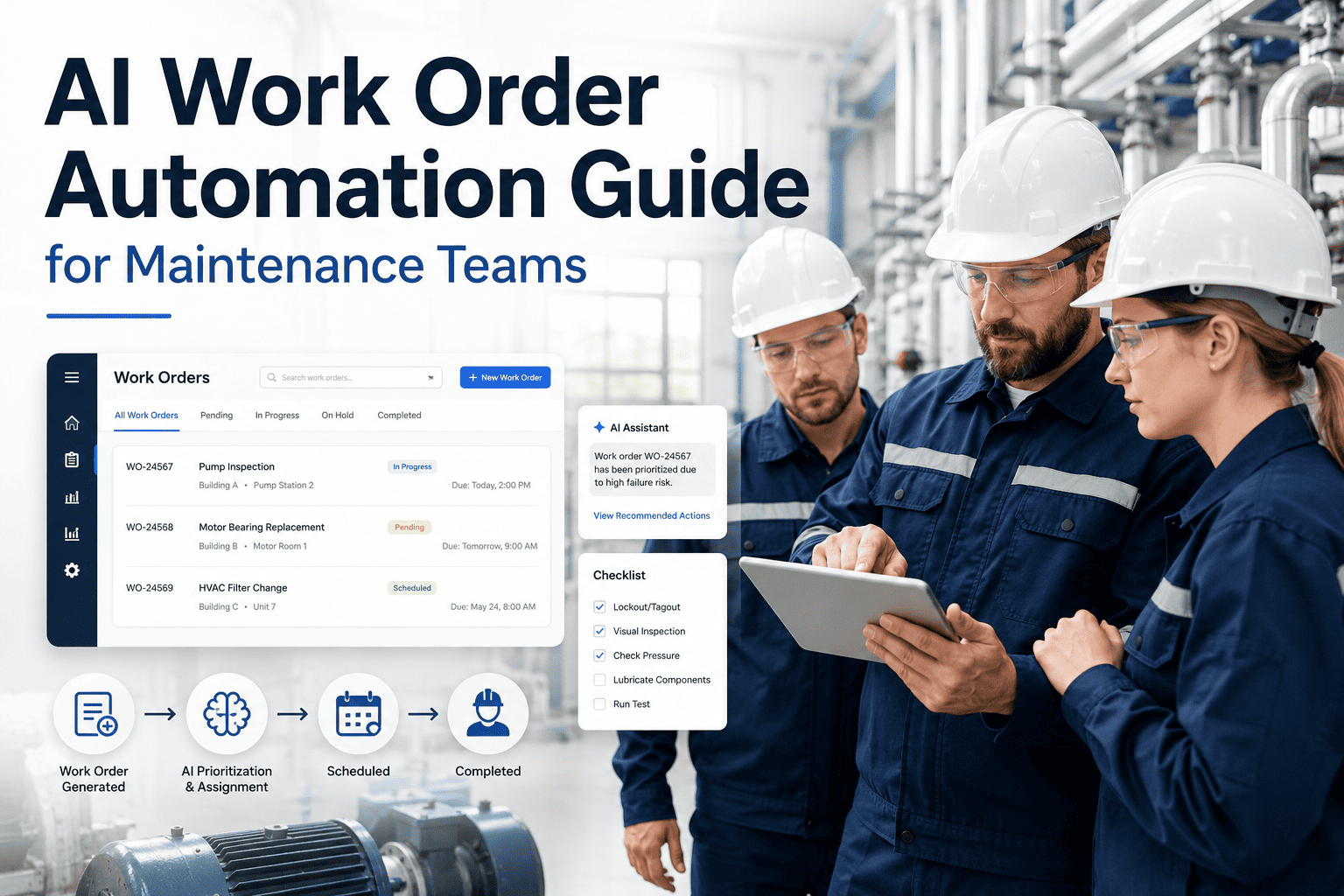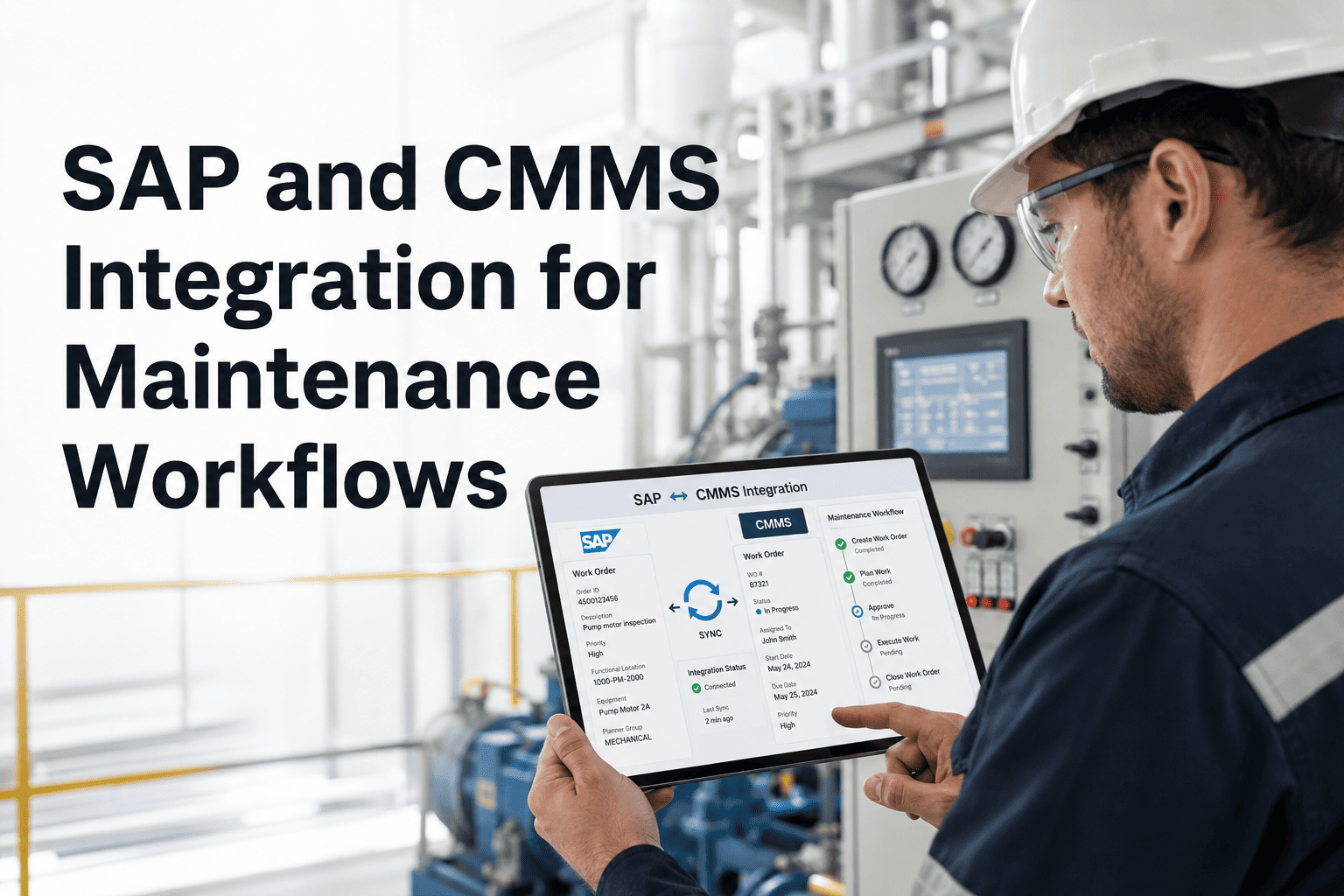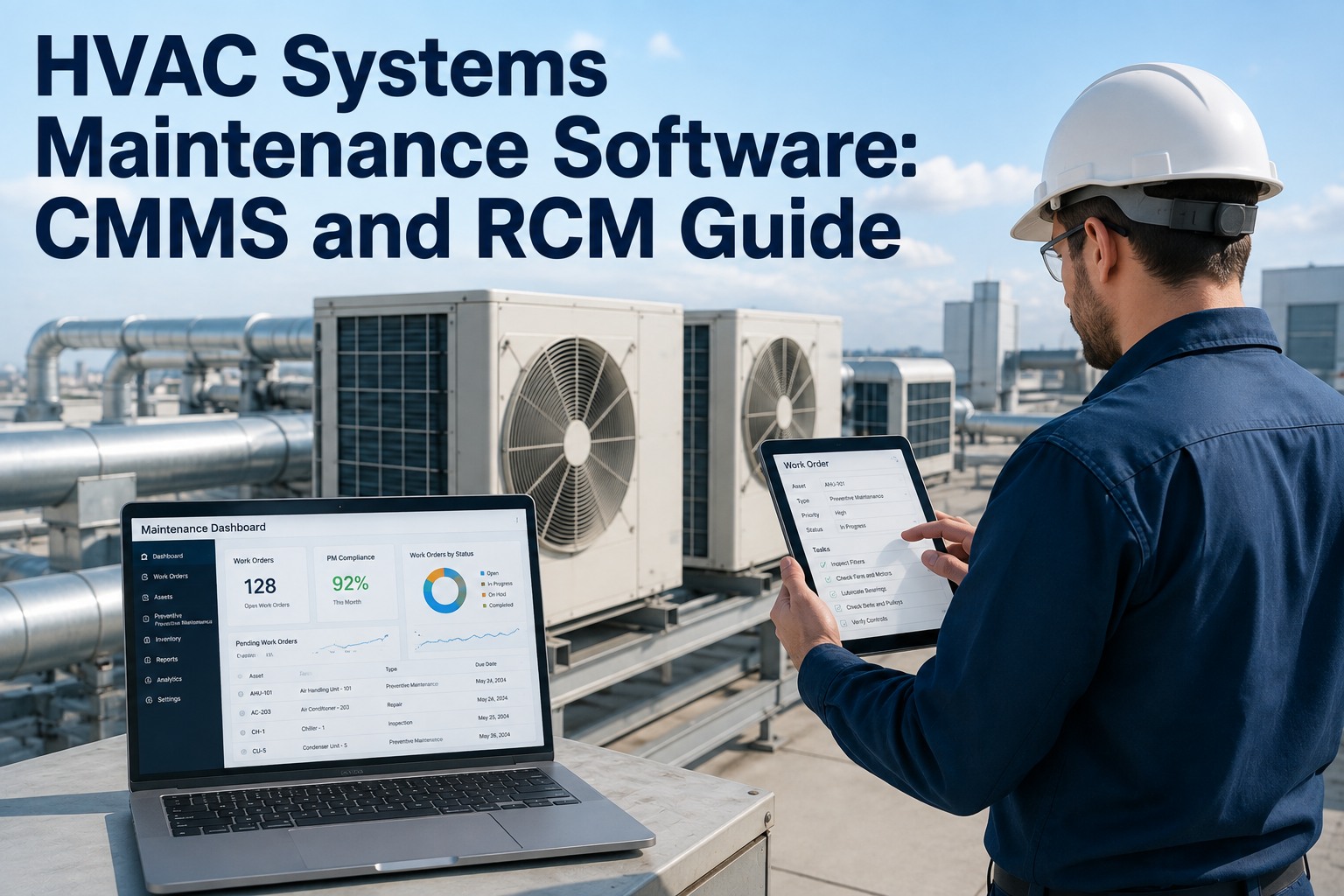
Reliability-centered maintenance combined with CMMS for HVAC and building systems is the proven way to move from reactive firefighting to engineered-out failures — cutting unplanned downtime 30–50% across chillers, AHUs, cooling towers and boiler plants. This guide shows how to implement RCM using modern HVAC and building systems maintenance software: the seven RCM questions, top failure modes, strategy selection, and KPI tracking that proves your program works. You will learn how to launch an RCM pilot in weeks, link every failure mode to a work-order trigger, and scale to a plant-wide reliability program that extends asset life and lowers total maintenance cost. Ready to see it on your assets? Start Free Trial or read on for the full framework.
What if every HVAC failure mode had a task before it failed?
Reliability-centered maintenance turns your HVAC and building systems maintenance software from a reactive ticket queue into an engineered reliability program — linking each failure mode to a PM trigger, condition threshold, or redesign decision.
Why HVAC and building systems reliability demands RCM — not just PM schedules
A 200-ton centrifugal chiller emergency repair can exceed $45,000 in parts, labor and overnight freight. A single AHU bearing failure can shut down a cleanroom or data hall for 6–18 hours, costing $10K–$100K per hour in lost production. Yet most plants still run time-based PMs copied from OEM manuals — over-maintaining 40% of assets and under-maintaining the 10% that actually fail.
Reliability-centered maintenance is the difference between an HVAC and building systems maintenance system that reacts to breakdowns and one that engineers them out. By answering seven structured questions for each critical asset, you select the right strategy — run-to-failure, time-based PM, condition monitoring, or redesign — and your CMMS enforces it automatically. The result: fewer catastrophic failures, longer asset life, lower maintenance spend, and audit-ready documentation.
The 7 RCM questions for HVAC and building systems CMMS deployment
Every RCM analysis for HVAC equipment answers the same seven questions in sequence. OxMaint's asset hierarchy and failure-mode library structure your data so each answer links directly to a work-order template, PM trigger, or condition alert.
Top HVAC failure modes — and which maintenance strategy each one needs
Below are the highest-impact failure modes across common HVAC and building-system assets, mapped to the RCM-recommended strategy. Use this as a starting template in OxMaint's failure-mode library, then adjust for your operating context, duty cycle and criticality.
| Asset | Failure Mode | Failure Effect | RCM Strategy | CMMS Trigger |
|---|---|---|---|---|
| Centrifugal chiller | Refrigerant charge loss | Capacity drop, compressor trip | Condition monitoring | Sensor: refrigerant pressure low — auto WO |
| Cooling tower | Fill scaling / biological fouling | Approach temp > 7°F, Legionella risk | Time-based PM + on-condition | Quarterly clean + conductivity threshold alert |
| AHU supply fan | Bearing wear (DE / NDE) | Vibration, shaft misalignment, fan trip | Condition monitoring | Vibration sensor RMS > 0.28 in/s — auto WO |
| Boiler (fire-tube) | Refractory cracking | Heat loss, casing hot-spot, CO leak risk | Scheduled restoration | Annual inspection + 3-yr refractory repair PM |
| Compressor (reciprocating) | Valve plate wear | Capacity loss, discharge temp rise | Scheduled discard | 10,000-hr valve replacement PM |
| Controls / BMS | Sensor drift (temp / pressure) | Staging errors, energy waste | Scheduled restoration | Annual calibration PM per ISO 9001 audit cycle |
| Toilet exhaust fan | Motor winding failure | Odor / humidity in non-critical zone | Run-to-failure | Reactive WO only — spares in stock |
| Chilled-water pump | Mechanical seal leak | Water loss, pump damage, downtime | Condition monitoring | Monthly visual + moisture sensor alert |
A 180-asset pharmaceutical plant spending $42K/yr on chiller PMs deployed OxMaint with an RCM pilot on 12 critical assets. By converting 6 time-based PMs to condition-based triggers (vibration, oil analysis, refrigerant pressure) and eliminating 4 unnecessary quarterly tasks, they cut PM labor 22%, caught a bearing failure 6 weeks before catastrophic failure, and saved $31,500 in avoided emergency repairs within the first 8 months.
How to launch an HVAC and building systems CMMS setup with RCM in 90 days
A phased HVAC and building systems CMMS deployment prevents the #1 cause of failed CMMS rollouts: trying to boil the ocean. Start with your 10–15 most critical assets, prove the ROI, then scale. Here is a proven 90-day timeline.
Build your asset hierarchy in OxMaint — mirror your plant P&ID and BMS points. Assign criticality (A/B/C) based on safety, production impact and repair cost. Identify the top 10–15 A-class assets for the RCM pilot: typically primary chillers, main AHUs, critical pumps and boilers.
Run the 7 RCM questions on each pilot asset. Document failure modes, effects and consequences. Select the maintenance strategy for each mode. Build PM templates and condition-monitoring triggers in OxMaint. Link failure codes to every work order for clean analytics.
Activate automated PMs and sensor-triggered work orders. Track baseline KPIs: MTBF, MTTR, PM compliance, unplanned downtime hours, maintenance cost per asset. Run weekly reliability huddles using OxMaint dashboards. Refine trigger thresholds and PM frequencies based on the first 4 weeks of data.
OxMaint: the HVAC and building systems maintenance software built for RCM
OxMaint is an AI-powered CMMS and EAM platform designed for maintenance and reliability teams putting RCM into practice. Every capability maps to a step in the RCM workflow — from asset hierarchy to failure-mode tracking to automated work-order triggers and analytics that prove your program is working.
Build multi-level asset trees — site, building, system, equipment, component — that match your P&ID and BMS naming. Attach criticality ratings, warranties, manuals and sensor tags to each node. Outcome: 100% of work orders traceable to the correct asset, eliminating the "which chiller?" ambiguity that kills data quality.
Pre-loaded with 200+ HVAC-specific failure modes and effects. Every work order captures failure code, cause code and remedy code — giving you clean FMEA data and trend analysis. Outcome: identify recurring failure patterns in weeks, not years, and prove RCM impact with real numbers.
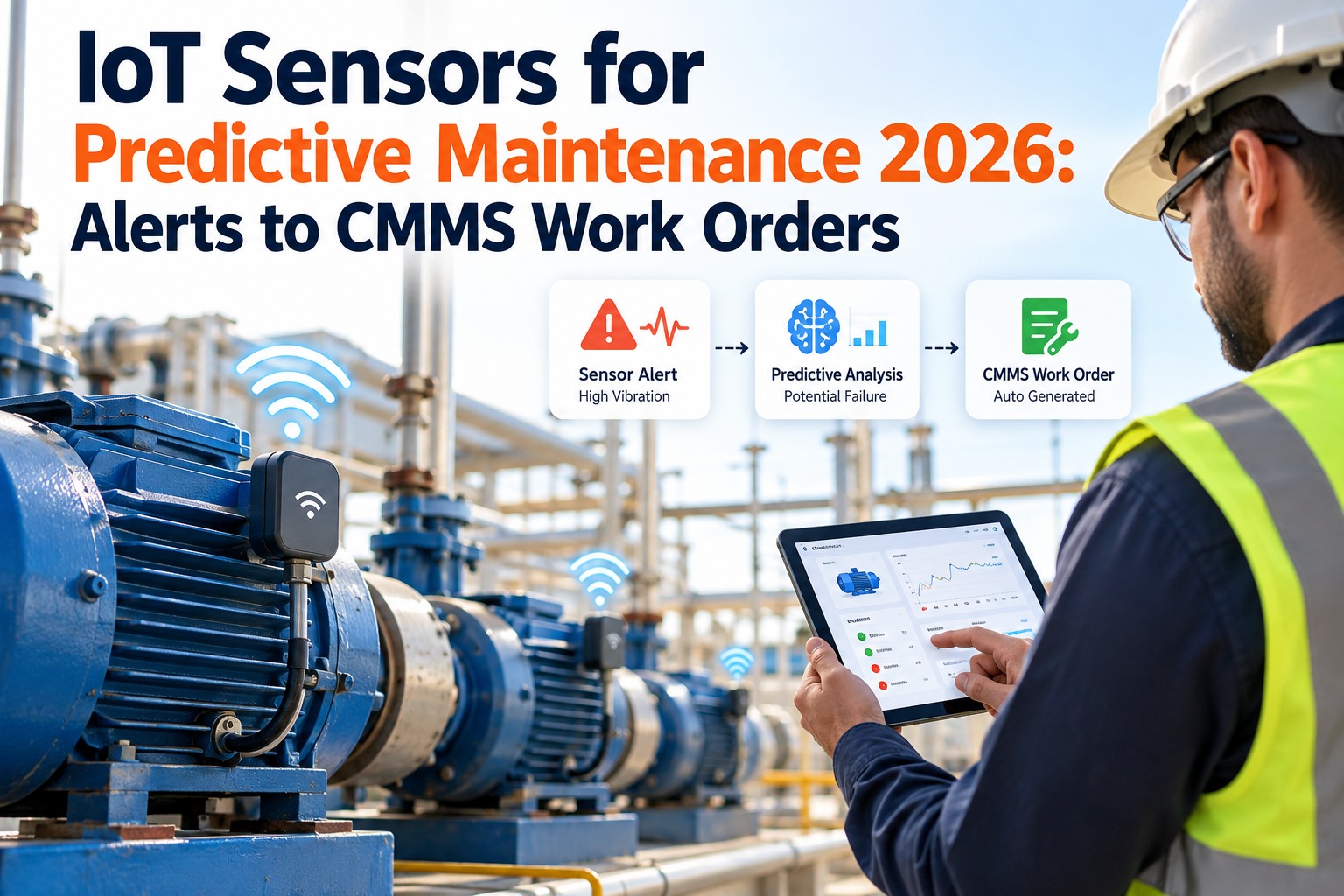
Generate work orders automatically on runtime hours (e.g., every 4,000 hr), calendar interval, or condition threshold (vibration, temperature, pressure, oil analysis). Connect BMS/SCADA points via API for true predictive maintenance. Outcome: cut unnecessary PMs 30–40% and catch failures 2–6 weeks earlier.
Dashboards for MTBF, MTTR, PM compliance, OEE, downtime cost and failure-mode trends — filterable by asset, system, building or site. Export audit-ready reports for ISO 55000, Joint Commission and corporate reliability reviews. Outcome: demonstrate 30–50% downtime reduction and defend your maintenance budget with data.
HVAC and building systems CMMS best practices for RCM success
Teams that succeed with CMMS and RCM follow a disciplined set of practices. Teams that fail usually skip the data-quality foundation, let failure codes drift, or never close the feedback loop between work-order data and FMEA reviews.
Require technicians to select a failure mode, cause and remedy code before closing any work order. OxMaint makes this mandatory — no free-text-only closures. This is the single highest-impact practice for RCM data quality and trend analysis.
Run a 60-minute reliability huddle each month. Pull OxMaint's failure-mode trend report for A-class assets. If a mode recurs 3+ times in 90 days, escalate to FMEA re-evaluation and adjust the maintenance strategy.
Stock critical spares for each A-class failure mode with a repair time > 24 hours. OxMaint links min/max levels to asset criticality and failure-mode data, auto-generating purchase requests when stock hits reorder points.
Operating context changes — a production line moves, a building is repurposed, a backup system is added. Re-rank asset criticality every 12 months and adjust your RCM strategies accordingly. OxMaint criticality reports make this a 2-hour exercise, not a 2-week project.
HVAC and building systems CMMS KPI tracking: the metrics that prove RCM ROI
If you cannot measure it, you cannot defend it. These are the core KPIs your HVAC and building systems maintenance system should track from day one of the RCM pilot. OxMaint calculates all of them automatically from work-order and asset data.
The ultimate reliability scorecard. A successful RCM program increases MTBF on A-class HVAC assets by 40–80% within 12 months. Track per asset, per system and per building.
Target ≥ 90%. Below 80%, your RCM program is paper-only — unexecuted PMs mean unmitigated failure modes. OxMaint flags overdue PMs daily and escalates to supervisors.
World-class plants run < 20% reactive. Most HVAC operations start at 55–70% reactive. An RCM-driven CMMS should drive this below 30% within 6–9 months.
Track monthly. RCM typically lowers cost per asset 15–25% by eliminating unnecessary PMs and reducing emergency repair spend — even as reliability improves.
See OxMaint run RCM on your HVAC assets — book a 30-minute demo
Walk through a live asset hierarchy, failure-mode library, sensor-triggered PMs and reliability dashboards configured for your plant. Bring your top 5 critical assets — we will build them in the demo.
CMMS and RCM for HVAC and building systems: your questions answered
CMMS is the software platform that manages work orders, PMs, assets and inventory. RCM is the analytical methodology that determines which maintenance strategy each failure mode requires. They work together: RCM defines the strategy, and your CMMS — like OxMaint — executes, tracks and measures it. Without RCM, a CMMS is just a digital filing cabinet for reactive tickets. You can Start Free Trial to see how OxMaint bridges both.
A focused pilot on 10–15 critical assets takes 60–90 days: Month 1 builds the asset hierarchy and criticality ranking, Month 2 runs FMEA and configures PM triggers, Month 3 executes, measures and refines. Full plant-wide deployment typically follows over 6–12 months, scaling from the pilot's proven template.
Start with A-class assets: equipment whose failure causes safety risk, production downtime, regulatory non-compliance or repair costs above $10K. Typically this includes primary chillers, main AHUs serving critical zones, central boilers, primary chilled/hot-water pumps and cooling towers. Avoid starting with low-criticality assets like toilet exhaust fans or unit heaters — they are run-to-failure candidates.
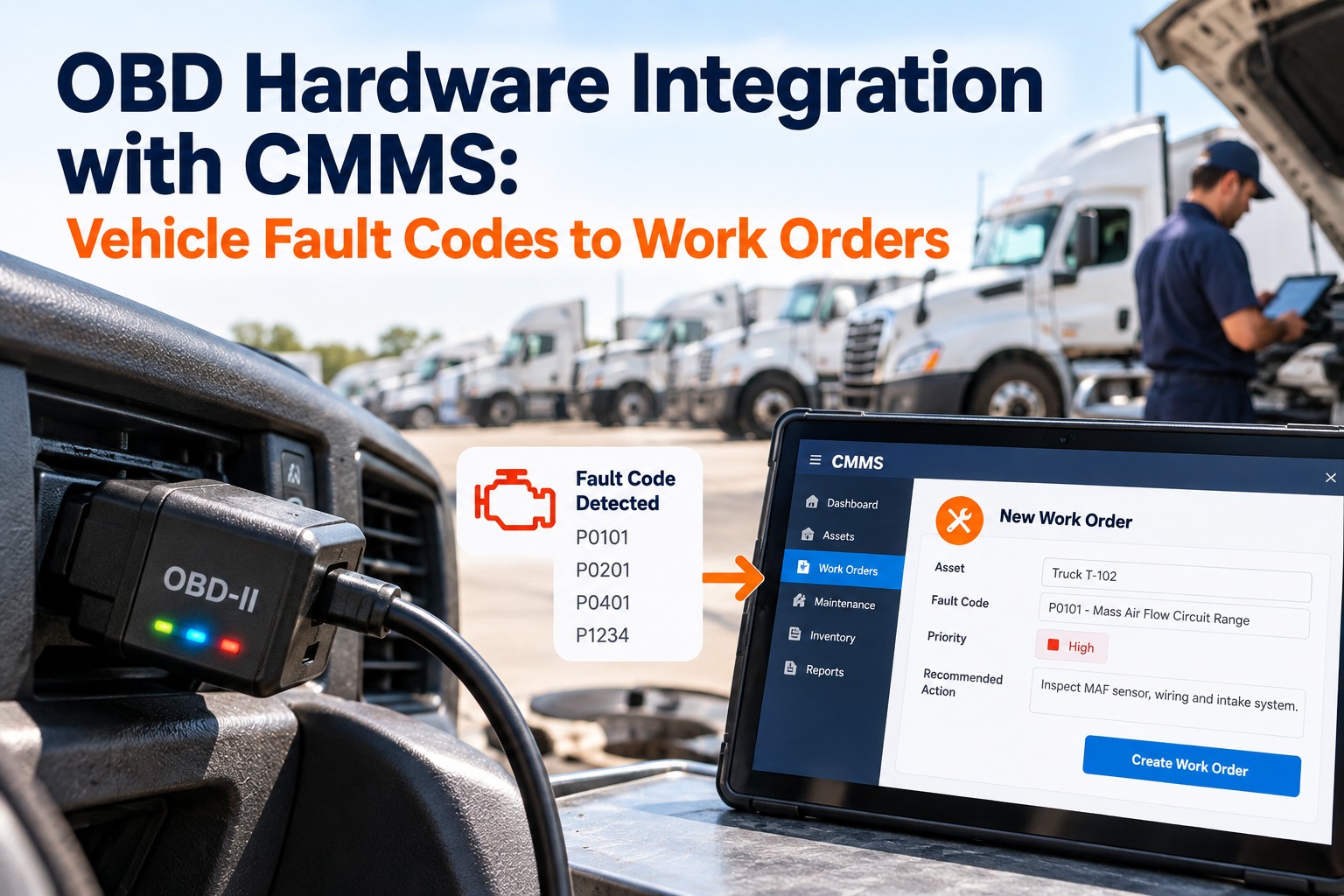
Yes. OxMaint provides REST API endpoints and pre-built connectors for common BMS/SCADA platforms (BACnet, Modbus, Niagara, Johnson Controls, Siemens Desigo). Sensor data — vibration, temperature, pressure, flow, current — flows into OxMaint and triggers work orders automatically when thresholds are crossed. Book a Demo to discuss your specific integration.
OxMaint pricing scales with asset count and user seats, with most mid-size plants (100–500 assets) investing $300–$1,200/month. Typical ROI is 2.5× within 12 months, driven by 30–50% unplanned downtime reduction, 15–25% lower maintenance cost per asset and 30–40% fewer unnecessary PMs. The avoided cost of a single chiller catastrophic failure often pays for the entire annual subscription.
Stop reacting to HVAC failures. Start engineering them out.
Deploy OxMaint's AI-powered CMMS with RCM workflows and turn your HVAC and building systems maintenance program from reactive to reliability-driven. Cut unplanned downtime 30–50%, extend asset life and lower total maintenance cost — starting with your most critical assets.
Free 14-day trial · No credit card