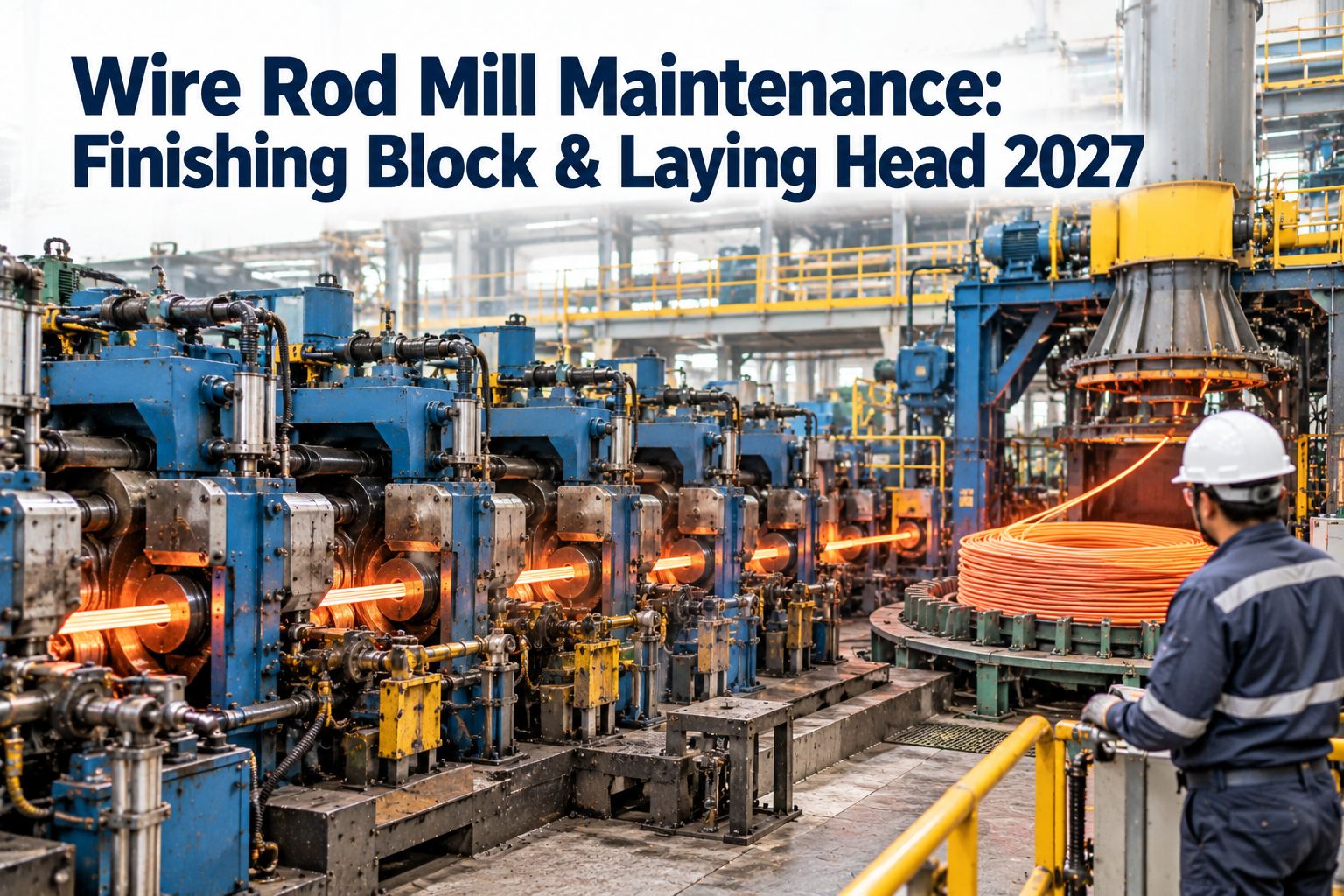
wire-rod-mill-maintenance-finishing-block-and-laying-head

Wire Rod Mill Maintenance: Finishing Block & Laying Head 2027


The finishing end of a wire rod mill is the fastest-moving steel in the plant  rod leaves the no-twist block at 100 metres a second or more, gets turned into rings by the laying head, and lands on the Stelmor conveyor to cool. At that speed there is no time to react: a worn roll ring, a grooved laying-head pipe or a stalled conveyor roller doesn't slow down, it cobbles — a tangle of red-hot wire that wrecks guides and stops the line. The fix is to change wear parts on tonnage, not on a hope. This guide walks the finishing block, laying head, pinch roll and Stelmor conveyor — and OXMAINT AI, the AI-powered maintenance management software, meters the tonnage, baselines the sensors and raises the work order before the cobble.

Rolling Mill Maintenance & Quality · Wire Rod Mill · 2027

Wire Rod Mill Maintenance: Finishing Block & Laying Head

The hot end runs too fast to react — so you maintain it ahead of the wear, not after the cobble. This guide follows the rod from block to coil and the PM that keeps each stage in spec, with OXMAINT AI metering tonnage campaigns and turning every drift into a work order.

01Finishing BlockNo-twist · ~100 m/s
→
02Pinch RollGrips & feeds rod
→
03Laying HeadForms the rings
→
04Stelmor ConveyorControlled cooling

The Cobble Is the Failure You Maintain Against

Almost every maintenance decision on the finishing end traces to one event: the cobble. When a wear part crosses its limit at full speed, the rod stops feeding cleanly and piles up in a white-hot tangle — lost product, a damaged guide or roll, and minutes to hours of downtime to clear. Change the part before the limit and the cobble never happens. Start free and tie every wear part to its tonnage limit in OXMAINT AI.

Worn roll rings
Carbide rings past their groove wear lose size control — the rod runs oversize or out of tolerance, then cobbles.
Grooved laying-head pipe
A worn laying pipe throws bad ring shape and spacing — uneven cooling on the Stelmor and a cobble risk at the head.
Bad guides & bearings
Worn entry/exit guides or a hot block bearing misfeed the rod at speed — the classic trigger for a stand cobble.
Stelmor roller stall
A seized deck roller or failed fan disrupts the ring pattern and cooling — pile-ups and off-spec mechanical properties.

Maintain by Tonnage, Not by Calendar

The finishing end wears by what it rolls, not by the days on the wall — so the clock that matters is tonnage. Roll rings, guides and laying pipes run a campaign: a set tonnage (or heat count) after which they're changed, before wear turns into a defect. Meter the tonnage and the change schedules itself. Book a demo to run tonnage-based campaign meters in OXMAINT AI.

Heat meter
Count heats through each stand — a simple, robust trigger for guide and ring checks.
Tonnage meter
Accumulate tonnes rolled per roll ring and laying pipe; change at the campaign limit.
Campaign limit
The wear life set per part and product size — the point to change before a defect appears.
Auto work order
The meter hits its limit and a roll-change work order opens on its own, with the part and stand attached.

Stage by Stage: What Wears and What to Watch

Each stage of the finishing end has its own wear part and its own early signal. Walking them in rod order — block, pinch roll, laying head, Stelmor — makes sure the part that actually limits the campaign gets changed on time. Start free and map each stage's wear parts and signals in OXMAINT AI.

Stage
Wears / fails
Watch
Driven by
Finishing block (no-twist)
Carbide roll rings, bearings, gears, roll-neck seals
Ring groove wear, bearing temp, vibration, oil film
Tonnage campaign
Pinch roll
Roll surface, grip, drive and alignment
Roll wear, slip, feed consistency into the head
Tonnage / condition
Laying head
Laying pipe wear/grooving, quill, bearings
Ring shape & spacing, pipe wear profile, vibration
Tonnage campaign
Stelmor conveyor
Deck rollers, chains, fans, dampers, insulation
Roller freedom, fan/damper function, cooling uniformity
Calendar / condition

Wear parts, signals and campaign drivers above reflect common wire-rod-mill practice; exact campaign tonnages, ring sizes, temperatures and tolerances come from your mill and equipment OEM and your product specification.

The Quality LinkThe Laying Head Is Where Wear Becomes a Coil Defect

A worn laying pipe doesn't just risk a cobble — it throws ring shape and spacing off, so the rings land unevenly on the Stelmor and cool at different rates. The result is scatter in mechanical properties and coil shape across what should be one uniform product. Wear on the head is a quality problem before it's a breakdown.

1
Worn pipe → irregular ring shape and spacing
2
Uneven rings → uneven cooling on the Stelmor
3
Uneven cooling → scattered mechanical properties
4
Change the pipe on campaign → consistent coil

At 100 Metres a Second, You Don't React to a Failure — You Prevent It.

There is no catching a cobble once the rod is moving; the only lever is changing the wear part before it crosses the line, and backing that with sensor baselines that flag a hot bearing or rising vibration early. The OXMAINT AI maintenance management software runs both — the tonnage campaign meters and the predictive signal-to-work-order loop.

Predictive Signals Behind the Campaign

Tonnage tells you when a part is due; sensors tell you if one is failing early. Baseline the block and head signals and a reading that drifts off its line raises a work order before the campaign limit — the belt-and-braces that catches the surprise failure. Book a demo to baseline the finishing-end signals in OXMAINT AI.

Vibration
Rising block or laying-head vibration flags bearing wear, imbalance or a loosening ring before it lets go.
Bearing temperature
A bearing running above its baseline band is a developing failure — caught as a temperature, not a seizure.
Oil & lubrication
Oil film pressure, flow and condition on the block and head bearings — loss of film is fast, serious damage.
Motor load & speed
Drive current and speed trends reveal binding, slip or a developing mechanical problem across the stage.

Read the Mill by Its OEE

The finishing end's health shows up in overall equipment effectiveness — availability lost to cobbles and roll changes, speed held or lost, and the quality yield of in-spec coil. Trend these and the cost of a slipping campaign becomes visible in the numbers. Start free and trend finishing-end OEE in OXMAINT AI.

Availability
Uptime lost to cobbles, roll changes and forced stops — the first number a slipping campaign hits.
Performance
Rolling speed held versus target — worn parts and misfeeds force the mill to run slower than design.
Quality
Share of coil in spec — ring defects and uneven cooling show up as scatter and downgrades.

How OXMAINT AI Runs Wire Rod Mill Maintenance

The finishing end rewards a program that changes parts on tonnage, watches the sensors, and keeps the component history that tunes the next campaign. The OXMAINT AI maintenance management software runs all three on one platform. Book a demo to see the full wire-rod-mill workflow in OXMAINT AI.

CAMPAIGN METERS
Heat, tonnage and campaign meters per roll ring, guide and laying pipe — a change work order fires at the limit.
CONDITION BASELINES
Vibration, bearing temp and oil baselines on the block and head, so an early failure is caught before the limit.
SIGNAL → WO
A drift off baseline or a meter at its limit raises a work order automatically, with the part and stand attached.
ROLL-CHANGE PLANNING
Plan and sequence roll and ring changes against the campaign, so swaps land in planned stops not cobbles.
SPARES READY
Roll rings, guides, laying pipes and bearings tracked in inventory, so a change isn't waiting on a part.
OEE & HISTORY
Cobble, roll-change and component history tied to each stand, feeding OEE and the next campaign's tuning.

Expert Review

This is a general maintenance framework for the finishing end of a wire rod mill. Exact campaign tonnages, roll-ring and laying-pipe wear limits, speeds, temperatures, cooling recipes and alignment tolerances come from your mill and equipment OEM (for example the no-twist block and laying-head manufacturer) and your product specification, which take precedence over anything here. Work on a high-speed mill involves stored energy, rotating equipment, heavy lifts and hot material — roll changes and finishing-end work must follow your site's isolation and safety procedures and qualified personnel. OXMAINT AI meters the campaigns, trends the signals, raises the work orders and keeps the component history; it supports the maintenance and quality program your mill and reliability teams own, not OEM guidance, process engineering or operator judgement.

Frequently Asked Questions

What causes a cobble in a wire rod mill?
A cobble is a pile-up of rod when it stops feeding cleanly at speed — usually triggered by a wear part crossing its limit: worn carbide roll rings that lose size control, a grooved laying pipe throwing bad ring shape, worn guides or a hot block bearing misfeeding the rod, or a stalled Stelmor roller. The defence is changing wear parts on tonnage before they reach the limit, which the OXMAINT AI software meters for you. Book a demo to see campaign metering in OXMAINT AI.
Why maintain the finishing block on tonnage instead of a calendar?
Because the block wears by what it rolls, not by elapsed time — two shifts can roll very different tonnages. Roll rings and guides run a campaign set in tonnes (or heats) rolled, and changing on that campaign catches wear before it becomes a defect or a cobble. A calendar schedule either changes too early and wastes ring life, or too late and risks a cobble. Book a demo to run tonnage-based campaigns in OXMAINT AI.
How does the laying head affect wire rod quality?
The laying head forms the hot rod into rings before the Stelmor conveyor. As the laying pipe wears and grooves, ring shape and spacing degrade, so the rings land unevenly and cool at different rates on the conveyor — producing scatter in mechanical properties and coil shape. Changing the pipe on its campaign keeps ring formation consistent, which keeps the coil consistent. Book a demo to track laying-pipe campaigns in OXMAINT AI.
What should be monitored on the Stelmor conveyor?
The Stelmor controls cooling, so it sets mechanical properties — watch deck roller freedom (a seized roller disrupts the ring pattern), the cooling fans and dampers (uneven airflow means uneven properties), chains, and insulation or cover condition. A conveyor fault shows up both as a pile-up risk and as off-spec coil, so it belongs in the same PM program as the block and head. Book a demo to put the Stelmor on a tracked PM in OXMAINT AI.
How does a CMMS help a wire rod mill?
It meters heat and tonnage per wear part and fires a change work order at the campaign limit, baselines the block and laying-head sensors so an early failure is caught before the limit, plans roll changes into stops rather than cobbles, and keeps the cobble, roll-change and component history that tunes the next campaign and feeds OEE. One platform for the finishing end's PM, PdM and quality link. Book a demo to see the full mill workflow in OXMAINT AI.

Change Before the Cobble, Every Campaign.

Run wire rod mill finishing-end maintenance on the OXMAINT AI maintenance management software — tonnage campaign meters on every wear part, sensor baselines that catch the early failure, planned roll changes, and the OEE and component history that tunes the next campaign. Keep the rod running clean from block to coil.

Share This Story, Choose Your Platform!