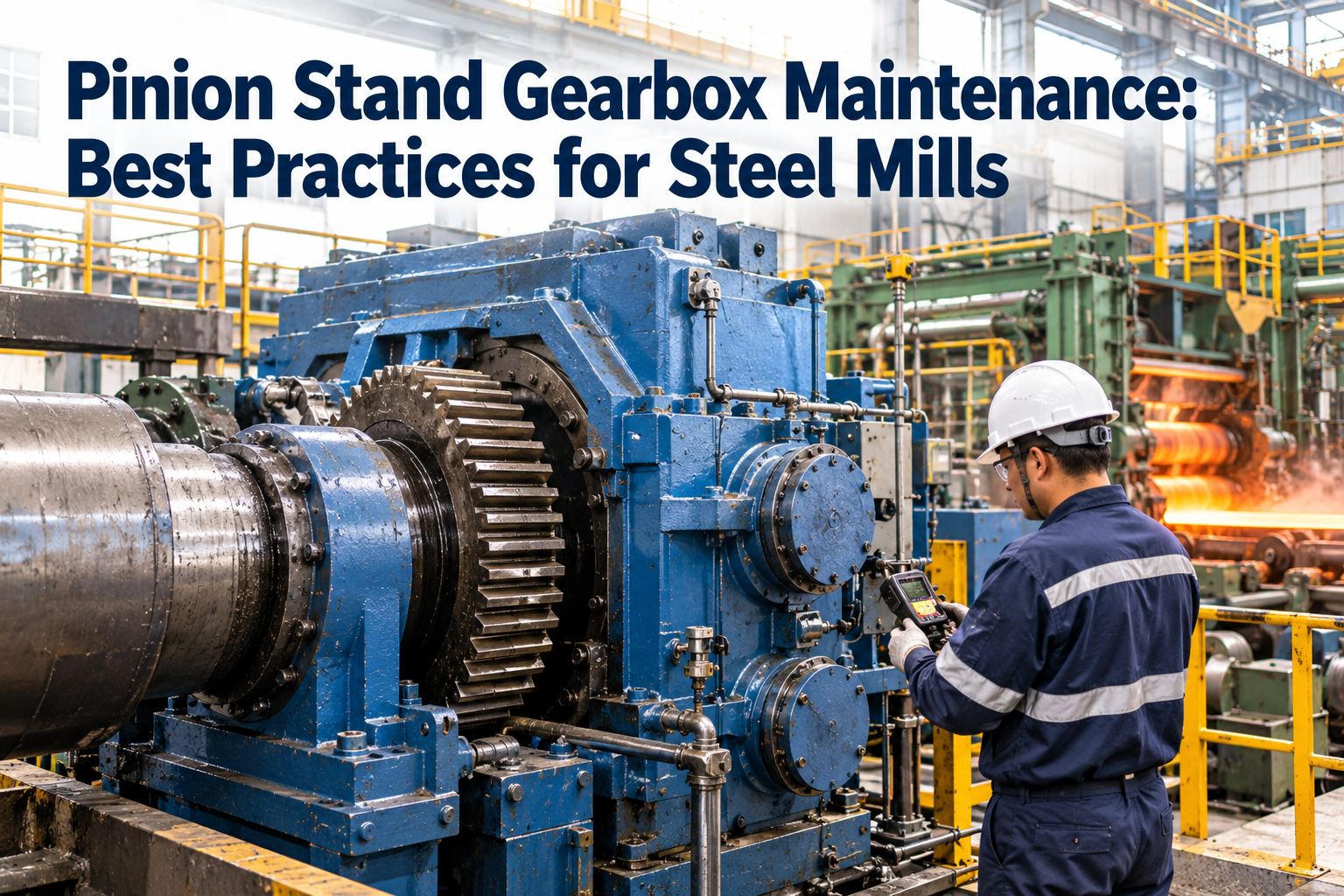
The pinion stand is the gearbox that takes one motor's torque and splits it into two driving the top and bottom work rolls together, at a fixed centre distance, in perfect time. It is small next to the mill, but when its gears pit, a bearing runs hot or the oil degrades, the whole stand stops and the line behind it with it. The good news: a pinion stand almost never fails without warning. Vibration, bearing temperature and oil all drift off their baseline first. This guide walks the predictive signals, the component history and the work-order loop that catch the drift early — and how to run it in OXMAINT AI, or book a demo of rolling mill maintenance.
PINION STAND GEARBOX · ROLLING MILL MAINTENANCE · BEST PRACTICES 2027
Pinion Stand Gearbox Maintenance: Best Practices for Steel Mills
One motor in, two rolls out — and the pinion stand in the middle fails slowly, on signals you can read. OXMAINT AI watches vibration, bearing temperature and oil against baselines, holds the component history, and raises a work order the moment a trend turns.
Motortorque in
→
Pinion Standsplits the drive
→
What the Pinion Stand Does — and Why It Fails
The pinion stand carries two pinion gears in one casing, dividing the motor's torque to the two work rolls and holding them at the exact centre distance the pass demands. It runs under shock loads, reversing duty and heavy torque — which is why it wears in a handful of predictable ways. Start free and build the pinion stand's asset record in OXMAINT AI.
Gear Tooth Wear & Pitting
Surface fatigue, pitting and scuffing on the pinion teeth under repeated shock and reversing load.
Bearing Degradation
The pinion bearings fatigue and overheat, the most common path to a sudden stand failure.
Lubrication Breakdown
Oil loses film strength, picks up water or metal, and stops protecting gears and bearings.
Misalignment & Backlash
Spindle and coupling misalignment or opened-up backlash hammers the mesh and spreads wear.
Four Signals, Each a Head Start
Every one of those failure modes announces itself in a signal that moves before the stand stops. Read all four against a baseline and you turn a breakdown into a planned repair.
Reads: gear-mesh frequency, sidebands, bearing defect tones
Tells you: tooth wear, pitting, bearing faults, looseness
Reads: each pinion bearing against its normal running band
Tells you: lube loss, overload, a bearing starting to fail
Reads: wear metals, viscosity, water, particle count, ferrography
Tells you: gear and bearing wear, contamination, oil end of life
Reads: backlash, tooth contact pattern, alignment checks
Tells you: misalignment, worn teeth, coupling and spindle play
The Core Practice
A Reading Means Nothing Without a Baseline
A single vibration number or oil result tells you little; the same number against the stand's own healthy baseline tells you everything. Predictive maintenance on a pinion stand is the discipline of recording what "good" looks like, then watching for the drift away from it — and acting on the trend, not the alarm. That is what turns a reading into a work order days or weeks before a failure.
1
Set the baseline — capture vibration, temperature and oil when the stand is known healthy.
2
Trend the signal — track each reading over time, not as a pass/fail against a fixed limit.
3
Act on the drift — a rising trend raises a work order while there is still time to plan.
4
Confirm after repair — re-baseline so the next drift is measured from the fixed condition.
From Signal to Work Order
A predictive signal only pays off if it ends in action. The loop is short and it is the heart of the program — watch, detect the drift, raise the job, fix it, and feed the outcome back to the stand's history.
1
Monitor
Vibration, temperature and oil tracked continuously against the stand's baseline.
→
2
Detect Drift
A trend turns — a mesh tone rising, a bearing warming, wear metals climbing.
→
3
Auto Work Order
OXMAINT AI raises a work order on the stand, with the trend attached, ranked by severity.
→
4
Fix & Record
Repair done in a planned window and logged to the component's history.
The History That Makes It Smarter
Each pinion stand should carry its own record — every reading, repair and part, so patterns emerge and the next decision is informed by the last. Asset history is what turns a monitoring tool into a reliability program.
Component Record
Pinions, bearings, seals and couplings tracked individually, with install dates and run time.
Reading Trends
Vibration, temperature and oil results stored per stand, so drift is seen against real history.
Repair & Failure Log
What failed, what was done and when — so a recurring mode gets a permanent fix.
Spares & Lead Time
Pinion sets and bearings linked to the stand, with the lead times that make planning real.
The Reliability Numbers to Track
A pinion stand program is measured on uptime and on how much of the work is planned rather than forced. These are the numbers that show it is working.
Stand Availability
Share of scheduled time the stand can run — the headline for a drive-train asset.
MTBF
Mean time between failures, rising as predictive catches wear earlier.
Planned vs Forced
The ratio of planned repairs to breakdowns — the sign the program is ahead of failure.
Vibration & Temp Trend
The condition signals themselves, trended per stand against baseline.
Oil Condition
Wear metals and oil life over time, the early read on gear and bearing health.
Mill Stops from the Stand
Unplanned mill stops traced to the pinion stand — the outcome the program drives down.
Where Pinion Stand Maintenance Falls Short
Most pinion stand failures that reach a breakdown were readable in advance — the program just was not set up to catch them. These are the usual gaps.
×
No Baseline
Readings taken but never compared to a healthy reference, so drift is invisible.
×
Alarm, Not Trend
Waiting for a fixed limit to trip instead of acting on the rising trend before it.
×
Oil Sampled, Not Read
Oil pulled on schedule but the results never trended or tied to a work order.
×
Alignment Overlooked
Spindle and coupling alignment left unchecked, so backlash quietly spreads wear.
×
Signal, No Work Order
A detected drift that never becomes an assigned, tracked job, so nothing happens.
×
No Component History
No per-stand record, so the same failure repeats with nobody seeing the pattern.
A Pinion Stand Tells You Before It Stops. Listen.
The failure that takes a mill down started as a trend someone could have seen — a mesh tone creeping up, a bearing warming, wear metal climbing in the oil. OXMAINT AI holds the baselines, watches the signals and raises the work order on the drift, so the stand is repaired on a plan, not after a stop.
1Baseline the stand
→
2Trend the signals
→
3Drift raises a work order
→
4Planned repair, logged
How OXMAINT AI Runs Pinion Stand Maintenance
OXMAINT AI is the AI-powered CMMS that holds each stand's baselines and history, watches the predictive signals, and turns a drift into a tracked work order — so the drive train stays up and the mill keeps rolling. Start free and bring your pinion stands onto OXMAINT AI.
Asset Register & History
Every pinion stand with its pinions, bearings, seals, readings and repairs in one record.
Condition Baselines
Vibration, bearing temperature and oil captured as a healthy reference for each stand.
Predictive Alerts
Trends watched against baseline, with an alert the moment a signal drifts out of band.
Auto Work Orders
A drift becomes a work order on the right stand, ranked by severity, with the trend attached.
Oil & Vibration Logs
Lab and route data stored and trended per stand, so condition is a history not a snapshot.
Spares & Planning
Pinion sets and bearings linked to the stand with lead times, so the repair is ready to plan.
EXPERT REVIEW
Written for rolling mill reliability, maintenance and condition-monitoring teams in steel. The failure modes, signals, practices and metrics here are a general framework — your actual baselines, alarm bands, oil limits and alignment tolerances come from the gearbox and mill manufacturer, your vibration analyst's judgement and your plant's standards. Work on mill drive trains carries stored-energy, rotating-machinery and heavy-lift hazards governed by your site's lock-out and safety procedures. OXMAINT AI is a maintenance management and analytics platform that holds the history, watches the trends and raises the work orders; it does not replace a qualified vibration analyst, the OEM's guidance, or your plant's engineering and safety authority.
Frequently Asked Questions
What is a pinion stand in a rolling mill?
A pinion stand is a gearbox that takes the drive from a single motor and divides it between the two work rolls of a mill stand, carrying two pinion gears in one casing and holding the rolls at the fixed centre distance the pass requires. It runs under heavy, reversing, shock loads, so it is one of the most stressed elements of the mill drive train — and when it fails, the stand and the line behind it stop.
Start free and set up pinion stand maintenance in OXMAINT AI.
How do you predict a pinion stand failure before it happens?
By watching the signals that move before the stand stops — vibration (gear-mesh frequency, sidebands and bearing defect tones), each pinion bearing's temperature against its normal band, and oil analysis for wear metals, water and viscosity change. Read against the stand's own healthy baseline and trended over time, a rising signal flags the developing fault days or weeks ahead, which is enough to plan the repair rather than suffer the breakdown.
Book a demo of predictive signal tracking in OXMAINT AI.
Why is a baseline so important for condition monitoring?
Because a single reading in isolation means very little — a vibration level or an oil result only becomes meaningful when compared to what the same stand looked like healthy. The baseline is that reference, and predictive maintenance is really the discipline of trending each signal away from it and acting on the drift rather than waiting for a fixed alarm limit to trip. Without a baseline, you are guessing.
Book a demo of baseline-and-trend monitoring in OXMAINT AI.
What does oil analysis reveal about a pinion stand?
Oil analysis is a window into the gears and bearings without opening the casing. Wear metals point to which components are wearing and how fast, viscosity and additive depletion show whether the oil can still protect, and water or particle counts reveal contamination that accelerates failure. Ferrography can identify the type of wear from the particles themselves. Tracked over time and tied to a work order, it is one of the earliest reads on pinion and bearing health.
Can a CMMS run pinion stand predictive maintenance?
Yes — a CMMS holds each stand's baselines and full component history, stores and trends the vibration, temperature and oil data, and turns a detected drift into a ranked, assigned work order with the trend attached. That closes the loop that condition monitoring alone leaves open: a signal that never becomes a scheduled repair changes nothing. Keeping the readings, the history and the work orders in one place is what makes the program repeatable.
Start free and run pinion stand maintenance in OXMAINT AI.
Keep the Drive Train Rolling.
Run pinion stand maintenance on OXMAINT AI: every stand baselined, vibration, temperature and oil trended against it, a drift turned into a planned work order, and the full component history kept — so the gearbox is repaired ahead of failure and the mill keeps running.