Every 60 seconds, a manufacturing plant somewhere loses $3,300 to an equipment failure nobody predicted. Across the industry, unplanned downtime drains an average of $253 million per large plant annually—and the cost per hour of unexpected stoppages has doubled since 2019. But the factories pulling ahead in 2026 are not simply maintaining equipment better. They are predicting the future. AI-powered analytics and IoT sensor networks now forecast mechanical failures 30 to 90 days before they happen, with machine learning models achieving over 94% accuracy. This is not experimental technology—it is the competitive dividing line between plants that control their uptime and plants that hope for the best. Schedule a free assessment to see how predictive intelligence can protect your production lines from costly surprises.
What Is Driving the Predictive Maintenance Revolution in Manufacturing?
Three forces are converging to make 2026 the tipping point for predictive maintenance adoption. First, IoT sensor costs have plummeted—industrial-grade vibration and temperature sensors now cost under $1 per unit, making large-scale deployment financially viable even for mid-size plants. Second, AI and machine learning models have matured from lab experiments to production-ready systems that learn your equipment's unique behavior. Third, the labor crisis in skilled maintenance trades means fewer technicians must manage more equipment—and they need data-driven prioritization to focus on what actually matters.
$91B
Projected global predictive maintenance market by 2033
29.4%
Annual market growth rate (CAGR) from 2025 to 2033
65%
Of maintenance teams plan to adopt AI by end of 2026
94.3%
Failure prediction accuracy achieved by LSTM neural networks
The Real Cost of Doing Nothing: Reactive vs. Predictive Outcomes
Most manufacturing plants still operate in a reactive or calendar-based maintenance model. The financial and operational gap between these legacy approaches and AI-driven prediction is not marginal—it is transformational. Here is what the data shows when you compare the two strategies side by side.
Legacy Approach
Reactive and Calendar-Based
Failure DetectionAfter breakdown occurs
Downtime Impact$50K-$200K per hour lost
Maintenance Costs30-40% higher than needed
Equipment LifespanShortened by emergency stress
Spare PartsOverstocked or unavailable
Team Utilization70% reactive firefighting
Modern Approach
AI and IoT Predictive
Failure Detection30-90 days before failure
Downtime Impact50% fewer unplanned stops
Maintenance Costs18-25% reduction achieved
Equipment Lifespan20-40% longer asset life
Spare PartsData-driven just-in-time stock
Team Utilization80% planned, strategic work
Still relying on reactive maintenance? Switch to predictive today. Create your free Oxmaint account in 2 minutes—start logging equipment health, setting up automated alerts, and tracking the downtime costs you are currently losing to unplanned breakdowns.
Inside the Technology Stack: How IoT Sensors Feed AI Predictions
Predictive maintenance is not a single technology—it is an integrated system where each layer builds on the one below it. Understanding this architecture helps you make smarter decisions about where to invest first and how to scale.
From Raw Signal to Predicted Failure: The Complete Data Pipeline
Layer 1
Physical Sensing
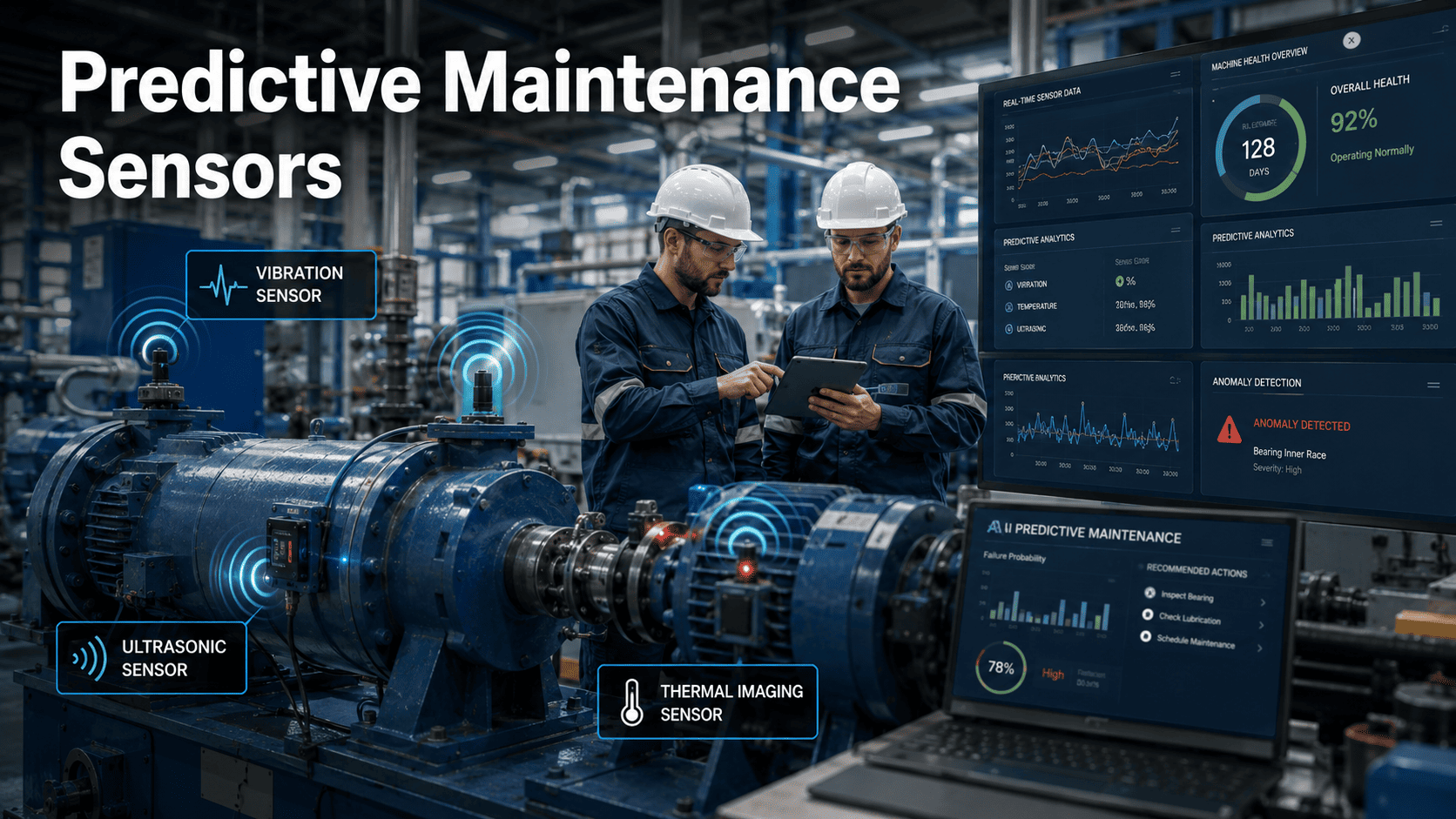
Wireless IoT sensors capture vibration (3-axis accelerometers at 25.6 kHz), temperature (thermocouples rated to 500 F), current (split-core CTs up to 100A), pressure, and acoustic emissions. Modern sensors install in under 3 minutes with magnetic or adhesive mounts—no wiring, no shutdown required.
Sensor data streams wirelessly via LoRaWAN (up to 2-mile range), NB-IoT, industrial WiFi, or mesh networks to edge gateways. Industrial protocols—Modbus, OPC-UA, MQTT—ensure compatibility with existing PLCs, SCADA, and DCS infrastructure.
Layer 3
Edge Intelligence
Edge computing devices perform initial anomaly detection with sub-second latency directly on the factory floor. Critical alerts fire instantly even during cloud connectivity interruptions. Edge processing reduces bandwidth costs by up to 90%.
Layer 4
AI and Machine Learning Engine
Cloud-based ML models—including LSTM neural networks, ensemble pipelines, and domain-adapted deep learning—analyze patterns across millions of data points. The AI correlates vibration signatures with temperature trends, production loads, and historical failure records to predict remaining useful life with 85-95% precision.
Layer 5
CMMS Action Layer
Predictions automatically generate prioritized work orders in your CMMS with failure type, urgency level, recommended parts, and repair procedures. Sign up for Oxmaint to connect your predictive alerts directly to automated maintenance workflows.
Which IoT Sensors Detect Which Failures?
Sensor selection determines the quality of your predictions. Each sensor type targets specific failure modes, and the right combination provides complete visibility across your plant's critical assets.
IoT Sensor-to-Failure Mode Mapping
Sensor Type
What It Measures
Failure Modes Detected
Protected Equipment
Lead Time
Vibration (3-Axis)
Acceleration, velocity, displacement, frequency spectrum
Start with vibration and temperature sensors on your top 5-10 bottleneck assets for the fastest measurable ROI.
Want to see which sensors will protect your most expensive equipment? Book a free 30-minute demo—our engineers will walk through your plant's critical assets, recommend the right IoT sensor setup, and show you live predictive alerts inside Oxmaint.
IoT sensors generate the raw signal. AI transforms that signal into a maintenance decision. Understanding the spectrum from basic alerting to advanced prediction helps you evaluate platforms and set realistic expectations.
Foundation
Threshold Alerting
Rule-based alerts when sensor readings exceed predefined limits. Simple but effective for known failure thresholds like bearing temperature above 80 C.
Catch Rate: ~60%
Intermediate
Anomaly Detection
Unsupervised ML models learn your equipment's normal operating signature and flag deviations automatically. Catches subtle degradation patterns that static thresholds miss entirely.
Catch Rate: ~85%
Advanced
Failure Classification
Supervised ML models tell you exactly what is failing—"Bearing inner race defect on Motor 7B" rather than just "vibration anomaly." Saves hours of diagnostic investigation.
Catch Rate: ~90%
Predictive
Remaining Useful Life
Deep learning models (LSTM, transformer architectures) estimate precisely how many operating hours remain before a component needs replacement. The gold standard for planned interventions.
Accuracy: up to 94.3%
Sector-by-Sector: Where Predictive Maintenance Delivers the Biggest Wins
Every manufacturing vertical has unique equipment, failure modes, and cost-of-downtime profiles. Here is how leading manufacturers across industries are applying AI and IoT predictive maintenance today.
Automotive and Assembly
Robotic arms, conveyors, presses, paint systems
Ford monitors 8,000+ components in real-time across 12 global assembly lines, reducing unplanned stoppages by hundreds of hours annually per facility.
Food and Beverage
Compressors, fillers, pasteurizers, CIP systems
Refrigeration compressor monitoring prevents product spoilage. Temperature and vibration sensors catch seal degradation weeks before contamination risk.
Chemical and Pharma
Pumps, reactors, HVAC, tablet presses
Pressure and ultrasonic monitoring detects pump cavitation and valve leaks before safety incidents. Vibration data correlates press health with batch quality.
Steel and Heavy Metals
Rolling mills, furnaces, cranes, cooling towers
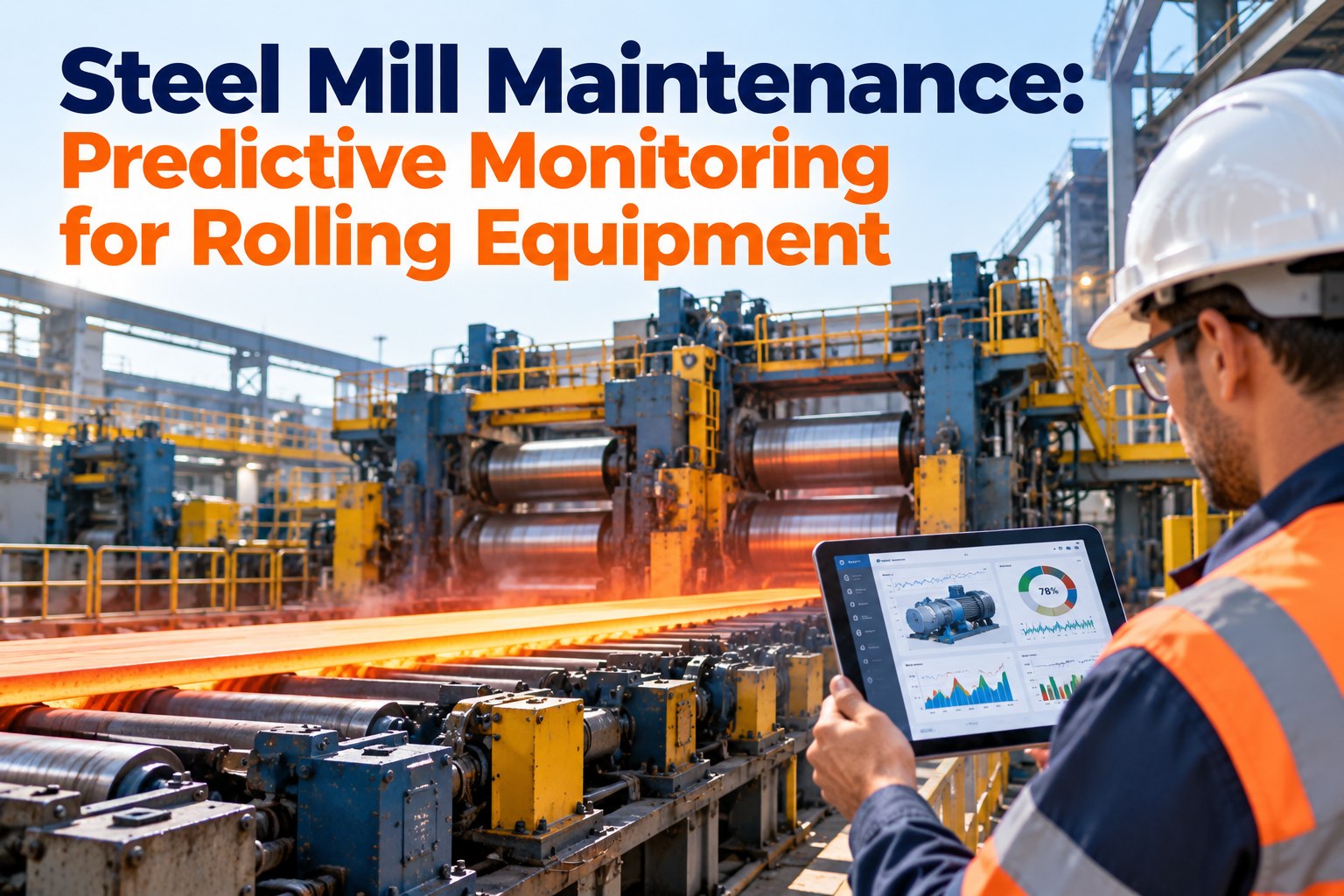
Acoustic and vibration monitoring on rolling mill bearings prevents catastrophic failures that can halt production for days and cost millions in lost output.
Electronics and Semiconductor
Clean room HVAC, pick-and-place, wave solder
Each hour of unexpected downtime in semiconductor fabs can exceed $1 million. Environmental sensors protect nanometer-precision equipment from contamination.
Packaging and Consumer Goods
Fillers, labelers, palletizers, wrappers
Current monitoring on servo drives catches belt wear and motor degradation on high-speed packaging lines running 24/7 operations.
Your Equipment Is Already Telling You What Is About to Fail
The vibration patterns, temperature shifts, and current signatures are all there—you just need a platform to listen. Oxmaint connects IoT sensor data to automated work order generation, turning raw signals into scheduled repairs before a single minute of production is lost.
Measured Returns: What Manufacturers Actually Achieve
Vendor claims are everywhere—but what do real-world deployments actually deliver? Here are the benchmarked outcomes from predictive maintenance programs across manufacturing sectors.
30-50%
Reduction in unplanned downtime events across monitored equipment
18-25%
Lower maintenance costs compared to calendar-based preventive programs
20-40%
Extension in average equipment lifespan through condition-based care
10:1-30:1
ROI ratio within 12-18 months of implementation
Ready to achieve these results at your facility? Sign up for Oxmaint free—connect your first 5 assets, start capturing real-time equipment data, and see within 30 days exactly where predictive maintenance will deliver the biggest savings for your operation.
You do not need to overhaul your entire plant. The most successful programs prove value on a small set of critical assets before expanding. Here is the proven playbook used by manufacturing leaders implementing modern maintenance strategies.
1
Identify Your Pain Points
Pick 5-10 assets where downtime costs are highest—main production line motors, critical pumps, bottleneck compressors. Analyze your CMMS history for equipment with the most unplanned work orders.
Week 1-2
2
Deploy Wireless Sensors
Install non-invasive vibration, temperature, and current sensors on your pilot assets. No wiring, no shutdown needed. Magnetic mounts go on in under 3 minutes per sensor.
Week 2-4
3
Establish Baselines and Train AI
Let the system learn your equipment's normal behavior for 2-4 weeks. Import historical maintenance records to accelerate model training. AI builds unique behavioral profiles per asset.
Week 4-8
4
Connect to Your CMMS
Link predictive alerts to your asset management platform for automated work order creation. When AI detects a developing fault, a prioritized ticket appears with diagnosis and recommended action.
Week 6-10
5
Measure, Expand, and Optimize
Track prevented failures, downtime savings, and cost reduction against your baseline. Use documented wins to justify expanding to additional lines and equipment.
Week 10+
Overcoming the 5 Biggest Implementation Barriers
Real-world deployments face practical obstacles that vendor brochures rarely mention. Here are the most common barriers and proven strategies to overcome them.
01
Legacy Equipment Without Built-In Sensors
Solution: Retrofit with non-invasive wireless sensors. Clamp-on current transformers, magnetic vibration sensors, and adhesive temperature probes install on any equipment—regardless of age—without modifications or downtime.
02
Poor Data Quality and Fragmented Systems
Solution: Centralize maintenance data in a single CMMS platform. AI-powered data validation algorithms automatically clean, fill gaps, and normalize data from heterogeneous sources into a unified format.
03
Maintenance Skills Gap and Low AI Adoption
Solution: Choose platforms with intuitive dashboards surfacing plain-language insights. Generative AI copilots now convert sensor findings into step-by-step repair procedures, embedding expert knowledge into every work order.
04
Difficulty Proving ROI to Leadership
Solution: Start with a focused pilot on 5-10 high-downtime assets. Document every prevented failure with before/after cost data. Most plants generate enough savings within 90 days to justify expansion.
05
Integration Complexity With Existing Systems
Solution: Select a CMMS with open API architecture and pre-built connectors for industrial protocols (OPC-UA, MQTT, Modbus). Oxmaint integrates with SCADA, MES, and ERP systems without custom development.
Predict Equipment Failures Before They Cost You Another Dollar
Your maintenance team cannot hear a bearing degrading at 25 kHz or see a motor winding losing insulation resistance. But IoT sensors can—and Oxmaint turns that sensor intelligence into automated work orders, real-time asset health dashboards, and measurable reductions in unplanned downtime.
How fast can we see results from predictive maintenance?
Most plants identify actionable anomalies within the first 30-60 days of sensor deployment. Quick wins from preventing even one unplanned shutdown often recover the entire investment within 6-9 months. Documented ROI ratios of 10:1 to 30:1 are typical within 12-18 months. Schedule a consultation to estimate projected savings for your plant.
Does predictive maintenance work on older legacy equipment?
Yes. You do not need new equipment. Wireless, non-invasive sensors retrofit onto any machine without modifications or production interruption. Many of the best predictive results come from decades-old brownfield plants where failure patterns are well-established.
Which IoT sensors should we install first?
Start with vibration and temperature sensors on your most critical rotating equipment—motors, pumps, compressors, and fans at production bottlenecks. These two sensor types catch the most common industrial failure modes. Sign up for Oxmaint to centralize sensor data and automated alerts from day one.
How accurate are AI failure predictions in real manufacturing environments?
Advanced deep learning models achieve 85-95% precision in predicting bearing, pump, and motor failures, with LSTM neural networks reaching 94.3% accuracy. Accuracy improves continuously as models learn your specific equipment behavior over time. Most systems provide 30-90 days of advance warning.
How does predictive maintenance integrate with our existing CMMS?
Modern predictive platforms connect via standard industrial protocols (OPC-UA, MQTT, REST APIs). When AI detects an anomaly, it automatically generates a work order with failure type, severity, and recommended repair steps. Oxmaint natively supports this workflow without custom development.
By oxmaint
✨
Experience Oxmaint's Power
Take a personalized tour with our product expert to see how OXmaint can help you streamline your maintenance operations and minimize downtime.