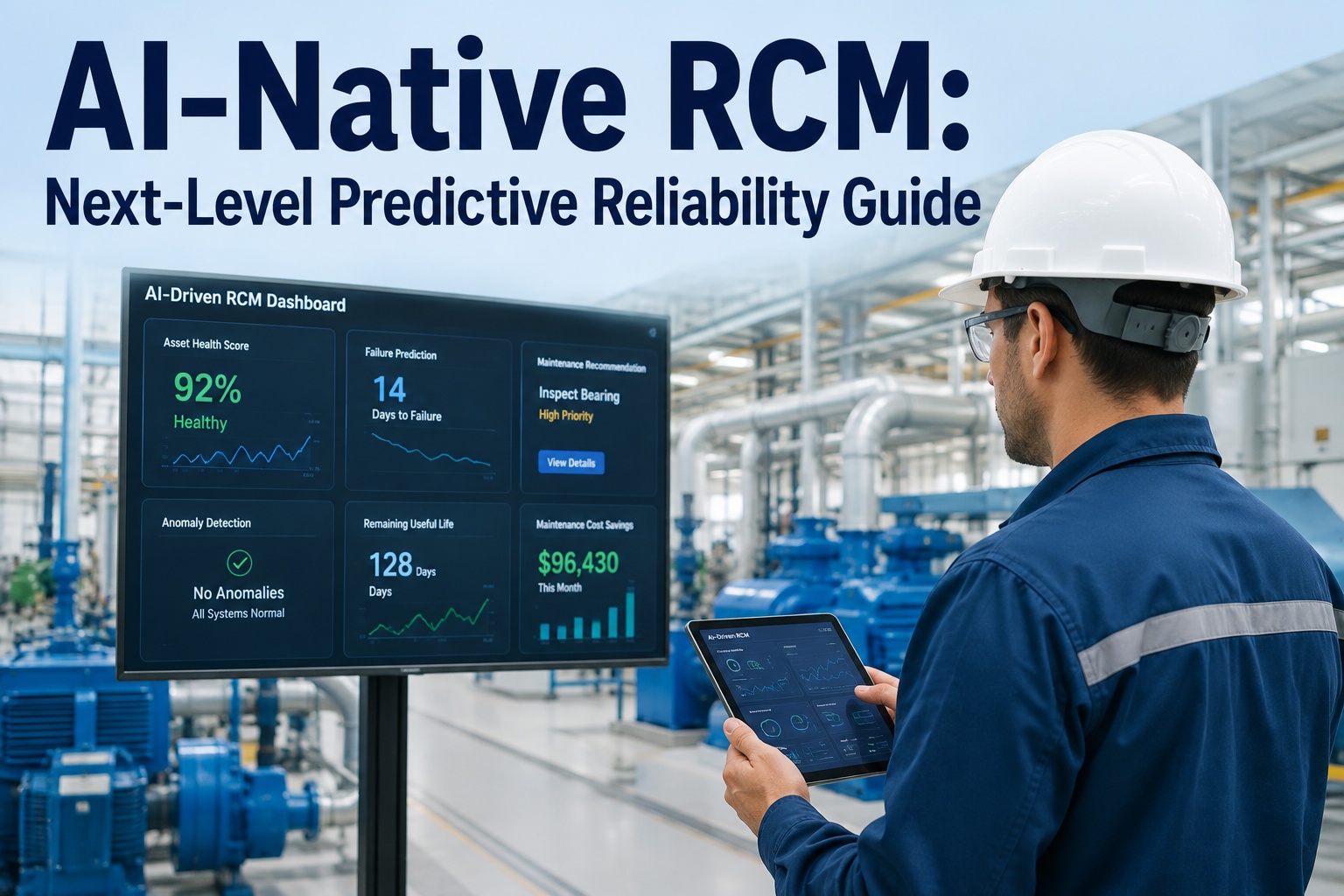
AI-native RCM (Reliability-Centered Maintenance) is the practice of using machine learning, anomaly detection and generative AI to answer the seven classic RCM questions automatically — predicting failures before they happen, auto-tuning PM intervals and generating work orders from live asset data instead of static spreadsheets. Where traditional RCM studies take 6–18 months of facilitator-led workshops per asset class, an AI-driven RCM platform continuously re-analyzes every failure mode across your entire asset base, in near real time. Plants that layer AI predictive reliability on top of their RCM program typically cut unplanned downtime 30–50% and reduce total maintenance cost 10–25% within the first year. This guide walks through how AI-native RCM works, how to pilot it on your most critical equipment in weeks, and how to scale it plant-wide. If you want to see it running on your own asset data, Start Free Trial and connect your first assets today.
What if your RCM analysis updated itself every time a machine hiccupped?
Classic RCM is powerful but static — a workshop, a binder, a review every few years. AI-native RCM turns those seven questions into a living system: sensors feed anomaly detection models, machine learning re-ranks your failure modes by real risk, and work orders write themselves before the breakdown. This guide shows you exactly how to make that shift, one pilot asset class at a time.
The 7 RCM Questions — and How AI Answers Each One Differently
Every RCM program, from the original MSG-3 airline standard to SAE JA1011, rests on seven questions. Traditional RCM answers them in workshops; AI-native RCM answers them continuously, from data. Here is the side-by-side that changes the economics of reliability.
| Classic RCM Question | Traditional Answer | AI-Native Answer |
|---|---|---|
| 1. What are the asset's functions? | Engineering docs + operator interviews | Asset hierarchy auto-built from nameplate, manuals and historian tags |
| 2. How can it fail to function? | Facilitated FMEA sessions (weeks) | Failure-mode library pre-seeded by equipment class, refined by your work-order history |
| 3. What causes each failure? | Root-cause workshops after events | ML pattern-matching across sensor, runtime and repair data finds causes humans miss |
| 4. What happens when it fails? | Consequence ranking by committee | Generative AI drafts consequence scenarios from similar failures across the fleet |
| 5. Why does the failure matter? | Static criticality score, reviewed yearly | Dynamic risk score that moves with production schedules, parts stock and season |
| 6. What can predict or prevent it? | Fixed PM calendar from OEM manuals | AI anomaly detection + auto-tuned PM intervals based on actual degradation curves |
| 7. What if no proactive task works? | Run-to-failure or redesign decision logged | Cost model continuously compares run-to-failure vs. redesign vs. monitoring spend |
The shift is not from "no RCM" to "RCM" — it is from RCM as a one-time project to RCM as a living system. That is what makes AI failure prediction economically viable for plants with hundreds of assets, not just flagship equipment.
How AI-Driven RCM Picks the Right Strategy for Every Failure Mode
A mature RCM program assigns every failure mode one of four strategies. AI-native RCM makes this assignment dynamic — a failure mode can graduate from run-to-failure to condition monitoring the moment the data justifies it. Most plants find 40–60% of failure modes belong on condition-based tasks, yet run 80% of their PMs on fixed calendars.
Run-to-Failure
For low-consequence, cheap-to-fix failures — a $40 exhaust fan belt. AI confirms the economics stay valid: if repair frequency or downtime cost creeps up, the model flags the mode for re-evaluation instead of letting it quietly drain budget.
Time-Based PM
For age-related wear with a predictable curve — brake linings, filters, lubrication. Machine learning maintenance models auto-tune intervals from actual work-order data, typically stretching intervals 15–30% without raising failure risk.
Condition Monitoring
For random-failure modes with detectable precursors — bearing vibration, oil debris, motor current signature. AI anomaly detection watches these streams 24/7 and triggers work orders at the earliest statistically valid warning, not at a human's monthly route.
Redesign / One-Time Change
For intolerable failures no task can prevent — chronic misalignment, undersized components. AI quantifies the lifetime cost of the recurring failure so the redesign business case writes itself: downtime hours x hourly loss, summed automatically.
How to Launch an AI-Native RCM Pilot in 8 Weeks
You do not need a plant-wide digital twin to start. The fastest AI predictive reliability programs begin with one critical asset class — typically 10–25 machines — and prove value before scaling. Here is the timeline that works.
Pick the pilot & build the hierarchy
Choose the asset class causing the most unplanned downtime — often compressors, pumps or conveyors. Mirror your plant structure in the CMMS: site, line, system, asset, component. OxMaint imports this from spreadsheets or your existing EAM in hours, not weeks.
Load failure modes & connect data
Seed each asset with its top 5–10 failure modes from a class library, then link live signals: runtime meters, sensor feeds, PLC tags or even manual inspection readings. AI condition monitoring starts baselining normal behavior from day one.
Turn on AI work order generation
Set thresholds so anomalies auto-create prioritized work orders with the failure mode, likely cause, required parts and safety notes attached. Technicians get context, not just an alarm — first-time fix rates typically jump 15–20%.
Measure, tune, and make the scale decision
Compare pilot assets against their trailing 12-month baseline: unplanned downtime, MTBF, PM compliance, cost per operating hour. Most pilots see the first avoided failure inside this window — one caught bearing on a critical line often pays for the entire pilot.
What AI Predictive Reliability Is Worth: A 180-Asset Plant, Real Numbers
Consider a mid-size packaging plant: 180 maintainable assets, 22 unplanned downtime events per quarter, average 3.5 hours per event, downtime costed conservatively at $2,600/hour. That is roughly $200K per quarter — $800K per year — in lost production alone, before expedited parts and overtime.
These are not best-case figures. Industry benchmarks for ML predictive maintenance consistently show 30–50% unplanned-downtime reduction and 10–25% total maintenance cost reduction once AI failure prediction is embedded in daily work-order flow — the key word being "embedded." Predictions nobody acts on are worth nothing.
How OxMaint Turns AI-Native RCM From Theory Into Tuesday's Work Orders
Most RCM initiatives die in binders because nothing connects the analysis to daily execution. OxMaint is an AI-powered CMMS + EAM built to close that loop — four capabilities do the heavy lifting.
AI anomaly detection & failure prediction
OxMaint's machine learning models baseline each asset's normal behavior from sensor, runtime and inspection data, then flag statistically meaningful deviations 2–6 weeks before failure — feeding your RCM strategy with live evidence, not gut feel.
AI work order generation
When an anomaly fires, OxMaint auto-creates a prioritized work order pre-loaded with the failure mode, probable cause, linked spare parts and procedure. Generative AI drafts the repair notes from your own history, so technicians start fixing, not investigating.
Self-tuning PM triggers
PMs fire on runtime hours, cycles, condition thresholds or calendar — whichever the failure mode demands — and OxMaint's AI maintenance optimization re-tunes intervals from actual failure data. Over-maintained assets get intervals stretched; under-maintained ones get flagged.
Reliability analytics that prove the program
MTBF, MTTR, PM compliance, downtime Pareto and cost-per-operating-hour dashboards update automatically — aligned with ISO 55000 asset-management expectations. When leadership asks whether the RCM program works, you show the chart, not a slide deck.
Book a 30-minute demo and watch AI-native RCM run on your equipment data
Bring your ugliest spreadsheet and your worst-behaving asset class. We will show you the failure-mode library, live anomaly detection and auto-generated work orders — mapped to your plant, not a generic demo.
AI-Native RCM: Frequently Asked Questions
What is AI-native RCM?
AI-native RCM is Reliability-Centered Maintenance where machine learning, anomaly detection and generative AI continuously answer the seven RCM questions from live asset data — instead of a one-time workshop. Failure modes, criticality scores and PM intervals update automatically as new sensor readings and work-order history arrive.
How is AI predictive reliability different from traditional preventive maintenance?
Preventive maintenance services assets on a fixed calendar regardless of actual condition; AI predictive reliability intervenes only when data shows real degradation. Plants typically eliminate 20–30% of unnecessary PMs while catching failures calendar schedules miss — the classic win-win of doing less work and getting more uptime.
Do I need sensors on every machine to start AI-driven RCM?
No. You can begin with runtime meters, operator inspection readings and work-order history — OxMaint's models extract failure patterns from those alone. Add vibration, temperature or oil sensors later on your most critical assets; the AI condition monitoring simply gets sharper as data richness grows. Start Free Trial with the data you already have.
How long before AI failure prediction shows measurable ROI?
Most pilots on a single critical asset class show measurable impact within 6–8 weeks, and full payback inside 6 months. One avoided failure on a critical production line — often worth $8K–$50K in downtime, parts and overtime — frequently covers the entire first-year software investment.
Can AI generate work orders automatically, and do technicians trust them?
Yes — OxMaint's AI work order generation creates prioritized, context-rich work orders the moment an anomaly is confirmed, complete with failure mode, likely cause, parts and procedure. Trust builds fast because technicians receive actionable detail instead of a bare alarm. Book a Demo to see a live auto-generated work order end to end.
Your failure modes are already in your data. Let AI find them first.
Launch your AI-native RCM pilot on your most critical asset class today — import your hierarchy, connect your data, and watch the first predicted failure turn into a planned, cheap, scheduled fix instead of a 2 a.m. breakdown.