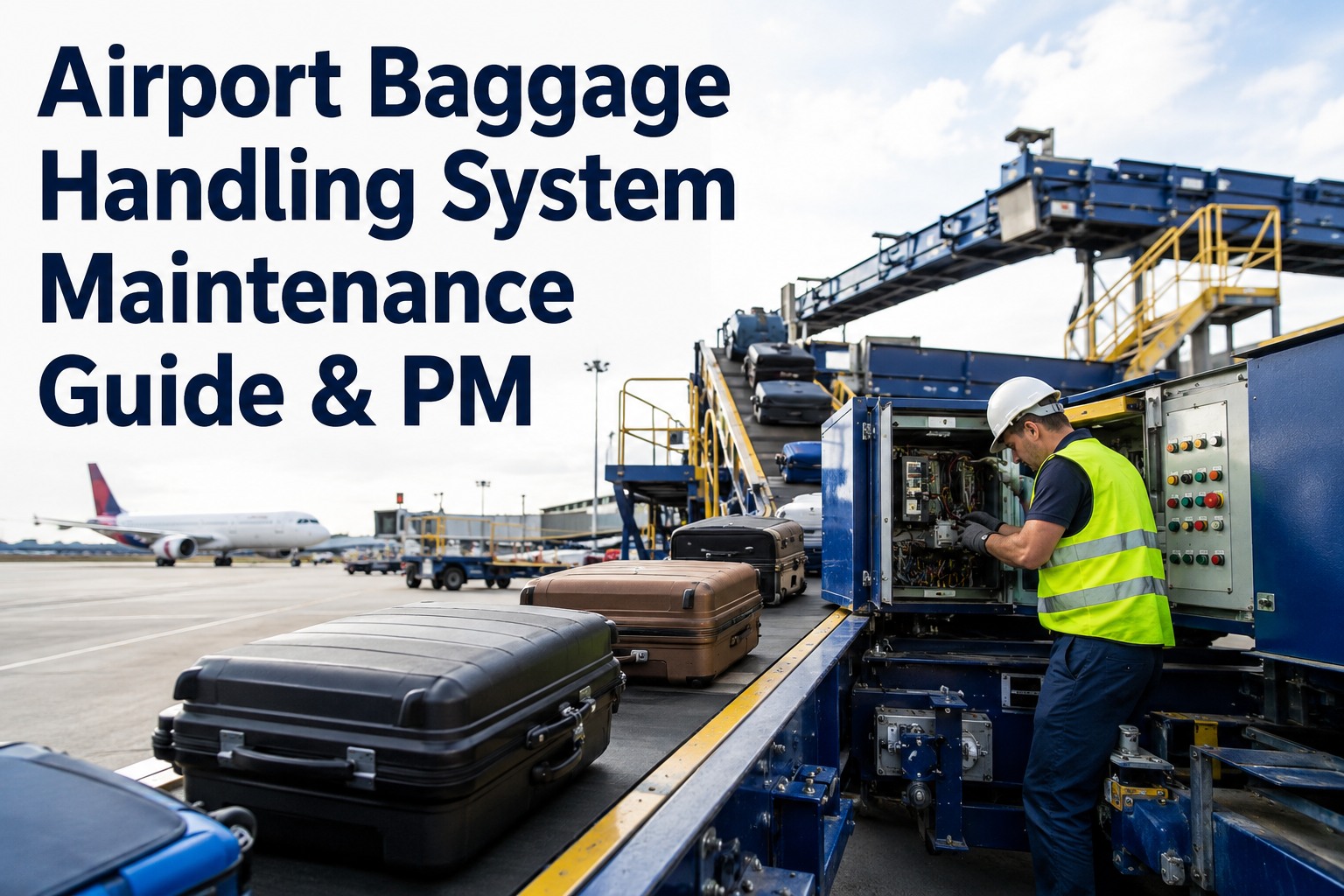
Airport baggage handling system maintenance is the single most consequential reliability challenge in terminal operations — one stalled conveyor belt or sortation diverter can cascade into missed flight departures, stranded passengers, and six-figure delay penalties within minutes. BHS maintenance teams responsible for conveyor belts, tub carts, Explosive Detection Systems (EDS), and baggage claim carousels need rigorous preventive maintenance schedules, real-time work order control, and a CMMS that integrates inspection data with spare-parts inventory to keep availability above 99 percent. This guide breaks down the PM checklists, failure modes, and CMMS structure that keep airport material handling systems flight-ready — and shows how OxMaint helps BHS operations teams eliminate reactive chaos and Start Free Trial to experience the difference.
Every conveyor stoppage costs your airport $10K+ per delayed departure — is your BHS maintenance ready?
Baggage handling systems run 18–24 hours a day under punishing loads. A structured PM program powered by a CMMS cuts unplanned BHS downtime 30–50 percent and keeps sortation, EDS, and baggage claim systems operating at the 99.5% availability threshold that on-time departures demand.
Where baggage handling system failures actually happen
Industry data from ACI and IATA reliability studies shows that the majority of BHS downtime traces back to a handful of mechanical and controls failure modes — most of which are predictable with proper inspection cadence and condition monitoring.
Tracking errors, worn lagging, bearing seize — the dominant failure family across airport conveyor maintenance.
Pneumatic pusher wear, encoder drift, and photoeye misalignment cause misreads and bag recirculation.
Explosive Detection System belt wear, X-ray calibration drift, and conveyor interface jams drive TSA checkpoints down.
PLC communication losses, VFD faults, and failed proximity switches create hard stops with no warning.
Baggage handling PM checklist by system component
A defensible BHS preventive maintenance program divides tasks across four system tiers, each with its own cadence, tools, and acceptance criteria. Below is the PM structure used by tier-1 airport maintenance teams.
Conveyor Belt Systems
- Inspect belt tracking and tension; adjust within 2% center-line tolerance
- Check drive pulley lagging for wear, delamination, or material buildup
- Lubricate pillow-block bearings per OEM hour-count; log temperature readings
- Test belt rip sensors, pull-cord e-stops, and slip detection circuits
- Replace worn belt scrapers and clean chute transfer points
Sortation & Diverter Systems
- Verify diverter actuator stroke time; flag readings beyond 350ms
- Calibrate barcode scanner array and photoeye alignment sensors
- Inspect pusher-arm pivot bearings and pneumatic cylinder seals
- Test tilt-tray and cross-belt sorter encoder positioning accuracy
- Audit PLC diverter logic and reject-rate exception logs
EDS Equipment Maintenance
- Run TSA-mandated daily readiness check; log X-ray penetration test
- Inspect lead-curtain integrity; replace if gaps exceed 3mm
- Verify conveyor interface handoff speed matches upstream belt rate
- Test radiation safety interlocks and emergency-stop circuits
- Schedule OEM calibration certification per manufacturer cycle
Baggage Claim Carousels
- Inspect oval-chain tension and sprocket tooth engagement
- Lubricate drive chain and motor reducer; record amperage draw
- Test claim-plate sensors and carousel E-stop accessibility
- Check structural track wear at curve sections; measure ovality
- Inspect surface plate integrity and replace cracked segments
What airport BHS downtime actually costs — and what CMMS control saves
A single delayed departure from baggage system failure can cost an airline $10,000–$35,000 in passenger compensation, rebooking, and crew scheduling. For a mid-size airport running 400+ daily departures, even a 1% BHS availability gap translates to millions annually.
A 1,200-bag/hour BHS at a mid-size airport
Consider a mid-size airport processing 1,200 bags/hour with 140 unplanned BHS stoppages per year averaging 25 minutes each — totaling 58 hours of downtime. At $14 per bag recovery cost and an average $12,500 per delay incident penalty, the annual downtime cost reaches approximately $976,400 plus $1,750,000 in penalties — over $2.7M annually. By implementing a CMMS-driven PM program that reduces unplanned downtime 40%, the airport recovers roughly $1.1M in year one alone — a payback well under 3 months when measured against OxMaint subscription and implementation cost.
| BHS Downtime Scenario | Hours Lost / Yr | Delay Incidents | Estimated Annual Cost |
|---|---|---|---|
| Reactive maintenance (baseline) | 120 hrs | 140 | $2,930,000 |
| Spreadsheet-based PM tracking | 72 hrs | 84 | $1,758,000 |
| CMMS-structured PM (OxMaint) | 42 hrs | 49 | $1,026,000 |
| CMMS + predictive analytics (OxMaint AI) | 24 hrs | 28 | $586,000 |
Building an airport BHS maintenance schedule that actually works
The difference between a PM program that holds availability and one that collapses under peak-season load is cadence discipline. Here is a proven 12-month BHS maintenance schedule structure aligned with ISO 55000 asset management principles.
Visual inspections & EDS readiness
Pre-shift walkdowns of critical conveyor paths, sortation diverters, and baggage claim entry points. TSA-mandated EDS daily readiness checks logged digitally. Vibration and temperature spot-checks on high-risk drive motors flagged by predictive sensors.
Mechanical PM & sensor calibration
Belt tension adjustments, bearing lubrication per OEM hour-counts, photoeye and scanner alignment verification, pneumatic system pressure checks, and diverter actuator stroke-time testing. All tasks assigned, completed, and signed off inside the CMMS mobile app.
Deep PM & failure-mode analysis
Comprehensive conveyor inspections, lagging replacement scheduling, sortation encoder recalibration, structural carousel track measurement, and monthly failure-mode review using CMMS analytics to identify recurring bad-actors and adjust PM frequencies.
OEM certifications & controls audit
EDS equipment OEM calibration certification, PLC logic and safety-interlock audit, VFD parameter review, spare-parts inventory reconciliation, and vendor-managed critical component stock verification to eliminate stockout risk.
Reliability-centered maintenance review
Full RCM review of PM effectiveness, MTBF and MTTR trend analysis across all BHS subsystems, predictive-analytics model retraining with accumulated sensor data, and maintenance budget reconciliation against actuals for ROI reporting.
See OxMaint on your baggage handling assets — book a 30-minute demo
Walk through a live BHS maintenance workflow: PM scheduling, mobile work orders, EDS compliance logging, and predictive analytics — configured for your terminal's exact equipment hierarchy.
How OxMaint CMMS transforms baggage handling maintenance
OxMaint is an AI-powered CMMS and EAM platform purpose-built for asset-intensive operations. For BHS teams, it maps directly to the four reliability levers that keep baggage moving: preventive scheduling, predictive insight, spare-parts control, and audit-ready compliance.
Automated PM Scheduling
Generate recurring preventive maintenance work orders by meter, calendar, or condition trigger for every conveyor, sorter, and EDS unit — assigned to the right technician with OEM checklists attached.
AI-Powered Predictive Maintenance
OxMaint's AI engine analyzes vibration, temperature, and amperage data from BHS sensors to predict bearing failures, belt wear, and drive-motor degradation weeks before catastrophic failure.
Spare-Parts Inventory Control
Track critical BHS spares — belts, bearings, diverters, photoeyes, EDS consumables — with min/max reorder triggers and vendor lead-time visibility so the right part is always in stock.
TSA & Audit-Ready Compliance
Every EDS readiness check, safety-interlock test, and PM completion is time-stamped, geo-tagged, and stored in a searchable audit trail — ready for TSA, FAA, or internal reliability reviews on demand.
BHS spare-parts strategy that prevents stockout delays
Critical BHS components carry lead times of 4–12 weeks. A reactive parts strategy guarantees extended downtime when a belt, drive, or EDS module fails. Here is the tiered stocking model that keeps availability high without inflating inventory carry costs.
Critical / Long-Lead Items
Drive motors, reducer assemblies, EDS conveyor modules, custom-length belts. Maintain 1–2 units on shelf with automatic reorder at 1 unit. OxMaint flags low stock and tracks vendor lead-time trends.
Essential Wear Parts
Bearings, belts, lagging, diverters, pneumatic cylinders, photoeyes. Maintain 2–4 weeks of consumption buffer with CMMS-driven reorder points tied to actual PM-driven usage rates.
Standard Consumables
Lubricants, fasteners, seals, EDS lead curtains, cleaning supplies. Min/max stock with monthly cycle counts; vendor-managed inventory where possible to reduce admin overhead.
"After switching to OxMaint, our BHS team cut emergency parts orders by 70% in the first quarter — the CMMS knew what we needed before we did."
Airport baggage handling system maintenance — frequently asked questions
What is included in a baggage handling system preventive maintenance program?
A comprehensive BHS PM program includes daily visual inspections of conveyor paths and EDS readiness checks, weekly mechanical PM (belt tension, lubrication, sensor calibration), monthly deep inspections with failure-mode analysis, and quarterly OEM certifications. Each task should be scheduled, assigned, and documented in a CMMS like OxMaint to ensure nothing is missed and audit trails are complete.
How often should airport conveyor belts be inspected?
Airport conveyor belts require daily visual inspections for tracking, damage, and debris; weekly mechanical checks of tension, lagging, and bearings; and monthly deep PM including belt rip sensor testing and drive component assessment. High-traffic belts running 18+ hours daily may need mid-shift spot checks during peak departure waves. You can Book a Demo to see how OxMaint automates these cadences.
How does a CMMS improve baggage handling system reliability?
A CMMS improves BHS reliability by automating PM scheduling so no task is skipped, capturing complete work-order histories for failure analysis, tracking spare-parts inventory to prevent stockout delays, and providing analytics that identify recurring bad-actor assets. Teams using OxMaint typically cut unplanned downtime 30–50% within the first six months of implementation.
What are the most common BHS failure modes?
The most common BHS failure modes are belt tracking and tension failures (38%), sortation diverter and sensor faults (24%), EDS equipment stoppages from calibration drift or conveyor interface jams (21%), and controls or electrical faults including PLC communication loss and VFD failures (17%). Most are preventable with condition-based monitoring and disciplined PM execution.
How much does BHS downtime cost an airport?
BHS downtime costs vary by airport size and delay type, but a single delayed departure from baggage system failure typically costs $10,000–$35,000 in passenger compensation, rebooking, and crew scheduling. For a mid-size airport with 100+ unplanned BHS stoppages annually, total downtime cost can exceed $2–3 million per year — making CMMS-driven preventive maintenance one of the highest-ROI investments an airport operations team can make.
Stop reacting to BHS failures — start preventing them
Join the airport maintenance teams using OxMaint to cut unplanned downtime 30–50%, pass audits in minutes, and keep every flight departing on time. Start your free trial today or book a personalized demo with our BHS reliability specialists.
Free 14-day trial · No credit card