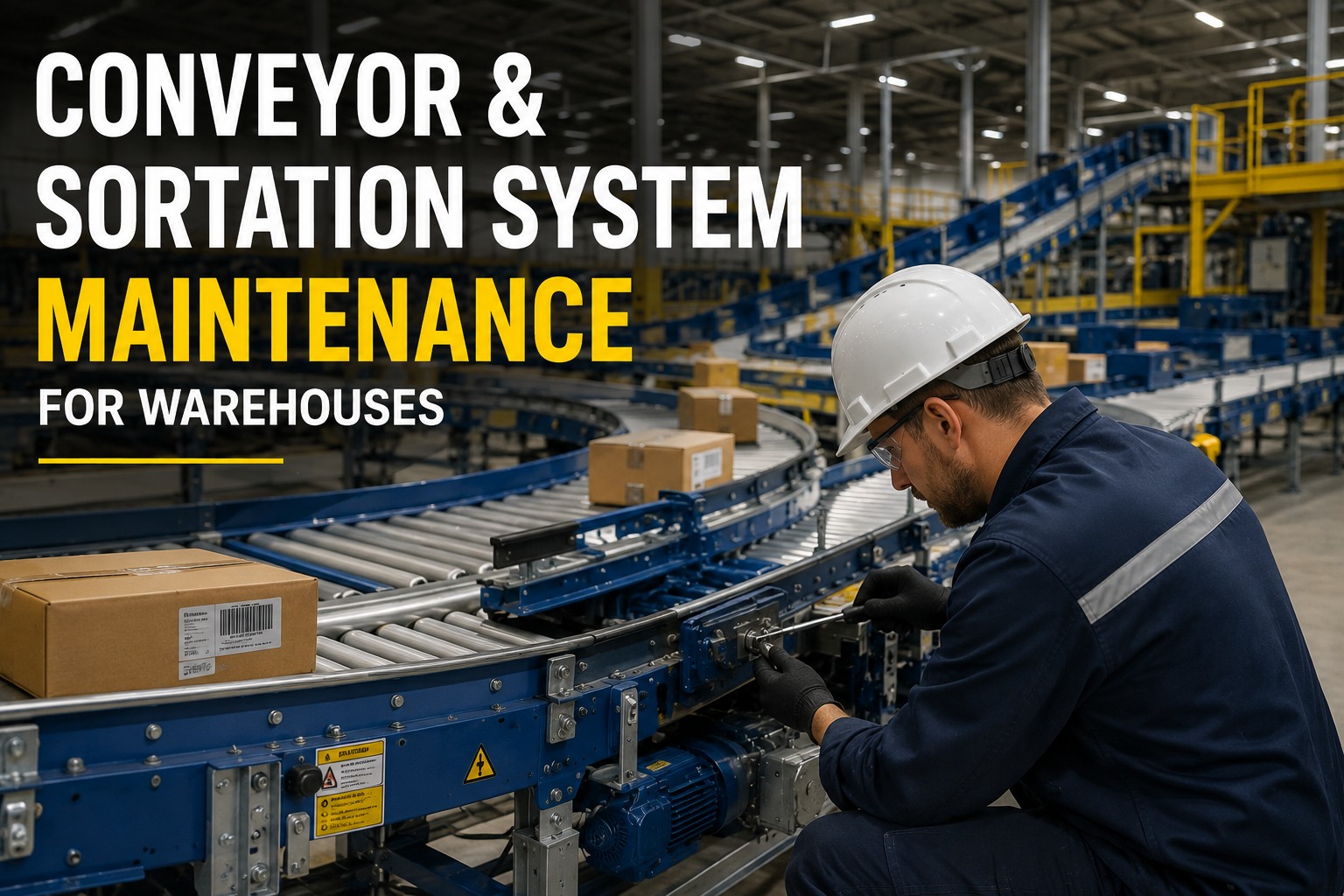
Conveyor maintenance in warehouse operations is the single largest determinant of order fulfillment throughput — a single belt slippage or sortation diverter jam can halt an entire pick line and cascade into thousands of late shipments per hour. Effective warehouse conveyor PM programs combine belt tension checks, roller replacement schedules, divert mechanism calibration, and scanner system preventive maintenance into a structured CMMS workflow that keeps material handling availability above 98%. Sortation system maintenance demands even greater precision because high-speed diverters, photo-eye arrays, and zone controllers fail silently until a misread triggers a massive recirculation loop. OxMaint brings every conveyor inspection task, PM trigger, and work order into one AI-powered platform — you can Start Free Trial today and replace clipboard-based rounds with mobile inspections that actually close the loop.
Warehouse Conveyor & Sortation PM
Every minute your conveyor is down, your DC stops shipping
A single sortation jam costs $4,000–$8,000 per hour in lost throughput. OxMaint structures your entire conveyor PM program — belt tension, roller replacement, divert maintenance, scanner calibration — into automated work orders that keep material handling uptime at DC-required levels.
The Real Cost Of Conveyor Downtime
Why warehouse conveyor uptime is a profitability metric, not a maintenance metric
In a 500K-square-foot distribution center running 8,000 packages per hour through sortation, a 1% drop in conveyor availability equals 80 delayed packages every hour — roughly 1,400 per shift and 7,000 per week. At an average order value of $45, that is $315,000 in at-risk revenue weekly from a single percentage point of uptime loss.
A mid-Atlantic 3PL operating 12 belt conveyors and 3 tilt-tray sorters was spending $52,000 annually on emergency parts and overtime labor. Reactive calls averaged 4.2 hours per event and occurred 3–4 times monthly. After implementing a structured conveyor PM schedule through OxMaint, unplanned events dropped to less than one per month, average repair time fell to 1.1 hours, and annual emergency spend dropped to $14,000 — a 73% reduction in the first year.
Conveyor PM Checklist
What a complete warehouse conveyor PM schedule covers
A defensible conveyor PM program is built on four equipment tiers — drive system, belt and rollers, sortation diverters, and controls/scanning. Each tier has its own cadence, inspection criteria, and failure signatures. Below is the structured checklist OxMaint loads into every warehouse deployment.
Drive System & Motor PM
- Motor amperage draw vs. baseline — weekly
- Gearbox oil level & leak inspection — weekly
- Coupling alignment & wear check — monthly
- Drive chain/belt tension & condition — bi-weekly
- Vibration analysis on drive motor — quarterly
- Gearbox oil sample & change — semi-annual
Belt, Roller & Track PM
- Belt tension measurement & adjustment — weekly
- Belt tracking & edge wear inspection — weekly
- Roller spin test & seized roller flag — weekly
- Belt splice integrity check — monthly
- Idler bearing temperature scan — monthly
- Belt replacement at 60% wear — predictive trigger
Sortation & Divert PM
- Divert shoe/pusher wear & travel — weekly
- Pneumatic pressure & valve response — weekly
- Sortation belt surface inspection — weekly
- Divert timing accuracy test — bi-weekly
- Zone controller error log review — monthly
- Lubrication of divert moving parts — monthly
Scanner, Sensor & Controls PM
- Photo-eye lens clean & alignment — daily
- Barcode scanner read-rate log review — daily
- Encoder position verification — weekly
- PLC fault log & alarm review — weekly
- Scanner firmware update & calibration — quarterly
- Network switch & I/O block inspection — quarterly
Conveyor Inspection Cadence
Conveyor PM schedule: daily, weekly, monthly, and quarterly tasks
The difference between 95% and 99% conveyor availability is almost entirely cadence discipline. Sortation system maintenance that slips by even one week creates a backlog of missed inspections that surfaces as cascading jams during peak. The table below maps the standard PM cadence OxMaint enforces through automated work order triggers.
| Frequency | Inspection Task | Equipment Scope | Typical Duration | Trigger Method |
|---|---|---|---|---|
| Daily | Photo-eye clean, scanner read-rate check, startup walk-down | All sortation zones & scan tunnels | 20–30 min | Shift-start auto-trigger |
| Weekly | Belt tension, roller spin, divert travel, motor amps | All conveyor lines & diverters | 2–4 hours | Calendar + runtime hours |
| Bi-weekly | Divert timing accuracy, belt tracking adjustment | Sortation diverters & transfer points | 1–2 hours | Calendar-based work order |
| Monthly | Gearbox inspection, PLC fault review, idler temp scan | Drive systems & controls | 3–5 hours | Calendar + condition-based |
| Quarterly | Vibration analysis, scanner calibration, network inspection | Critical drives, scanners, PLCs | 4–8 hours | Condition + calendar hybrid |
| Semi-annual | Gearbox oil change, major belt replacement evaluation | All drive systems & belts | 8–16 hours | Runtime hours + wear data |
How OxMaint Helps
How OxMaint keeps conveyor & sortation availability above 98%
OxMaint maps directly to the four conveyor PM tiers above — each capability below replaces a manual, spreadsheet-driven process with an automated workflow that produces audit-ready records and measurable uptime gains.
Pre-built conveyor PM library
Deploy 60+ conveyor and sortation PM templates on day one — belt tension, roller replacement, divert calibration, scanner firmware — all pre-loaded with cadence, parts lists, and safety procedures. Cut PM setup time from weeks to hours.
Mobile inspection workflow
Technicians complete conveyor inspections on a phone or tablet — photo evidence of belt wear, pass/fail criteria per checkpoint, digital sign-off, and automatic work order generation for any failed item. Eliminates paper rounds entirely.
Predictive failure alerts
OxMaint's AI analyzes vibration trends, motor amperage drift, scanner read-rate degradation, and runtime hours to predict belt, bearing, and scanner failures 2–4 weeks before they cause a jam. Convert unplanned downtime into scheduled maintenance windows.
Spare-parts inventory sync
Every conveyor PM and work order automatically reserves and deducts spare parts — belts, rollers, divert shoes, bearings, photo-eyes. Minimum-stock alerts trigger reorders before you run out of the one part you need at 2 AM during peak season.
Conveyor Reliability ROI
The ROI of moving from reactive to CMMS-driven conveyor maintenance
A warehouse running 15 conveyor lines with 3 sortation systems typically spends $35,000–$60,000 annually on reactive repairs, overtime, and expedited parts. Structuring that same maintenance through a conveyor CMMS produces a measurable, defensible return inside the first quarter.
Payback on OxMaint for warehouse conveyor and sortation maintenance averages 2.5–4 months. A typical 200K-square-foot DC recovers the platform subscription cost in the first quarter through reduced expedited parts freight alone — before counting the throughput gains from higher availability.
See OxMaint on your conveyor lines — book a 30-minute demo
Walk through a live conveyor PM library, mobile inspection workflow, and predictive alert dashboard configured for your distribution center. See exactly how OxMaint maps to your belt conveyors, sortation diverters, and scanner systems.
FAQ
Warehouse conveyor & sortation maintenance: common questions
How often should warehouse conveyors be inspected?
Daily walk-downs for photo-eye cleaning and scanner read-rate verification, weekly inspections for belt tension and roller condition, and monthly deep inspections for gearbox oil, PLC fault logs, and idler bearing temperatures. Sortation diverters require bi-weekly timing-accuracy checks because even a 50ms drift causes mis-sorts. OxMaint auto-triggers each cadence so nothing slips — you can configure triggers by calendar, runtime hours, or condition data from your scanner and PLC logs.
What is included in a conveyor belt maintenance program?
A complete belt conveyor PM program covers belt tension measurement and adjustment, tracking and edge-wear inspection, splice integrity checks, roller spin tests, idler bearing temperature scans, and predictive belt replacement at 60% wear. It also includes drive-system tasks like motor amperage monitoring, gearbox oil sampling, and coupling alignment. OxMaint ships with all of these pre-built as templated work orders — start a Start Free Trial to deploy them in hours, not weeks.
How does a CMMS improve warehouse material handling maintenance?
A conveyor CMMS replaces paper inspection sheets and reactive call-outs with automated PM triggers, mobile inspection checklists, photo evidence capture, and predictive failure alerts. The result is 30–50% less unplanned downtime, 75% faster inspection-to-repair cycles, and a complete audit trail for every asset. OxMaint adds AI-driven failure prediction on top of standard CMMS features, giving you 2–4 weeks of lead time before a belt, bearing, or scanner fails during peak.
What are the most common sortation system failures?
The top four failure modes are divert shoe or pusher wear causing mis-sorts, pneumatic valve response degradation, photo-eye misalignment from dust and vibration, and scanner read-rate drops from lens contamination or firmware drift. Each of these is preventable with weekly or bi-weekly PM. OxMaint tracks read-rate trends and divert timing accuracy over time so you see degradation before it becomes a jam — not after.
How long does it take to implement conveyor CMMS software?
A warehouse can deploy OxMaint for conveyor and sortation maintenance in 1–2 weeks. The platform ships with a pre-built PM library of 60+ conveyor tasks, so you import your asset list, assign PM templates to each conveyor line, and configure trigger cadences. Mobile inspections go live immediately. Most DCs see full adoption across all maintenance technicians within 30 days and measurable uptime improvement within the first quarter. Book a demo to see a live configuration tailored to your layout.
Stop losing throughput to preventable conveyor failures
Deploy a structured conveyor and sortation PM program in days — not months. OxMaint's AI-powered CMMS gives you the preventive maintenance library, mobile inspections, and predictive alerts that keep your DC shipping at full capacity.
Free 14-day trial · No credit card