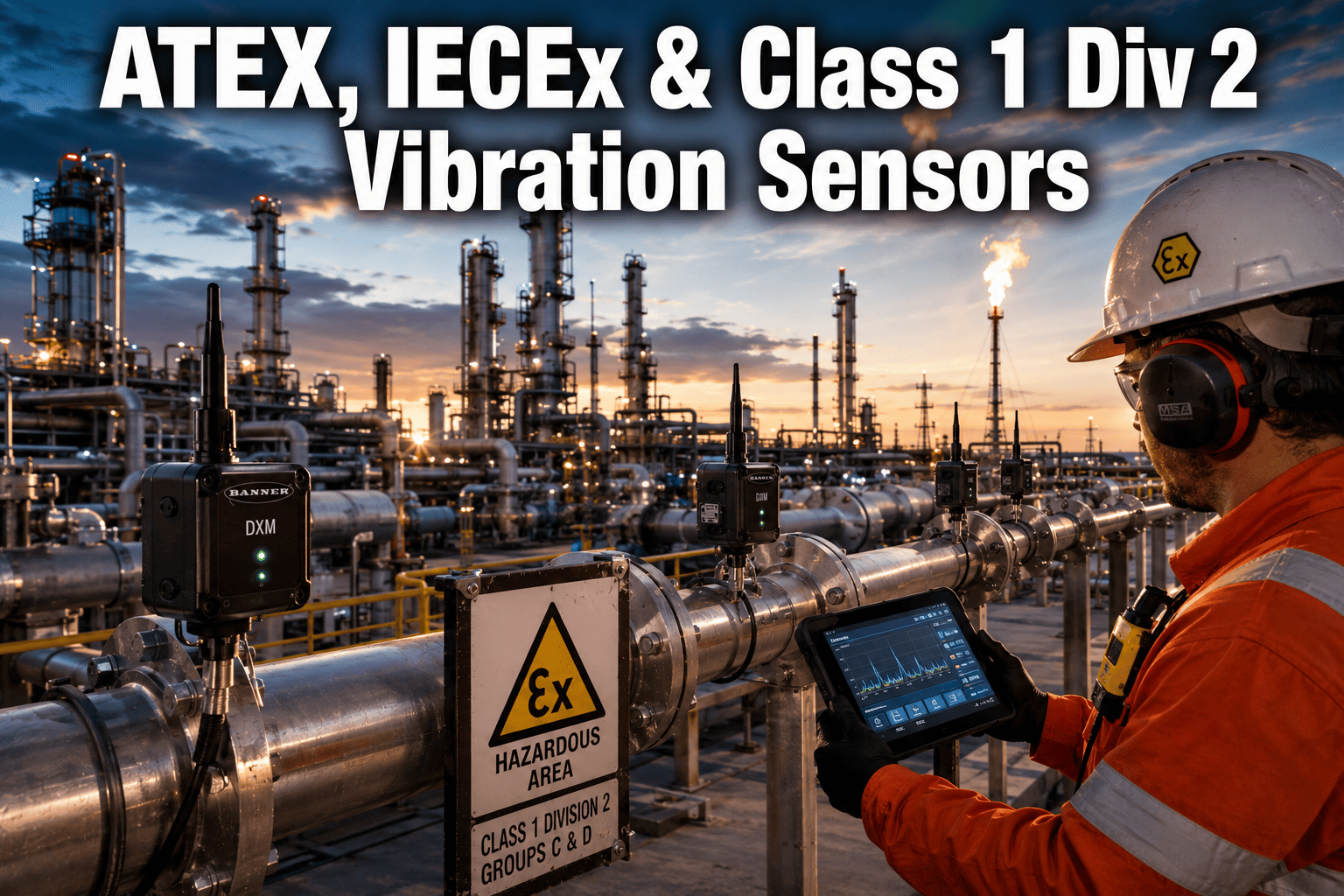
Installing a non-certified vibration sensor in an ATEX Zone 2 classified area is not a compliance shortcut — it is a potential ignition source in an atmosphere where flammable gas concentrations can reach explosive levels. Every year, process safety investigations in oil and gas, chemical, and pharmaceutical facilities identify instrumentation failures as contributing factors in incidents that could have been prevented with intrinsically safe certified equipment. The global market for hazardous area electrical equipment — including wireless vibration and temperature sensors — is projected to reach $8.2 billion by 2026, driven by regulators in the USA (NEC Class 1 Division 2), EU (ATEX Directive 2014/34/EU), and international markets (IECEx) requiring documented proof of equipment certification for any device installed in classified zones. Choosing the wrong sensor — or failing to document the certification match between sensor, zone classification, and gas group — creates both operational risk and a compliance liability that safety auditors and insurers are increasingly equipped to identify. Start a free trial to connect your hazardous area asset monitoring to a CMMS compliance framework, or book a demo and we will walk through how to structure your EHS inspection records and equipment certifications within Oxmaint.
Process Safety · EHS Compliance Guide 2026
ATEX, IECEx & Class 1 Div 2 Vibration Sensors: Selection Guide 2026
Choose the right intrinsically safe wireless vibration and temperature sensors for ATEX Zone 2, IECEx, and Class 1 Division 2 hazardous areas. Certification selection framework, gas group matching, and EHS compliance checklist — all in one guide.
Certification Is a Legal Requirement, Not a Design Feature
The Hazardous Area Compliance Gap Is Larger Than You Think
Most process plants have classified area drawings. Far fewer have a systematic record of whether installed instrumentation — including wireless vibration sensors deployed in the last 3 years — actually matches those area classifications. The gap between zone documentation and installed equipment reality is where process safety incidents begin.
$8.2B
projected global hazardous area instrumentation market by 2026, driven by regulatory compliance tightening
34%
of process industry safety incidents involve inadequately certified or improperly installed electrical equipment
3 schemes
ATEX (EU), IECEx (international), NEC Class/Division (North America) — non-interchangeable, each requiring separate certification
$156K
maximum OSHA PSM penalty per willful violation (2026) for Mechanical Integrity documentation deficiencies
What Are Hazardous Area Vibration Sensors and Why Certification Matters
Hazardous area vibration sensors are condition monitoring instruments evaluated, tested, and certified by an accredited body to confirm they cannot ignite an explosive atmosphere under normal operation or defined fault conditions. The certification is not a design feature — it is a legal and regulatory requirement for any electrical equipment installed in a zone or division classified as having a risk of flammable gas, vapor, dust, or fiber concentration reaching explosive limits. A sensor that transmits vibration data wirelessly contains a radio transceiver, battery or local power source, and processor — each capable of generating heat, sparks, or electromagnetic energy sufficient to cause ignition if not designed to intrinsic safety (Ex i) or explosion-proof (Ex d) standards.
The three dominant certification schemes — ATEX, IECEx, and NEC Class 1 Division 1/2 — are technically similar but not legally interchangeable. A sensor with ATEX Zone 2 certification cannot be installed in a Class 1 Division 2 area in the USA without separate NRTL listing, and vice versa. Reliability engineers deploying wireless monitoring in refineries, petrochemical plants, offshore facilities, or pharmaceutical solvent handling areas must verify the sensor certification matches the zone classification, gas group, and temperature class of the installation point — not just the product marketing sheet. Teams managing multi-site hazardous area compliance need a CMMS that tracks certification expiry, zone mapping, and documentation per asset — start a free trial to build that framework in Oxmaint, or book a demo and walk through your EHS compliance structure.
Certification Schemes: Key Concepts for Sensor Selection
Every sensor selection decision in a classified area must flow from documented area classification, not from product availability or price. These are the concepts that determine whether a sensor installation is compliant — or a liability.
ATX
ATEX Zone 2 Classification (EU/UK)
Zone 2 areas have flammable atmospheres occurring only under abnormal conditions. Equipment must carry CE Ex marking under Directive 2014/34/EU with Category 3G notation. Most process plant areas outside reactor cores qualify as Zone 2. Zone 1 (occasional flammable atmosphere) requires Category 2G — higher protection level, higher cost.
IEC
IECEx International Mutual Recognition
IECEx is accepted in 50+ countries including UAE, Australia, Singapore, and most Asian and African markets. Certificates issued by approved ExCBs are accepted without re-testing in member countries. For global sensor procurement, IECEx certification significantly reduces country-specific re-testing costs and procurement lead time across multi-national operations.
NEC
NEC Class 1 Division 2 (North America)
North American classification for areas where flammable concentrations are not normally present but may occur under abnormal conditions — equivalent to ATEX Zone 2. Equipment must be evaluated by a Nationally Recognized Testing Laboratory (NRTL) — UL, CSA, or FM Approvals. OSHA PSM covered facilities require documented NRTL certification for all equipment in classified areas.
Ex i
Intrinsic Safety — Preferred for Wireless Sensors
Intrinsic safety limits electrical energy in the sensor circuit below the minimum ignition energy of the classified atmosphere — even under fault conditions. No heavy enclosures required, enabling lighter and lower-cost wireless designs. Preferred solution for wireless MEMS vibration sensors in Zone 2 and Division 2 applications where explosion-proof enclosures add unnecessary weight and cost.
GAS
Gas Group and Temperature Class Matching
Equipment certification must match the gas group present: Group IIA (propane-like), IIB (ethylene-like), IIC (hydrogen, acetylene). Temperature class (T1–T6) must be below the auto-ignition temperature of the substance. A T4 rated sensor at 135°C maximum surface temperature is not suitable for hydrogen atmospheres where T6 at 85°C is required.
RF
RF Energy and Wireless Transmission Compliance
Radio frequency transmission from wireless sensors must not generate RF energy sufficient to ignite the atmosphere. ISM band transmitters at 1–100 mW power levels used in industrial wireless sensors are generally acceptable under IEC 60079-0 RF evaluation. Certification documentation must explicitly confirm RF power compliance — not just physical construction standards.
Your Classified Area Assets Need a Compliance System, Not a Spreadsheet
Oxmaint tracks ATEX, IECEx, and NEC certification status per asset, sends expiry alerts 60 days ahead, and generates inspection workflows that produce the audit-ready documentation your safety managers and insurers require.
Where Hazardous Area Sensor Programs Fail
The failure modes in hazardous area sensor programs are consistent across industries — and each one represents a documented process safety or regulatory liability that accumulates in silence until an audit or incident surfaces it.
01
Zone Classification Not Matched to Installed Sensor Certificate
Procurement selects sensors on price or delivery — certification details are checked only when the safety auditor asks. Mismatches between installed sensor certification scope and actual area classification are common and constitute a process safety non-conformance requiring immediate remediation. In ATEX jurisdictions this creates both regulatory and insurance exposure simultaneously.
02
Certificate Expiry Not Tracked — Withdrawn Certificates Go Unnoticed
ATEX and IECEx equipment certificates are periodically reviewed by notified bodies and can be withdrawn if the manufacturer changes design without re-certification. Operating equipment against a withdrawn certificate creates regulatory exposure that most facility asset registers do not track or alert on. The equipment still works — the protection is what's gone.
03
Sensor Condition Alerts Never Reach the Maintenance Planner
Hazardous area wireless sensors generate alert data that does not reach the CMMS work order system. Alerts received in analyst dashboards are not automatically escalated to maintenance planners — and in high-consequence classified areas, this gap is not just a maintenance problem. Delayed response to vibration alerts on pumps in ATEX zones creates secondary risk when reactive repairs require hot work permits and classified area entry.
04
OSHA PSM Inspection Documentation Cannot Be Produced on Demand
OSHA PSM Element 5 (Mechanical Integrity) requires written procedures, training records, and inspection documentation for equipment in PSM-covered processes. Paper-based or spreadsheet maintenance records cannot produce the searchable, timestamped documentation package that OSHA inspectors and PHA facilitators require during process hazard analysis and compliance audits.
05
Multi-Scheme Global Compliance Managed by Institutional Memory
Portfolio operators running facilities in the USA, EU, UAE, and Australia face four different certification schemes that must be tracked per-asset, per-site. Without a centralized CMMS asset register capturing zone classification, certification scheme, gas group, and certificate reference per installed sensor, compliance is managed by whoever happens to remember — until they leave or retire.
Each of these failures creates measurable financial exposure before any incident occurs — the cost of PSM citations, insurance premium increases after audit findings, or the regulatory shutdown that follows a non-conformance discovery during inspection. The teams closing these gaps use a CMMS that tracks certification documentation at the asset level — start a free trial to build your EHS asset compliance framework in Oxmaint, or book a demo to walk through a live hazardous area inspection workflow.
How Oxmaint Manages Hazardous Area Equipment Compliance
From asset-level certification tracking to automated inspection workflows and portfolio-wide compliance dashboards — Oxmaint closes the gap between area classification documentation and operational reality.
1
Asset-Level Certification Document Storage
Store ATEX, IECEx, and NEC certification documents, zone classification drawings, and area classification references directly against each instrumented asset record. Retrieve the full compliance package for any asset during an audit or PSM inspection in seconds — not hours spent searching filing cabinets or shared drives.
2
Certification and Inspection Expiry Alerts
Configure Oxmaint to alert EHS and maintenance managers 60, 30, and 7 days before equipment certification review dates, inspection intervals, and insurance survey requirements are due. Expired certifications on operating equipment are flagged as compliance risks in the portfolio dashboard — visible to plant managers and compliance officers simultaneously.
3
GMP-Compliant Digital Inspection Workflows
Configure digital inspection checklists for hazardous area sensor condition checks, area boundary verification, and enclosure integrity assessments. Completed checklists are timestamped, signed electronically, and stored against the asset record — meeting GMP 21 CFR Part 11 audit trail requirements and ATEX periodic inspection documentation requirements simultaneously.
4
OSHA PSM Mechanical Integrity Records
Oxmaint's work order history, inspection records, and PM completion logs satisfy OSHA PSM Element 5 documentation requirements for equipment in PSM-covered processes. Records are searchable by equipment, date, technician, and task — providing the evidence package OSHA Process Safety inspectors request within minutes of arriving on site.
Unmanaged Hazardous Area Compliance vs. CMMS-Tracked Program
Without CMMS Compliance Tracking
Zone-to-certificate match checked at installation — never revisited until audit
Certificate expiry discovered after a PSM audit citation, not before
Sensor alerts stay in analyst dashboards — work orders raised manually if at all
PSM inspection records reconstructed from memory — incomplete, not timestamped
Multi-site compliance managed by site-level spreadsheets and institutional memory
GMP and EHS records maintained in separate systems — version control failures common
With Oxmaint Compliance Framework
Zone classification linked to asset record — mismatch flagged on installation or reclassification
Expiry alerts at 60, 30, and 7 days — compliance maintained proactively not reactively
Threshold crossings auto-generate work orders with zone classification and PPE requirements
Timestamped digital inspection records — audit-ready in seconds, compliant with ATEX Art. 6
Portfolio dashboard — all sites, all certification statuses, all inspection due dates in real time
Single CMMS satisfying ATEX inspection records and GMP 21 CFR Part 11 requirements
Measurable Results in the First 30 Days
ROI of Structured Hazardous Area Compliance Management
The financial case for CMMS-managed hazardous area compliance is built on two numbers: the cost of an OSHA PSM citation versus the cost of the program, and the insurance premium difference between a facility with documented inspection records versus one that cannot produce them.
$156K
max OSHA PSM penalty per willful violation (2026)
Mechanical Integrity documentation deficiencies — avoidable with CMMS-tracked inspection records and audit-ready evidence packages
60%
reduction in audit preparation time
EHS teams using CMMS-tracked hazardous area inspection records vs. paper-based systems — from days of document collection to minutes of report generation
100%
certification expiry visibility
Every ATEX, IECEx, and NEC certificate tracked with automated expiry alerts — eliminating the operating risk of lapsed certifications discovered at audit or inspection
3 days
typical deployment to full EHS framework
Oxmaint configured with classified area asset register, certification documents, inspection checklists, and expiry alert schedules — operational without lengthy implementation
Neither the citation cost nor the insurance exposure calculation requires an incident to close — they represent the regulatory and financial reality of operating classified area equipment without a structured compliance system. Start a free trial to build your hazardous area compliance framework in Oxmaint, or book a demo and walk through your specific zone classification and certification tracking requirements with our team.
Frequently Asked Questions
Is ATEX certification accepted in the USA and Canada for hazardous area sensor installations
ATEX certification is not accepted as equivalent to NEC Class 1 Division 2 in the USA or Canada. The USA requires evaluation by a Nationally Recognized Testing Laboratory (NRTL) — UL, FM Approvals, or CSA Group — under NFPA 70 Articles 501 and 505. Canada follows the Canadian Electrical Code with CSA certification. ATEX-certified equipment can be installed in the USA only if it also carries NRTL listing for the equivalent NEC classification. For global procurement, sensors carrying both ATEX/IECEx and UL/FM certification provide the broadest geographic deployment flexibility without country-specific re-testing costs.
What is the difference between intrinsically safe and explosion-proof vibration sensors for Zone 2
Intrinsically safe (Ex i) sensors limit electrical energy within the device to levels below the minimum ignition energy of the hazardous atmosphere — even under fault conditions. They do not require heavy enclosures, are typically lighter and lower-cost, and are the preferred solution for wireless MEMS vibration sensors in Zone 2 and Division 2 applications. Explosion-proof (Ex d) equipment contains any internal explosion within a robust enclosure and vents combustion gases before they reach the external atmosphere. Explosion-proof designs are heavier, more expensive, and better suited for Zone 1 and Division 1 applications where ignition-capable energy is inherent in the device function. For Zone 2 wireless vibration monitoring, intrinsic safety is the standard engineering approach.
How should gas group and temperature class be determined for sensor selection in a refinery
Gas group and temperature class must be determined from the hazardous area classification documentation for the specific installation point — not from general site classification. Area classification diagrams, created per IEC 60079-10-1 or API RP 505, define the flammable substance at each zone, its gas group (IIA, IIB, or IIC), and the relevant auto-ignition temperature determining required temperature class (T1 through T6). In a refinery, different process units handle different substances: hydrogen service requires Group IIC and T6 rating; propane or LPG service requires Group IIA and T1–T3. Using the highest severity rating (Group IIC, T6) across all zones provides coverage but may not be cost-effective for every installation point. Always verify against the site-specific area classification document.
How does Oxmaint manage EHS compliance documentation for ATEX and PSM-covered facilities
Oxmaint provides a structured asset register where each piece of installed equipment in classified areas stores its certification reference, zone classification, gas group, temperature class, installation date, and associated certification documents. Periodic inspection intervals are configured per asset type, generating work orders with zone-specific checklists that include safety procedures for classified area entry. Completed inspections are timestamped and stored against the asset record, creating an audit trail satisfying OSHA PSM Element 5 (Mechanical Integrity), ATEX Article 6 (periodic inspection requirements), and GMP 21 CFR Part 11 for pharmaceutical facilities. The portfolio dashboard shows certification expiry, overdue inspections, and compliance gaps across all sites — enabling proactive remediation before any regulatory review.
EHS Compliance · Process Safety
Stop Managing Hazardous Area Compliance by Memory and Spreadsheet
Turn every classified area asset into a tracked, certification-verified, inspection-compliant record — with automated alerts that ensure your ATEX, IECEx, and NEC documentation is always audit-ready before the inspector arrives.
Certification documents stored per asset with automatic expiry alerts
GMP-compliant inspection workflows for ATEX and OSHA PSM Mechanical Integrity
Portfolio compliance dashboard across all sites and certification schemes
Used by operations teams managing 10,000+ assets · Works across multi-site portfolios · Live in days, not months