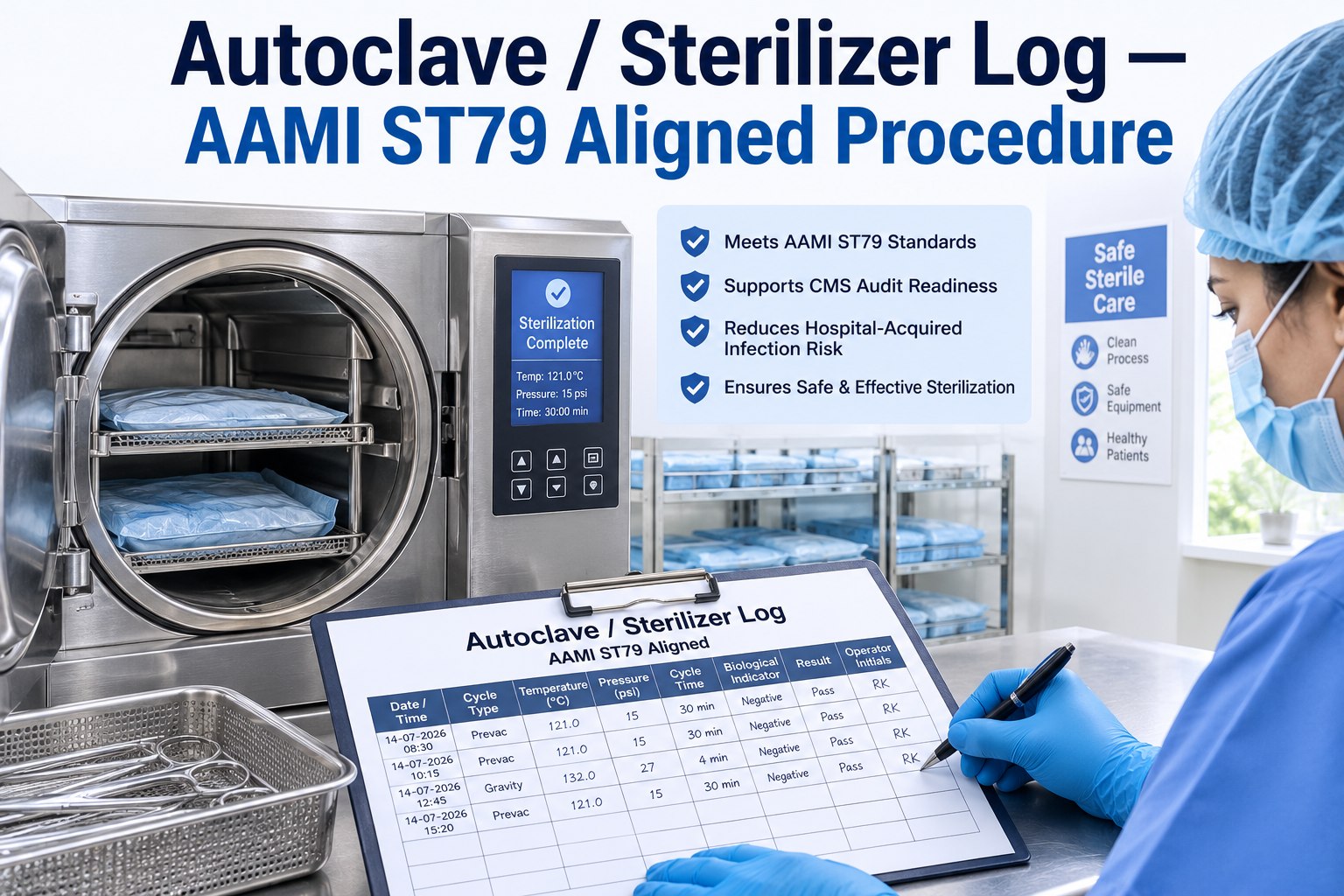
An autoclave that runs a failed cycle unnoticed doesn't announce itself — it quietly releases instruments that were never sterile, and the first sign of trouble may be a surgical-site infection weeks later. That's why the autoclave/sterilizer log isn't paperwork; it's the evidence trail that proves every load was monitored, evaluated, and released on real data. ANSI/AAMI ST79, the comprehensive guide to steam sterilization in U.S. health care facilities, defines a three-tier monitoring system — physical, chemical, and biological — and the biggest reason facilities fail an inspection is inconsistency: readings skipped on a busy shift, a Bowie-Dick test not logged, a positive biological indicator noted but not acted on. This guide lays out the full ST79-aligned logging procedure — what to record on every cycle, the three monitoring layers, the load-release decision, and the failure-response protocol — and shows how to run it as a repeatable, audit-ready program. Book a free sterilization-log program review for your facility.
ST79
ANSI/AAMI comprehensive guide to steam sterilization in U.S. health care facilities
3 tiers
Physical, chemical, and biological monitoring — every load evaluated across all three
Daily
Biological indicator testing in each sterilizer — the highest-level assurance of efficacy
Every load
Documented release decision — never released on gauge readings alone
The Three Monitoring Tiers · What Each One Actually Proves
ST79 sterility assurance rests on a layered system, because no single monitor is sufficient on its own. Each tier answers a different question, and a complete log records all three for every cycle.
TIER 1 · PHYSICAL
Mechanical Monitors
The printout and gauges verify the cycle reached required temperature, pressure, and time. Checked on every load to confirm the parameters were met before any release decision.
Proves: the cycle ran to spec
TIER 2 · CHEMICAL
Chemical Indicators
External Type 1 CIs (autoclave tape) confirm exposure; internal CIs confirm steam penetrated the pack. Bowie-Dick testing checks air removal in prevacuum sterilizers at the start of the day.
Proves: steam reached the items
TIER 3 · BIOLOGICAL
Biological Indicators
Spore-based BIs provide direct evidence the cycle could inactivate the most resistant organisms under worst-case conditions. Run daily in each sterilizer and incubated per manufacturer specs.
Proves: the cycle actually kills
What to Record on Every Cycle
A defensible log captures the same fields on every load, on every shift, at every site — because inconsistency across technicians is the single most common reason an inspection fails. These are the data points the log should require.
01
Load & Cycle Identification
Sterilizer ID, load number, date, time, operator, and cycle type — the traceability anchor that ties every item to a specific run.
02
Cycle Parameters
Temperature, pressure, and exposure time from the physical printout — confirmed against the required values for that cycle.
03
Chemical Indicator Results
External and internal CI outcomes, plus the Bowie-Dick result on prevacuum units at start-of-day — pass or fail, recorded per load.
04
Biological Indicator & Control
Daily BI result and the paired control result — the control must grow for the test to be valid, and both outcomes belong in the record.
05
Load Contents & Release Decision
What was in the load, whether it was released or quarantined, and the signature of the person making the release decision based on all available data.
06
Corrective Action
On any failure: the quarantine, recall, retest, and root-cause steps taken — closing the loop so a failure is resolved, not just noted.
Turn This Log Into a Scheduled Digital Program in 30 Minutes
Working session with our team — bring your sterilizer list and monitoring schedule. We'll show how OxMaint delivers the log to the operator's phone as a scheduled work order, captures readings and photos per item, and auto-escalates any failure.
The Load-Release Decision · Read the Data Before You Release
The most consequential moment in the whole process is releasing a load. ST79 is explicit that release is a decision made after evaluating the available data — never on a single gauge reading. Here's the logic every operator should follow.
1
Check the physical printout. Confirm temperature, pressure, and time met the required cycle parameters.
2
Inspect the chemical indicators. Every pack should show a passing external CI; internal CIs are read by the person opening the set.
3
Account for the biological indicator. Implant and high-risk loads are quarantined by default until the BI clears — not released on gauges alone.
4
Record the release or quarantine. Sign the decision. If any monitor failed, the load does not go out — it enters the failure protocol below.
When a Biological Indicator Fails · The Response Protocol
A positive (growth) BI means the sterilizer did not achieve sterilization for that run. It requires a defined response — not just a note in the logbook. This is the sequence ST79-aligned facilities follow.
Step
Action
Why It Matters
Verify the control
Confirm the paired control grew
If the control didn't grow, the spore lot may be bad — retest before blaming the sterilizer
Quarantine
Hold every load since the last passing BI
Anything already released must be tracked down and evaluated
Remove from service
Take the sterilizer offline pending investigation
Prevents further suspect loads while the cause is found
Requalify
Qualification testing with a BI PCD after repair
ST79 requires requalification after failures, major repairs, or relocation before returning to routine use
Document
Log the failure, actions, and resolution
The corrective-action record is what an auditor looks for — a failure caught and closed is a program working
How OxMaint Runs the Autoclave / Sterilizer Log
OxMaint makes sterilization logging repeatable and traceable — the checklist arrives on the operator's phone as a scheduled work order, readings and photos are captured against each item, any failure escalates automatically, and a complete inspection history is stored against every sterilizer asset for audit.
Schedule
Logs as Scheduled Work Orders
Daily BI tests, Bowie-Dick checks, and per-load logs arrive on the right cadence per sterilizer — no skipped tests on a busy shift.
Capture
Readings & Photo Evidence
Operators record cycle parameters, CI and BI results, and photo evidence against each item on mobile — consistent data, every technician, every site.
Escalate
Auto-Escalation on Failure
A failed CI, BI, or out-of-range reading auto-generates a tracked corrective-action work order — the failure protocol starts itself.
Sign-Off
Documented Release Decision
The load-release decision is signed and timestamped against the run — a defensible record of who released what, on what data.
History
Full Log Per Sterilizer
Every cycle, reading, result, and corrective action logged against the asset — the complete history retrievable in seconds for any auditor.
Scale
One Department or a Whole System
Standardize logging across a single SPD or a multi-facility health system from one dashboard — audit-ready year-round.
Keep Every Sterilizer Audit-Ready, Every Day
Stop letting a skipped reading or an unlogged failure become a compliance gap. See how OxMaint schedules sterilization logs, captures readings and photos, auto-escalates failures, and keeps a complete, defensible history per asset. Free forever plan available.
Frequently Asked Questions
What is an autoclave / sterilizer log and why is it required?
It's the record of every sterilization cycle — parameters, chemical and biological indicator results, load contents, and the release decision. ANSI/AAMI ST79, the comprehensive guide to steam sterilization in U.S. health care facilities, treats documentation as part of sterility assurance: the log is the evidence that each load was properly monitored and released on real data. It's what an auditor, an infection-prevention review, or an accrediting body examines to confirm the program is working. Skipped or inconsistent entries are the most common reason facilities struggle in an inspection.
Book a review of your logging program.
What are the three types of sterilization monitoring?
Physical, chemical, and biological — a layered system where each tier proves something different. Physical monitors (the printout and gauges) verify the cycle reached required temperature, pressure, and time. Chemical indicators confirm steam reached the items: external Type 1 CIs on each pack, internal CIs inside, and Bowie-Dick testing for air removal in prevacuum units. Biological indicators use spores to give direct evidence the cycle could inactivate the most resistant organisms. A complete log records all three for every load, because none is sufficient alone.
How often should biological indicator testing be done?
ST79-aligned practice calls for biological indicator testing daily in each sterilizer, incubated per the manufacturer's specifications, as the highest-level assurance of sterilization efficacy. Implant loads and other high-risk items are typically quarantined by default until the BI clears, rather than released on gauge readings. Prevacuum sterilizers also get a Bowie-Dick air-removal test at the start of each day. Confirm your exact required cadence against your accrediting body and facility policy, since requirements vary by setting.
What happens when a biological indicator fails?
A positive (growth) BI means the sterilizer did not achieve sterilization for that run, and it requires a defined response — not just a note. First confirm the paired control grew; if it didn't, the spore lot may be bad, so retest before concluding the sterilizer failed. Then quarantine every load processed since the last passing BI and track down anything already released, remove the sterilizer from service, and requalify it with a BI process challenge device after repair before returning to routine use. Every step gets documented — the corrective-action record is exactly what an auditor looks for.
Sign up free to automate failure escalation.
Can OxMaint manage sterilizer logs across multiple facilities?
Yes. OxMaint delivers each log to the operator's phone as a scheduled work order on the right cadence, captures cycle parameters, CI and BI results, and photo evidence against every item, auto-escalates any failed indicator or out-of-range reading into a tracked corrective-action work order, records a signed and timestamped release decision, and stores a complete history against each sterilizer. Whether you run one sterile processing department or a multi-facility health system, logging stays standardized and every record is instantly retrievable for audit. A free forever plan is available to trial the full workflow.


.jpg)
