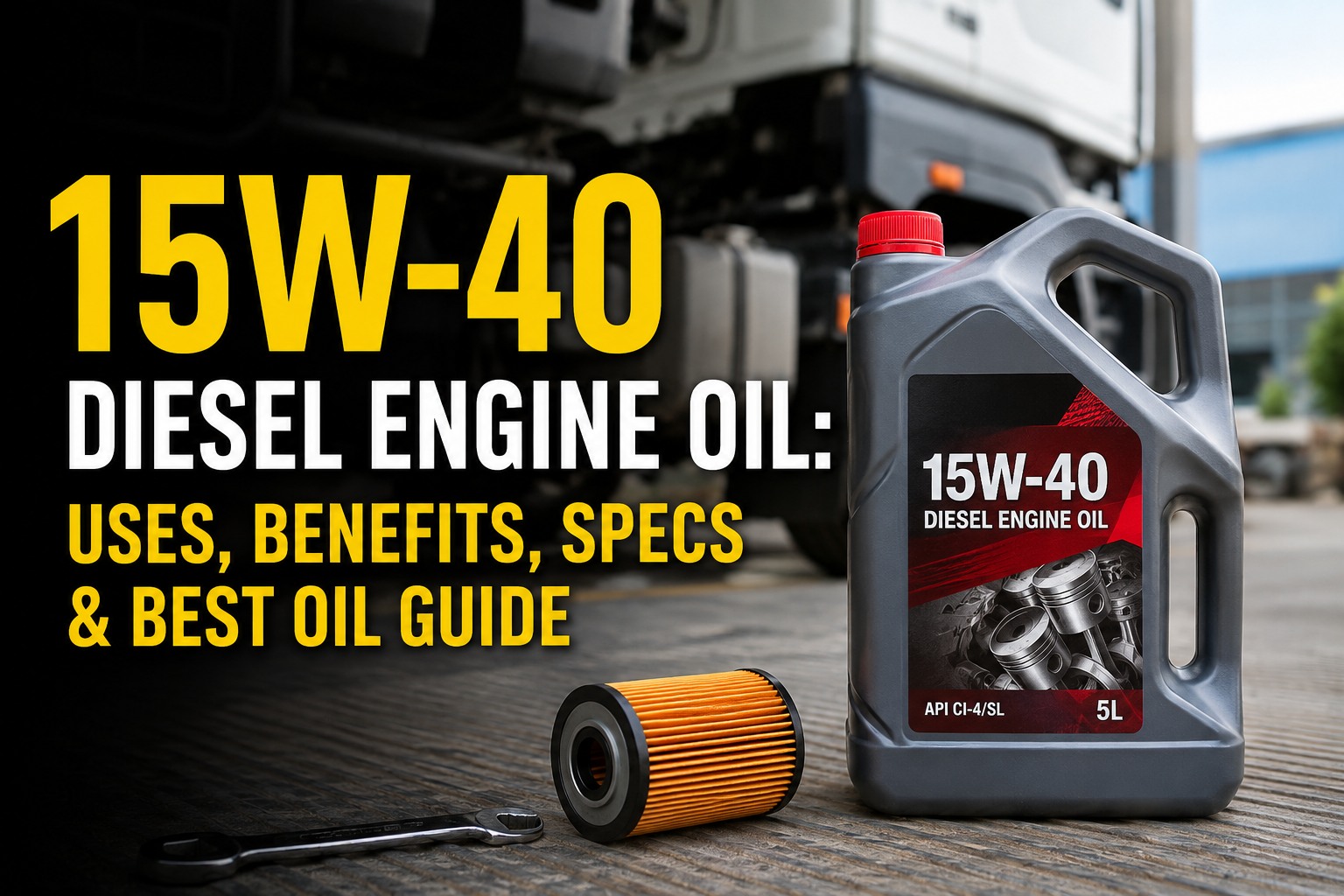
SAE 15W-40 is the workhorse multigrade diesel engine oil of the heavy-duty commercial world — running in the majority of long-haul trucks, delivery fleets, buses, construction equipment, farm tractors, marine engines, and stationary generators across most operating regions. Its dominance is not accidental. The 15W-40 viscosity grade sits at the exact intersection of cold-start protection, high-temperature film strength, wear protection, and emission-system compatibility that modern heavy-duty diesel engines demand — while remaining substantially cheaper than the fully synthetic alternatives. But 15W-40 is not just a viscosity number on a jug. Behind that label sits a stack of API service classifications (CK-4 current, FA-4 alternative, CJ-4/CI-4 backward compatible), ACEA European categories (E9, E7, E4), and a long list of OEM approvals (Cummins CES 20086, Detroit DFS 93K222, Volvo VDS-4.5, Mack EOS-4.5, Renault RLD-4, MB 228.31, Ford WSS-M2C171-F1) that determine whether a given 15W-40 product actually protects a specific engine or invalidates its warranty. This guide walks through what 15W-40 is, where it fits, what specifications matter, how it compares to alternative grades, and how a fleet or facility maintenance team should structure oil-change cadence and product selection. Oxmaint is the CMMS that holds every diesel asset's oil specification, service interval, and change history against the asset record — so a $20,000 to $50,000 engine failure never traces back to the wrong oil or a missed drain. Start a free Oxmaint trial to run diesel engine oil management on the CMMS, or book a demo to see fleet oil change tracking mapped to your diesel assets.
Fleet · Heavy Duty · Diesel Engine Oil Guide
15W-40 Diesel Engine Oil: Uses, Benefits, Specs & Best Oil Guide
SAE 15W-40 viscosity decoded, API and ACEA specifications, OEM approvals, application matrix, oil change intervals, and how to select the right diesel engine oil for your fleet.
-
SAE 15W-40
multigrade viscosity — cold-flow at winter start plus 40-weight protection at operating temperature
-
API CK-4
current heavy-duty diesel service classification — backward compatible with CJ-4, CI-4, CH-4
-
80%
of engine wear occurs at cold startup — where multigrade cold-flow behavior matters most
-
$20K–$50K
typical cost of a single diesel engine failure — the payoff for right oil, right interval, right record
Decoding the Label
What "15W-40" Actually Means on the Bottle
The 15W-40 designation is a Society of Automotive Engineers (SAE) multigrade viscosity code — two numbers describing how the oil behaves at two very different temperatures. Understanding both halves is the starting point for selecting the correct grade for any given diesel engine.
-
15W
Cold Behavior
The "W" stands for winter. 15W measures how easily the oil pumps and flows at cold start. Lower first numbers (5W, 10W) flow at colder temperatures. 15W is suitable down to approximately -20°C ambient — most temperate and warm climates.
-
40
Hot Behavior
The "40" measures viscosity at 100°C — normal engine operating temperature. A "40 weight" oil provides thicker, stronger film protection at operating temperature than a "30 weight" — critical for heavy loading, high loads, and turbocharged diesel engines.
-
Multigrade
Best of Both Worlds
Modern additives allow one oil to behave like a 15W at cold and a 40 at hot — the multigrade concept. Prior to multigrades, seasonal oil changes were required. Now one 15W-40 covers the full year in most operating climates.
Where 15W-40 Is Used
Six Primary Application Categories for 15W-40 Diesel Oil
15W-40 is not a truck-only oil. It runs across the entire heavy-duty diesel operating universe — six application categories cover the vast majority of the market, and each has slightly different service interval and specification requirements.
-
A1
Heavy Trucks & Tractors
Long-haul freight, delivery fleets, dump trucks, mixers. The largest 15W-40 use case globally. Both on-highway and vocational duty.
-
A2
Buses & Coaches
School buses, transit buses, motor coaches, tour buses. Stop-and-go duty, extended idling, high passenger safety consequence.
-
A3
Construction Equipment
Excavators, wheel loaders, bulldozers, articulated trucks, backhoes. Severe duty, dust exposure, tier 4 emission systems.
-
A4
Agricultural Equipment
Tractors, combines, sprayers from John Deere, Case, New Holland, Kubota, Mahindra. Seasonal peak loads, extended storage periods.
-
A5
Marine Diesel Engines
Commercial fishing, workboats, tugs, smaller vessels. Continuous duty, humid environment, water contamination risk.
-
A6
Stationary Generators
Standby generators, prime power gensets, industrial diesel drives. Low-hour high-consequence duty for hospitals, data centers, utilities.
Key Benefits of 15W-40
Five Reasons 15W-40 Dominates Heavy-Duty Diesel Applications
-
B1
Wide Operating Temperature Range
One oil covers cold winter starts to full summer highway load. Suitable across most temperate and warm operating climates without seasonal changes.
-
B2
Strong Wear Protection
40-weight film at operating temperature protects cams, bearings, rings, and cylinder walls under heavy loading. Higher HTHS viscosity than 10W-30 or FA-4.
-
B3
Emission System Compatible
API CK-4 formulation designed for engines with EGR, DPF, and SCR emission systems. Low ash, controlled sulfur, phosphorus limits.
-
B4
Soot Handling
Heavy-duty diesel oils carry high soot loads without viscosity increase. Detergent and dispersant packages engineered specifically for diesel combustion products.
-
B5
Cost Efficiency
Substantially cheaper than fully synthetic alternatives. Fleet-scale economics favor conventional or synthetic-blend 15W-40 unless duty cycle demands otherwise.
Specifications That Matter
The Three Specification Layers Every 15W-40 Product Must Meet
A 15W-40 product is defined by three parallel specification systems — API service categories, ACEA European sequences, and specific OEM approvals. Buying a 15W-40 without checking all three is a warranty gamble.
API Service Categories
American Petroleum Institute heavy-duty diesel categories. CK-4 is current (2017+). Backward compatible with CJ-4, CI-4 PLUS, CI-4, CH-4. FA-4 is a fuel-economy variant for select engines only.
Look for: API CK-4/SN on the label
ACEA European Sequences
Association of European Automobile Manufacturers heavy-duty sequences. E9 for engines with DPF, E7 for engines without DPF but with EGR, E4 for high-performance long-drain applications.
Look for: ACEA E9, E7, or E4
OEM Approvals
Engine manufacturer specific approvals — the most decisive layer for warranty. Cummins CES 20086, Detroit DFS 93K222, Volvo VDS-4.5, Mack EOS-4.5, Renault RLD-4, MB 228.31, Ford WSS-M2C171-F1, MAN M3775, MTU 2.1, CAT ECF-3.
Look for: Your engine OEM in the approval list
The Approval Reality
"Meets API CK-4" Is Not the Same as "Approved for Your Engine"
Relying solely on the API category — without checking for the specific OEM approval like Cummins CES 20086 or Detroit DFS 93K218 — can void engine warranties. Additive packages in "universal" 15W-40 oils may not meet the specific protection requirements for certain cam designs, valve trains, or emission systems. Every 15W-40 asset in the fleet should have its approved oil specification recorded against the asset in the CMMS, so the technician at the pit never grabs the wrong drum.
Grade Comparison
15W-40 vs Other Common Diesel Engine Oil Grades
Where 15W-40 fits — and where it does not — becomes clear against the alternatives. Below is the working grade comparison for fleet and facility teams making the specification call.
| Grade | Cold Reach | Hot Film | Best Application |
|---|---|---|---|
| SAE 15W-40 (CK-4) | Down to -20°C | Strong (HTHS >3.5 cP) | Universal heavy-duty diesel — trucks, buses, construction, farm, marine, gensets |
| SAE 10W-30 (CK-4) | Down to -25°C | Strong (HTHS >3.5 cP) | Cold climate linehaul, modest fuel economy gain over 15W-40 |
| SAE 5W-40 (Synthetic) | Down to -30°C | Strong (HTHS >3.5 cP) | Severe cold operation, extended drain intervals, premium fleets |
| SAE 10W-30 (FA-4) | Down to -25°C | Lower (HTHS 2.9–3.2 cP) | Fuel-economy linehaul, only engines specifically approved for FA-4 |
| SAE 20W-50 | Above -10°C only | Very strong | Older engines, hot climates, high-wear rebuilds |
Oil Change Intervals
Recommended 15W-40 Drain Intervals by Application Type
Drain intervals depend on duty cycle, engine make, oil quality, and — most importantly — used-oil analysis where available. Below are the typical starting points every fleet should adjust downward for severe duty or upward with a sampling program.
-
I1
Long-Haul Highway Trucks
30,000 to 50,000 miles or 500 to 800 engine hours. Extend only with oil analysis confirming TBN reserve.
-
I2
Vocational & Severe Duty
15,000 to 25,000 miles or 300 to 500 hours. Dust exposure, stop-start, heavy load shorten drain.
-
I3
Buses (Urban Transit)
10,000 to 20,000 miles or 300 to 500 hours. Continuous stop-and-go with heavy idling.
-
I4
Construction Equipment
250 to 500 engine hours depending on OEM. Sample-based extension possible in low-dust environments.
-
I5
Farm Equipment
Every 250 to 400 hours or annual — whichever comes first. Seasonal storage drain critical.
-
I6
Standby Generators
Annual regardless of run hours. Oil oxidizes with time even without operation.
Warning Signs
Six Signs the Oil Should Be Changed Before the Scheduled Interval
Not every drain hits the scheduled hours or miles. Six warning signs — from the oil itself, engine behavior, or analysis results — indicate the oil is spent early. Any one of these triggers a work order in Oxmaint.
-
S1
Very Dark, Sooty Oil on Dipstick
All diesel oil darkens quickly. Very black with visible soot suspension well before interval indicates high soot loading or DPF regeneration issue.
-
S2
Viscosity Loss
Fuel dilution or additive shear cause viscosity drop. Oil analysis showing viscosity below the 40-grade window flags immediate change.
-
S3
TBN Depletion
Total Base Number reserve neutralizes acids. TBN below 3.0 mg KOH/g in analysis indicates the alkaline reserve is spent — change immediately.
-
S4
Coolant or Fuel Contamination
Milky appearance, sweet smell, or oil analysis showing glycol or fuel above threshold means an internal engine leak — oil change plus root cause investigation.
-
S5
Metal Wear Spike in Analysis
Iron, copper, lead, aluminum trending upward faster than baseline indicates accelerated wear. Change oil and investigate the wear source.
-
S6
Burnt or Sour Smell
Oil that smells burnt or sharp has oxidized past its useful life. Common on high-idle applications or exhaust-heat exposure. Change immediately.
Choose the Right 15W-40
Five-Step Framework for Selecting the Right 15W-40 for Your Fleet
Fleet-wide oil selection is not a per-truck decision — it is a specification standard applied consistently across all assets sharing the same engine family. Five decision factors drive the choice.
-
01
Confirm the Engine OEM's Approved Specification
Start with the OEM manual. Cummins engines need CES 20086. Detroit needs DFS 93K222. Volvo needs VDS-4.5. Mack needs EOS-4.5. Not API alone — the actual OEM number.
-
02
Match Duty Cycle to Formulation Type
Conventional 15W-40 for standard duty. Synthetic blend for extended drains or severe duty. Full synthetic for cold climates or premium fleets.
-
03
Verify the Ambient Temperature Range
15W-40 covers down to about -20°C. Below that, 10W-30 or 5W-40 protect better at startup where 80% of engine wear occurs.
-
04
Consolidate Suppliers, Not Specifications
One or two approved suppliers reduce cost 10 to 15% versus multi-supplier fragmentation. Never consolidate specifications to save inventory — the wrong oil in the wrong engine costs more than the inventory saved.
-
05
Run an Oil Analysis Program
Regular used-oil sampling on TBN, oxidation, viscosity, wear metals, and contamination tells you when the oil is actually spent — enabling both safe extension and early change when needed.
Built for Fleet Oil Management
How Oxmaint Runs Diesel Engine Oil Management Across the Fleet
-
Asset-Level Oil Spec
Approved 15W-40 Recorded Against Every Diesel Asset
Every engine's approved oil specification — API CK-4, ACEA E9, and specific OEM approval — held against the asset record. Technicians never guess at the pit.
-
Drain Interval PM
Interval Fires by Miles, Hours, or Time
Whichever comes first. Highway truck at 40,000 miles or 12 months. Generator at 12 months regardless of hours. PM triggers automatically per asset class.
-
Oil Analysis Records
Sample Results Held Against the Asset
TBN, oxidation, viscosity, and wear metals trended over time. Threshold breaches raise early-change work orders. Trend history builds asset-specific baselines.
-
Change History
Full Chronology for Every Engine
Complete drain history, product used, filter changed, technician who performed the work. Warranty audits, engine failure investigations, and analysis all draw from one record.
-
Inventory Linked
Oil Stock Consumption Tracked
Bulk 15W-40 drum or tote stock consumption tied to specific work orders. Reorder thresholds trigger before storage runs dry.
-
Warranty Documentation
Every Change Timestamped and Audit-Ready
Engine OEM warranty claims require proof of approved oil at approved intervals. Oxmaint holds the trail complete on every asset.
Frequently Asked
15W-40 Diesel Engine Oil Questions
Can I use API CK-4 15W-40 in an older diesel engine specified for CJ-4 or CI-4?
Yes — API CK-4 is backward compatible with CJ-4, CI-4 PLUS, CI-4, and CH-4. CK-4 was designed as a superset that protects modern emission-system engines while retaining protection for the older engines those categories were built around. The reverse is not true — an older CI-4 or CJ-4 oil should never be used in a new API CK-4 engine, since it will not meet the current emission-system protection requirements. Sign up for Oxmaint to hold approved specification against every diesel engine in your fleet.
Is FA-4 the same as CK-4? Can I substitute one for the other?
No — FA-4 and CK-4 are distinct categories. CK-4 is the standard heavy-duty category with HTHS viscosity above 3.5 cP. FA-4 is a fuel-economy variant with lower HTHS viscosity (2.9 to 3.2 cP), designed for select modern engines specifically approved by their OEM for FA-4. Using FA-4 in a CK-4 engine can cause low oil pressure and bearing damage. Using CK-4 in an FA-4-approved engine is generally safe but forfeits the fuel-economy gain FA-4 was designed to deliver.
Can 15W-40 be used in a gasoline engine?
Modern heavy-duty 15W-40 oils typically carry a dual API rating such as CK-4/SN, meaning they meet current diesel and current gasoline service categories both. In principle they can lubricate a gasoline engine. In practice they are not the optimal choice — gasoline engine oils are formulated around different fuel chemistry, different emission systems, and different service intervals. Use a purpose-built gasoline oil for gasoline engines and reserve 15W-40 CK-4 for diesel service. Book a demo to see Oxmaint's oil specification management.
How often should I change 15W-40 in a standby generator?
Annually, regardless of run hours. Standby generators typically accumulate very few operating hours — sometimes only during monthly load tests and annual exercises. But engine oil oxidizes and absorbs moisture with time, not just with hours. Waiting for an hour-based interval to trigger on a low-usage generator means the oil degrades in storage well before the change fires. Oxmaint schedules annual changes on standby assets independent of hours. Sign up for Oxmaint to run time-based PM cadence on standby diesel gensets.
Specify · Track · Protect
The Right 15W-40 in the Right Engine at the Right Interval — Every Time
A $20,000 to $50,000 diesel engine failure rarely traces to a mystery cause. It traces to the wrong oil in the wrong engine, a missed drain interval, or an oil analysis flag that nobody actioned. Oxmaint is the CMMS that holds every diesel asset's approved 15W-40 specification, fires the drain interval against miles or hours or time, records every sample and every change against the engine, and keeps the full audit trail warranties and insurance require. Right oil, right interval, right record — every asset, every time.