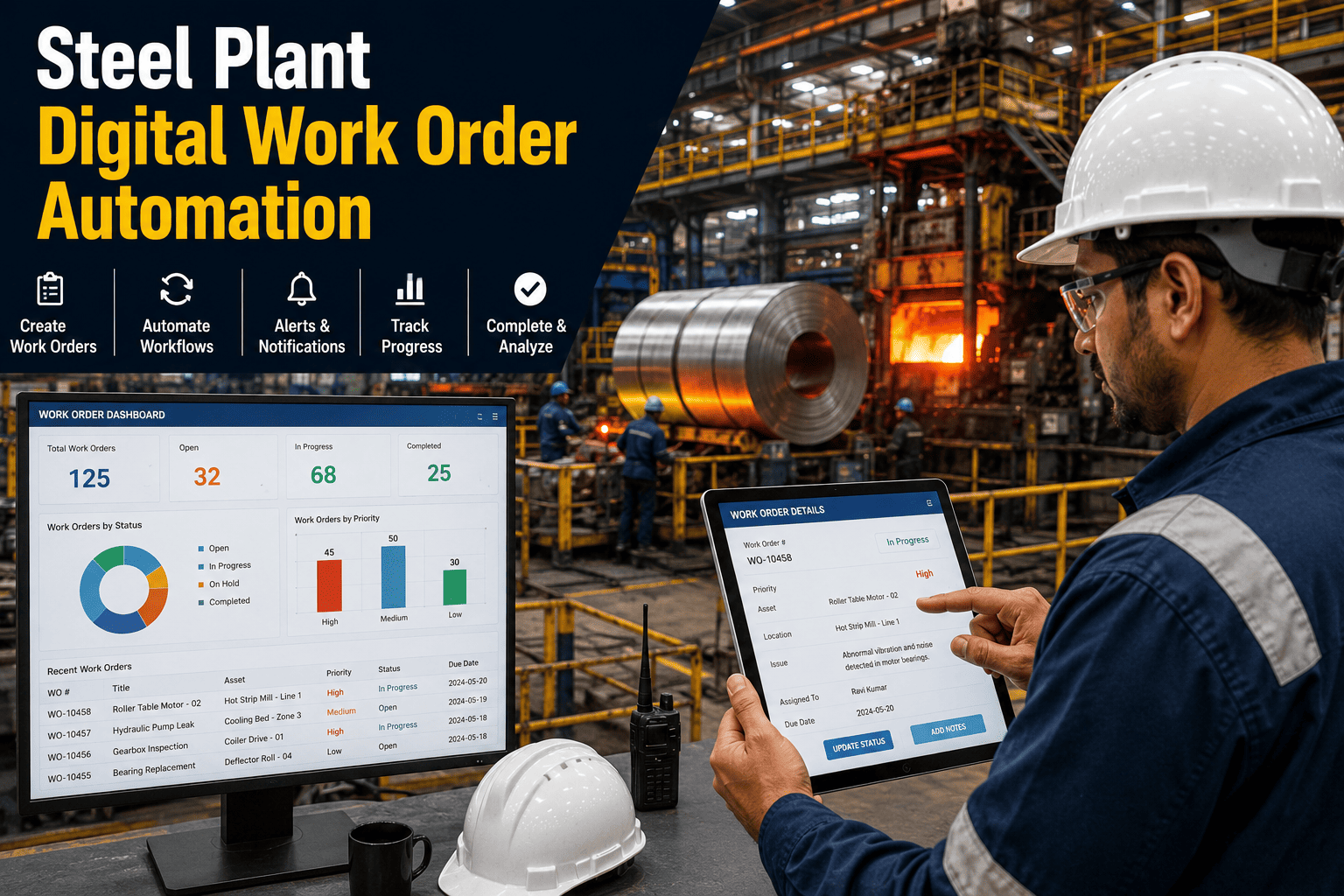
Your maintenance supervisor walks into Monday morning's planning meeting with a concerning update: "We've got 47 open work orders from last week, 12 are past due, and I can't tell you which ones are actually critical because half the paperwork is incomplete." You review the maintenance backlog—156 total work orders scattered across clipboards, spreadsheets and sticky notes—but struggle to prioritize effectively or track real progress. Without automated work order management, your maintenance team wastes 20-30% of their time on administrative tasks instead of actual repairs.
This scenario repeats daily in manufacturing facilities across America as maintenance departments struggle with manual work order processes that create bottlenecks, errors and inefficiencies. The average manufacturing facility loses $50,000-75,000 annually to poor work order management, including delayed repairs, duplicate efforts and missed preventive maintenance.
Organizations implementing automated work order systems through CMMS platforms achieve 40-50% improvements in maintenance efficiency while reducing administrative overhead by 60-70% compared to manual processes. The key lies in understanding automation best practices, selecting appropriate CMMS functionality, and building workflows that eliminate friction while ensuring accountability.
Ready to eliminate maintenance chaos and unlock hidden productivity that your competitors can only dream of? Discover the automation secrets that transform struggling maintenance departments into profit-generating powerhouses.
Start Your TransformationSee Live Demo
Understanding Work Order Automation Fundamentals
Effective work order automation extends far beyond simply digitizing paper forms. Modern CMMS platforms create intelligent workflows that route requests, assign resources, track progress, and generate insights automatically. These systems transform maintenance from reactive firefighting to proactive asset management through data-driven decision making.
Automated work orders eliminate the manual handoffs and information gaps that plague traditional maintenance operations. Instead of maintenance requests disappearing into email threads or getting lost on supervisor desks, automated systems ensure every request gets properly categorized, prioritized, and assigned based on predefined rules and resource availability.
Request Automation
Automatic work order creation from equipment alarms, scheduled inspections, and operator reports. Eliminates manual entry errors and ensures consistent documentation standards.
Intelligent Assignment
Automated technician assignment based on skills, availability, location, and workload. Optimizes resource utilization while ensuring appropriate expertise for each task.
Priority Management
Dynamic priority assignment based on equipment criticality, safety impact, and business priorities. Prevents important work from getting buried in routine tasks.
Progress Tracking
Real-time status updates and milestone tracking without manual reporting. Provides visibility into work completion and identifies bottlenecks automatically.
Parts Integration
Automatic parts reservation and procurement triggers based on work order requirements. Prevents delays due to parts availability issues.
Compliance Documentation
Automated compliance check recording and regulatory documentation generation. Ensures safety procedures are followed and documented consistently.
Integration capabilities determine automation effectiveness more than individual features. Systems that connect with existing ERP, procurement, and production planning platforms create seamless workflows that eliminate duplicate data entry and ensure information consistency across departments.
Mobile accessibility represents a critical automation component often overlooked in planning. Technicians need instant access to work orders, procedures, and documentation while working on equipment, not just when sitting at office computers.
CMMS Implementation Best Practices for Maximum ROI
Successful CMMS implementation requires strategic planning that aligns system capabilities with operational workflows and organizational culture. Technology alone cannot fix broken processes—automation simply makes bad processes faster and more consistent. Effective implementation begins with process optimization followed by technology deployment.
Data standardization provides the foundation for automation effectiveness. Inconsistent equipment naming, unclear priority definitions, and undefined procedures create automation chaos rather than efficiency. Establishing clear standards before system deployment prevents ongoing frustration and ensures meaningful reporting.
| Implementation Phase | Timeline | Key Activities | Success Metrics |
|---|---|---|---|
| Process Analysis | 2-4 weeks | Current state mapping, bottleneck identification | Documented workflows, stakeholder buy-in |
| Data Preparation | 4-6 weeks | Equipment inventory, standardization, cleanup | Complete asset database, naming standards |
| System Configuration | 3-5 weeks | Workflow setup, user roles, automation rules | Configured system matching requirements |
| User Training | 2-3 weeks | Role-based training, procedure documentation | User competency, adoption readiness |
| Pilot Deployment | 4-6 weeks | Limited rollout, issue resolution, refinement | System stability, user satisfaction |
| Full Rollout | 2-4 weeks | Facility-wide deployment, ongoing support | Complete adoption, performance targets met |
Change management often determines implementation success more than technical factors. Maintenance teams comfortable with paper systems may resist digital workflows without proper training and support. Involving key technicians in system selection and configuration builds ownership and reduces resistance.
Phased rollout strategies minimize disruption while allowing learning incorporation. Starting with preventive maintenance work orders before tackling emergency repairs enables teams to learn system functionality during lower-pressure situations.
Integration planning must consider both current and future system requirements. While basic CMMS functionality may meet immediate needs, scalability for predictive maintenance, IoT integration, and advanced analytics ensures long-term value rather than system replacement within 2-3 years.
Measuring Success: KPIs and ROI Tracking
Quantifying work order automation benefits requires establishing baseline metrics before implementation and tracking improvements consistently. Generic industry benchmarks provide context, but meaningful measurement focuses on specific operational improvements aligned with business objectives.
Leading indicators like work order completion rates and response times provide early success signals, while lagging indicators such as equipment reliability and maintenance costs demonstrate long-term value creation. Balanced scorecards incorporating both perspectives enable better decision making and continuous improvement.
Key Performance Measurement Framework
Productivity measurement extends beyond simple work order counts to include quality metrics like first-time fix rates and customer satisfaction scores. Automation that increases work order volume without improving actual maintenance effectiveness provides limited value.
Efficiency Metrics
Work order cycle time, backlog reduction, and administrative time savings demonstrating process improvements
Quality Indicators
First-time fix rates, repeat work percentage, and customer satisfaction measuring work effectiveness
Resource Utilization
Technician productivity, skill matching, and capacity optimization showing resource improvements
Financial Impact
Maintenance cost per unit, emergency repair reduction, and total cost of ownership
Compliance Performance
Safety incident reduction, regulatory compliance rates, and audit performance
Strategic Outcomes
Equipment reliability, production availability, and competitive advantage creation
Financial ROI calculation must include both direct cost savings and indirect benefits like improved production reliability and reduced safety risks. Many organizations discover that indirect benefits exceed direct savings by 2-3x when comprehensively measured.
Continuous improvement requires regular metric review and automation refinement. Initial automation rules may need adjustment as operational patterns become clear and organizational priorities evolve.
Advanced Automation Strategies and Future Technologies
Next-generation work order automation leverages artificial intelligence, machine learning, and IoT integration to create predictive and prescriptive maintenance capabilities. These advanced systems don't just manage work orders—they anticipate maintenance needs and optimize resource allocation automatically.
Predictive work order generation based on equipment condition monitoring and failure pattern analysis enables proactive maintenance before problems impact production. AI algorithms learn from historical data to predict optimal maintenance timing and resource requirements with increasing accuracy.
Advanced Automation Capabilities
- AI-powered predictive work order creation based on equipment condition trends
- Dynamic resource optimization considering skills, location, and real-time availability
- Intelligent parts forecasting and automatic procurement for anticipated maintenance
- Natural language processing for automated work order categorization and routing
- Machine learning algorithms optimizing maintenance schedules and procedures
- IoT integration enabling automatic work order triggers from sensor data
- Augmented reality integration for enhanced technician guidance and documentation
- Blockchain-based compliance tracking ensuring audit trail integrity
Integration ecosystem development connects CMMS platforms with enterprise systems, supplier networks, and industry databases. These connections enable automatic parts pricing updates, vendor performance tracking, and benchmark comparisons that improve decision making.
Mobile-first design principles ensure technicians can complete entire work order lifecycles without desktop access. Advanced mobile capabilities include offline functionality, voice-to-text documentation, and camera integration for visual condition reporting.
Collaborative automation enables seamless handoffs between departments, contractors, and management levels. Work orders automatically escalate based on time thresholds, include relevant stakeholders in communications, and maintain audit trails for accountability.
2025 Technology Trends Shaping Work Order Automation
- Generative AI creating detailed work instructions and troubleshooting guides automatically
- Digital twin integration enabling virtual work order simulation and optimization
- 5G connectivity supporting real-time video collaboration with remote experts
- Edge computing enabling instant decision making without cloud connectivity delays
- Quantum computing optimizing complex resource allocation and scheduling problems
- Sustainability tracking integration measuring environmental impact of maintenance decisions
Vendor ecosystem management becomes critical as automation expands beyond internal operations. Systems that integrate contractor management, vendor performance tracking, and external service coordination create comprehensive maintenance ecosystems.
Cybersecurity considerations grow in importance as work order systems connect with critical infrastructure and contain sensitive operational data. Automation implementations must balance accessibility with security requirements through proper authentication and data protection measures.
Conclusion
Work order automation through CMMS platforms represents a fundamental shift from reactive maintenance management to proactive operational excellence. Successful implementations achieve 40-50% efficiency improvements while reducing administrative overhead by 60-70% through strategic automation of routine tasks and intelligent resource optimization.
Understanding automation fundamentals reveals that technology success depends on process optimization, data standardization, and change management more than software features. Comprehensive automation strategies address request management, assignment optimization, progress tracking, and compliance documentation while maintaining flexibility for operational variations.
Implementation best practices emphasize systematic planning, phased deployment, and user engagement throughout the transformation process. Organizations following structured methodologies achieve 80-90% adoption rates compared to 40-50% for rushed implementations without proper preparation.
Success measurement requires balanced scorecards incorporating efficiency metrics, quality indicators, financial impact, and strategic outcomes. Leading organizations achieve 25-35% better ROI through data-driven optimization compared to those focusing only on basic efficiency improvements.
Advanced automation strategies leveraging AI, machine learning, and IoT integration create predictive capabilities that anticipate maintenance needs and optimize resource allocation automatically. These next-generation systems transform maintenance from cost center to competitive advantage through superior reliability and efficiency.
The 2025 technology landscape offers unprecedented opportunities for maintenance transformation through intelligent automation. Success requires balancing proven automation principles with emerging technologies that enhance rather than complicate operational workflows.
Ready to stop losing thousands monthly to maintenance inefficiencies? Join 500+ manufacturing leaders who've already transformed their operations with proven automation strategies.
Claim Your Competitive EdgeSchedule Strategy Call