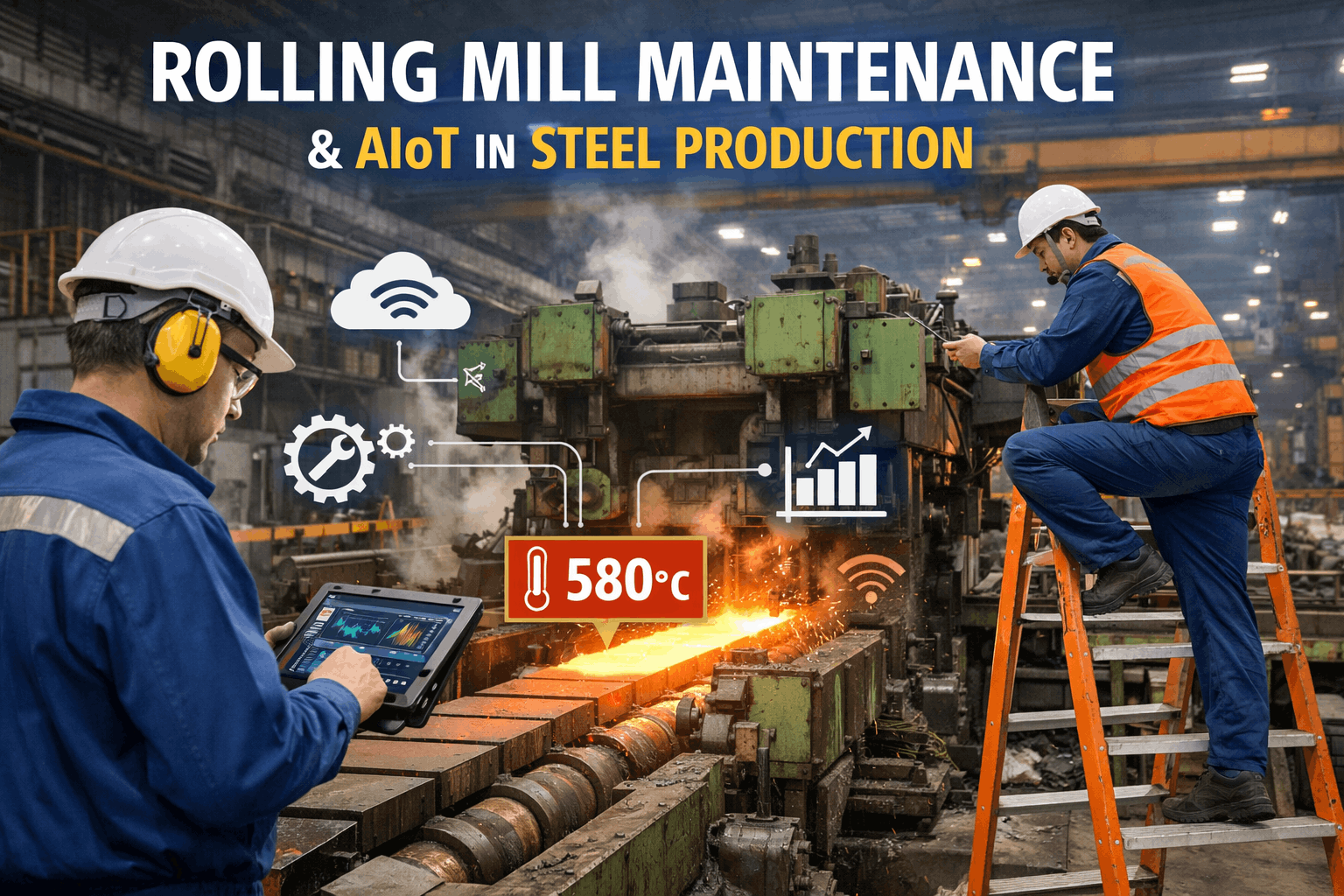
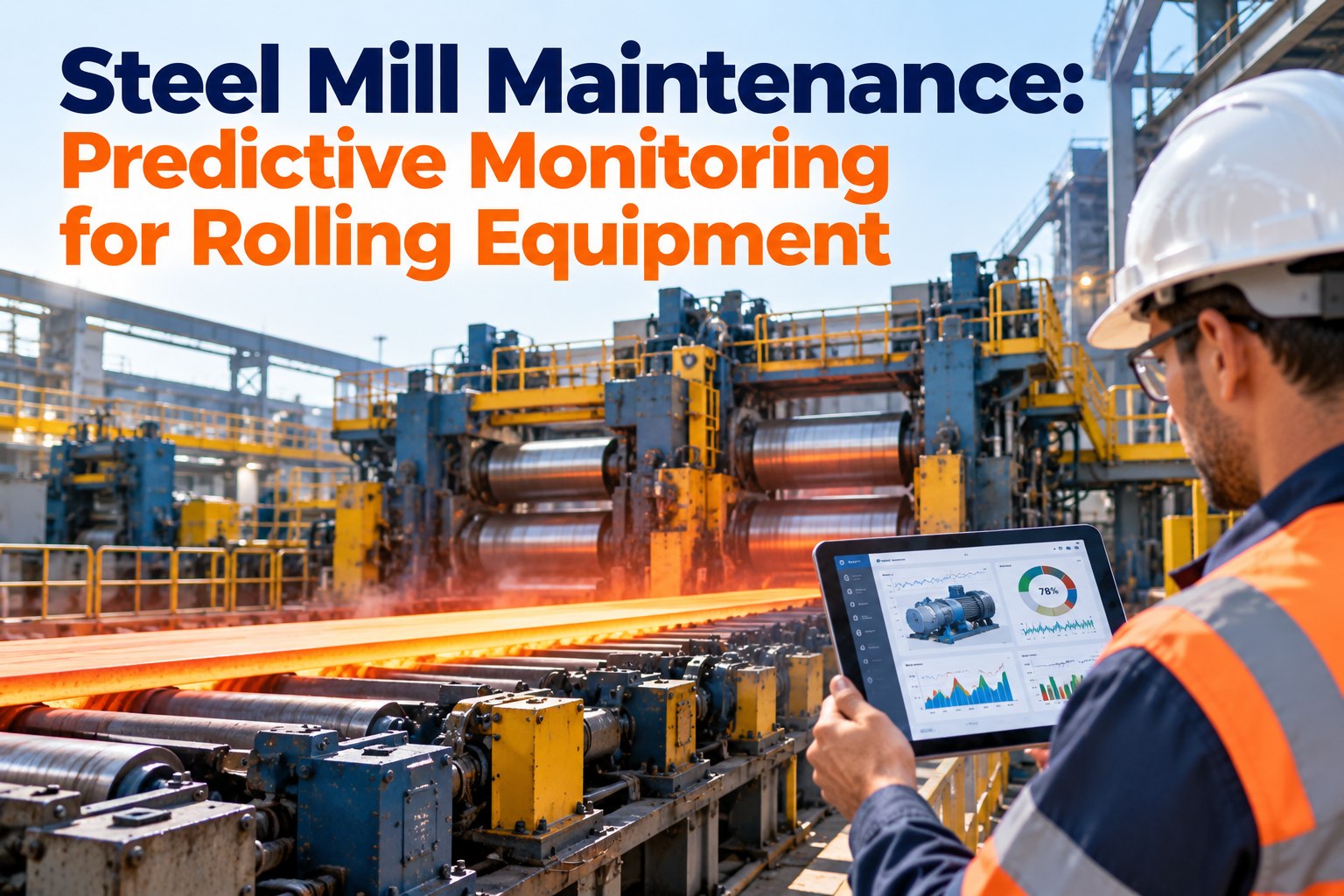
A flat steel producer in Gary, Indiana was losing 14 hours of unplanned downtime per month across its four-stand tandem hot rolling mill — with bearing failures, roll surface degradation, and hydraulic system faults accounting for 78% of all stoppages. Each hour of unplanned downtime cost $38,000 in lost production, energy waste, and reheating penalties. When the plant deployed IoT vibration and temperature sensors on all work roll bearings, backup roll bearings, and main drive gearboxes — feeding data into an AI predictive maintenance platform integrated with their CMMS — unplanned downtime dropped 61%, bearing-related failures decreased 74%, and roll change scheduling shifted from calendar-based to condition-based, extending average roll campaigns by 22%. The metric that justified the capital expenditure was total maintenance cost per ton: the reactive program averaged $4.80/ton in combined maintenance, downtime, and quality losses — the predictive program brought it to $1.90/ton within 14 months. Schedule a demo to see how Oxmaint manages rolling mill maintenance with AI-driven predictive analytics, or sign up now to start tracking your mill assets in minutes.
Why Rolling Mills Demand Predictive Maintenance
Rolling mills are the highest-throughput, most mechanically stressed assets in any steel plant. Work rolls contact strip at temperatures exceeding 1,000°C in hot mills, absorbing forces up to 25,000 kN per stand while rotating at surface speeds above 15 m/s. Cold mills operate at tighter tolerances with rolling forces that create sub-micron surface finish requirements. In both environments, the gap between a healthy bearing and a catastrophic failure can close in hours — and a single undetected fault cascades into strip breaks, roll damage, guide failures, and hours of lost production. Traditional calendar-based maintenance either over-services healthy components or misses rapidly developing faults. AI and IoT close that gap.
61%
reduction in unplanned rolling mill downtime with IoT-monitored predictive maintenance
74%
fewer bearing-related failures through AI vibration analysis and thermal trending
$1.90
per-ton maintenance cost vs. $4.80/ton under reactive programs — 60% reduction
Your mill runs 8,000+ hours per year — every unplanned stop costs $38K+. Oxmaint manages every roll stand, drive system, and hydraulic circuit in one platform with condition-based PMs and real-time health monitoring.
Critical Rolling Mill Subsystems for IoT Monitoring
Each mill type — hot strip, cold reduction, plate, section, and bar — creates distinct failure modes and maintenance requirements. But across all configurations, these subsystems account for 85%+ of all unplanned downtime and must be monitored independently with dedicated sensor arrays and AI failure models.
Work Roll Bearings & Chocks
Four-row tapered roller bearings operating at 50–200 RPM under 15,000–25,000 kN rolling force. IoT vibration (accelerometer + velocity), temperature, and oil film thickness sensors detect inner race spalling, cage wear, and lubrication starvation 2–6 weeks before failure. Failure cost: $80K–$250K per event including roll damage.
Main Drive Systems — Motors & Gearboxes
2,000–8,000 kW drive motors through herringbone or planetary gearboxes delivering torque to spindles. Current signature analysis detects rotor bar faults, while vibration monitoring catches gear tooth wear, pinion misalignment, and coupling degradation. Failure cost: $150K–$500K+ with 48–120 hour repair windows.
Hydraulic Screw-Down & AGC Systems
Servo-hydraulic cylinders controlling roll gap to ±0.01mm at response rates under 10ms. IoT monitors hydraulic pressure pulsation, servo valve spool position, oil particulate count, and cylinder seal leakage. Degradation causes strip thickness variation before catastrophic failure. Failure cost: $40K–$120K plus off-gauge production losses.
Roll Surface & Profile Management
Work roll surface roughness degrades from Ra 0.8μm to Ra 3.0μm+ during a campaign — affecting strip surface quality, friction coefficient, and rolling force. AI tracks surface degradation rate against tons rolled, strip grade mix, and coolant condition to predict optimal roll change timing. Over-running: quality defects. Under-running: wasted roll grinding capacity.
How AI Optimizes Rolling Mill Maintenance Scheduling
AI-powered maintenance does not simply replace calendar dates with sensor readings — it builds a dynamic failure probability model for every subsystem that continuously updates based on operating conditions, production mix, environmental factors, and maintenance history. Book a demo to see how predictive scheduling integrates with Oxmaint's work order workflows.
1
Continuous Sensor Data Ingestion
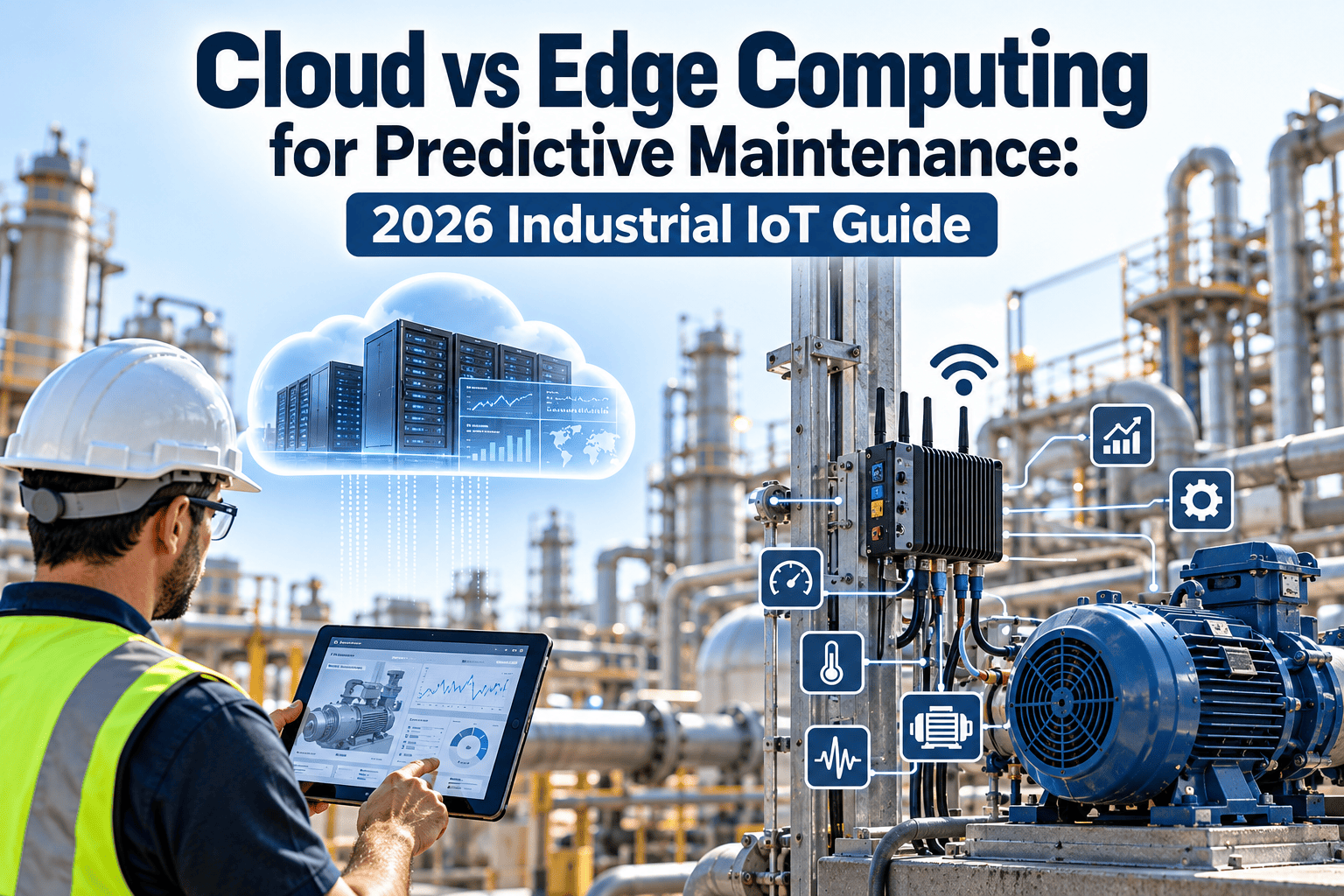
Vibration (triaxial accelerometers at 20kHz sampling), temperature (bearing housings, oil return, cooling water), hydraulic pressure, motor current, and roll force data streams into the AI platform at 1–10 second intervals per sensor. Edge computing at the mill stand pre-processes raw signals into frequency spectra, RMS trending, and anomaly flags before cloud transmission.
2
AI Pattern Recognition & Failure Modeling
Machine learning models trained on historical failure data identify early-stage fault signatures — bearing inner race defect frequencies, gear mesh harmonics, hydraulic servo valve spool stiction, and motor current imbalance patterns. Each subsystem gets a continuously updated remaining useful life (RUL) projection calibrated against your specific mill's operating profile.
3
Production-Aware Work Order Generation
When a subsystem's failure probability crosses the intervention threshold, the platform auto-generates a CMMS work order with the specific fault diagnosis, recommended repair action, required parts, and estimated repair duration — then schedules it during the next planned production gap, grade change, or roll change window to minimize throughput impact.
4
Closed-Loop Feedback & Model Refinement
Every completed work order feeds back into the AI model — confirming or correcting the diagnosis, updating failure progression curves, and refining RUL projections. Models improve with each maintenance event, achieving 90%+ prediction accuracy within 6–12 months on established fault patterns. False positive rates drop below 5% as the system learns your mill's specific behavior.
Schedule a free demo with our steel industry specialists. We will show you how Oxmaint automates predictive work orders, tracks roll campaigns, and reduces mill downtime for your specific rolling configuration.
Deploying IoT sensors on a rolling mill is not a single-technology exercise — it requires a layered architecture where each sensor type addresses a specific failure mode and feeds a dedicated AI model. The mills achieving 96%+ availability deploy sensors against operating conditions, not sensor catalogs.
Vibration — Triaxial Accelerometers & Velocity SensorsMounted on bearing housings, gearbox casings, and motor frames. 20kHz sampling captures bearing defect frequencies (BPFO, BPFI, BSF, FTF), gear mesh harmonics, and structural resonance. Detects faults 2–8 weeks before functional failure. Install: every bearing position + every gearbox.
Temperature — RTDs, Thermocouples & IR PyrometersBearing housing RTDs detect lubrication failure and overload. Oil return temperature reveals gearbox internal heating. IR pyrometers monitor strip temperature profile across width for process correlation. Temperature rise rate is often the first detectable symptom of bearing distress.
Hydraulic Health — Pressure, Flow & ParticulateHigh-frequency pressure transducers on AGC cylinders detect servo valve degradation and seal leakage. Online particle counters monitor oil cleanliness to ISO 4406 standards. Flow sensors verify cooling and lubrication delivery rates. Hydraulic faults degrade product quality before causing mechanical failure.
Motor Current Signature Analysis (MCSA)Non-invasive current clamps on main drive motors detect rotor bar cracks, air gap eccentricity, stator winding degradation, and mechanical load imbalance — all from the electrical signature without additional mechanical sensors. Particularly effective on 2,000+ kW mill motors where access for vibration sensors is limited.
Roll Force & Torque — Load Cells & Strain GaugesRolling force measurement per stand detects roll profile degradation, bearing wear, and asymmetric loading. Torque monitoring on spindles identifies coupling wear and universal joint degradation. Force deviations from model predictions indicate developing mechanical problems or process upsets requiring maintenance intervention.
Rolling Mill Performance Metrics That Matter
Tracking the right KPIs across your rolling mill transforms maintenance from guesswork into data-driven decision-making. Here are the critical metrics every mill maintenance manager should monitor in their CMMS.
96%+
Mill Availability
Scheduled production hours vs. actual production hours — directly correlates to annual tonnage and revenue
$1.90/t
Maintenance Cost/Ton
Total maintenance spend per ton rolled — predictive programs target sub-$2.00 vs. $4.50+ reactive
<4 hrs
MTTR
Mean time to repair — measures diagnostic speed, parts availability, and crew response effectiveness
+22%
Roll Campaign Length
Condition-based roll changes extend campaigns vs. calendar-based — more tons per grind cycle
<0.3%
Quality Reject Rate
Maintenance-related surface and gauge defects — directly linked to bearing, hydraulic, and roll condition
14 mo
ROI Payback
Time to recover IoT + AI investment through downtime reduction, quality improvement, and maintenance savings
Create your free Oxmaint account and start tracking today. Register every mill stand, drive system, and hydraulic circuit as a tracked asset, configure condition-based PMs, and build your mill dashboard in minutes.
Calendar-Based vs. AI Predictive Rolling Mill Maintenance
The difference between managing a rolling mill with fixed-interval maintenance versus an AI-integrated predictive program is the difference between reacting to catastrophic failures and preventing them weeks in advance.
Calendar-Based / Reactive Maintenance
$4.80/ton total maintenance cost including downtime and quality losses
Bearing failures account for 40%+ of all unplanned mill stoppages
Roll changes on fixed schedules — either too early (waste) or too late (defects)
Hydraulic faults detected only when product quality degrades visibly
14+ hours/month unplanned downtime at $38K+ per hour
82–88% typical mill availability
AI Predictive + Oxmaint CMMS
$1.90/ton with CMMS-integrated predictive maintenance programs
Roll changes triggered by surface condition data — 22% longer campaigns
Hydraulic degradation caught at servo valve level before quality impact
5.5 hours/month unplanned downtime — 61% reduction from baseline
96%+ mill availability with predictive PMs
Bring Your Entire Rolling Mill Under One Platform
Oxmaint manages every stand, drive, hydraulic system, roll shop, and auxiliary circuit in a single platform — with condition-based work orders from IoT sensors, AI-driven roll change optimization, bearing lifecycle tracking, spare parts management, and mill-wide analytics that connect maintenance discipline directly to production throughput and product quality.
Most steel plants achieve full predictive rolling mill integration within 16–24 weeks when sensor deployment, CMMS configuration, and AI model training are executed in parallel with ongoing production. Schedule a demo and our team will map this roadmap to your specific mill configuration and production schedule.
Weeks 1–4
Mill Assessment & Sensor Design
Map all critical subsystems — bearings, drives, hydraulics, rolls, auxiliaries. Identify highest-downtime failure modes from historical data. Design sensor placement, edge computing architecture, and data integration with existing Level 1/Level 2 systems. Define spare parts and installation requirements.
Weeks 5–12
Sensor Install & CMMS Configuration
Install vibration, temperature, hydraulic, and motor monitoring sensors during planned shutdowns. Register every subsystem in Oxmaint with parent-child asset hierarchy. Configure condition-based PM triggers, spare parts catalog with min/max levels, and work order workflows for mill maintenance crews.
Weeks 10–18
AI Model Training & Baseline Capture
AI ingests 8–12 weeks of sensor data under normal operating conditions to establish baseline signatures for each subsystem. Historical failure data from CMMS supplements live data to accelerate model training. Initial fault detection alerts begin generating — validated against field inspection before auto-generating work orders.
Weeks 18–24
Production Ramp & Model Optimization
Full predictive maintenance operational across all monitored subsystems. Calibrate AI models against confirmed failure events and maintenance outcomes. Optimize roll change scheduling, bearing replacement intervals, and hydraulic service timing. Build mill-wide dashboards connecting maintenance metrics to production KPIs.
Best Practices for Rolling Mill Predictive Maintenance
Based on successful AI and IoT deployments across hot strip, cold reduction, plate, and long product rolling mills, here are the practices that separate high-performing maintenance programs from those struggling with persistent mill downtime.
01
Register Every Subsystem as a Separate Asset
Do not track "Mill Stand 3" as a single asset. Register the work roll bearings, backup roll bearings, drive motor, gearbox, spindle coupling, hydraulic AGC cylinder, servo valves, and roll coolant nozzles as independent child assets — each with its own failure mode library, PM schedule, and sensor data feed.
02
Integrate Roll Shop & Mill Floor Maintenance
Roll grinding, surface inspection, and chock maintenance in the roll shop must be linked to mill production data. AI tracks surface degradation rate per grade mix, coolant condition, and rolling force — predicting when the current campaign will reach the quality threshold and triggering roll shop preparation in advance.
03
Pre-Position Critical Spares by Failure Probability
Bearing sets, servo valves, spindle components, and gearbox assemblies have 6–16 week lead times. Use AI failure probability to trigger spare parts procurement well before the intervention date — not after the failure. A $12K bearing set on the shelf prevents a $250K+ unplanned stop.
04
Schedule Predictive Work During Grade Changes
Grade changes, width changes, and scheduled roll changes already require production interruptions. AI work order scheduling aligns predictive maintenance with these planned windows — capturing maintenance time inside production gaps that already exist, rather than creating additional stops.
The biggest shift was not the technology — it was the mindset change from fixing what broke yesterday to preventing what will break next week. When maintenance crews see the AI diagnosis confirmed on disassembly, they stop questioning the sensors and start trusting the schedule. That trust is what drives 96% availability.
— Rolling Mill Maintenance Manager, Integrated Steel Producer, Great Lakes Region
Your Mill Rolls Steel 8,000 Hours a Year. Your Maintenance System Should Predict Every Fault.
Oxmaint gives your maintenance team complete visibility into every roll stand, drive system, hydraulic circuit, and auxiliary subsystem across your rolling mill. From AI-driven predictive work orders and roll campaign optimization to bearing lifecycle tracking and spare parts management — everything lives in one mobile-friendly platform built for the demands of steel production.
Can IoT sensors survive the extreme environment of a hot rolling mill?
Yes — but sensor selection and mounting design are critical. Industrial-grade vibration sensors rated to 125°C operate reliably on bearing housings and gearbox casings that are shielded from direct radiant heat. For positions near the roll bite where ambient temperatures exceed 80°C, sensors with thermal isolation mounts, heat shields, and extended cables are standard. Temperature sensors (RTDs and thermocouples) are inherently designed for extreme heat. The key is placing sensors on the mechanical components (bearings, gearboxes, motors) — not on the strip itself. Book a demo to discuss sensor architecture for your specific mill environment.
How does AI predict bearing failure in rolling mill applications?
AI analyzes vibration frequency spectra to detect characteristic bearing defect frequencies — BPFO (outer race), BPFI (inner race), BSF (ball spin), and FTF (cage) — that appear as the bearing develops spalling, pitting, or lubrication degradation. The model also tracks temperature trending, oil film thickness, and rolling force asymmetry as confirming indicators. By comparing current signatures against the learned degradation curve for each specific bearing position, the AI projects remaining useful life with increasing confidence as the fault develops. Typical detection: 2–8 weeks before functional failure.
How does Oxmaint differ from our existing Level 1/Level 2 automation?
Level 1 and Level 2 systems control the rolling process — gap settings, speed, tension, temperature. They are designed for real-time process control, not maintenance management. Oxmaint is the maintenance layer that sits alongside L1/L2: it ingests sensor data (including from L1/L2 process variables), builds failure prediction models, generates maintenance work orders, tracks spare parts, manages roll campaigns, and provides maintenance KPI dashboards. When L2 reports a roll force deviation, Oxmaint already has the work order created with the diagnosed root cause, parts, and scheduled repair window. Sign up free to start building your mill maintenance program alongside your existing automation.
What ROI should we expect from predictive rolling mill maintenance?
Most steel plants see payback in 12–18 months based on downtime reduction (61% fewer unplanned stops at $38K+/hour), maintenance cost per ton improvement ($4.80 → $1.90/ton), quality reject reduction (fewer surface and gauge defects from equipment degradation), and roll campaign extension (22% more tons per grind cycle). A four-stand hot strip mill typically recovers the full IoT and AI investment from prevented bearing failures alone within the first year — each avoided catastrophic bearing event saves $80K–$250K in direct repair plus lost production.
Can we start with one mill stand before deploying across the entire line?
Yes — and most plants do. The recommended approach is to instrument the highest-downtime stand first (typically the finishing stands in a hot strip mill or the final stand in a cold mill), prove the predictive model on real failures, then expand systematically. Oxmaint's asset hierarchy supports incremental deployment — add stands, drives, and auxiliaries as budget and shutdown windows allow. Each stand added improves the AI model for the entire mill because failure patterns correlate across similar equipment operating in the same environment.
By Oxmaint
✨
Experience Oxmaint's Power
Take a personalized tour with our product expert to see how OXmaint can help you streamline your maintenance operations and minimize downtime.