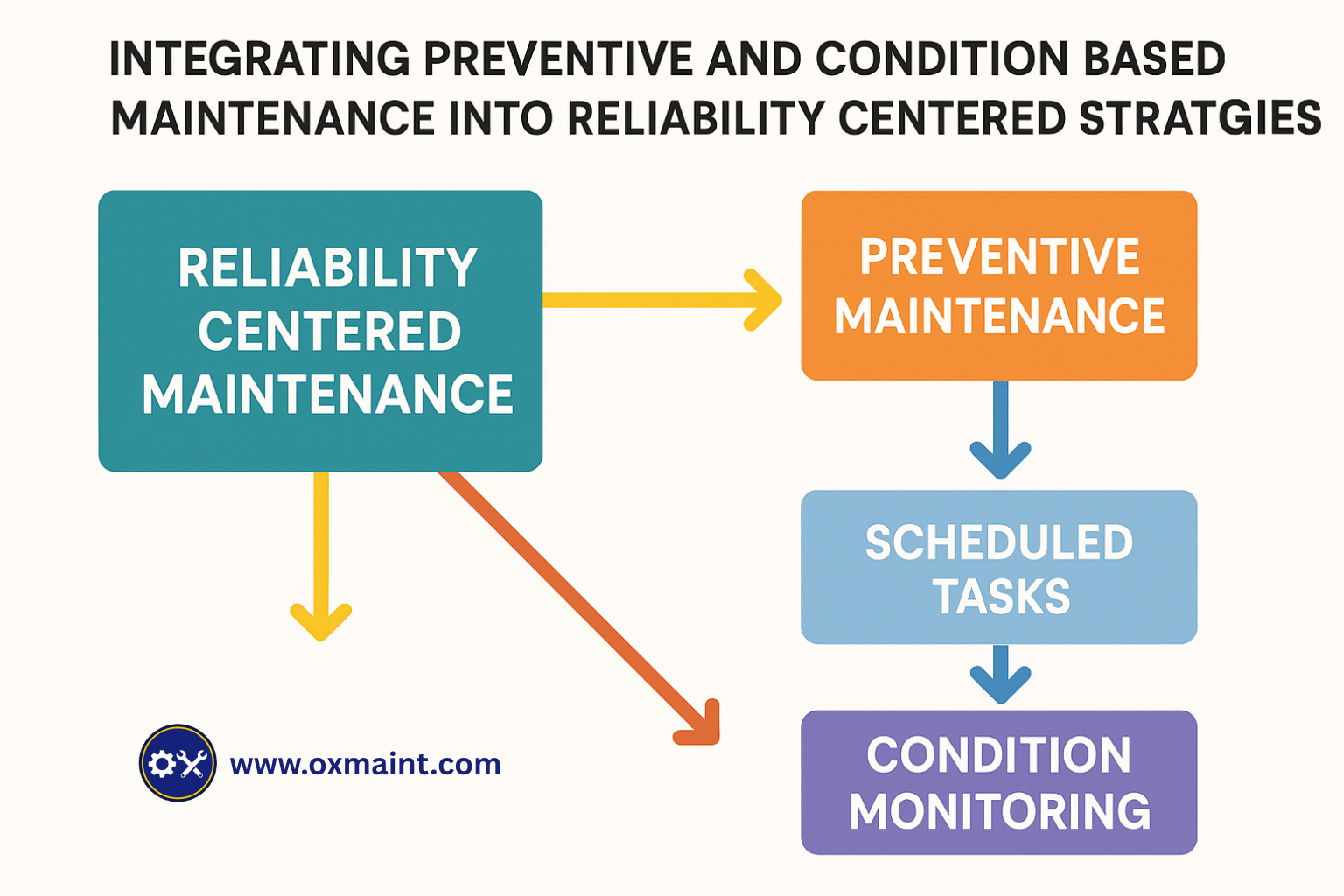
Reliability centered maintenance in renewable energy is the structured process of identifying how turbines, inverters, trackers, and balance-of-plant assets fail, and matching each failure mode to the right maintenance strategy—run-to-failure, time-based PM, condition monitoring, or redesign—to cut unplanned downtime and lower total cost of ownership. A well-executed renewable energy reliability program moves teams from reactive firefighting to predictive asset management, extending equipment life while protecting energy yield. This guide walks through the seven classic RCM questions, failure-mode mapping, and how to launch a pilot project on your most critical assets. Ready to replace spreadsheets with a CMMS built for reliability? Start Free Trial and configure your asset hierarchy today.
RCM IMPLEMENTATION GUIDE
What if you could prevent 70% of unplanned renewable energy failures before they happen?
Renewable energy reliability centered maintenance (RCM) shifts maintenance teams from reactive firefighting to engineered prevention. Identify critical failure modes, select the right maintenance strategy for each asset, and scale a plant-wide reliability program that protects energy yield and lowers total maintenance cost.
is preventable with a structured RCM strategy aligned to ISO 55000 asset management principles.
The 7 Questions of RCM
How to build a renewable energy reliability program using the seven RCM questions
A renewable energy reliability program built on RCM principles answers seven structured questions for every critical asset. This systematic approach—rooted in SAE JA1011 standards—ensures you are applying the right maintenance strategy to the right failure mode, eliminating wasted PM hours while reducing catastrophic breakdowns.
Define Asset Functions
Map what the asset must do and at what performance level. A wind turbine must generate rated power in wind speeds of 3–25 m/s; a solar inverter must convert DC to AC at 98% efficiency. Establishing primary and secondary functions sets the baseline for failure detection.
Identify Functional Failures
Determine how the asset can fail to perform its functions. A tracker motor seizing is a total loss of positioning function; an inverter derating by 15% due to overheating is a partial functional failure that silently drains energy yield.
Determine Failure Modes
Identify the specific physical events that cause each functional failure—bearing degradation, grid voltage transients, soiling accumulation, or gearbox lubrication breakdown. OxMaint’s failure-mode libraries link these directly to work order histories.
Describe Failure Effects
Document what happens when the failure occurs: loss of production, safety hazards, environmental risk, and secondary damage to adjacent components. A failed generator bearing can cascade into a $250K generator rewind if not caught early.
Assess Failure Consequences
Classify the impact as safety, environmental, operational, or non-operational. RCM in renewable energy prioritizes failure modes that trigger safety incidents or massive energy revenue loss over those with minor, localized effects.
Select Maintenance Tasks
Choose the right strategy: on-condition monitoring, scheduled restoration, scheduled discard, failure-finding, or run-to-failure. Condition-based monitoring via vibration and thermal sensors often wins for high-criticality rotating equipment.
Implement & Validate
Roll out tasks as PM triggers inside your CMMS, measure the reduction in unplanned downtime over 90 days, and adjust intervals based on actual asset condition data and work order history.
Failure Mode Analysis
Top renewable energy failure modes and the best maintenance strategy for each
Not every component deserves a preventive maintenance task. Applying the wrong strategy wastes labor budget and can actually induce failures through intrusive inspections. Use this RCM decision matrix to align your renewable energy failure prevention tactics with the correct maintenance approach.
| Asset & Component | Primary Failure Mode | Failure Consequence | Best RCM Strategy |
|---|---|---|---|
| Wind Turbine Gearbox | Bearing pitting / lubrication degradation | $300K+ replacement, 3-week downtime | Condition Monitoring (Oil / Vibration) |
| Solar Inverter (Central) | Capacitor aging / IGBT thermal stress | 15% yield derating, sudden grid trip | Condition Monitoring (Thermal) |
| PV Tracker Motor / Actuator | Mechanical seizure, moisture ingress | Row misalignment, 5% daily yield loss | Time-Based PM (Scheduled Lubrication) |
| HV Transformer | Insulation breakdown, dissolved gas | Catastrophic fire, total plant outage | Predictive (DGA) + Scheduled Restoration |
| SCADA Communication Gateway | Hardware crash, network drop | Blind operation, reporting gaps | Run-to-Failure (Rapid Switchover) |
| Cable Connections / Combiner Box | Thermal cycling, arc flash | Fire risk, localized string failure | Infrared Thermography (On-Condition) |
Worked Example: A 200MW solar plant spending $48K annually on quarterly thermal inspections identified 12 overheating combiner boxes in the first quarter. By shifting to condition-based IR scanning via OxMaint analytics, they cut unplanned string failures by 85% and reduced inspection labor by 30 hours per quarter.
RCM Implementation Timeline
How to launch an RCM renewable energy pilot project in 90 days
Do not attempt to apply RCM across an entire renewable portfolio simultaneously. A targeted 90-day pilot on your top 5–10 critical assets proves ROI, builds team confidence, and creates a repeatable template for scaling your renewable energy maintenance strategy.
Criticality Analysis & Asset Selection
Select 5–10 high-impact assets (e.g., main wind turbines, central inverters). Build a mirrored asset hierarchy in OxMaint. Score criticality based on safety risk, revenue impact, and redundancy. Identify historical failure data from past work orders to establish baseline unplanned downtime metrics.
FMEA & Strategy Assignment
Conduct Failure Mode and Effects Analysis (FMEA) on selected assets. Map each failure mode to the optimal strategy: condition monitoring, time-based PM, or run-to-failure. Configure PM triggers inside OxMaint based on runtime hours, sensor thresholds, or calendar intervals.
Execute, Measure & Scale
Execute the new maintenance plan. Track mean time between failures (MTBF), wrench time, and energy availability. Compare against the pre-RCM baseline. Present the downtime reduction and cost savings data to stakeholders, then scale the pilot to the next tier of critical plant equipment.
Maintenance Optimization
Renewable energy maintenance optimization: Calculating RCM ROI
RCM benefits in renewable energy operations must be quantified to secure ongoing stakeholder buy-in. The core formula for maintenance optimization compares the cost of proactive tasks against the avoided cost of unplanned downtime and emergency repairs. A well-run RCM program typically yields a 300% to 500% ROI within the first 12 to 18 months.
Consider a 150MW wind farm with an energy value of $45/MWh. If RCM prevents just two major gearbox failures per year (saving $600K in repairs and 14 days of downtime worth $226K in lost energy), the gross avoided cost is $826K. Subtracting $120K for enhanced condition monitoring and PM execution yields a net savings of $706K—representing a clear, quantifiable renewable energy downtime reduction.
OxMaint Platform
How OxMaint powers your renewable energy asset reliability program
OxMaint is an AI-powered CMMS and EAM platform engineered to operationalize RCM. From mapping asset hierarchies to triggering condition-based work orders, OxMaint eliminates the spreadsheet chaos that stalls renewable energy maintenance best practices and turns your RCM analysis into automated, trackable action.
Asset Hierarchies & Failure Libraries
Mirror your exact plant structure—from wind farm to turbine, nacelle, and generator. OxMaint links standard failure-mode libraries directly to assets and work orders, giving you actionable reliability analytics without manual data mining.
Condition-Based PM Triggers
Move beyond calendar-based maintenance. OxMaint triggers PM work orders based on runtime hours, sensor thresholds, or predictive AI alerts, ensuring tasks are only performed when the asset condition actually warrants intervention.
Automated Work Order Execution
Eliminate paper work orders. OxMaint dispatches mobile work orders to technicians with attached failure history, OEM manuals, and safety procedures, increasing wrench time by up to 25% and ensuring RCM tasks are executed correctly.
Reliability Analytics & KPI Dashboards
Prove your RCM program works. OxMaint dashboards track MTBF, MTTR, energy availability, and PM compliance in real-time, allowing reliability managers to demonstrate downtime reduction and secure ongoing program funding.
See OxMaint on your assets—book a 30-minute demo
Discover how fast you can deploy an RCM-driven maintenance strategy across your renewable energy portfolio. Our reliability engineers will map your critical assets to the OxMaint platform live.
Frequently Asked Questions
RCM in renewable energy: Common questions answered
What is reliability centered maintenance in renewable energy?
Reliability centered maintenance (RCM) in renewable energy is a systematic process used to determine the optimal maintenance strategy for wind, solar, and energy storage assets. By analyzing how equipment fails and the consequences of those failures, RCM ensures that condition monitoring, preventive maintenance, and run-to-failure strategies are applied exactly where they protect energy yield and reduce total cost.
How long does it take to implement an RCM pilot project?
A targeted RCM renewable energy pilot project typically takes 90 days. The first month focuses on asset criticality and hierarchy mapping, the second on Failure Mode and Effects Analysis (FMEA), and the third on executing condition-based tasks and measuring downtime reduction. You can Book a Demo to see how OxMaint accelerates this timeline.
What are the main benefits of RCM for a solar or wind plant?
The primary RCM benefits in renewable energy include a 30–50% reduction in unplanned downtime, a 20% decrease in overall maintenance costs, and a 2–5% increase in net energy yield. By preventing catastrophic failures on high-value assets like wind turbine gearboxes and central inverters, RCM directly protects the plant's revenue stream and extends asset operational life.
How does RCM differ from standard preventive maintenance?
Standard preventive maintenance (PM) relies on fixed calendar or runtime intervals, which can result in over-maintaining healthy assets and under-maintaining degrading ones. RCM is a decision-based framework that uses failure mode analysis and condition monitoring data to trigger maintenance only when specific thresholds are met, optimizing labor hours and reducing invasive inspections.
Can a CMMS software support renewable energy RCM implementation?
Yes, an AI-powered CMMS like OxMaint is essential for scaling RCM. It mirrors your asset hierarchy, links failure-mode libraries to automated work orders, triggers PMs based on sensor data, and tracks reliability KPIs like MTBF. You can Start Free Trial to configure your plant hierarchy and replace reactive spreadsheets immediately.
Stop reacting to breakdowns. Start engineering reliability.
Deploy OxMaint to map failure modes, automate condition-based work orders, and drive a measurable renewable energy downtime reduction across your entire portfolio.
Free 14-day trial · No credit card required