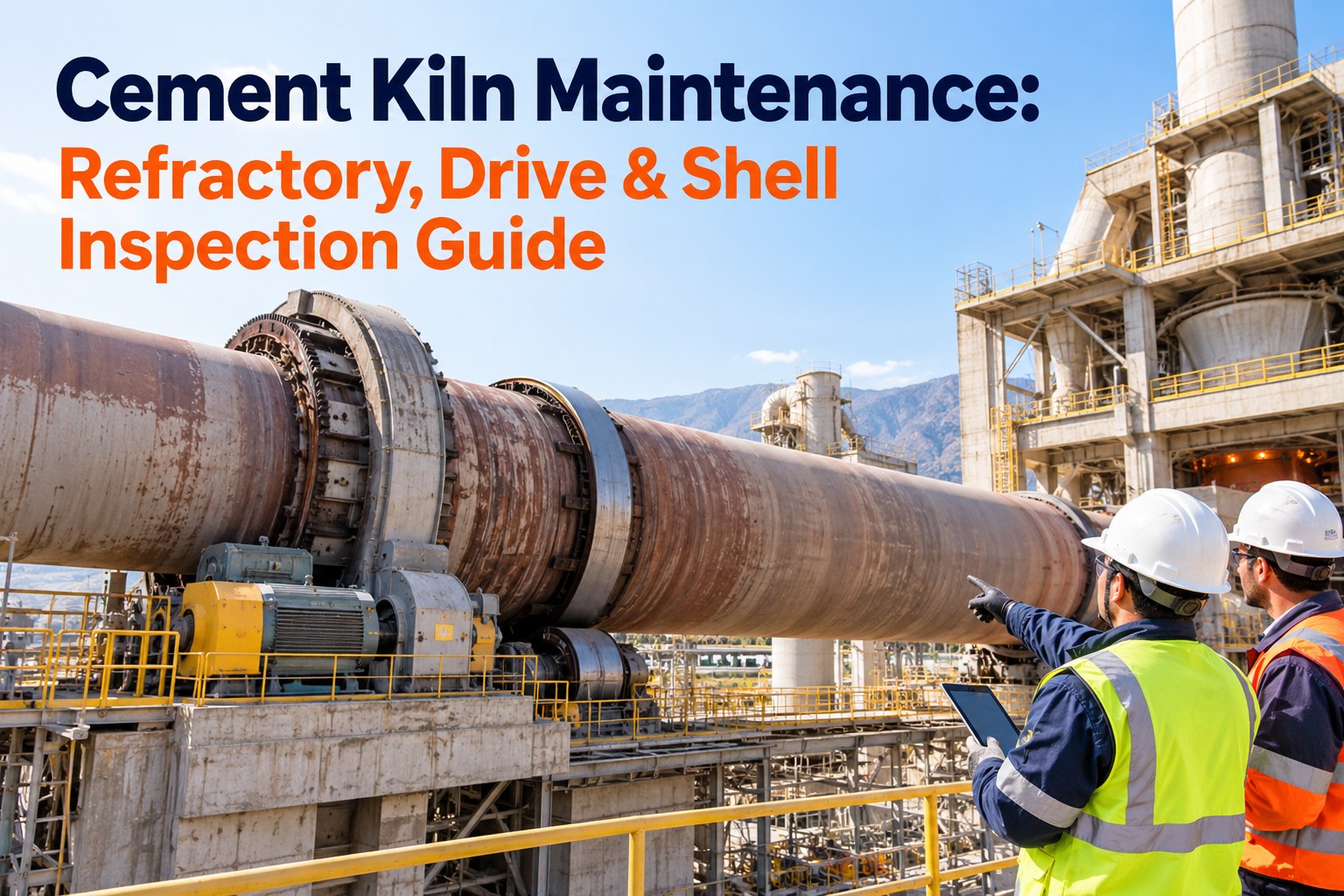
A rotary kiln is the one asset a cement plant can't run without — and an unplanned kiln stop is measured in lost days, not hours. Almost every forced outage traces back to one of three systems: refractory that thinned until the shell overheated, a shell that distorted or cracked, or a drive and support train that drifted out of alignment. Each one gives warning long before it stops the kiln, if someone is inspecting for it. This guide covers maintenance of the refractory, the shell and supports, and the drive — and how to track it all as work orders in OXMAINT AI — or book a demo of kiln reliability tracking in OXMAINT AI.
CEMENT KILN MAINTENANCE · REFRACTORY · SHELL · DRIVE · 2026
Cement Kiln Maintenance: Refractory, Drive & Shell Inspection Guide
A thinning lining, a distorting shell or a misaligned drive each ends the same way — a forced kiln stop and days of lost clinker. OXMAINT AI is the AI-powered CMMS that schedules the kiln inspections, logs shell-temperature, alignment and drive readings against limits, and raises a work order the moment one drifts — so a kiln problem is a planned repair, not an emergency shutdown.
1 · Refractory
2 · Shell & Supports
3 · Drive
4 · Track & plan
~1450°C
burning-zone temperature the refractory holds off the steel shell
3
systems behind most forced stops — refractory, shell, drive train
Scan
continuous shell-temperature scanning is the kiln's early-warning layer
Align
kiln axis alignment underpins refractory, shell and bearing life alike
The Rotary Kiln and Its Three Systems
A rotary kiln is a long, slightly inclined steel tube, refractory-lined inside, turning on tyres that ride on support rollers, driven by a girth gear. Maintenance lives in three systems along its length — and a failure in one soon damages the others. Start free and build your kiln asset register in OXMAINT AI.
Feed end — coolermaterial flow →Discharge — burning zone
Feed inlet
Tyre + rollers
Girth gear drive
Tyre + rollers
Burning zone / burner
Refractory lining runs the full length inside
Shell & supports carry and rotate it
Drive turns it through the girth gear
System 1 · Refractory Lining
The brick lining is what keeps 1,450°C clinker off a steel shell that softens far below that. Lose the lining locally and the shell overheats in minutes — the single most urgent kiln risk.
What to inspect
Brick thickness and wear by zone, especially the burning zone
Stability of the protective coating over the brick
Shell-temperature scan for developing hot spots
Brick anchoring, joints and signs of loosening
Warning signs
A hot spot climbing on the shell scanner
Visible red spot on the shell — emergency
Coating loss or repeated coating shed-off
Brick dust or fragments at the outlet
System 2 · Shell & Supports
The shell carries the whole load and must stay round and straight as it turns. Tyres (riding rings) transfer that load to support rollers; if the shell distorts or the supports drift, stress concentrates and cracks start.
What to inspect
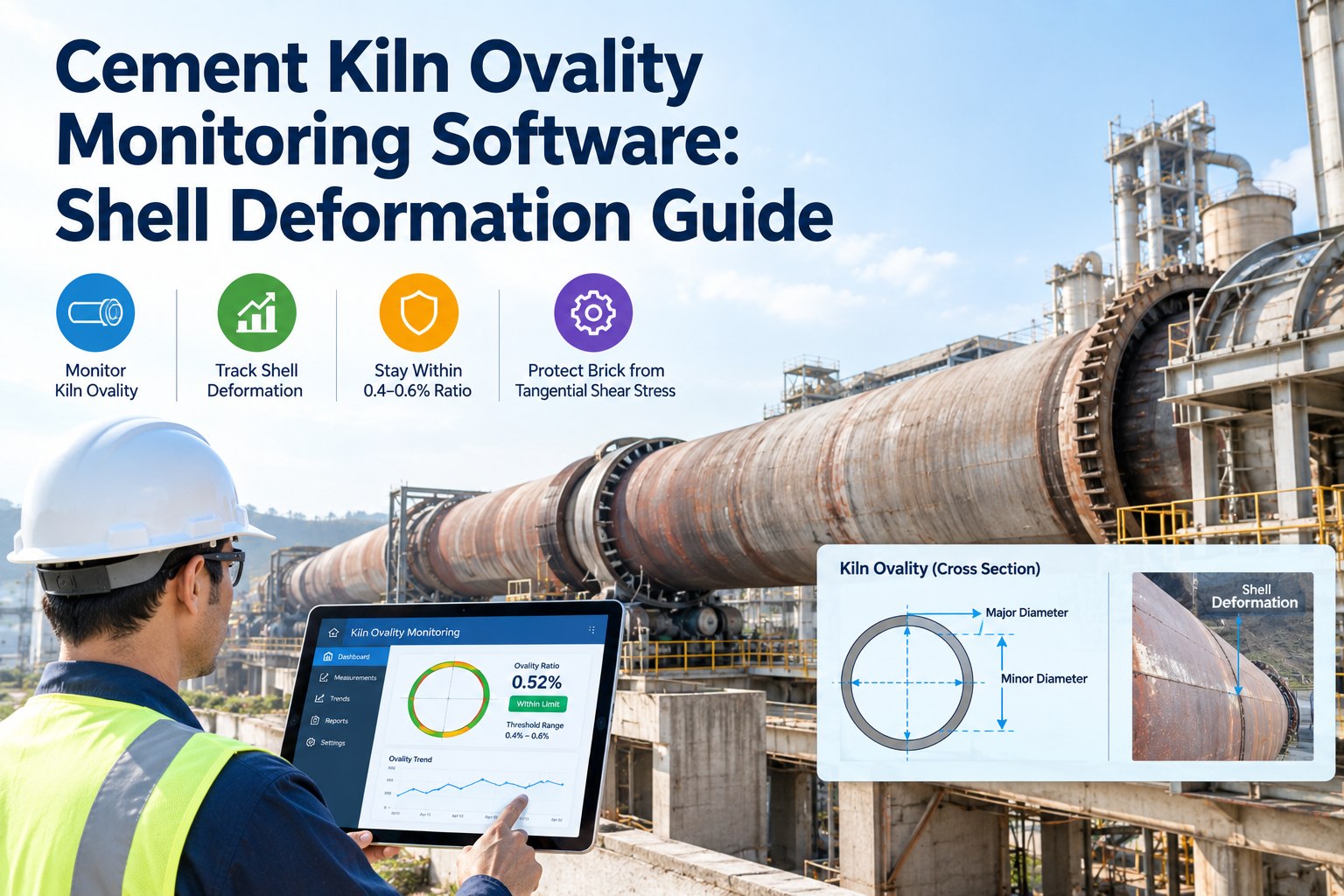
Shell ovality and deformation as it rotates
Tyre migration (creep) and the gap to the shell
Support-roller surface, skew and bearing temperature
Shell cracks, especially near tyre seats
Warning signs
Rising or uneven roller-bearing temperature
Excessive tyre creep or none at all
Growing ovality or audible knocking
Hairline cracks propagating in the shell
System 3 · Drive Train
A girth gear around the shell, driven by a pinion, gearbox and motor, turns the kiln. Gear alignment, backlash and lubrication decide whether it runs for decades or wears out in years — and the auxiliary drive has to be ready to turn the kiln during an outage so it doesn't sag.
What to inspect
Girth gear and pinion tooth contact, wear and backlash
Root clearance and gear-to-shell runout
Lubrication delivery and condition on the gear
Motor and gearbox vibration, temperature and current
Warning signs
Uneven or heavy tooth-wear pattern
Backlash drifting outside the set range
Rising drive current, vibration or noise
Lube starvation or contamination on the gear
Kiln Inspection & Monitoring Matrix
These are the readings that turn kiln maintenance from reactive to planned — what to measure, how, and what it catches. Trend each over time and a problem shows up as a line, not a breakdown. Book a demo of kiln reading trends in OXMAINT AI.
Parameter
Method
What it catches
Shell temperature
Continuous IR shell scanner
Refractory thinning and hot spots
Shell ovality
Ovality (crank) gauge
Shell distortion, tyre-gap problems
Tyre migration
Creep measurement at the tyre
Loose or over-tight tyre fit
Roller bearings
Temperature and vibration
Alignment load, lubrication faults
Kiln axis
Hot alignment survey
Misalignment stressing shell and brick
Girth gear
Backlash, runout, tooth check
Drive wear and gear-mesh problems
Drive motor
Current, vibration, temperature
Rising load, mechanical binding
Emergency RuleA Red Spot on the Shell Is a Stop-the-Kiln Event
Every other reading gives you time. A visible red or glowing hot spot on the shell does not — it means the refractory behind it is gone or going, and a softening shell can deform permanently in minutes. This is the one finding that overrides production.
!
Watch the scanner trend — a hot spot climbing toward the limit is the warning before the red spot.
!
Act on the plant's limit — follow the defined shell-temperature action and shutdown thresholds.
!
Never run through a red spot — a permanently bent shell is a far longer outage than a reline.
!
Log it and plan the reline — capture the location and cause so the repair is scoped before the stop.
How OXMAINT AI Keeps the Kiln Reliable
OXMAINT AI is the AI-powered maintenance management software that holds the whole kiln on one platform — the asset register across all three systems, the inspection schedule, the shell, alignment and drive readings, and the work orders that follow. Put your kiln on it when you start free and schedule kiln inspections in OXMAINT AI.
Kiln Asset Register
Refractory zones, shell, tyres, rollers and drive as structured assets with their limits on file.
Scheduled Inspections
Recurring refractory, shell and drive checks generated on cadence so none is forgotten.
Readings vs Limits
Shell temperature, ovality, bearing temps and backlash logged against the action thresholds.
Deviation → Work Order
A reading past its limit raises a prioritised repair with the location and data attached.
Refractory & Reline History
Lining life and reline records by zone, so the next shutdown scope is ready in advance.
Reliability Trending
Readings trended over time so slow drift in shell, supports or drive is caught early.
The Kiln Tells You Before It Stops — If You're Listening.
A climbing shell temperature, a creeping tyre, a drifting backlash — each is a warning weeks ahead of the failure it becomes. OXMAINT AI captures those readings, trends them, and turns the drift into a planned repair before it becomes a forced outage.
EXPERT REVIEW
Written for cement-plant maintenance, reliability and production teams. Rotary kiln maintenance is specialised work — refractory installation and relining, hot kiln alignment, shell crack repair and girth-gear work are performed by trained crews and specialist contractors, and the temperature, ovality, backlash and alignment limits that govern action come from the kiln maker, the refractory supplier and plant engineering. The figures and practices here are a general framework — a burning-zone temperature near 1,450°C is typical but process-dependent — and the plant's own defined limits and procedures govern every decision, above all shell-temperature shutdown thresholds. OXMAINT AI is a maintenance management platform that schedules the work, logs the readings and tracks the repairs — it is not a shell scanner, an alignment system, or a substitute for qualified kiln specialists.
Frequently Asked Questions
Why is shell-temperature scanning so important?
Because it's the early-warning layer for the kiln's most urgent risk — refractory loss. A continuous infrared scanner reads the shell along its length, and a developing hot spot shows that the brick behind it is thinning before the shell is damaged. Trending those readings catches the problem while there's still time to plan a reline.
Start free and log shell-scan readings in OXMAINT AI.
What causes a cement kiln shell to crack?
Usually stress concentration from distortion or misalignment — excessive ovality, a misaligned kiln axis, tyre-seat problems, or thermal stress from refractory issues. Cracks often start near the tyre seats where load concentrates. Because the shell carries the entire kiln, cracks are serious and tie directly back to alignment and support-roller condition.
What is tyre migration and why monitor it?
The tyre (riding ring) sits slightly loose on the shell and "creeps" relative to it as the kiln turns — a small amount is normal. Too much creep means a loose fit; none means it has seized tight, which stresses the shell. Measuring migration tells you the tyre-to-shell fit is healthy and the kiln is expanding and rotating as designed.
How often should a kiln be aligned?
Hot kiln alignment is typically checked on a periodic schedule and whenever symptoms appear — rising roller-bearing temperatures, shell cracks, uneven tyre wear or drive load changes. Alignment underpins refractory life, shell integrity and bearing life all at once, so it's a foundational check rather than a one-time setup. The plant's engineering sets the interval.
How does a CMMS help with kiln maintenance?
It holds the kiln as structured assets, schedules the refractory, shell and drive inspections, logs each reading against its limit, and raises a work order when something drifts — plus keeps the reline and repair history so the next shutdown is scoped in advance. It turns scattered readings into a trend and a plan.
Book a demo of kiln maintenance tracking in OXMAINT AI.
Keep the Kiln Turning, On Plan.
Run cement kiln maintenance on OXMAINT AI: refractory, shell, supports and drive as tracked assets, inspections scheduled across all three systems, shell-temperature, alignment and drive readings logged against limits, and a work order raised the moment one drifts — so the kiln is relined and repaired on plan, not stopped by surprise.