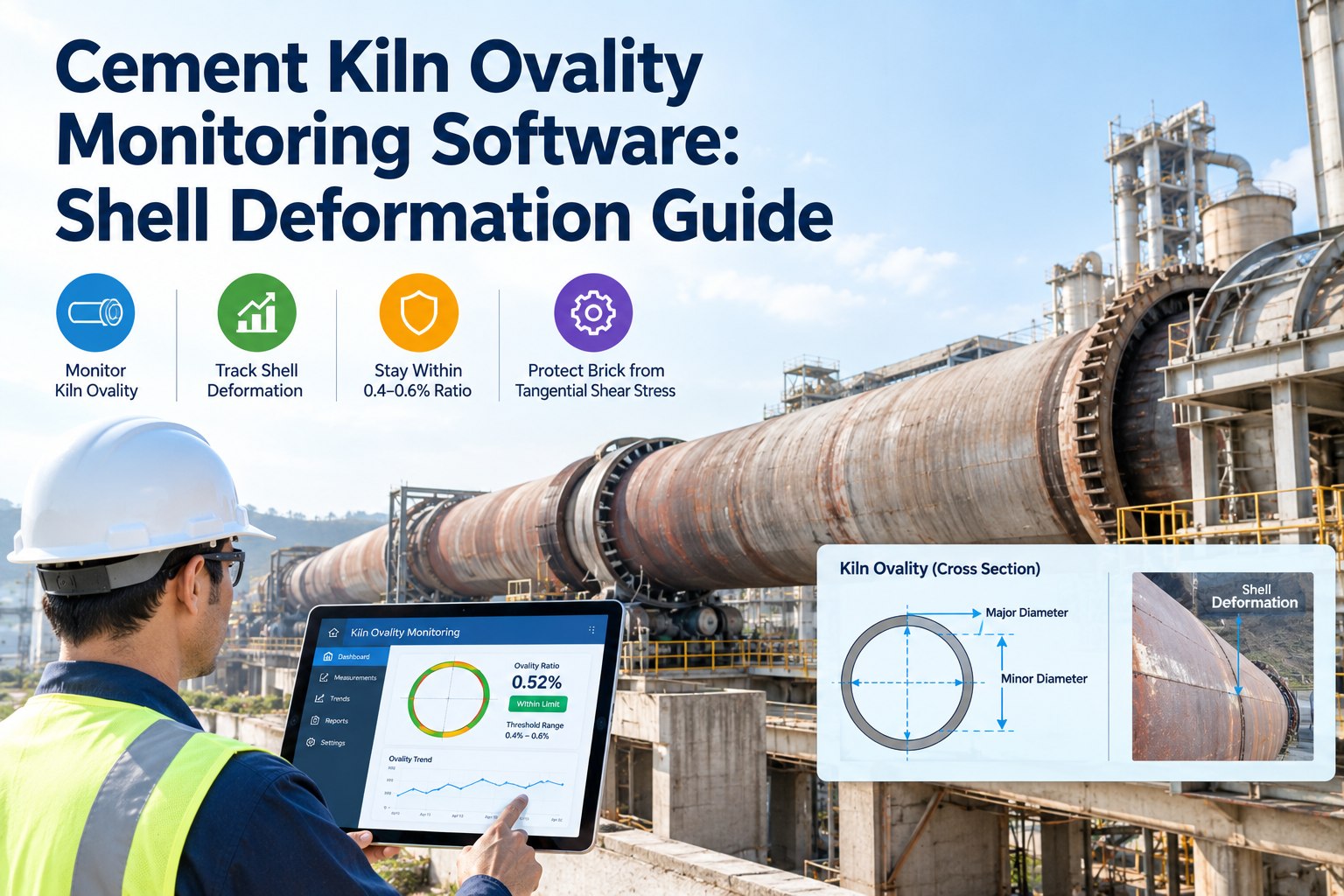
A rotary kiln is a 2,000-tonne steel tube that everyone pictures as a perfect cylinder but it isn't, not while it turns. Under the weight of the shell, the refractory, and the clinker inside, the tube flexes out of round into a slow-breathing ellipse on every single revolution. That flexing is ovality, and it's invisible: you can't see it from the deck, you can't feel it, and you can't measure it by looking at a stopped kiln, because it only exists while the kiln rotates. Left unwatched, ovality quietly crushes the refractory brick from the inside — and refractory failure is one of the most expensive stops a cement plant can take. This guide covers cement kiln ovality monitoring: what ovality does to the brick, the 0.4–0.6% threshold that defines the safe band, the four shell measurements that read kiln health together, and how a CMMS turns scattered readings into a trend that warns you weeks ahead. Start free on OxMaint or book a demo.
Cement Kiln Ovality Monitoring · Shell Deformation Guide
The kiln isn't round while it turns — and the deformation you can't see is the one eating your brick.
0.4–0.6%
of kiln diameter — the ovality ratio ceiling a modern high-capacity kiln must stay under
0.3%
the tighter limit at the tyre cross-section, where brick cracking accelerates fastest
40–80%
more that emergency refractory work costs versus the same job done as a planned campaign
Weeks
of advance warning every shell failure signature gives — if the readings are trended
What Ovality Actually Does to the Brick
The refractory lining fights a constant battle against mechanical, thermal, and chemical stress — and ovality is the mechanical one that a maintenance program can directly control. As the shell flexes from a circle into an ellipse each rotation, the brick ring is squeezed at the pinch point and pulled apart at the opening point. Do that thousands of times an hour and the bricks crush at their edges where they're squeezed and loosen where they're stretched. The result is annular spalling — brick failing in uniform flakes around the ring. Above the 0.4–0.6% threshold, the tangential shear stress driving this climbs sharply, and refractory life falls off a cliff.
Pinch Point
At the top of rotation the ellipse squeezes the brick ring. Brick edges are crushed under compression — the flexing repeats every revolution, thousands of times a shift.
Opening Point
At the bottom the ring stretches open. Bricks loosen in their seating, mortar joints work apart, and the ring loses the tight compression that holds it stable.
Annular Spalling
Crushed-then-loosened brick fails in uniform flakes around the whole ring — the signature damage of an over-oval kiln, and the start of a refractory stop.
The Ovality Threshold Bands
Ovality is expressed as a ratio — the deformation as a percentage of kiln diameter — and where a reading sits in the band determines the action. The numbers aren't arbitrary; they mark where tangential stress on the brick shifts from tolerable to destructive. This is the reference every kiln team should trend against.
Below 0.4%
Healthy Band
Shell flex within design tolerance. Tangential stress on the brick is normal. Continue routine measurement and trend for any upward drift.
0.4–0.6%
Threshold Zone
The ceiling for a modern high-capacity kiln. Stress on the brick is rising sharply here — investigate cause, tighten measurement cadence, plan intervention.
Above 0.6%
Destructive
Tangential shear stress is now actively crushing and loosening brick. Annular spalling is underway or imminent — refractory life is being spent fast.
A tighter limit applies at the tyre cross-section: the general industry ceiling there is 0.3% of shell diameter, because that's where brick cracking and seal degradation accelerate first. Measure ovality with cross-diameter readings at four positions around the circumference, and trend across shutdown events — one reading is a number, a trend is a warning.
Ovality Never Travels Alone · The Four Shell Measurements
Because the kiln interior is sealed and unreachable during operation, the shell surface is your only diagnostic window — and ovality is one of four measurements that only mean something when read together. A rising ovality number alongside creeping tyre migration and a warm spot tells a story no single reading could. These four are the standard shell-condition set.
Shell Ovality
Cross-diameter readings at four points define how far the shell flexes out of round. The direct measure of tangential stress on the brick ring.
Tyre Migration (Creep)
The relative slip between tyre and shell per revolution — a normal band of roughly 25–75 mm/day. Rapid creep signals clearance wear and drives ovality up.
Shell Temperature
Hot spots of just 15–20°C above baseline reveal refractory coating loss — detectable three to four weeks before the lining is actually damaged.
Support Roller Vibration
Rising roller vibration and skew flag misalignment loading the shell unevenly — a root cause that pushes ovality past threshold if left uncorrected.
Trend Every Shell Reading on the Kiln Asset Record — Free Forever
Sign up on OxMaint's free forever plan and log ovality, tyre migration, shell temperature, and roller vibration against each kiln — and each tyre station — as a structured asset. Set the threshold, let readings trend across every shutdown, and fire an automatic work order the moment a value crosses the band. No card, no time limit.
The Real Failure Is the Spreadsheet
Here's the uncomfortable truth about kiln ovality: most plants measure it correctly. The failure isn't the measurement — it's what happens to the reading afterward. Numbers land in shift logbooks, paper rounds sheets, or a spreadsheet on one engineer's laptop, disconnected from work order history. With no trend across campaigns, a slow drift from 0.35% to 0.55% over eighteen months is invisible until brick starts flaking. The measurement gap that costs a plant a six-figure stop develops silently, one un-trended reading at a time.
Readings in a Spreadsheet
Numbers scattered across logbooks and laptops
No trend line across shutdown campaigns
Drift invisible until brick already spalling
No link between a reading and a corrective action
Response is reactive — symptom, not signature
Readings in a CMMS
Every value on the kiln and tyre-station record
Trend line built automatically across campaigns
Drift flagged the moment it crosses the band
Each threshold breach opens a numbered work order
Response is planned — into the next shutdown window
How OxMaint Runs the Ovality Program
Ovality monitoring only protects brick if the readings live where the maintenance happens. OxMaint structures each kiln — and each tyre station within it — as an asset node with its own measurement history, thresholds, and work order log, so a shell reading becomes an action instead of an orphaned number.
Structure
Kiln & Tyre Hierarchy
Each kiln built as an asset with tyre stations as child nodes — every station carrying its own ovality history, trend, and corrective log.
Schedule
Measurement Cadence
Weekly-to-monthly ovality rounds and the 12–18 month hot-kiln survey scheduled as recurring PMs — intervals that never slip under production pressure.
Trend
Against the Threshold
Every reading plotted against the 0.4–0.6% band and the tyre 0.3% limit — drift visible as a line climbing toward the ceiling, not a number in isolation.
Trigger
Threshold to Work Order
A value crossing the band fires an automatic work order — roller-skew check, alignment survey, or refractory inspection assigned and tracked.
Correlate
Four Signals Together
Ovality read alongside tyre migration, shell temperature, and roller vibration on one record — the combined picture no single reading gives.
Prove
Audit-Ready History
Timestamped readings, signoffs, and corrective trails — the immutable record insurers and regulators increasingly expect for kiln mechanical programs.
Catch the Drift Before It Reaches the Brick
Free forever plan — no card, no time limit. Trend ovality and every shell measurement against threshold on the kiln asset record, and turn each breach into a planned intervention instead of an emergency refractory stop. Or book 30 minutes and we'll map a kiln measurement program across your plant.
Frequently Asked Questions
What is an acceptable ovality for a cement rotary kiln?
Modern high-capacity kilns must hold an ovality ratio below 0.4–0.6% of the kiln diameter. At the tyre cross-section specifically, the general industry ceiling is tighter — around 0.3% — because brick cracking and seal degradation accelerate fastest there. Above these thresholds, tangential shear stress on the refractory rises sharply and brick life drops.
Why can't ovality be measured on a stopped kiln?
Because ovality is a dynamic deformation — the shell flexes into an ellipse only under the rotating load of its own weight, the refractory, and the clinker. A stationary kiln relaxes back toward round, so the destructive flexing simply isn't present to measure. Ovality is captured while the kiln turns, with cross-diameter readings taken at four positions around the shell.
How does ovality damage the refractory lining?
As the shell flexes each revolution, the brick ring is crushed at the pinch point (top of rotation) and loosened at the opening point (bottom). Repeated thousands of times an hour, this crushes brick edges and works joints apart, producing annular spalling — brick failing in uniform flakes around the ring. It's the signature failure of an over-oval kiln.
How often should kiln ovality be measured?
Routine ovality measurement runs weekly to monthly, with a full hot-kiln alignment survey every 12–18 months for kilns in continuous operation — plus an unscheduled survey after any refractory replacement, a major shutdown, or a sustained shift in tyre migration outside the normal 25–75 mm/day band. Scheduling these in a CMMS prevents intervals slipping under production pressure.
Why track ovality in a CMMS instead of a spreadsheet?
Most plants measure ovality correctly but record it inconsistently — in logbooks and disconnected spreadsheets with no trend across campaigns, so a slow drift toward threshold stays invisible until brick spalls. A CMMS keeps every reading on the kiln and tyre-station record, trends it against the band automatically, and turns each breach into a tracked work order.
Start free or
book a demo.