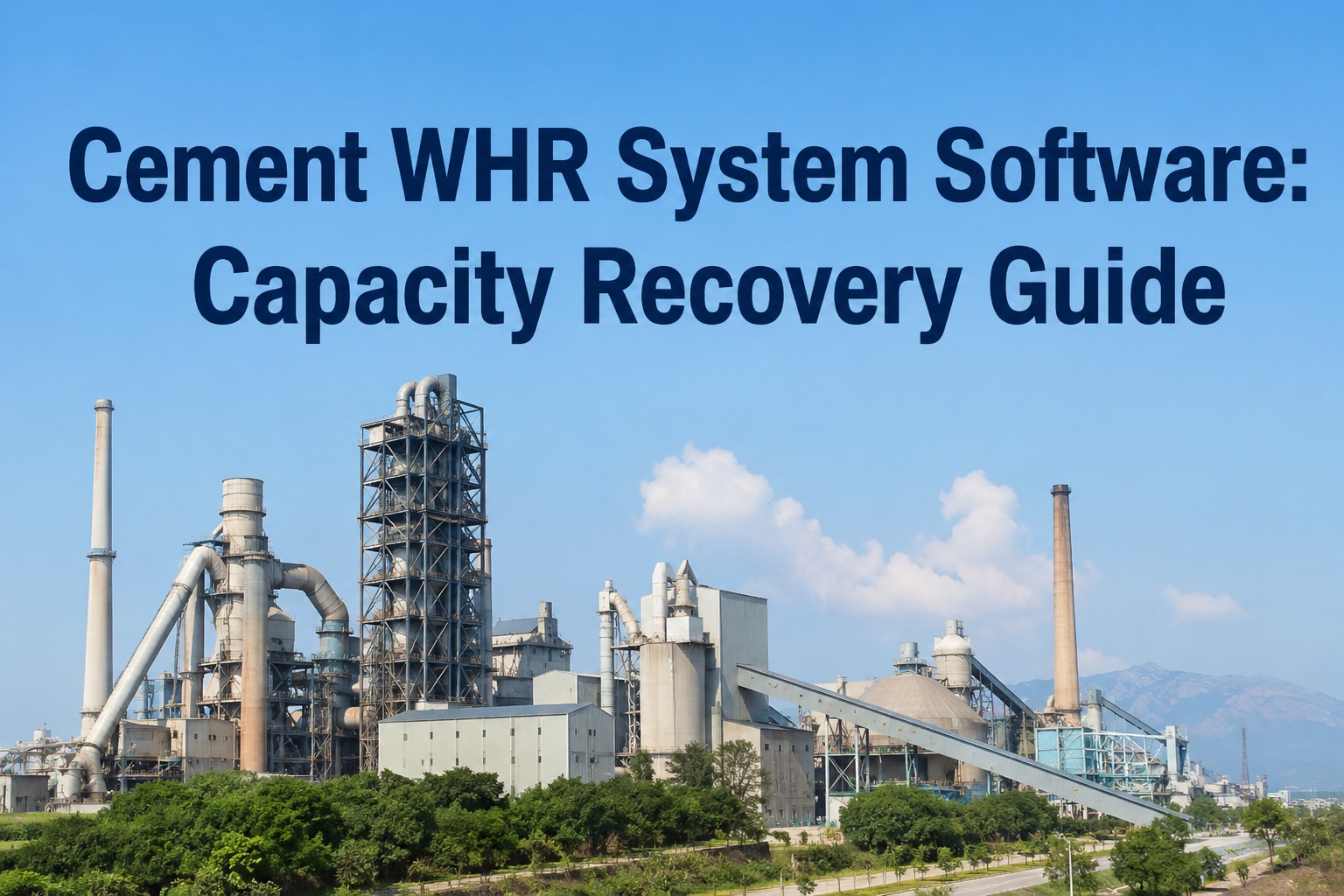
A cement plant's waste heat recovery system has two capacity numbers, and the gap between them is where the money is. There's the rated capacity — the 7 to 13 MW the WHR was designed to generate on a million-tonne kiln line, enough to supply 25 to 30% of the plant's power. And there's the actual capacity — what it delivers on an average day two years into operation, after dust has fouled the boiler tubes, the working fluid has degraded, and nobody has trended the heat-transfer coefficient in months. That gap is rarely a broken machine; it's a slow, invisible erosion where every fouled tube and every degraded component quietly shaves a fraction of a megawatt off output until the WHR is generating a fraction of what it should. Recovering that capacity is a maintenance discipline: you can't get the rated MW back without tracking boiler duty, heat availability, and generation output against the baseline the system was designed to. This guide covers cement WHR capacity recovery: how the system generates, why capacity leaks away, the recovery levers, and how a CMMS turns WHR performance into tracked, scheduled work. Book a free WHR performance review.
Every WHR Has Two Capacity Numbers — The Gap Is the Money
Rated MW is what it was designed for. Actual MW is what fouling and degradation left you. Recovery is maintenance.
7–13 MW
Rated WHR output on a 1 Mt/yr cement kiln line
25–30%
Of total plant power a healthy WHR can supply
25–45
kWh per tonne of clinker recoverable as generation
14–36 mo
Payback window a capacity gap directly extends
How a Cement WHR System Generates
WHR capacity starts with two heat sources on the kiln line, each feeding its own boiler. Understanding the two streams is the key to understanding where capacity is won and lost — they behave differently and foul differently.
350–400°C
Preheater (PH) Boiler
Hot exhaust from the kiln preheater tower — the higher-temperature source. One kiln line typically runs two PH boilers, delivering the largest share of recoverable heat.
250–300°C
Air-Quenching Cooler (AQC) Boiler
Hot air from the clinker cooler — lower temperature but high volume. One AQC boiler per line, tapped from vent or mid-tap gases to maximize steam temperature.
SRC / ORC
Power Generation Cycle
Steam or organic-fluid Rankine cycle drives a turbine-generator. Steam Rankine is widely used; ORC suits the low-to-medium temperatures where cement waste heat sits.
Where the Capacity Leaks Away
The rated-to-actual gap opens through a handful of degradation modes, each shaving output. None trips an alarm — they just quietly lower generation until someone compares today's MW to the design baseline and asks where it went.
Boiler Tube Fouling
The number-one enemy. Cement exhaust is notoriously dust-heavy. Dust coats the boiler tubes as an insulating layer that drops the heat-transfer coefficient — less heat captured, less steam, less MW. Shows first as a rising temperature delta and pressure drop across the boiler.
Working-Fluid Degradation
In ORC systems the organic fluid degrades with thermal cycling and contamination, losing the properties that make the cycle efficient. Unmonitored, it silently lowers conversion efficiency across the whole system.
Turbine & Generator Wear
Turbine-blade fouling and degradation, plus generator condition, erode conversion efficiency at the output end — the last stage where recovered heat becomes sellable power.
Pump Seals & Condenser
Feed-pump seal wear and condenser fouling degrade the cycle's low-pressure end. Small individually, together they raise back-pressure and pull output below rated capacity.
The Master Signal · Heat-Transfer Coefficient
Just as a chiller has approach temperature, a WHR boiler has one master health signal that captures fouling before output visibly drops — the heat-transfer coefficient, read through the temperature delta and pressure drop across each boiler.
When the Coefficient Drops, Capacity Is Already Leaking
A falling heat-transfer coefficient means dust is insulating the tubes and less heat is crossing into the water — the earliest quantifiable sign of fouling, visible in the widening temperature delta and rising pressure drop across the boiler long before the generation meter tells the story. The correct response is a triggered soot-blower sequence, not a calendar-based clean. Monitored continuously and trended against the commissioning baseline, this single coefficient converts fouling from an invisible capacity drain into a scheduled cleaning task — the core of keeping actual MW close to rated MW.
Measure Your Rated-to-Actual Gap in 30 Minutes
Working session with our cement team — bring your WHR generation data. We'll compare actual output to design baseline, find where fouling and degradation are shaving MW, and show how OxMaint turns heat-transfer trends into scheduled cleaning and PM work orders.
The Capacity Recovery Levers
Closing the rated-to-actual gap comes down to four disciplines. Each targets a different leak, and together they hold generation near design output year after year.
01
Trend Boiler Duty vs Baseline
Track heat-transfer coefficient, temperature delta, and pressure drop against the commissioning baseline — so fouling shows as a trend line, not a surprise at the meter.
02
Clean on Condition, Not Calendar
Trigger soot-blower sequences and offline cleaning from the actual heat-transfer signal, so tubes are cleaned when they foul — not too early wasting effort, not too late losing MW.
03
Monitor Fluid & Rotating Health
Track working-fluid condition, turbine vibration, pump seals, and condenser performance — the output-end degradation that erodes conversion efficiency invisibly.
04
Maintain Without Stopping the Kiln
Use guillotine dampers to isolate a boiler for cleaning or repair without a kiln shutdown — recovery work planned around production, never at the cost of clinker.
Kiln-First · The Non-Negotiable Constraint
One rule governs every WHR maintenance decision in a cement plant, and it's what makes WHR reliability a CMMS problem rather than a standalone power-plant one: the WHR exists to recover heat, never to compromise the kiln.
Heat Recovery Never Overrides Clinker Production
The kiln makes the product; the WHR is a beneficiary of its waste heat. If kiln-feed chemistry needs more preheater heat for drying, or production demands a bypass, the WHR yields — via bypass dampers — so heat recovery never compromises clinker quality or volume. That's why WHR maintenance can't be scheduled in isolation: it has to be coordinated with kiln operation, raw-mill demand, and plant-wide production in one system. A CMMS that already manages kilns, mills, crushers, coolers, and conveyors is the natural home for WHR work, because the WHR's constraints live in those same assets.
How OxMaint Recovers & Protects WHR Capacity
OxMaint is the single source of truth for cement WHR performance and maintenance — preventive scheduling, digital LOTO and permit-to-work, inspection checklists, RCA workflows, IoT and vibration monitoring, and compliance-grade reporting, coordinated with the whole plant from one dashboard on desktop or mobile.
Baseline
Performance vs Design
Track generation output, boiler duty, and heat-transfer coefficient against the commissioning baseline — making the rated-to-actual gap visible and measurable.
Detect
Fouling & Drift Alerts
IoT temperature-delta and pressure-drop trends flag boiler fouling and efficiency drift early — turning a falling coefficient into a cleaning work order before MW is lost.
Schedule
Condition-Based Cleaning & PM
Auto-generate soot-blowing, offline cleaning, and component PM from the condition signal, planned around kiln operation so recovery never stops production.
Safe Work
Digital LOTO & Permits
Digital lockout-tagout and permit-to-work for boiler isolation and turbine work — audit-ready for OSHA 1910.147 and MSHA, with the damper isolation logged.
Monitor
Turbine, Fluid & Pump Health
Vibration, working-fluid, and condenser condition tracked with RCA workflows — catching the output-end degradation that erodes conversion efficiency.
Report
Reliability & Compliance
Generation, availability, and reliability dashboards plus ISO 55000-aligned records across kilns, mills, coolers, and WHR — one plant or a global fleet.
Close the Gap Between Rated and Actual MW
Stop letting fouling and degradation quietly shave your WHR output. See how OxMaint trends boiler duty and generation against baseline and turns it into scheduled, kiln-coordinated work. Free forever plan available.
Frequently Asked Questions
What is a cement plant WHR system?
A waste heat recovery system captures the hot exhaust gases a cement kiln would otherwise waste — from the preheater tower and the clinker cooler — and uses them to generate electricity. The gases pass through waste heat boilers that raise steam (or heat an organic fluid) to drive a turbine-generator. On a one-million-tonne-per-year kiln line it can generate roughly 7 to 13 MW, supplying 25 to 30% of the plant's power and cutting both energy cost and Scope 2 emissions.
Book a performance review.
Why does WHR generation capacity decline over time?
Mostly through boiler tube fouling. Cement exhaust is heavily dust-laden, and that dust coats the boiler tubes in an insulating layer that lowers the heat-transfer coefficient, so less heat is captured and less power generated. Working-fluid degradation in ORC systems, turbine and generator wear, and pump-seal and condenser degradation add further losses. None of these trips an alarm — they quietly erode output until actual generation sits well below rated capacity.
What is the best signal to monitor WHR health?
The heat-transfer coefficient across each boiler, read through the temperature delta and pressure drop. It's the earliest quantifiable sign of fouling — it falls as dust insulates the tubes, well before the generation meter shows the loss. Trended against the commissioning baseline, it converts fouling into a scheduled, condition-based cleaning task rather than a surprise.
Start free.
Does WHR maintenance require stopping the kiln?
It shouldn't. WHR boilers are typically fitted with guillotine dampers on the inlet and bypass ducts that let a boiler be isolated for cleaning or repair while the kiln keeps running. The governing principle is kiln-first: the WHR must never compromise clinker production or quality, so its maintenance is planned around kiln operation and can usually be done without a production shutdown.
How does OxMaint help recover WHR capacity?
It tracks generation output, boiler duty, and heat-transfer coefficient against the design baseline so the rated-to-actual gap is visible; flags fouling and efficiency drift from IoT temperature-delta and pressure-drop trends; and auto-generates condition-based cleaning and PM planned around kiln operation. It runs digital LOTO and permit-to-work for safe boiler isolation, audit-ready for OSHA 1910.147 and MSHA, monitors turbine, fluid, and pump health with RCA workflows, and reports reliability across the whole plant. A free forever plan is available.