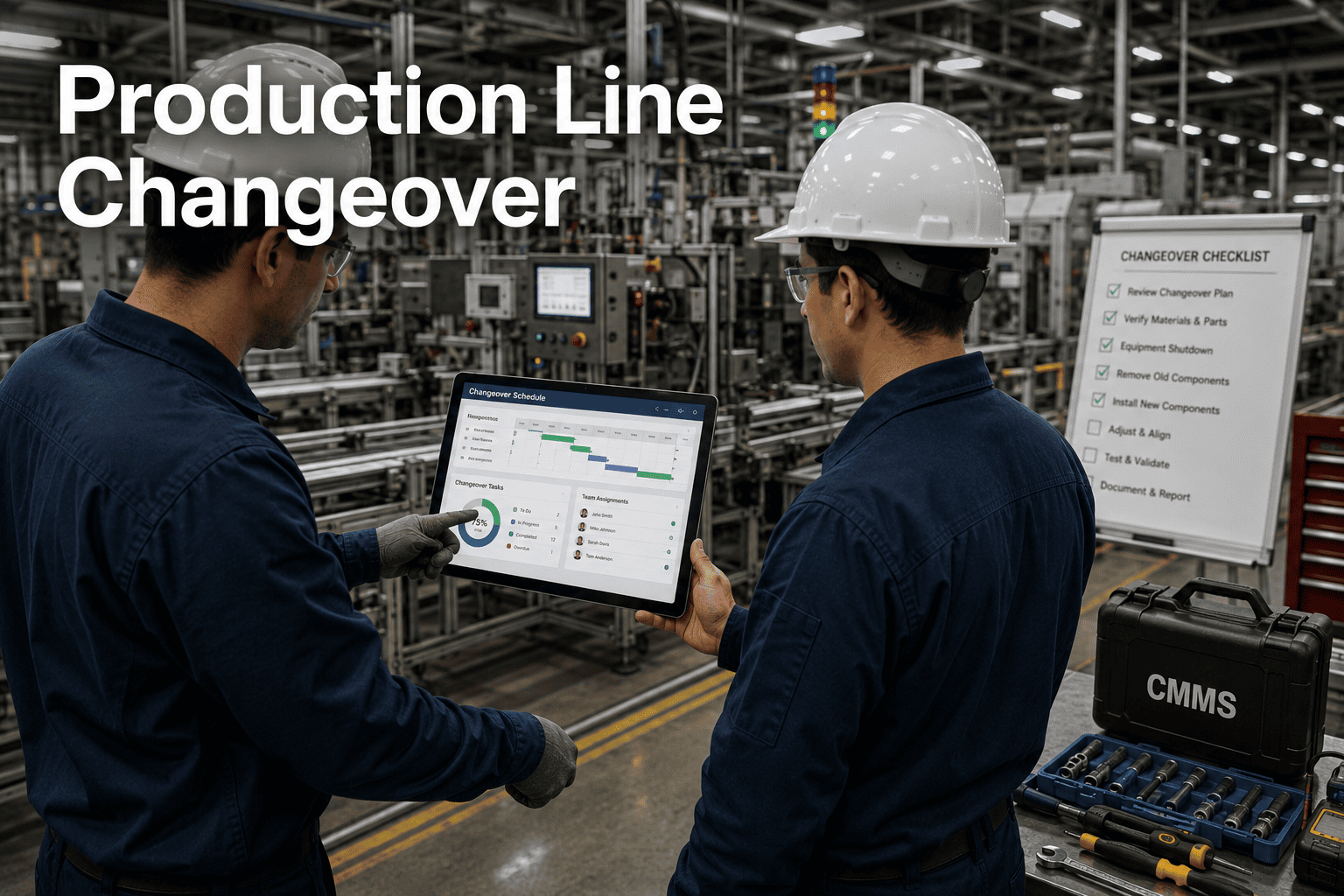
Production line changeover is the single largest source of planned downtime in discrete and batch manufacturing — and the maintenance coordination gap during changeover is what turns a 45-minute SMED target into a 90-minute reality. When production switches from one product to another, equipment adjustments, tooling changes, and cleaning tasks are typically managed by production operators, while maintenance tasks — lubrication, filter replacement, guard adjustments, sensor recalibration — are managed separately through the maintenance team's own schedule. Without a CMMS that coordinates both workflows into a single changeover window, maintenance tasks either delay the changeover (because they start after production tasks finish) or get skipped entirely (because the production team starts the next run before maintenance arrives). Plants that have integrated maintenance coordination into their changeover planning report 25–40% reductions in changeover duration and 30–50% fewer post-changeover breakdowns caused by deferred maintenance items. OxMaint CMMS gives manufacturing teams the tools to coordinate maintenance tasks within changeover windows — so every changeover is both a production transition and a structured maintenance opportunity that keeps equipment in optimal condition.
Changeover Maintenance Coordination for Production Lines
Integrate maintenance tasks into production changeover windows to reduce changeover time by 25–40%, eliminate deferred PM backlogs, and prevent post-changeover breakdowns caused by skipped maintenance items.
What Is Changeover Maintenance Coordination
Changeover maintenance coordination is the practice of scheduling, sequencing, and executing maintenance tasks within the production changeover window — treating the changeover as a structured maintenance opportunity rather than a production-only event. In SMED methodology terms, maintenance tasks that can be performed while the line is stopped for changeover are "internal" maintenance tasks — and coordinating them to run in parallel with production changeover activities eliminates the separate maintenance window that would otherwise be required.
Without CMMS coordination, maintenance tasks during changeover face two failure modes: they are performed sequentially after production tasks complete (extending the changeover window), or they are skipped because production starts the next run before maintenance arrives (deferring maintenance and increasing post-changeover failure risk). Both outcomes carry measurable cost — extended changeovers reduce available production time, and deferred maintenance generates breakdowns that cost 3–5x more to repair reactively than they would have cost during the changeover window.
The plants that have solved this problem use CMMS to generate changeover-linked maintenance work orders that are pre-staged before the changeover begins, with parts and tools positioned at the machine, technician assignments confirmed, and task sequences coordinated with the production changeover plan. Start a free trial to see how Oxmaint links maintenance work orders to production changeover schedules, or book a demo for a walkthrough of coordinated changeover dashboards.
6 CMMS Strategies for Changeover Maintenance Coordination
Tie PM work orders to changeover events rather than calendar intervals. CMMS generates maintenance tasks automatically when a changeover is scheduled — ensuring every maintenance opportunity within the changeover window is captured and pre-staged.
Map maintenance tasks against production changeover tasks to identify parallel execution opportunities. CMMS visualises the combined changeover timeline so supervisors can assign maintenance tasks that run simultaneously with production setup — not sequentially after it.
When a changeover-linked PM is generated, CMMS checks line-side inventory for required parts and triggers pre-staging. Parts are at the machine before the changeover begins — eliminating the storeroom trip that typically adds 15–20 minutes to maintenance tasks during changeovers.
CMMS assigns maintenance technicians to changeover-linked work orders and sends mobile notifications before the changeover window opens. Technicians arrive at the machine when the changeover begins — not 30 minutes after production stops.
Track actual changeover duration including maintenance task completion time. CMMS data shows which maintenance tasks extend the changeover window and which run successfully in parallel — enabling continuous improvement of the changeover-maintenance coordination process.
If a maintenance task cannot be completed during the changeover window, CMMS escalates it as a deferred item with risk assessment — ensuring production leadership is aware of the deferral and the maintenance backlog does not grow silently across changeovers.
4 Pain Points in Uncoordinated Changeover Maintenance
Maintenance tasks start only after production changeover tasks finish — adding 20–45 minutes to every changeover. Over 200+ changeovers per year, this sequential pattern consumes 65–150 hours of available production time that could have been saved through parallel task coordination.
Production supervisors start the next run before maintenance tasks are completed — either because maintenance was not notified of the changeover or because production pressure overrides maintenance scheduling. Skipped PM accumulates as deferred maintenance that generates 3–5x more expensive reactive failures within 2–4 weeks of the deferral.
Maintenance technicians discover during the changeover window that the required filter, belt, or tool is not at the machine — triggering a storeroom trip that consumes 15–20 minutes of the changeover window. Without CMMS-driven pre-staging linked to the changeover schedule, parts readiness is left to individual technician preparation, which fails inconsistently.
Without CMMS tracking of maintenance task duration within changeover windows, production and maintenance leadership have no data to drive continuous improvement. Which tasks extend the changeover and which run in parallel is invisible — making SMED improvement programs incomplete. Teams ready to close this gap can start a free trial today.
How Oxmaint Solves Changeover Maintenance Coordination
CMMS generates maintenance work orders automatically when a production changeover is scheduled. Tasks are linked to the specific machine and changeover event — ensuring nothing is missed and technicians are assigned before the window opens.
Visualise maintenance and production changeover tasks on a single timeline. Supervisors can identify parallel execution opportunities and adjust task assignments to minimise total changeover duration.
CMMS checks parts availability and triggers pre-staging before every changeover-linked maintenance event. Parts are at the machine before the changeover begins — eliminating the storeroom trip that extends the maintenance window.
Maintenance technicians receive mobile notifications with task details, parts list, and arrival time before the changeover window opens. Real-time work order status gives supervisors visibility into maintenance progress during the changeover.
Tasks that cannot be completed during the changeover window are escalated with risk assessment. Production and maintenance leadership see the deferred maintenance backlog accumulating — before it generates the post-changeover breakdown.
Track changeover duration trends, maintenance task completion rates, and parallel execution efficiency across all production lines. Data drives continuous SMED improvement and identifies which machines benefit most from enhanced changeover coordination.
Uncoordinated vs CMMS-Coordinated Changeover — Before and After
| Changeover Factor | Uncoordinated Maintenance (Before) | CMMS-Coordinated Maintenance (After) |
|---|---|---|
| Changeover Duration | 60–120 minutes including sequential maintenance tasks. 35% of time consumed by uncoordinated maintenance activities. | 40–75 minutes. Maintenance tasks run in parallel with production changeover — 25–40% duration reduction. |
| PM Completion During Changeovers | 40–60% of scheduled changeover PM tasks completed. Remainder deferred or skipped under production pressure. | 88–96% completion. CMMS-driven assignment and pre-staging ensures tasks are ready when the window opens. |
| Post-Changeover Breakdowns | 6–14 per month caused by deferred maintenance items. Each event costs $5K–$25K in unplanned downtime and emergency repair. | 2–4 per month after 6 months of coordinated changeover maintenance. 60–70% reduction in post-changeover failures. |
| Parts Readiness | Dependent on technician preparation. 25–40% of changeover maintenance events delayed by parts retrieval from central storeroom. | Automated pre-staging. Parts confirmed available and positioned at the machine before the changeover window opens. |
| SMED Improvement Data | No structured data on maintenance contribution to changeover duration. SMED programs address production tasks only — missing 35% of the total changeover time opportunity. | Full changeover duration data including maintenance task timing, parallel execution rates, and completion metrics. Complete SMED improvement picture. |
ROI and Results — Coordinated Changeover Maintenance
Frequently Asked Questions
How does CMMS coordinate maintenance tasks with the production changeover schedule?
What happens when a maintenance task cannot be completed within the changeover window?
Can Oxmaint support SMED-style internal/external task classification for maintenance activities?
How does changeover coordination work across multiple production lines in the same plant?
Stop Losing Production Hours to Uncoordinated Changeover Maintenance
Every changeover is a maintenance opportunity that most plants waste. Oxmaint coordinates maintenance tasks within changeover windows — running PM in parallel with production setup, pre-staging parts before the window opens, and tracking every deferred task before it becomes a breakdown.
See measurable results in the first 90 days. Works across multi-line manufacturing portfolios. Live in days, not months.