Line-side spare parts management is the difference between a 15-minute bearing swap and a 6-hour production stoppage — yet most manufacturing plants still manage parts inventory through a combination of central storerooms, tribal knowledge, and emergency purchase orders that arrive too late and cost too much. When a critical machine goes down and the required part is either missing, mislocated, or on a 3-day lead time from a supplier that charges 40% premium for expediting, the cost of parts unavailability quickly dwarfs the cost of carrying that part on the shelf. Line-side spare parts management software solves this by placing real-time inventory visibility, automated reorder alerts, and parts-to-work-order traceability directly in the hands of maintenance teams on the plant floor — reducing mean time to repair, eliminating emergency procurement, and cutting inventory carrying costs simultaneously. Start a free trial to see how Oxmaint manages line-side parts inventory across your production lines, or book a demo and walk through your specific plant layout and inventory structure with our team.
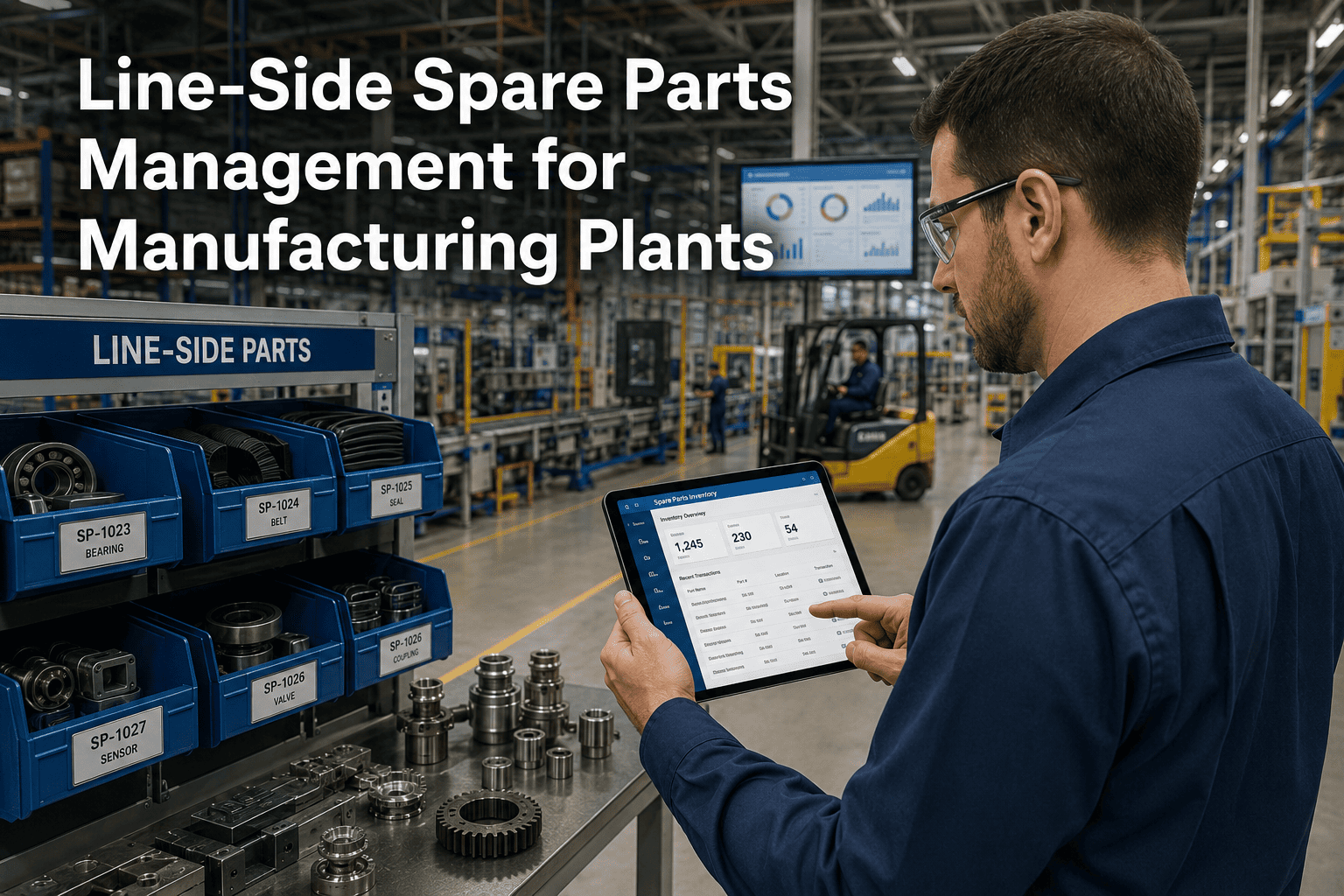
Line-Side Spare Parts Management for Manufacturing Plants
Eliminate parts-driven downtime with real-time inventory tracking, automated reorder alerts, and consumption analytics tied directly to work orders — designed for multi-line plants managing thousands of SKUs across distributed storerooms and line-side bins.
- ✔ Real-time parts visibility at every line-side location and central store
- ✔ Automated reorder alerts before critical parts reach minimum stock levels
- ✔ Parts consumption tracked per work order, machine, and maintenance event
See how much downtime and procurement cost you can eliminate from your plant floor — in 30 minutes.
No heavy implementation required · Live in days, not months · Multi-site plant support · Works with existing ERP systems
What Is Line-Side Spare Parts Management Software?
Line-side spare parts management is the practice of staging critical maintenance inventory at or near the production lines where it will be consumed — rather than holding everything in a central storeroom that may be physically distant from the failure point. The goal is to reduce the time between a maintenance technician identifying a failure and having the right part in hand to repair it. In plants with long production lines, multiple halls, or distributed equipment layouts, the difference between 50 meters and 500 meters to the nearest spare can represent 30–60 minutes of additional downtime per repair event.
Line-side spare parts management software adds real-time tracking, automated replenishment alerts, and consumption analytics to this process. Every part stored in a line-side bin, cabinet, or mobile cart is visible in the system with current quantity, location, minimum stock level, and linked work order history. When stock drops below reorder threshold, the system generates a procurement alert automatically — eliminating the lag between depletion and restocking that causes stockout events during the next shift's maintenance window.
The financial case is compelling on both sides of the inventory equation: plants that implement digital parts tracking simultaneously reduce emergency procurement costs by eliminating stockouts, and reduce carrying costs by identifying obsolete and overstock items that tie up capital without serving a maintenance purpose. Across a plant managing 3,000–10,000 active parts SKUs, this dual optimization typically releases 15–25% of inventory value within the first 6 months — start a free trial to see where your current parts inventory has hidden cost and risk.
Six Components of Effective Line-Side Parts Management
Real-time stock levels for every part at every location — line-side bins, mobile carts, satellite storerooms, and central warehouse. Technicians locate parts instantly without walking the floor or calling stores.
Minimum and maximum stock levels set per part per location. System generates procurement requests automatically when quantities fall below threshold — before stockouts occur, not after the next breakdown.
Every part assigned a fixed location code — bin, shelf, cabinet, line number. Technicians receive exact location on work order. No time wasted searching, no substitutions made from wrong-spec parts grabbed in haste.
Critical parts designated as high-priority with escalating alerts as stock approaches minimum. Supervisors and procurement teams notified automatically — giving advance warning before a machine goes down waiting for a part.
Parts requests linked to preferred suppliers with lead times, pricing, and approved vendor records. Procurement workflows triggered from Oxmaint with full traceability from reorder alert to purchase order to receipt.
Parts usage tracked per machine, work order, and maintenance event. High-consumption parts flagged for root cause analysis — separating design-life replacement from premature failure that signals a deeper equipment issue.
Four Parts Management Failures That Cost Plants Millions in Downtime
The most expensive parts management failure is discovering a critical spare is out of stock only when a machine goes down. At that point, options are: wait for expedited delivery at premium cost, search other facilities, or hold the production line. At $10,000–$50,000 per hour of lost output in high-volume manufacturing, a single stockout event can cost more than a year of inventory management software.
The opposite problem is equally costly: plants that over-order to avoid stockouts end up carrying 20–30% dead stock — parts for decommissioned equipment, duplicates of items that couldn't be located in stores, and safety stock that was never consumed. This locked working capital represents a direct financial cost that compounds year over year without visibility into actual consumption rates.
Plants with multiple production areas, satellite storerooms, and line-side bins often operate without a consolidated inventory view. Technicians who cannot find a part in one location assume it doesn't exist — triggering an emergency purchase for a part that is actually sitting in a bin three aisles away or in an unlabeled cabinet in another building.
Emergency parts procurement routinely costs 40–60% more than planned purchasing — same part, same supplier, but expedited shipping, after-hours handling, and last-minute sourcing from secondary suppliers add significant markup. Plants running on reactive parts management normalize this premium as a fixed cost of doing business, when it is actually an operational choice that structured inventory tracking eliminates. Book a demo to see how Oxmaint eliminates emergency procurement from your parts workflow.
How Oxmaint Manages Line-Side Spare Parts Across Your Entire Plant
Live stock levels for every part at every location — line-side bins, satellite storerooms, and central stores visible in a single dashboard. Technicians find parts in seconds from mobile app or workstation terminal.
Minimum stock thresholds trigger procurement alerts automatically. Purchase requests generated and routed to approved suppliers before stockouts occur — eliminating emergency procurement as a standard practice.
Parts consumption recorded against each work order automatically. Every repair event creates a full parts audit trail — enabling cost-per-machine analytics and identifying assets with abnormal consumption patterns.
Technicians search by part number, description, or machine name from their phone. Location code returned instantly. No radio calls to stores, no time wasted searching bins or asking colleagues during a breakdown.
Consumption analytics flag parts with zero movement over configurable periods. Obsolete stock identified and earmarked for return or disposal — releasing working capital tied up in non-moving inventory items.
Parts inventory visible across all plants in the portfolio. Identify where critical spares are available across sites before placing an external purchase order — transferring from a sister facility when stock is available.
Reactive Parts Management vs Line-Side Optimization with Oxmaint
| Dimension | Reactive Approach | Planned with Oxmaint |
|---|---|---|
| Parts Visibility | Technician physically searches bins, asks colleagues, or calls stores — 15–45 min delay per repair event | Real-time stock and location on mobile app — technician retrieves part in under 5 minutes, every time |
| Stockout Detection | Discovered when a machine fails and the part isn't there — emergency purchase at 40% premium already required | Automatic alert when stock reaches minimum level — procurement initiated before the next breakdown occurs |
| Procurement Trigger | Technician or supervisor calls purchasing during a breakdown — emergency lead time, after-hours sourcing | System-generated purchase request to approved supplier at planned pricing — no emergency premium |
| Inventory Accuracy | Physical count quarterly or annually — significant variance between records and actual stock between counts | Consumption tracked per work order — inventory accuracy maintained continuously without manual counts |
| Dead Stock Identification | Unknown until physical count reveals non-moving items — capital locked in obsolete stock for years | Zero-movement flags identify obsolete stock automatically — working capital released on rolling basis |
| Cost Per Repair Event | Emergency part cost + overtime labor + production loss + expediting fee — true cost rarely captured | Planned part cost + standard labor — full cost captured per work order with machine-level analytics |
| Multi-Site Coordination | No visibility across plants — each site orders independently, no cross-plant stock sharing | Portfolio-level parts visibility — transfer from sister facility before placing external purchase order |
What Manufacturing Plants Achieve with Oxmaint Parts Management
Manufacturing plants managing 3,000+ active SKUs see measurable downtime reduction within the first 60 days — start a free trial to see where your current parts inventory has hidden cost and risk, or book a demo to model the ROI against your plant's downtime cost and procurement spend.
Line-Side Spare Parts Management — Common Questions
How does Oxmaint track spare parts at line-side locations versus central stores simultaneously?
Oxmaint uses a location hierarchy that maps to your physical plant layout — each storage location assigned a unique ID, whether it's a central warehouse bay, satellite storeroom, line-side bin, or mobile tool cart. Every part is tracked at the location level with its own quantity, minimum stock threshold, and replenishment rule. Technicians see real-time stock at every location for a given part number simultaneously — so if a part is out at the line-side bin but available in central stores, that's visible before a purchase order is placed. Location transfers are recorded in the system, maintaining accurate stock across all locations without manual reconciliation.
Can Oxmaint integrate with our ERP and existing purchasing systems?
Yes. Oxmaint integrates with ERP systems including SAP, Oracle, Microsoft Dynamics, and others via REST API and file-based data exchange. Purchase requests generated in Oxmaint can be transmitted directly to ERP purchasing modules, maintaining a single source of truth for procurement across systems. Parts receipts posted in ERP update Oxmaint inventory levels automatically, eliminating manual data entry and the stock discrepancies that result from dual-system management. For plants without ERP integration, Oxmaint operates as a standalone MRO procurement hub with supplier portal connectivity.
How does Oxmaint calculate and manage minimum stock levels and automatic reorder points?
Minimum stock levels in Oxmaint can be set manually based on engineering judgment and supplier lead times, or calculated automatically from Oxmaint's consumption analytics — which track average usage per part per period, variance in demand, and historical lead time from the assigned supplier. For critical parts where stockout has a known hourly downtime cost, Oxmaint allows safety stock buffers to be set as a multiple of average lead time demand. Reorder points trigger procurement workflows — not just alerts — so the response to a declining stock level is a system-generated purchase request, not a manual decision that depends on someone noticing a spreadsheet cell.
Can Oxmaint track parts consumption per machine or per work order for cost accounting?
Yes. Every part issued from inventory in Oxmaint is linked to the work order it was consumed against, which in turn is linked to the specific asset being maintained. This creates a full cost trail: parts cost + labor hours + contractor costs per work order, rolled up to asset-level cost-per-year and cost-per-failure-event analytics. Maintenance managers can identify assets with abnormally high parts consumption — distinguishing between design-life consumable replacement and premature failure driven by operating conditions, operator error, or poor installation — and use that data to drive root-cause corrective actions.
Stop Losing Production Hours to Parts Unavailability
Turn every spare part into a tracked, located, replenishable asset with Oxmaint — and eliminate the stockouts, emergency procurement, and search time that cost your plant floor hours every week.
- ✔ Real-time parts visibility at every line-side and central store location
- ✔ Automated reorder alerts before critical stockouts occur
- ✔ 5–10 year MRO spend forecasting tied to asset lifecycle data
Used by maintenance teams managing 10,000+ parts SKUs across multi-plant portfolios · Measurable results in the first 30 days
No heavy implementation required · Live in days, not months · Multi-site manufacturing support