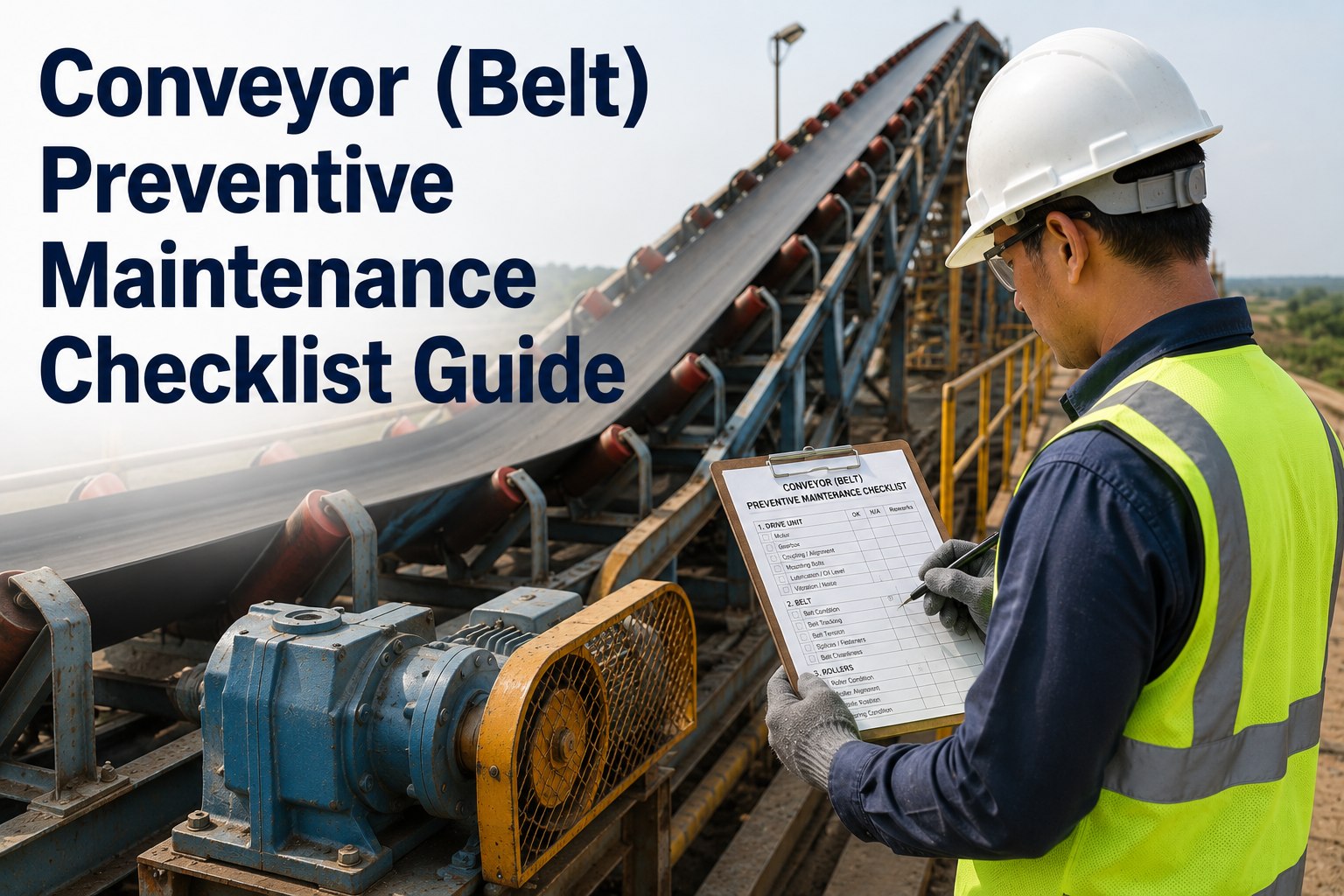
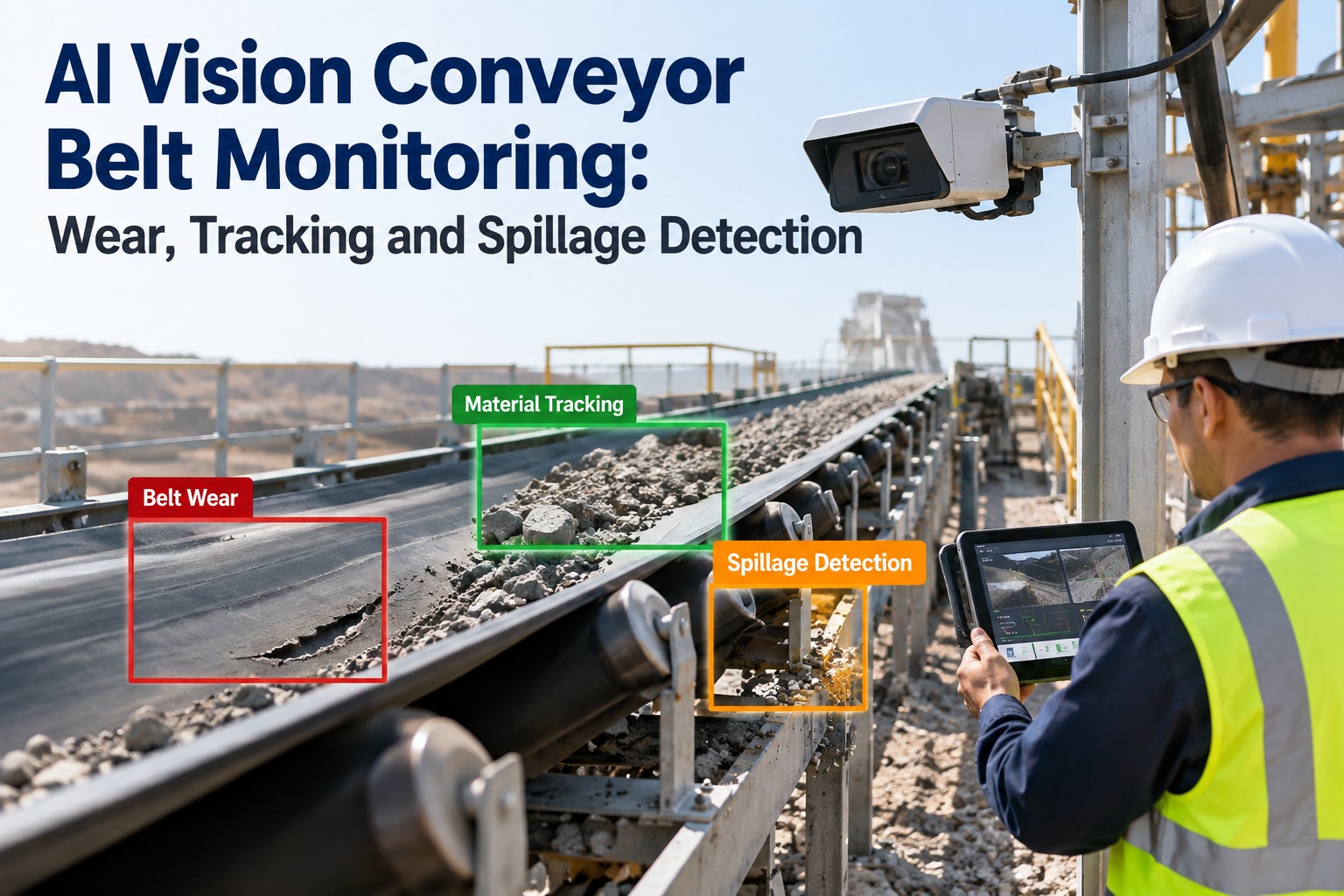
A belt conveyor gives warning long before it fails — a slightly skewed idler, a fastener loosened by a quarter turn, a bearing running a few degrees warmer than last shift, a splice showing edge lift no bigger than a fingernail. The plants that catch those signals systematically run their conveyors longer, ship orders on time, and stay off the emergency-overtime treadmill. The plants that skip them keep meeting the same six failure modes over and over: belt mistracking, splice failure, roller seizure, bearing wear, drive slippage, and safety-device drift. The difference between a 30-minute planned fix and a 6-hour production stoppage almost always comes down to whether someone walked the line yesterday with a structured checklist in hand — not a photocopied paper form that gets initialed without being read, but a real procedure with mobile capture, mandatory fields, and photo evidence auto-generating corrective work orders. This guide is the working PM checklist reference for belt conveyors: every inspection point per subsystem, tiered by cadence, cross-referenced to the OSHA and NFPA compliance standards that make PM non-optional, and structured for immediate deployment in the CMMS. Book a free demo to see the checklist live on mobile.
42 pts
Critical inspection points across 8 subsystem sections in a standard conveyor weekly PM
3 modes
Belt mistracking, splice failure, and roller seizure account for the majority of unplanned stops
30 min
Typical planned fix window when defects are caught on the daily walk-down — vs 6+ hours reactive
4 tiers
Cadence structure: Daily · Weekly · Monthly · Quarterly — each with different tools and scope
The Compliance Stack · Why PM Isn't Optional
Conveyors sit at the intersection of the highest-risk equipment categories in most industrial facilities — nip points, moving loads, energized components — which is why the regulatory stack that governs them is unusually dense. Any PM program worth running documents evidence against each of these standards. Miss the documentation and OSHA inspections, insurance audits, and internal reviews all become open exposure.
OSHA
29 CFR 1910.147
Control of Hazardous Energy · LOTO
Lockout / tagout procedures required before any maintenance access · verified isolation before mechanical work
OSHA
29 CFR 1910.212
Machine Guarding General Requirements
Nip point, chain, pulley, and shaft guards inspected · missing or damaged guards flagged for immediate correction
NFPA
NFPA 70B
Electrical Equipment Maintenance
Motor, drive, and control panel inspection cadence · thermal imaging on connections · torque verification
NFPA
NFPA 70E · Article 130
Electrical Safety Work Practices
PPE requirements for electrical inspection · arc-flash boundary observance · qualified-worker verification
ANSI
B11.19-2019
Safeguarding Performance Criteria
E-stop response, pull-cord function, interlock verification · documented functional testing per cycle
ISO
55000:2014
Asset Management Systems
PM records as evidence for reliability program governance · MTBF, MTTR, and PM compliance metrics
The Six Subsystems · How the Checklist Actually Organizes
Effective conveyor PM organizes by subsystem, not by frequency. A technician working through the checklist on a specific belt segment moves through all six subsystems in one physical pass — belt, then rollers, then pulleys, then drive, then splices, then safety devices — rather than doing "the Monday list" and "the Wednesday list" in a way that skips whole components on any given walk.
SUB 1
Belt Surface & Edges
Failure modes: Mistracking · edge wear · cuts · fraying · surface cracking · elongation
What to look for: Belt drift to one side · uneven edge wear · material spillage · cover damage
SUB 2
Idlers & Rollers
Failure modes: Bearing seizure · roller wear · shell perforation · alignment drift · frozen return idlers
What to look for: Non-rotating rollers · flat spots · unusual noise · thermal hotspots · buildup on shells
SUB 3
Pulleys & Drums
Failure modes: Lagging wear · pulley crown erosion · shaft misalignment · bearing wear
What to look for: Slick lagging · asymmetric wear pattern · pulley wobble · misaligned head/tail
SUB 4
Drive Train (Motor · Gearbox · Coupling)
Failure modes: Motor overheating · gearbox wear · coupling failure · belt/chain drive slippage
What to look for: High motor amperage · gearbox leaks · coupling misalignment · abnormal vibration
SUB 5
Splices & Fasteners
Failure modes: Splice separation · fastener pull-through · vulcanized joint lift · elongation
What to look for: Edge lift on vulcanized joints · fastener heads pulling through belt · splice creep
SUB 6
Safety Devices & Guards
Failure modes: E-stop drift · pull-cord failure · guard damage · interlock bypass · missing labels
What to look for: Non-functional pull cords · damaged nip guards · missing e-stop labels · bypassed interlocks
The Four-Tier Cadence · Daily · Weekly · Monthly · Quarterly
Every conveyor gets checked at four cadences, each with a distinct scope, tool set, and time budget. The daily walk catches acute issues in 5 minutes. The weekly PM finds developing wear in 30–60 minutes. The monthly inspection uses instruments the daily round doesn't. The quarterly is the deep look — bearing analysis, structural inspection, electrical testing. Skipping any tier creates a blind spot that failures grow in.
Shift-Start Walk-Down
Tools: Eyes, ears, phone camera
Visual belt tracking check at head, tail, transfer points
Auditory scan for grinding, squealing, thumping
Material spillage or buildup along run
E-stop and pull-cord visual function test
Debris blocking rollers or transfer points
Photo capture of any anomaly · auto-WO trigger
Tier 2 · WEEKLY
30–60 min
Hands-On Inspection · LOTO Required
Tools: IR thermometer, tension gauge, torque wrench, grease gun
Manual roller rotation check · flag frozen idlers
Belt tension measurement · adjust take-up if outside spec
Lubricate bearings per OEM chart · avoid over-greasing
IR temperature scan on drive motor, gearbox, pulley bearings
Splice inspection · visual + tactile on all fastener heads
Guard fastener torque check · replace damaged guards
Tier 3 · MONTHLY
2–4 hours
Comprehensive Inspection · Instruments
Tools: Vibration meter, motor clamp meter, alignment gauge, splice caliper
Motor current draw across all phases · flag asymmetry
Vibration reading on drive train bearings · trend vs baseline
Splice elongation measurement · track vs replacement threshold
Pulley lagging wear assessment · pulley crown check
Full functional test of e-stops, pull cords, and interlocks
Belt cover thickness measurement at wear zones
Tier 4 · QUARTERLY
4–8 hours
Deep Inspection · Component-Level
Tools: Vibration analyzer, thermal imager, insulation tester, laser aligner
Bearing vibration spectral analysis on drive train
Motor winding megger insulation test
Full drive-to-head-pulley laser alignment check
Structural inspection of frame, supports, walkways
Gearbox oil sample · particle count · wear metal test
Complete safety system audit · documentation review
The Wear Threshold Reference · What Numbers Trigger Action
Vague inspection instructions like "check for wear" produce inconsistent judgments across technicians. Specific measurement thresholds produce consistent action decisions. The reference table below is the working guide — measure, compare, and route to work order when the threshold is crossed. These are typical industry-standard triggers; adjust based on OEM guidance and your own historical failure data.
Component
Measurement
Warning Threshold
Action Threshold
Belt cover thickness
Depth gauge
30% loss vs new
50% loss · schedule replacement
Belt tracking deviation
Ruler at head pulley
±10 mm from centerline
±25 mm · adjust training idlers
Splice elongation
Reference-mark caliper
1% length increase
3% · re-splice or replace
Pulley lagging wear
Depth gauge
50% original thickness
Fully worn · re-lag or replace
Bearing housing temperature
IR thermometer
Ambient + 30°C
Ambient + 50°C · shutdown
Motor amperage
Clamp meter
10% above baseline
20% above nameplate · investigate
Drive belt tension (V-belt)
Tension gauge
±10% of OEM spec
±20% · re-tension
Bearing vibration RMS
Vibration meter
4.5 mm/s (ISO 10816 warn)
7.1 mm/s (ISO 10816 alarm)
Deploy the Checklist on Your Conveyor Fleet in 30 Minutes
Working session with our reliability team — bring your conveyor register. We'll import the 4-tier checklist as scheduled PMs against your assets, configure mobile capture with photo evidence and mandatory fields, and set auto-WO triggers on wear thresholds.
Field-Ready Checklist · The Working Reference by Subsystem
Below is the master checklist in the form technicians actually use in the field — every task grouped by subsystem, with cadence tag, tool required, and the specific action or measurement. Print it, mobile-deploy it, or import as PM templates in the CMMS. Every item has an unambiguous pass/fail or measurement outcome.
D Visual scan for cuts, tears, fraying at edges — photo capture any defect
D Belt tracking check at head and tail — flag drift beyond ±10 mm
W Material spillage inspection along full run — clean and root-cause
M Belt cover thickness measurement at wear zones — flag >30% loss
M Edge condition check — uneven wear indicates tracking or loading issue
D Auditory scan for grinding, squealing, thumping from any roller
W Manual rotation check on all accessible rollers — flag any frozen
W Grease bearings per OEM chart — avoid over-lubrication
W IR temperature scan on all accessible bearing housings
M Roller shell inspection for flat spots, buildup, perforation
Q Full-line idler alignment audit with laser or string
D Visual check of head and tail pulley for wobble or asymmetric wear
W Lagging condition inspection — flag slick, glazed, or peeling zones
M Pulley lagging depth measurement — flag <50% original thickness
M Pulley crown assessment for belt-tracking-critical drums
Q Full drive-pulley to head-pulley alignment with laser
S4
Drive Train · Motor · Gearbox · Coupling
D Motor housing visual and auditory check for anomalies
W Gearbox oil-level sight-glass check · leak inspection
W IR scan of motor, gearbox, coupling — flag hotspots vs baseline
M Motor amperage clamp-meter reading across all phases
M Coupling inspection — visual for elastomer wear or slippage
Q Vibration spectral analysis on drive train bearings
Q Motor winding insulation megger test
Q Gearbox oil sample — ISO 4406 particle count, wear metals
W Visual and tactile check of every splice for edge lift, fastener movement
W Photo log of splice condition — track vs prior weeks
M Splice elongation measurement against reference marks
M Track splice age against OEM replacement schedule
M Fastener head inspection for pull-through or lift
S6
Safety Devices & Guards
D E-stop button visual check — labels visible, no damage
D Pull-cord visual check along full run — no slack, no obstruction
W Guard fastener torque check — flag missing or damaged guards
W Interlock inspection at access panels and covers
M Full functional test of every e-stop and pull cord
Q Complete safety system audit with documentation for compliance
D Daily · shift-start walk
W Weekly · LOTO required
M Monthly · with instruments
Q Quarterly · deep inspection
The Top Six Failure Modes · What This Checklist Actually Prevents
The checklist above is not academic — every item exists because it catches one of the six failure modes that account for the majority of unplanned conveyor stops in industrial plants. Understanding which failure each check prevents makes the "why we do this" conversation with technicians and operators trivial.
F1
Belt Mistracking
Root: idler misalignment, uneven loading, pulley crown wear · Prevented by: daily tracking checks, weekly idler alignment verification, monthly pulley assessment
F2
Splice Failure
Root: over-tension, splice age, fastener fatigue · Prevented by: weekly visual/tactile splice check, monthly elongation measurement, replacement schedule tracking
F3
Roller / Idler Seizure
Root: bearing failure, contamination, over-greasing · Prevented by: daily auditory scan, weekly manual rotation check, IR thermometer thermal trending
F4
Drive-Motor Bearing Failure
Root: fatigue, contamination, misalignment · Prevented by: weekly thermal scan, monthly amperage draw, quarterly vibration spectral analysis
F5
Belt Slippage at Drive Pulley
Root: worn lagging, incorrect tension, load spike · Prevented by: weekly tension check, monthly lagging inspection, take-up adjustment
F6
Safety Device Drift
Root: unnoticed damage, bypass, cable stretch · Prevented by: daily visual check, weekly guard verification, monthly functional test
Expert Perspective · Why Paper Checklists Become Shelf-Ware
The conveyor PM checklist is one of the most studied documents in industrial maintenance. Every conveyor OEM ships one, every consulting engagement produces one, every reliability audit recommends one. And in half the plants we work with, the paper form is initialed in a clipboard binder somewhere without ever having been read by the person signing it. This is the failure mode of the paper checklist itself. It survives audit day because the initials are there. It doesn't survive contact with reality because there's no way to enforce that a technician actually looked at splice 27 or measured the lagging on the tail pulley. Digital changes the equation. When the checklist lives on a phone with mandatory fields, photo capture required at specific inspection points, GPS or NFC location verification at each conveyor section, and auto-generated corrective work orders when a defect is flagged, the paper-charade failure mode disappears. Every check becomes a data point that trends against history. Every anomaly becomes a scheduled repair with parts reserved. Every completion feeds MTBF and PM compliance metrics that reliability engineers can actually use. That's the conveyor PM program that catches the 30-minute defects before they become 6-hour outages. The paper version, however faithfully filled in, was never going to.
Mandatory Fields Beat Trust
Mobile forms with required entries and photo capture eliminate the "initial without inspecting" failure mode that paper enables.
Defect → Auto WO
A flagged item on the checklist auto-generates a corrective work order with parts reserved. No email chain, no forgotten note.
Every Check = Data Point
Every completion feeds MTBF, PM compliance, and audit-ready evidence. Paper checklists never generate the data reliability programs need.
How OxMaint Turns This Checklist Into a Working PM Program
OxMaint imports the 4-tier checklist directly against your conveyor asset register — 42+ inspection points across 6 subsystems, scheduled at the right cadence, delivered to the technician's phone with mandatory fields, photo capture, and auto-generated corrective work orders when a threshold is crossed.
Templates
6 Conveyor Types Pre-Built
Troughed belt, flat belt, cleated belt, modular belt, powered roller, chain — each with its own tiered checklist structure ready to deploy
Schedule
Auto-Generated PMs
Daily walks · weekly LOTO PMs · monthly comprehensive · quarterly deep inspection — auto-fired against each conveyor section per cadence
Mobile
Technician Field Execution
WO on phone · mandatory fields · photo capture required at defined checkpoints · offline sync for plant dead zones
Trigger
Threshold-Driven Corrective WOs
Flagged defect or measurement crossing threshold auto-generates corrective WO · parts reserved · priority set · planner sees it immediately
Audit
OSHA / NFPA Evidence Package
Complete inspection history · photos · corrective WOs · e-signatures · exportable as PDF package for OSHA, NFPA, insurance audits
Metrics
Live Reliability KPIs
MTBF per conveyor · PM compliance rate · corrective-to-preventive ratio · time-to-close on defects — live dashboards, no report cycle
Turn the Paper Checklist Into a Working PM Program
Stop signing off on inspections nobody actually did. See how OxMaint delivers the full 4-tier conveyor PM checklist on mobile with mandatory fields, photo capture, threshold-triggered corrective WOs, and audit-ready evidence packages. Free forever plan available to trial the full workflow.
Frequently Asked Questions
What should a conveyor belt preventive maintenance checklist include?
A working conveyor PM checklist covers six subsystems — belt surface and edges, idlers and rollers, pulleys and drums, drive train (motor/gearbox/coupling), splices and fasteners, and safety devices/guards — organized across four cadence tiers: daily walk-down (5 minutes, visual/auditory), weekly hands-on inspection (30–60 minutes, LOTO required, tools include IR thermometer and tension gauge), monthly comprehensive inspection (2–4 hours, instruments include vibration meter and clamp meter), and quarterly deep inspection (4–8 hours, includes vibration spectral analysis, motor megger test, and gearbox oil sampling). Total: typically 42+ inspection points across 8 sections for a standard weekly PM.
Which OSHA and NFPA standards apply to conveyor maintenance?
The core compliance stack is: OSHA 29 CFR 1910.147 (Control of Hazardous Energy / LOTO), OSHA 29 CFR 1910.212 (General Machine Guarding), NFPA 70B (Electrical Equipment Maintenance), NFPA 70E Article 130 (Electrical Safety Work Practices), ANSI B11.19-2019 (Safeguarding Performance Criteria), and ISO 55000:2014 (Asset Management Systems). Every PM inspection should document evidence against these standards — LOTO verified before mechanical work, guards inspected each visit, electrical inspections done with proper PPE and by qualified workers, safety device functional testing completed on cadence, and the whole inspection history exportable as an audit-ready package.
Book a free demo to see the compliance-ready audit package.
How often should each conveyor PM tier actually be performed?
Cadence varies with intensity, environment, and criticality, but the standard baseline is: daily visual/auditory walk-down every shift on operating conveyors (5 minutes), weekly LOTO-required hands-on PM (30–60 minutes with grease gun, IR thermometer, tension gauge), monthly comprehensive inspection during scheduled downtime (2–4 hours with vibration meter, motor clamp meter, splice caliper), and quarterly deep inspection (4–8 hours with vibration analyzer, thermal imager, insulation tester, laser aligner). High-throughput or safety-critical lines may need more aggressive cadence; low-utilization lines can extend intervals. Adjust based on historical MTBF data and OEM guidance.
What wear thresholds trigger belt or component replacement?
Industry-standard triggers to route into work orders: belt cover thickness — 30% loss warning, 50% loss replace; belt tracking deviation — ±10 mm warning, ±25 mm adjust; splice elongation — 1% warning, 3% re-splice/replace; pulley lagging — 50% original thickness warning, fully worn re-lag; bearing housing temperature — ambient + 30°C warning, +50°C shutdown; motor amperage — 10% above baseline warning, 20% above nameplate investigate; drive belt tension — ±10% OEM spec warning, ±20% re-tension; bearing vibration — 4.5 mm/s RMS warning per ISO 10816, 7.1 mm/s alarm. Adjust based on your specific OEM guidance and historical failure data.
Which three failure modes cause most conveyor unplanned downtime?
Belt mistracking, splice failure, and roller/idler seizure account for the majority of unplanned conveyor stops in manufacturing plants. All three are detectable through routine inspection: mistracking through the daily visual tracking check at head and tail pulleys, splice failure through weekly visual/tactile splice inspection and monthly elongation measurement, and roller seizure through the daily auditory scan combined with weekly manual rotation checks and IR temperature scans. The remaining stops are typically drive-motor bearing failure, belt slippage at drive pulley, and safety device drift — all also detectable through the standard four-tier checklist.
Sign up free to auto-fire corrective WOs on flagged defects.
How does OxMaint deliver the conveyor PM checklist to technicians?
OxMaint ships six pre-built conveyor-type templates — troughed belt, flat belt, cleated belt, modular belt, powered roller, and chain — each with a tiered daily/weekly/monthly/quarterly checklist structure. When you add a conveyor section to your asset register, the checklist attaches and PMs auto-generate at the right cadence. Technicians see the WO on their phone with mandatory fields, photo capture required at defined checkpoints, offline sync for plant dead zones, and e-signature on completion. Flagged defects auto-generate corrective work orders with parts reserved. The complete inspection history exports as an audit-ready PDF package for OSHA, NFPA, and insurance reviews. Free forever plan available to trial the workflow.
Book a free demo to see the mobile execution.