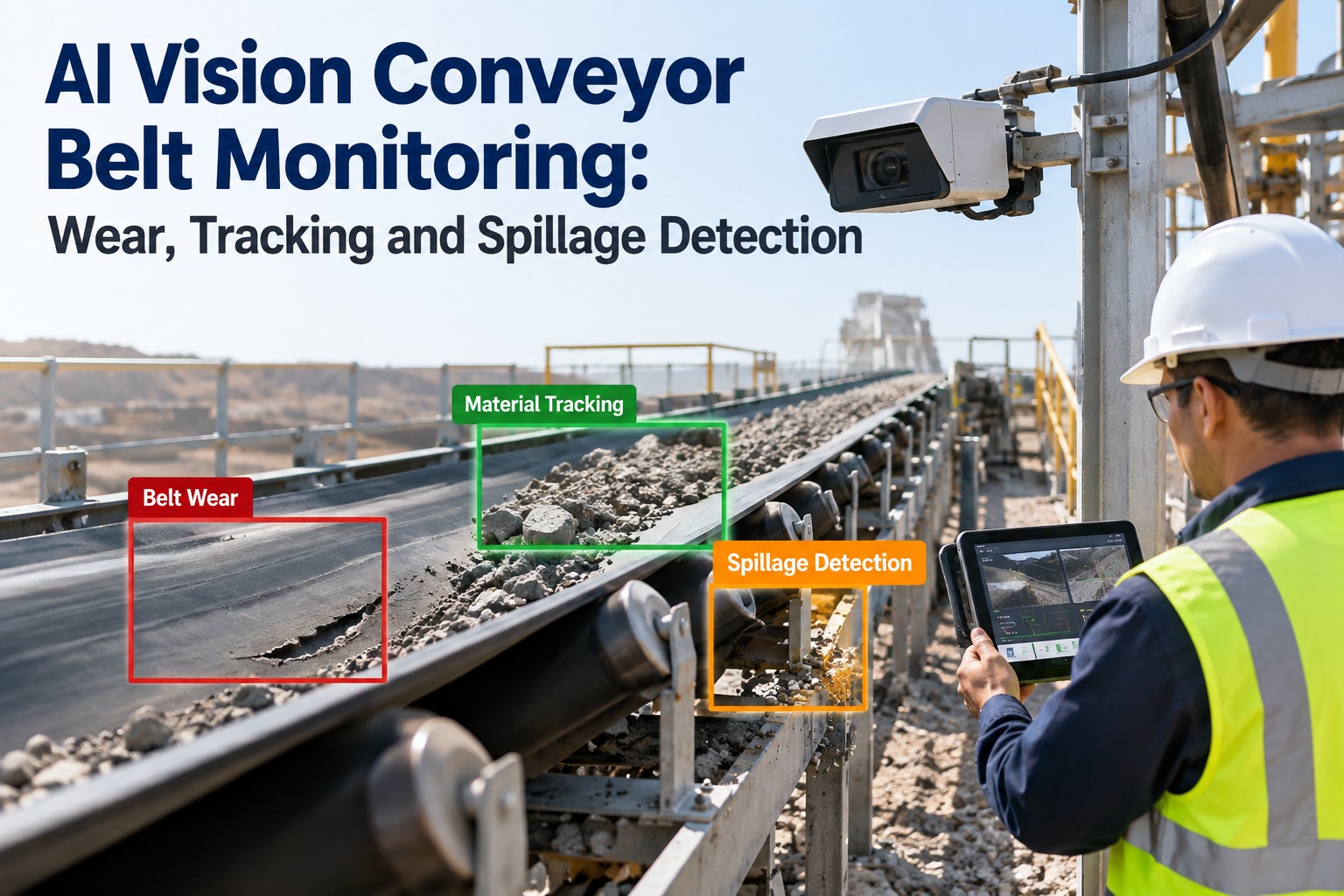
A conveyor belt fails in slow motion, and almost always in ways a camera can see before a person does. A cover crack widens run by run, the belt drifts a few millimeters off-center until it's shredding against the frame, and material sheds along the return path until there's a pile nobody logged. Manual rounds catch some of it, some of the time — but a belt runs 24/7 and an inspector walks it once a shift. AI vision watches continuously, flags wear, tracking and spillage the moment they appear, and — this is the part that matters — hands the finding to maintenance as work. This guide covers how vision-based conveyor monitoring works and how OXMAINT AI, the AI-powered CMMS, turns each detection into a prioritized work order.
AI Vision Conveyor Belt Monitoring: Wear, Tracking & Spillage Detection
Belt problems build between rounds — a spreading cover cut, a belt drifting into the structure, spillage piling on the return. OXMAINT AI closes the loop from camera to crew: vision detections become tracked issues, issues become prioritized work orders, and closed work orders feed the preventive schedule. So a mistracking alert becomes an assigned adjustment before the belt edge is destroyed — not a note found after.
What the Camera Sees That the Round Misses
Manual inspection isn't wrong — it's intermittent. A belt develops problems on its own schedule, and the gap between rounds is where a small defect becomes a torn belt or a buried idler. Continuous vision closes that gap, and pairing it with a maintenance workflow closes the loop.
Start free and route vision detections to work in OXMAINT AI.
- A belt runs 24/7; an inspector walks it once a shift
- Early cover cracks look like nothing until they spread
- Slow mistracking is invisible until the edge frays
- Spillage accumulates between walks, unlogged
- Findings live on a clipboard, not in a work order
- Continuous monitoring, every run, every shift
- Wear and damage flagged as it first appears
- Tracking drift caught before it reaches the frame
- Spillage detected and located along the line
- Every detection becomes a tracked work order
The Three Things Vision Watches For
Conveyor vision monitoring focuses on three failure families — the ones that drive most unplanned belt downtime and cleanup labor. Each shows up differently to a camera, and each triggers a different kind of maintenance response.
Book a demo to see these detections on your belts.
Detection to Work Order, Defect by Defect
A detection is only useful if it becomes the right response. Here's how each defect family maps from what the camera sees to the maintenance action it triggers in the CMMS.
Sign up free and map detections to work orders in OXMAINT AI.
| Defect | What vision detects | Why it matters | Work it triggers |
|---|---|---|---|
| Wear | Cuts, cracks, rips, splice & edge damage | Progresses to belt failure and unplanned downtime | Inspect/repair belt, schedule splice or section replacement |
| Tracking | Off-center running toward the structure | Shreds belt edge, spills material, wears idlers fast | Adjust training idlers, check loading & alignment |
| Spillage | Accumulation at transfers & on the return | Safety hazard, idler fouling, cleanup labor | Clean-up work order, tune skirting & belt cleaners |
A Detection That Doesn't Become Work Is Just a Video Clip.
Cameras generate alerts; only a work order fixes the belt. OXMAINT AI turns each detection into a prioritized, assigned work order tied to the conveyor — so a flagged rip becomes scheduled repair, not footage nobody reviews.
The Detection-to-Work Pipeline
Vision monitoring pays off only as an end-to-end flow — from the camera to a closed work order, with the evidence carried the whole way. Here's the path each detection follows through OXMAINT AI.
Book a demo to see this pipeline on your line.
Where Cameras Watch the Line
Coverage matters: defects cluster where the belt is stressed. A vision program places watch points at the zones most likely to reveal wear, tracking and spillage early.
Start free and log each conveyor zone in OXMAINT AI.
Camera placement, lighting and detection tuning depend on the material, environment and belt speed — a dusty transfer chute is a different problem from a clean packaging line. Treat these as the high-value watch points, then tune to your line.
Frequently Asked Questions
Let the Camera Catch It — and the CMMS Fix It.
Pair continuous vision monitoring for wear, tracking and spillage with a workflow that turns every detection into a prioritized, tracked work order on the conveyor — with OXMAINT AI, so belt problems get fixed early instead of found late.