Manufacturing operations lose an average of $260,000 per hour during unplanned downtime, yet 67% of facilities still track critical machine history in disconnected spreadsheets, paper files, and technician memory. When a high-value CNC mill throws a bearing fault at 2 AM, the maintenance team has no instant access to previous failure modes, warranty status, parts inventory, OEM manuals, or vibration trend data. Every minute spent searching records extends downtime and compounds production loss. Critical machine asset history software centralizes every maintenance record, warranty document, parts specification, inspection report, and performance trend for every piece of production equipment in one searchable platform. The shift from fragmented records to unified asset intelligence is the operational foundation that prevents emergency shutdowns from cascading into six-figure revenue losses. Start a free trial or book a demo to see Oxmaint critical machine asset history for your production floor.
Manufacturing CMMS
Critical Machine Asset History Software
High Priority · 8 min read
$260K
Average cost per hour of unplanned manufacturing downtime across all industries
67%
Manufacturing facilities still tracking critical asset history in disconnected spreadsheets and paper systems
3.2 hrs
Average time wasted per critical failure event searching for asset documentation and maintenance history
82%
Reduction in repeat failures when maintenance teams have instant access to complete machine asset history
See Your Critical Assets in One Platform
Complete Machine History, Warranties, Manuals and Performance Data in One Searchable System
Oxmaint centralizes every maintenance record, parts specification, warranty document, inspection report, and failure analysis for every critical machine. Live in 14 days. No implementation fees required.
✓ Instant access to complete asset maintenance history
✓ Warranty tracking with automated expiration alerts
✓ OEM manuals and parts diagrams digitally indexed
What Is Critical Machine Asset History Software?
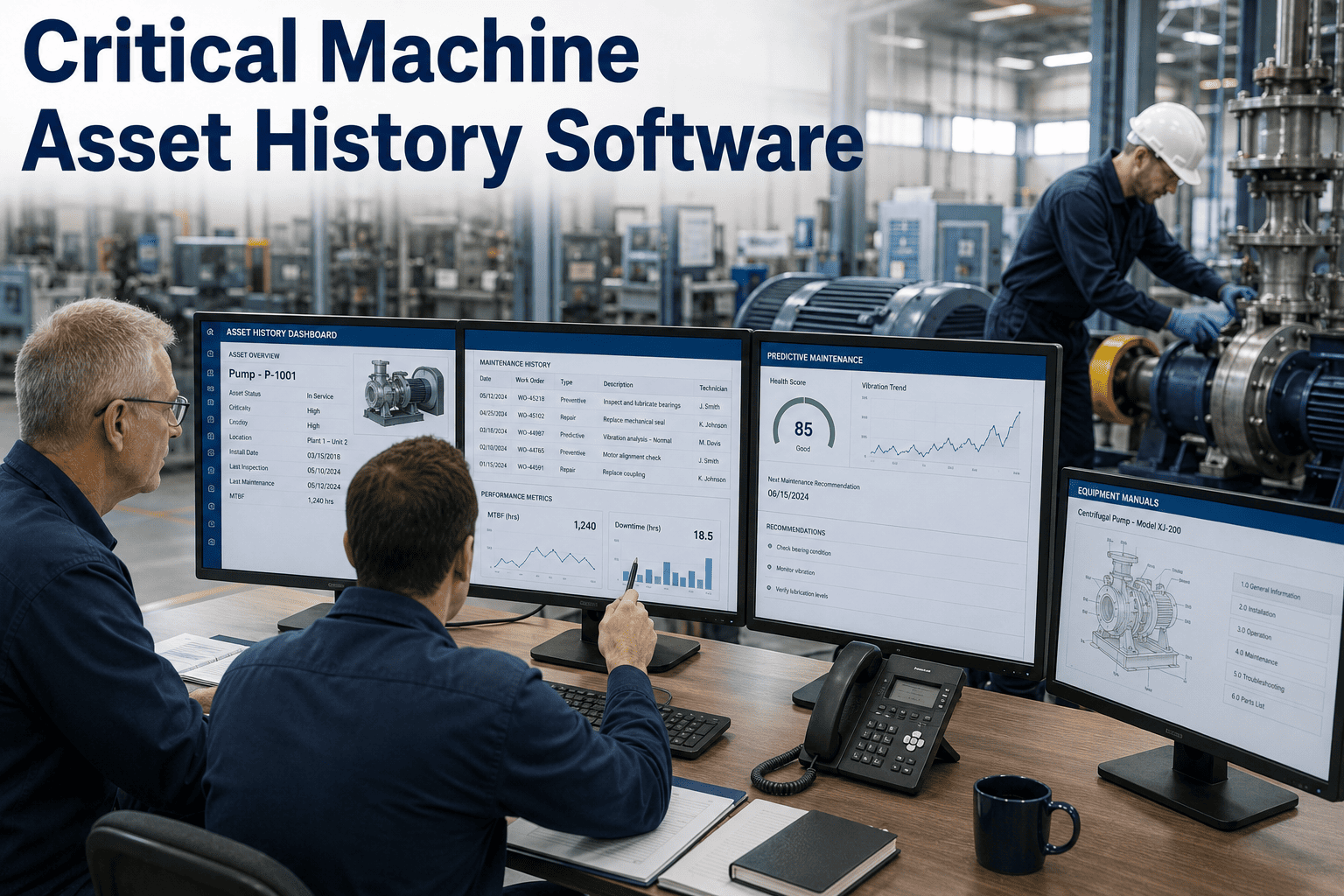
Critical machine asset history software is a centralized digital platform that stores, organizes, and surfaces every piece of documentation and performance data associated with production equipment. Instead of maintenance teams searching through filing cabinets, email threads, and tribal knowledge to reconstruct what happened to a machine over its operational life, every work order, inspection report, parts replacement, warranty claim, vibration reading, and failure analysis is instantly accessible from a single asset record. When a CNC lathe shows abnormal vibration at 11 PM, the technician pulls up the asset history on a mobile device and sees that the same bearing housing failed 14 months ago, the replacement part came from a specific supplier, the installation torque spec was 85 ft-lbs, and the warranty expires in 60 days. That context converts a 4-hour diagnostic guessing session into a 45-minute targeted repair with pre-staged parts and no repeat failure risk.
The ROI materializes in three operational areas. First, mean time to repair drops by 40 to 60% because technicians stop repeating diagnostic work that was already completed on previous failures. Second, warranty recovery rates jump from under 15% to over 70% because expiration dates and claim documentation are tracked automatically rather than discovered months after the coverage window closes. Third, repeat failure rates on high-value assets drop by 82% because root cause analysis from past events informs current repair procedures and prevents identical faults from recurring on the same failure mode, which is why manufacturing operations managing critical assets without centralized history software are systematically leaving 6-figure cost savings on the table every year — start a free trial to deploy Oxmaint asset history across your production floor, or book a demo and we will walk through your specific critical machine portfolio.
Essential Components of Critical Machine Asset History
01
Complete Maintenance Timeline
Every work order, PM task, inspection, calibration, and emergency repair logged chronologically per asset with technician notes, parts consumed, and labor hours.
02
Warranty and Contract Tracking
OEM warranties, extended service agreements, and parts coverage tracked with automated alerts 60 days before expiration and claim documentation stored per asset.
03
Digital Manuals and Drawings
OEM manuals, electrical schematics, P&ID diagrams, parts catalogs, and torque specifications indexed and searchable directly from the asset record.
04
Parts Inventory Integration
Critical spare parts linked to specific machines with usage history, reorder thresholds, supplier details, and lead times tracked per component.
05
Failure Analysis Repository
Root cause analysis reports, failure mode classification, corrective actions, and lessons learned documented and accessible for every critical failure event.
06
Performance Trend Data
OEE metrics, cycle time trends, vibration data, temperature readings, and production output tracked over time to identify degradation patterns before failure.
The Cost of Fragmented Machine Asset Records
Manufacturing facilities with disconnected asset records waste 18 to 25% of maintenance labor searching for documentation that already exists somewhere in the organization.
⚠
Repeated Diagnostic Work on Identical Failures
Without access to previous failure analysis, technicians restart troubleshooting from zero every time the same fault recurs. A gearbox that failed from lubrication contamination 8 months ago fails again from the same root cause because the corrective action was never documented or surfaced to the current repair crew.
⚠
Missed Warranty Recovery Opportunities
Warranty claims discovered 3 months after coverage expires because expiration dates are tracked in spreadsheets that no one checks. A $42,000 servo motor replacement paid from the maintenance budget when the OEM warranty still had 90 days of coverage remaining.
⚠
Emergency Downtime Extended by Records Search
Critical production line down at 2 AM. Technician needs torque spec for a coupling replacement. The manual is in a filing cabinet that is locked, the engineer who has the key is on vacation, and the OEM hotline does not answer until 8 AM. Three hours of production lost searching for a single specification.
⚠
Tribal Knowledge Vanishes with Retirements
Senior technician retires and takes 30 years of machine-specific knowledge with them. The replacement crew has no access to undocumented modifications, field fixes, or lessons learned from past failures. Repeat failures spike 40% in the 12 months following the knowledge loss event.
How Oxmaint Centralizes Critical Machine Asset History
Unified Asset Registry with Document Attachments
Every critical machine registered with serial number, installation date, OEM details, and warranty expiration. OEM manuals, schematics, calibration certificates, and parts catalogs uploaded and indexed to the specific asset record for instant mobile access.
Automated Warranty Expiration Alerts
Warranty and service contract end dates tracked per asset with automated email alerts 90, 60, and 30 days before expiration. Maintenance managers see portfolio-wide warranty status in real time and can prioritize claims before coverage windows close.
Complete Chronological Maintenance Timeline
Every work order, inspection, PM task, and emergency repair logged automatically with timestamp, technician ID, parts consumed, labor hours, and completion notes. Asset history searchable by date range, failure type, parts replaced, or technician for instant pattern recognition.
Mobile Access to Asset Documentation
Technicians scan asset QR code from mobile device and pull up complete maintenance history, OEM manuals, torque specs, and parts diagrams on the production floor. No laptop required. No filing cabinet access needed. Documentation available at point of repair in under 10 seconds.
Failure Mode Analysis Tracking
Root cause analysis reports, corrective actions, and lessons learned documented per failure event and linked to the asset record. When the same failure mode recurs, technicians see what was tried previously, what worked, and what did not to prevent repeat diagnostic cycles.
Parts Usage and Supplier History
Every part installed on the machine tracked with part number, supplier, installation date, and replacement cost. When a bearing fails prematurely, maintenance managers see which supplier provided the defective component and can switch vendors or file a warranty claim with full documentation evidence, which is why operations using Oxmaint for critical machine history see warranty recovery rates jump from 15% to over 70% within the first 12 months —
book a demo to see asset history tracking configured for your production equipment.
Fragmented Records vs Centralized Asset History
| Asset History Function |
Spreadsheets and Paper Files |
Oxmaint Centralized Asset History |
| Maintenance record access |
Search filing cabinets, email threads, and technician memory. 2 to 4 hour average delay during emergency repairs. |
Scan QR code on asset, pull complete history on mobile device in under 10 seconds at point of repair. |
| Warranty tracking |
Manual spreadsheet updates, no expiration alerts. 85% of warranty claims discovered after coverage expires. |
Automated alerts 90, 60, and 30 days before expiration. 70% warranty recovery rate within first year. |
| OEM manual access |
Paper manuals in locked filing cabinets or lost entirely. Average 3 hour delay to retrieve specifications. |
Digital manuals, schematics, and torque specs indexed to asset record. Instant mobile access 24/7. |
| Failure pattern recognition |
No searchable history. Repeat failures on identical root causes because previous analysis not accessible. |
Searchable failure mode database per asset. 82% reduction in repeat failures from documented corrective actions. |
| Knowledge transfer |
Tribal knowledge lost when senior technicians retire. 40% spike in repeat failures post-retirement. |
All asset knowledge documented and accessible to entire team. Zero knowledge loss from staff turnover. |
| Parts history tracking |
No record of which supplier provided defective parts. Repeat purchases from unreliable vendors. |
Complete parts usage history with supplier details. Vendor performance tracked per component type. |
Stop Losing Hours to Records Search
See Every Machine's Complete History in One Mobile-Accessible Platform
Oxmaint deploys across your critical machine portfolio in 14 days. No consultant fees. No heavy implementation project required.
✓ Complete maintenance timeline per asset
✓ Automated warranty expiration tracking
✓ Instant mobile access to OEM manuals
Critical Asset History Results: Performance Benchmarks
82%
Reduction in Repeat Failures
When maintenance teams have instant access to documented root cause analysis and corrective actions from previous failure events on the same asset
70%
Warranty Recovery Rate
Achieved within 12 months of deploying automated warranty tracking with 90-day expiration alerts compared to 15% industry average on manual systems
3.2 hrs
Time Saved Per Critical Failure
Eliminated from records search and repeated diagnostic work when complete asset history is accessible at point of repair via mobile device
40-60%
Reduction in Mean Time to Repair
When technicians have instant access to OEM specifications, parts diagrams, previous repair procedures, and failure analysis documentation
Frequently Asked Questions
What is critical machine asset history software and why do manufacturing operations need it?
Critical machine asset history software centralizes every maintenance record, warranty document, OEM manual, parts specification, and failure analysis report for production equipment in one searchable platform. Manufacturing operations need it because fragmented records waste 3 to 4 hours per critical failure searching for documentation, result in 85% missed warranty claims, and cause repeat failures from undocumented root causes.
Start free trial to deploy Oxmaint asset history across your production floor.
How does Oxmaint track warranty expiration dates and automate claim recovery?
Oxmaint stores OEM warranty and service contract end dates per asset and sends automated email alerts 90, 60, and 30 days before expiration. Maintenance managers see portfolio-wide warranty status in real time and can file claims with complete documentation before coverage windows close. Operations using Oxmaint warranty tracking achieve 70% recovery rates compared to 15% industry average on manual spreadsheet systems.
Book a demo to see warranty tracking configured for your critical machines.
Can technicians access asset history and OEM manuals from mobile devices on the production floor?
Yes. Technicians scan the asset QR code from the Oxmaint mobile app and pull up complete maintenance timeline, OEM manuals, electrical schematics, torque specifications, and parts diagrams in under 10 seconds. No laptop required. No filing cabinet access needed. Documentation available at point of repair 24/7 including during emergency breakdowns at night and weekends.
How quickly can Oxmaint deploy critical machine asset history across an existing manufacturing facility?
Most manufacturing operations go live in 10 to 14 days. Asset register import, document upload, and QR code generation complete in the first week. Mobile access and warranty tracking activate immediately. No heavy implementation project. No consultant fees required.
Start free trial or
book a demo to see the deployment timeline for your facility.
Stop Losing Production Hours to Records Search
82% Fewer Repeat Failures. 70% Warranty Recovery. Complete Asset History in One Platform.
Oxmaint centralizes every maintenance record, warranty document, OEM manual, and failure analysis for every critical machine. Mobile access. Automated alerts. Live in 14 days.