Only 7% of motor carriers walk away from a DOT audit without a single violation. The remaining 93% face fines that now reach $19,277 per Hours of Service infraction, out-of-service orders that ground vehicles mid-route, and CSA score damage that inflates insurance premiums for years. In 2026, FMCSA has overhauled its Safety Measurement System, split Vehicle Maintenance into two scoring categories, officially authorized electronic DVIRs, and started revoking CDLs for unresolved Clearinghouse violations. Fleet managers who still rely on filing cabinets and spreadsheets are running a compliance program built for 2015 in a 2026 enforcement environment. Schedule a compliance assessment to identify your fleet's gaps before FMCSA does.
What Changed in FMCSA Regulations This Year
2026 brings the most significant enforcement updates since the ELD mandate. These are not minor adjustments—they fundamentally change how carrier safety is measured, how inspections are documented, and how quickly violations escalate into operational shutdowns.
High Impact
SMS Scoring System Rebuilt from the Ground Up
BASICs are now called "compliance categories." Vehicle Maintenance has been split into two separate categories—mechanical defects and driver-observed conditions—doubling the weight of maintenance violations in your carrier score. The scoring window shrinks from 24 months to 12, and 950+ violation codes consolidate into 116 groups. The utilization factor jumps from 200,000 to 250,000 VMT per power unit.
Action Required
Electronic DVIRs Now Explicitly Legal
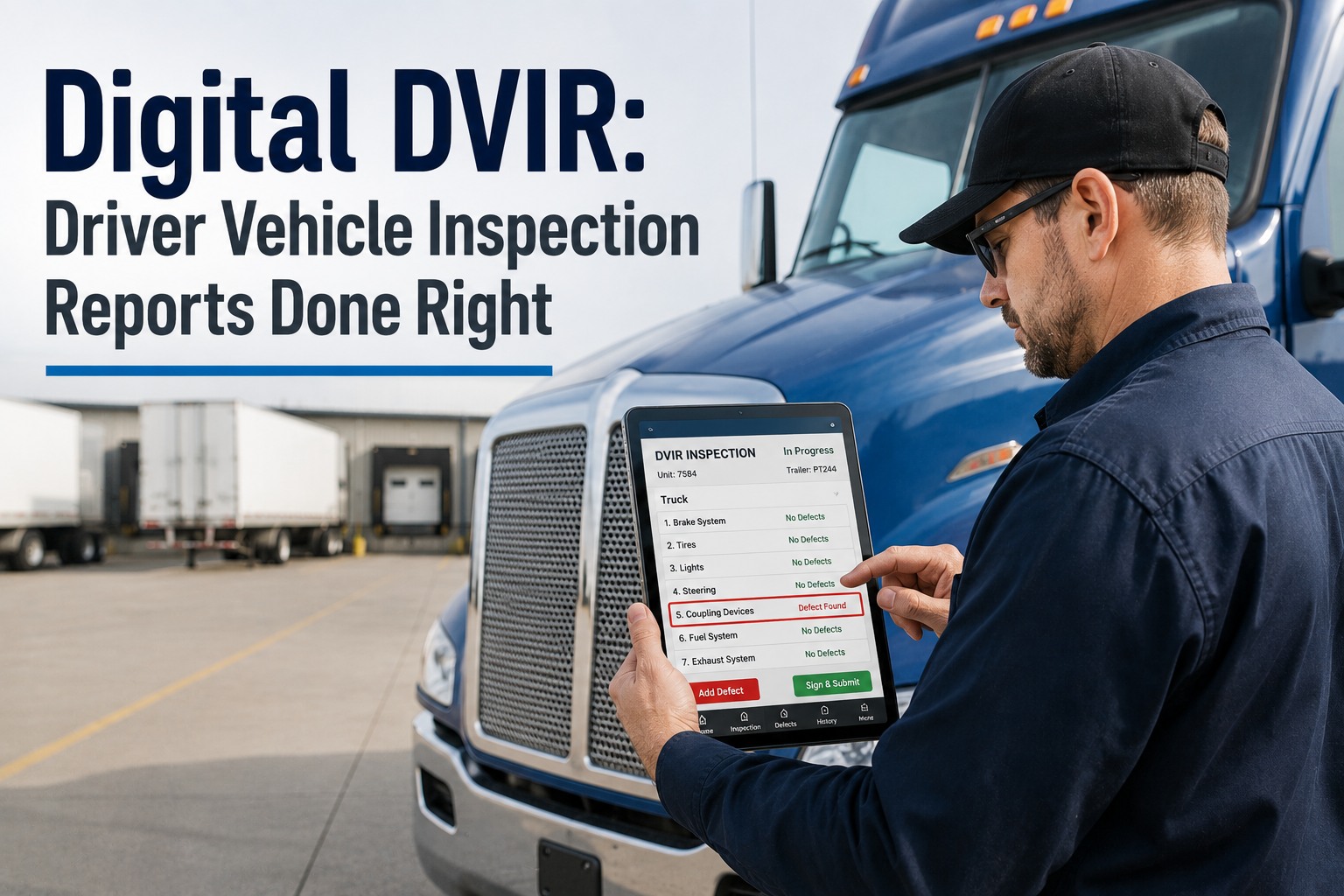
FMCSA-2025-0115, effective March 23, 2026, removes all legal ambiguity around paperless inspection reports. Digital DVIRs that capture vehicle ID, defect details, driver signature, and repair verification are fully compliant. Fleets still using paper DVIRs are missing the documentation advantages—timestamps, GPS stamps, and photo evidence—that digital platforms provide during audits.
Deadline Passed
MC Numbers Permanently Eliminated
USDOT numbers are now the sole federal identifier for all carriers, brokers, and freight forwarders. Every vehicle marking, insurance filing, and business document must reflect your USDOT number exclusively. Operating authority is now designated through suffixes attached to USDOT numbers under the Registration Modernization system.
Enforcement Active
Clearinghouse CDL Revocations Underway
FMCSA is actively downgrading and revoking CDLs for drivers with unresolved "prohibited" status. Pre-employment full queries and annual limited queries are mandatory. The 2026 random testing rate holds at 50% for drugs and 10% for alcohol, with fines exceeding $16,000 per violation for non-compliant testing programs.
These regulation changes affect your fleet right now. Oxmaint automatically updates compliance rules when FMCSA regulations change—so your inspection workflows, document requirements, and scoring alerts always reflect current enforcement standards without manual policy updates.
Every DOT compliance review follows the same structure: six regulatory areas, each evaluated independently. A gap in any single area can trigger deeper investigation across your entire operation. Here is what auditors look for and where most carriers fail.
Driver Qualification Files
Employment application with 3-year history, annual MVRs from every state, current medical certificate (now verified electronically via MVR), road test or valid CDL copy, Clearinghouse pre-employment and annual queries, and previous employer safety verification for 3 years.
12% of all FMCSA violations
Hours of Service & ELD
11-hour driving limit, 14-hour on-duty window, mandatory 30-minute break after 8 hours, 60/70-hour weekly limits, ELD data retention for 6 months with transfer capability (web service + local), and supporting documents including fuel receipts and bills of lading.
Up to $19,277 per violation
Vehicle Inspections (DVIRs)
Pre-trip verification before every dispatch, post-trip condition report with defect or "no defect" certification, driver signature, documented repair verification for every reported defect, and 3-month minimum retention. Electronic DVIRs with photos now explicitly authorized.
Prevents ~14,000 accidents annually
Drug & Alcohol Program
Pre-employment testing before any safety-sensitive duty, random selection at 50% drug / 10% alcohol rates, post-accident testing within 8 hours (alcohol) and 32 hours (drugs), Clearinghouse reporting for all results, and 5-year retention for positive test records.
CDL revocation for non-compliance
Vehicle Maintenance Records
Systematic inspection and maintenance program, annual DOT inspections (37-point minimum), brake adjustment records, tire condition logs, lighting and coupling device checks, and repair documentation with mechanic certification. Now scored in two separate SMS categories.
$53,203 maximum penalty
Authority & Insurance
Active USDOT registration with current MCS-150 biennial update, operating authority with appropriate endorsements, proof of financial responsibility (Form BMC-91 or BMC-34), UCR annual registration, and USDOT number displayed on all vehicles per FMCSA marking requirements.
Operating authority at risk
Tracking six compliance areas across dozens of vehicles and drivers is where spreadsheets fail. In a 15-minute demo, we will show you how Oxmaint monitors DQ files, HOS records, DVIRs, drug testing schedules, maintenance logs, and insurance expirations from a single dashboard—and alerts you the moment any item approaches non-compliance.
Penalty Breakdown: What Non-Compliance Actually Costs
DOT fines are just the starting point. Each violation triggers secondary costs—CSA score damage that raises insurance premiums, freight access restrictions from shippers who check carrier scores, and the operational disruption of out-of-service orders. Here is the real cost structure fleet managers need to understand.
2026 FMCSA Civil Penalty Schedule
HOS Violations (Carrier)
$19,277
Operating OOS Vehicle
$19,277
Recordkeeping (Daily Max)
$1,584
Recordkeeping (Total Max)
$15,846
Maintenance Violations
$13,300–$53,203
HazMat Violations
Up to $102,348
Violation Causing Death/Injury
Up to $238,809
Penalty amounts reflect 2025 inflation-adjusted FMCSA civil penalty schedule (effective December 30, 2024). Repeat offenders face escalating fines and increased audit frequency.
Building a Compliance Rhythm: Daily, Weekly, Quarterly, Annual
The fleet managers who consistently pass audits treat compliance as a continuous rhythm rather than a last-minute scramble. Here is the cadence that keeps your records current, your drivers qualified, and your vehicles audit-ready 365 days a year.
Daily
Frontline Compliance
Weekly
Record Integrity Check
Quarterly
Internal Self-Audit
Annual
Full Program Review
The difference between a quick green light at a roadside inspection and a 46-hour shutdown comes down to having the right records accessible in under two minutes. In 2026, that means digital records—not filing cabinets.
— Fleet Safety & Compliance Director
Managing this daily-to-annual compliance rhythm manually across a growing fleet is where most carriers fall behind. Every missed DVIR closeout, every unassigned ELD event left unchecked, every expired medical card that slips through a spreadsheet—these are the gaps that become violations during audits. Oxmaint automates each step in this rhythm: DVIRs route defects to maintenance instantly, expiration alerts fire at 30/60/90 days, and CSA scores are tracked continuously. Sign up for free to replace your compliance spreadsheets with automated tracking, or schedule a walkthrough to see how it maps to your fleet's specific workflow.
2026 CSA Intervention Thresholds and Scoring Changes
The new Safety Measurement System changes how carriers are scored and which fleets get prioritized for compliance reviews. Understanding these thresholds helps fleet managers focus resources where violations carry the most weight.
SMS Intervention Thresholds by Compliance Category
Compliance Category
Threshold
What Gets Measured
2026 Change
Unsafe Driving
65th percentile
Speeding, reckless driving, lane violations, seatbelt use
Violation code consolidation
HOS Compliance
80th percentile
Drive time, on-duty limits, rest periods, ELD data accuracy
Under the 2026 methodology, only 12 months of data count toward scores (down from 24 months). Inspection performance and OOS rates now directly impact carrier ratings. Monitor scores monthly through the FMCSA SMS website.
Your Fleet Deserves a Compliance System That Works Around the Clock
Filing cabinets cannot flag an expiring medical card at 2 AM. Spreadsheets cannot generate audit-ready documentation in 48 hours. Paper DVIRs cannot provide the timestamped, photo-verified, GPS-stamped inspection records that digital platforms deliver. Oxmaint gives fleet managers a single compliance command center—automated alerts, digital inspections, driver document tracking, and CSA score monitoring—accessible from any device, anywhere your fleet operates.
What documents do I need for a DOT compliance audit?
FMCSA auditors examine six core areas: driver qualification files (employment applications, MVRs, medical certificates, Clearinghouse queries), Hours of Service records with ELD data retained for 6 months, DVIR records for at least 3 months, drug and alcohol testing records with Clearinghouse compliance, vehicle maintenance and annual inspection documentation, and proof of operating authority and insurance. Every document must be retrievable within 48 hours for off-site audits. Schedule a compliance review to ensure your documentation is audit-ready.
How much do DOT compliance violations cost in 2026?
Penalties vary by violation type and severity. HOS violations can reach $19,277 per infraction for carriers. Daily recordkeeping violations cost $1,584, with a cumulative maximum of $15,846. Maintenance violations range from $13,300 to $53,203. Hazardous materials violations can exceed $102,348, and violations resulting in death or serious injury can reach $238,809. Beyond direct fines, violations damage CSA scores, increase insurance premiums, and can restrict freight access.
Are electronic DVIRs accepted by FMCSA?
Yes. The FMCSA-2025-0115 final rule, effective March 23, 2026, explicitly authorizes electronic Driver Vehicle Inspection Reports. Digital DVIRs that capture vehicle identification, defects found or "no defects" certification, driver signature, and repair verification are fully compliant. Digital platforms offer advantages over paper including timestamps, GPS location stamps, photo evidence, and automatic routing of defects to maintenance. Sign up for Oxmaint to start using compliant electronic DVIRs.
How does the 2026 SMS overhaul affect my CSA scores?
The overhaul splits Vehicle Maintenance into two separate compliance categories—mechanical defects and driver-observed conditions. This means maintenance issues now impact two scoring areas instead of one. The scoring window shortens from 24 to 12 months, the utilization factor increases to 250,000 VMT per power unit, and 950+ violation codes are consolidated into 116 groups. Carriers should monitor their scores monthly and address any categories approaching intervention thresholds.
How can a CMMS platform help with fleet DOT compliance?
A CMMS like Oxmaint centralizes all compliance workflows in one system: automated expiration tracking for medical cards, CDLs, and annual inspections; digital DVIR capture with photo evidence and automatic defect-to-work-order routing; preventive maintenance scheduling tied to mileage and time intervals; and instant audit report generation. This eliminates the manual tracking that leads to missed expirations and incomplete documentation. Book a demo to see fleet compliance automation in action.
By oxmaint
✨
Experience Oxmaint's Power
Take a personalized tour with our product expert to see how OXmaint can help you streamline your maintenance operations and minimize downtime.